
The Science of Next-Generation Geothermal: How Earth's Heat Could Provide 24/7 Clean Power
Advances in horizontal drilling have unlocked Enhanced Geothermal Systems (EGS), allowing engineers to tap into the Earth's inexhaustible heat almost anywhere on the planet. This evidence pack examines the data behind EGS, its potential to replace fossil-fuel baseloads, and the remaining hurdles to global scale.
By Factlen Editorial Team
- Geothermal Optimists
- Argue that EGS is the ultimate clean energy silver bullet, capable of providing limitless baseload power.
- Economic Skeptics
- Point out that deep drilling costs remain prohibitively high compared to cheap solar and wind paired with batteries.
- Environmental Pragmatists
- Support the technology but urge strict regulation regarding induced seismicity and initial water usage in arid regions.
What's not represented
- · Local communities living near proposed drilling sites
- · Fossil fuel workers transitioning to geothermal drilling jobs
Why this matters
Wind and solar are cheap but intermittent, requiring massive battery storage to keep the grid stable when the sun sets or wind dies. If Enhanced Geothermal Systems can scale economically, they provide the missing piece of the clean energy puzzle: a zero-carbon, always-on power source that can run 24 hours a day, 365 days a year, anywhere on Earth.
Key points
- Enhanced Geothermal Systems (EGS) allow geothermal power to be generated anywhere, not just near tectonic fault lines.
- The technology adapts horizontal drilling and fracturing techniques from the oil and gas industry.
- Geothermal provides 24/7 baseload power, filling the gaps left by intermittent solar and wind.
- The primary hurdle is economic, with deep drilling in hard rock remaining highly expensive.
- Strict monitoring protocols have been developed to mitigate the risk of induced micro-earthquakes.
The global clean energy transition has a persistent 'nighttime' problem. While solar and wind power have plummeted in cost over the last decade, they remain fundamentally intermittent—they stop producing electricity when the weather changes or the sun sets. To maintain a stable electrical grid, operators must rely on what is known as 'baseload' power, which is energy that flows constantly and predictably.[7]
Currently, the vast majority of the world's baseload power is supplied by burning coal and natural gas, or by splitting atoms in nuclear reactors. Replacing these massive, always-on fossil fuel plants with solar panels requires an astronomically expensive overbuild of lithium-ion battery storage to bank daytime energy for nighttime use.[6]
Next-generation geothermal technology, specifically Enhanced Geothermal Systems (EGS), claims to solve this exact bottleneck. By tapping into the immense, inexhaustible heat trapped beneath the Earth's crust, EGS aims to provide zero-carbon electricity that runs 24 hours a day, regardless of surface weather conditions.[1]
Traditional geothermal energy is highly geographically constrained. It requires naturally occurring underground hot springs or highly permeable rock, typically found only near tectonic plate boundaries like those in Iceland, California, or New Zealand. EGS bypasses this limitation by engineering its own permeability in hot, dry rock.[3]
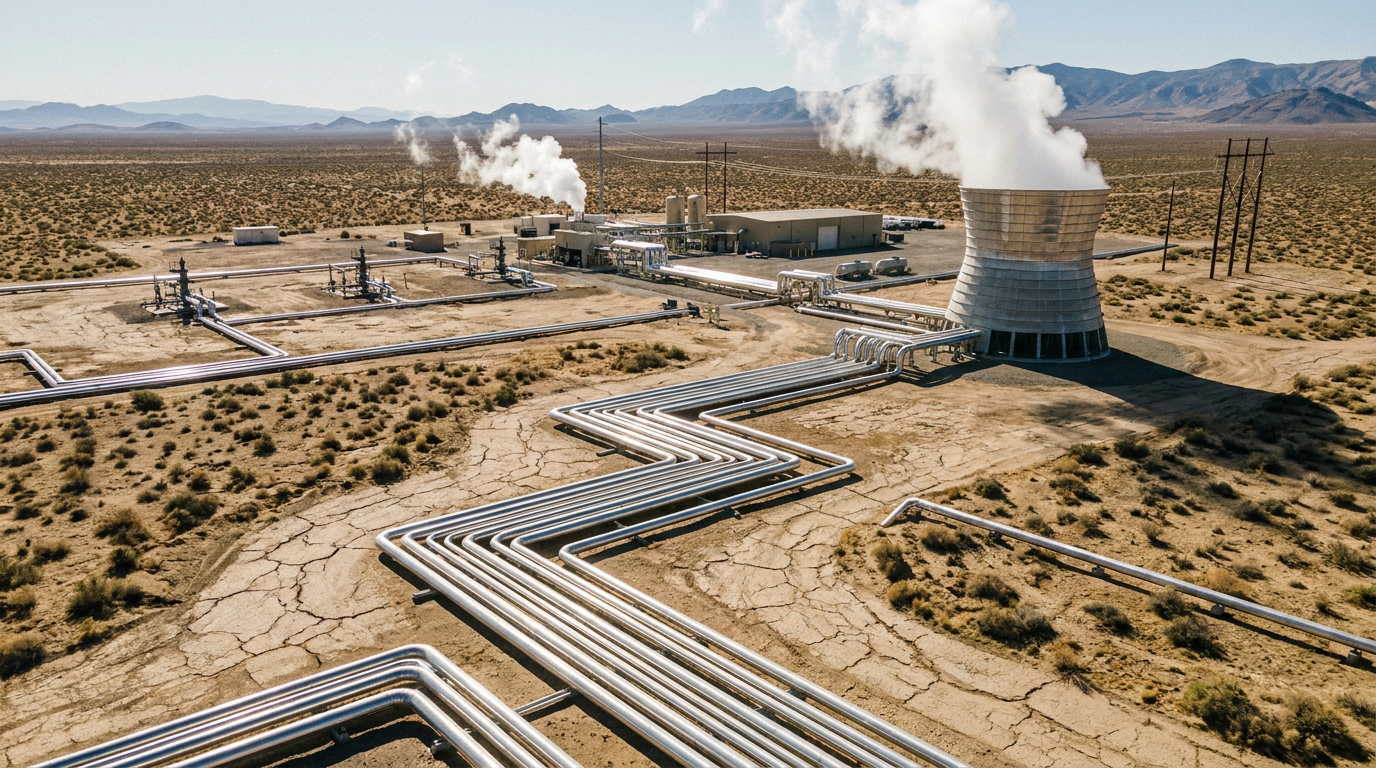
The mechanism relies on drilling deep into the Earth's crust—often 8,000 to 10,000 feet down—where temperatures naturally exceed 350 degrees Fahrenheit. Engineers then inject fluid at high pressure to create a network of tiny, hair-like fractures in the solid granite. Cold water is pumped down an injection well, heated as it flows through the fractured rock, and extracted from a second production well to drive a steam turbine on the surface.[1]

This breakthrough is largely the result of a technology crossover. EGS borrows the advanced horizontal drilling and hydraulic fracturing techniques pioneered by the oil and gas industry over the last twenty years, repurposing that fossil-fuel technology to extract zero-carbon heat instead of hydrocarbons.[5]
Recent commercial pilots have provided hard evidence that the physics of EGS work at a grid-relevant scale. A landmark pilot project in Nevada successfully demonstrated a 30-day continuous well test, producing enough sustained fluid flow to generate 3.5 megawatts of electricity—enough to power thousands of homes continuously.[5]
Recent commercial pilots have provided hard evidence that the physics of EGS work at a grid-relevant scale.
Data published in peer-reviewed journals confirms that horizontal well configurations significantly increase the surface area available for heat exchange. This solves a major historical problem with geothermal energy: rapid thermal depletion, where the rock cools down faster than the surrounding Earth can reheat it.[2]
With the physics largely proven, the primary barrier to global EGS deployment is no longer scientific, but economic. Drilling deep, horizontal wells through incredibly hard, abrasive igneous rock like granite is vastly more expensive and time-consuming than drilling through the softer sedimentary rock typical in oil and gas extraction.[3]
To bridge this gap, the U.S. Department of Energy has launched an aggressive 'Earthshot' initiative. The program aims to slash the cost of Enhanced Geothermal Systems by 90%, targeting a levelized cost of energy of $45 per megawatt-hour by 2035—a price point that would make it highly competitive with fossil fuels.[1]

If that economic target is reached, global energy models suggest geothermal could rapidly replace retiring coal plants. Because EGS facilities have a very small surface footprint, they can be built directly on the sites of decommissioned coal plants, plugging seamlessly into the existing high-voltage transmission infrastructure.[6]
However, the technology is not without environmental uncertainties. The most significant concern surrounding EGS is induced seismicity—small earthquakes triggered by the high-pressure injection of fluid into fault lines.[4]
Extensive research indicates that while micro-seismicity is an inevitable part of fracturing rock, it can be safely managed. By utilizing real-time seismic monitoring networks and adaptive pumping protocols, operators can detect pressure buildup and reduce fluid injection rates, keeping tremors well below the threshold of human perception or structural damage.[4]
A secondary concern is water usage. EGS requires millions of gallons of water to initially fracture the rock and prime the underground reservoir. In arid regions like the American Southwest—where geothermal potential is highest—this presents a potential resource conflict with local agriculture and municipalities.[2]
Engineers mitigate this by designing EGS plants as closed-loop systems. Once the underground reservoir is primed, the water is continuously recirculated between the surface turbine and the deep rock. Because the fluid is never exposed to the open air, long-term water consumption drops to near zero.[5]

The sheer scale of the potential resource is staggering. Academic assessments estimate that capturing just 2% of the thermal energy stored in the Earth's crust between 3 and 10 kilometers deep could power the entire United States for more than 2,000 years.[3]
We are currently witnessing the transition of EGS from a theoretical science experiment to a deployable commercial technology. Over the next decade, the success of this industry will depend entirely on driving down hard-rock drilling costs and proving that these engineered reservoirs can sustain their heat output over a standard 30-year commercial lifespan.[7]
How we got here
1970s
The concept of extracting heat from dry rock is first tested at Los Alamos National Laboratory.
2010s
Advances in horizontal drilling for shale oil make deep, directional drilling economically viable.
2023
Commercial pilots in Nevada successfully demonstrate sustained multi-megawatt power generation from an EGS well.
2026
The U.S. Department of Energy accelerates funding to slash EGS costs by 90% over the next decade.
Viewpoints in depth
The Baseload Advocates
Grid operators and energy researchers who see geothermal as the necessary replacement for coal.
This camp emphasizes that a grid running entirely on intermittent renewables (solar and wind) requires an astronomically expensive overbuild of battery storage. They argue that investing heavily in EGS now will save trillions of dollars in grid-balancing costs by 2050. Because geothermal plants have a small surface footprint and run continuously, they are viewed as the ideal drop-in replacement for retiring fossil fuel plants, able to plug directly into existing high-voltage transmission lines.
The Cost-Curve Skeptics
Energy economists who question if drilling costs can fall fast enough to compete.
While acknowledging the physics work, this group points to the harsh realities of deep-earth engineering. Drilling through 10,000 feet of hard, abrasive granite is vastly more expensive than drilling through the softer sedimentary rock typical in oil and gas extraction. They argue that unless drilling technology experiences a radical, unforeseen breakthrough—such as millimeter-wave or laser drilling—EGS will remain a niche, premium-priced energy source unable to compete with the plummeting costs of utility-scale solar.
What we don't know
- Whether the artificial underground reservoirs will maintain their heat output over a 30-year commercial lifespan without cooling down too rapidly.
- If next-generation drilling technologies can reduce costs enough to hit the DOE's $45/MWh target by 2035.
Key terms
- Enhanced Geothermal Systems (EGS)
- A man-made reservoir created by injecting fluid into hot, dry rock to extract heat for electricity generation.
- Baseload Power
- The minimum amount of electric power needed to be supplied to the electrical grid at any given time, traditionally provided by coal or nuclear.
- Capacity Factor
- The ratio of an energy plant's actual electrical energy output over time to its maximum possible output.
- Induced Seismicity
- Minor earthquakes and tremors that are caused by human activity, such as fluid injection into the Earth's crust.
Frequently asked
Can geothermal energy run out?
The Earth's internal heat is practically inexhaustible on human timescales. However, a specific local well can cool down if heat is extracted faster than the surrounding rock can replenish it.
Does EGS cause dangerous earthquakes?
EGS does cause micro-seismicity (tiny tremors) as rock fractures. However, modern projects use strict monitoring and adaptive pumping to keep these tremors well below the threshold of human perception.
How is this different from traditional geothermal?
Traditional geothermal relies on naturally occurring hot water reservoirs near the surface, like in Iceland or California. EGS creates its own reservoir in hot, dry rock, meaning it can be built almost anywhere.
Sources
Source coverage
7 outlets
3 viewpoints surfaced







[1]U.S. Department of EnergyGeothermal Optimists
Enhanced Geothermal Systems (EGS) Fact Sheet
Read on U.S. Department of Energy →[2]Nature EnergyEconomic Skeptics
Techno-economic performance of next-generation geothermal power
Read on Nature Energy →[3]MIT Energy InitiativeEnvironmental Pragmatists
The Future of Geothermal Energy
Read on MIT Energy Initiative →[4]ScienceEnvironmental Pragmatists
Mitigating induced seismicity in enhanced geothermal systems
Read on Science →[5]Fervo EnergyGeothermal Optimists
Commercializing Next-Generation Geothermal
Read on Fervo Energy →[6]International Energy AgencyEconomic Skeptics
Geothermal Energy Progress Report
Read on International Energy Agency →[7]Factlen Editorial Team
Synthesis by Factlen editorial team
Read on Factlen Editorial Team →

Every angle. Every day.
Get science stories with full source coverage and perspective breakdowns delivered to your inbox.