
The Science of Earthshine: How the Moon's Dark Side Reveals Earth's Changing Climate
A faint glow on the unlit portion of the crescent moon is providing scientists with crucial data about Earth's climate, cloud cover, and the search for extraterrestrial life.
By Factlen Editorial Team
- Climate Researchers
- Focus on how Earth's diminishing reflectance alters the global energy budget.
- Observational Astronomers
- Value the self-calibrating, wide-angle nature of ground-based lunar observations.
- Astrobiologists
- Utilize earthshine as a proxy to design the search for extraterrestrial life.
- Science Communicators
- Focus on public engagement and the accessibility of naked-eye stargazing.
What's not represented
- · Policymakers tasked with integrating albedo decline into international climate targets.
- · Satellite engineers designing the next generation of space-based radiation budget instruments.
Why this matters
By using the moon as a giant, naturally occurring mirror, scientists can measure exactly how much sunlight Earth reflects—revealing a hidden shift in our planet's cloud cover that directly impacts the speed of global warming.
Key points
- Earthshine is sunlight that reflects off Earth, illuminates the dark side of the moon, and bounces back to our eyes.
- By measuring the brightness of earthshine, scientists can calculate Earth's albedo, or total reflectance.
- Two decades of data show Earth's albedo has declined, meaning the planet is absorbing more solar heat.
- The dimming is linked to a reduction in highly reflective, low-lying clouds over the warming Pacific Ocean.
- Astrobiologists are using earthshine as a proxy to learn how to detect signs of life on distant exoplanets.
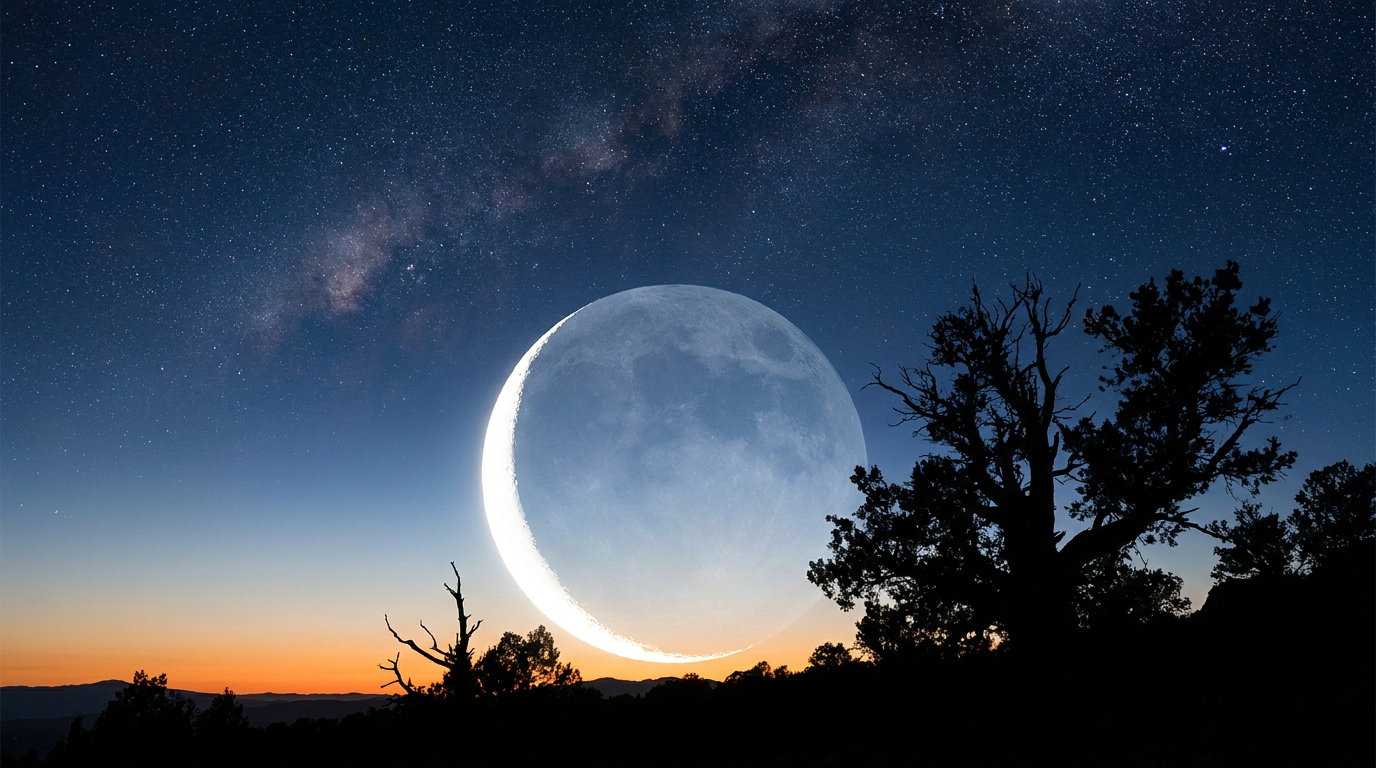
If you step outside a few days before or after a new moon, you might notice a striking celestial illusion: the dark, unlit portion of the lunar disk glowing with a faint, ghostly light. This phenomenon, recently highlighted in a BBC Science feature, is known as earthshine. To the naked eye, it appears as a pale, ashen sphere cradled within a bright crescent—a sight romantically dubbed 'the old moon in the new moon's arms.'[1][2]
While earthshine has captivated stargazers for centuries, it is far more than a backyard curiosity. For modern scientists, that faint lunar glow serves as a massive, naturally occurring mirror that reflects the real-time state of Earth's climate. By measuring the exact brightness of the dark side of the moon, researchers can calculate our planet's albedo—the total amount of sunlight Earth reflects back into space.[3][4]
The mechanics of earthshine are an elegant display of celestial geometry. Sunlight strikes the day side of Earth, bouncing off highly reflective surfaces like clouds, sea ice, and snow. A fraction of that light travels 240,000 miles through the vacuum of space to hit the moon. Because the moon's dark side is facing Earth during a crescent phase, it catches this terrestrial light and reflects it back to observers standing on Earth's night side.[2][3]

The first person in recorded history to correctly deduce this double-bounce mechanism was Leonardo da Vinci, around the year 1510. Da Vinci realized that Earth, like the moon, shines in the sky, and that the 'Da Vinci glow' was simply our own planet's radiance bouncing back at us. However, it took another four centuries before astronomers realized this glow could be quantified to track global environmental changes.[2][3][4]
Earth's albedo is a fundamental regulator of the global energy budget. Historically, Earth reflects roughly 30 percent of the incoming shortwave sunlight it receives, while absorbing the remaining 70 percent to heat the oceans, land, and atmosphere. If the planet's albedo increases, more energy is deflected, leading to a cooling effect. If the albedo decreases, the planet absorbs more solar radiation, exacerbating global warming.[4][5]
Measuring a globally integrated albedo is notoriously difficult. Satellites orbiting Earth can only see small patches of the planet at any given moment, requiring complex mathematical models to stitch those observations together. Earthshine, however, offers an instantaneous, large-scale snapshot. Because the moon observes up to 40 percent of Earth's surface at once, the brightness of the earthshine provides a self-calibrating, wide-angle measurement of our planet's total reflectance.[4][5]
To capture this data, researchers at the Big Bear Solar Observatory (BBSO) in California have been conducting a continuous, decades-long photometric study of the moon. Using specialized coronagraphs, the BBSO team measures the exact ratio between the moon's bright, sunlit crescent (moonshine) and its dim, earth-lit dark side (earthshine). This ratio allows them to track nightly, seasonal, and annual anomalies in Earth's cloud cover and ice caps.[4][5]
To capture this data, researchers at the Big Bear Solar Observatory (BBSO) in California have been conducting a continuous, decades-long photometric study of the moon.
The evidence gathered from these observations has revealed a startling trend: Earth is losing its shine. According to a landmark analysis of two decades of earthshine data, the planet's albedo has steadily declined since 1998. The drop in reflectance equates to a net climate forcing of approximately 0.5 watts per square meter—meaning Earth is absorbing significantly more solar energy today than it did twenty years ago.[5][6]

This dimming effect is not caused by changes in the sun's output, but rather by shifts in Earth's own atmosphere. Climate researchers attribute the declining albedo to a reduction in low-lying, highly reflective stratocumulus clouds over the eastern Pacific Ocean. As ocean temperatures in this region have warmed, the marine cloud layer has thinned, exposing more of the dark, light-absorbing ocean surface beneath.[5][6]
The earthshine data aligns remarkably well with independent measurements taken by NASA's Clouds and the Earth's Radiant Energy System (CERES) satellites, which began operating in 2000. Both ground-based and space-based instruments confirm the same reality: the loss of reflective cloud cover is acting as a positive feedback loop, amplifying the warming driven by anthropogenic greenhouse gases.[4][6]

However, transparent uncertainty remains regarding the long-term permanence of this trend. Scientists are still debating whether the reduction in Pacific cloud cover is a permanent consequence of global warming or a temporary fluctuation tied to the Pacific Decadal Oscillation—a long-term ocean temperature cycle. If the dimming is purely cyclical, Earth's albedo may eventually rebound; if it is structurally driven by climate change, the accelerated warming will likely persist.[6][8]
Beyond climate science, earthshine is also revolutionizing the field of astrobiology. As astronomers discover thousands of exoplanets orbiting distant stars, they face a daunting challenge: how to identify which of those worlds might harbor life. Because we cannot yet travel to these exoplanets, scientists must rely on the faint light they reflect—their own versions of earthshine.[7]
By studying the spectrum of light reflected from Earth to the moon, astrobiologists are learning what a habitable, life-bearing planet looks like from afar. Earthshine contains the distinct optical 'fingerprints' of our atmosphere, including atmospheric oxygen, ozone, water vapor, and the 'red edge' of chlorophyll from global plant life.[7]

Future lunar missions are already being designed to capitalize on this. Concepts like the proposed 'EarthShine' instrument suite aim to place dedicated telescopes on the lunar surface to continuously monitor Earth as if it were an exoplanet. This data will be vital for calibrating the next generation of space telescopes tasked with hunting for biological signatures across the galaxy.[7]
Ultimately, the study of earthshine bridges the gap between backyard astronomy and planetary survival. The next time you look up at a crescent moon and see the faint outline of its dark sphere, you are not just witnessing a beautiful optical illusion. You are looking in a 240,000-mile-long mirror, watching the reflection of our changing world.[8]
How we got here
c. 1510
Leonardo da Vinci first correctly deduces that the ghostly glow on the moon is sunlight reflecting off Earth's oceans and clouds.
1928
French astronomer André-Louis Danjon pioneers the first quantitative, ground-based measurements of earthshine.
1998
The Big Bear Solar Observatory begins a continuous, decades-long project to measure Earth's albedo using modern photometric techniques.
2000
NASA launches the CERES satellite instruments, providing a space-based counterpart to ground-based earthshine observations.
2021
Researchers publish two decades of earthshine data revealing a climatologically significant drop in Earth's reflectance.
June 2026
The phenomenon continues to draw public and scientific interest as a vital metric for both climate modeling and exoplanet research.
Viewpoints in depth
Climate Researchers
Focus on how Earth's diminishing reflectance alters the global energy budget.
For climatologists, the earthshine data is a crucial, independent verification of satellite records. They view the 0.5 W/m² drop in albedo as a significant positive feedback loop. Because warmer oceans dissipate the low-lying stratocumulus clouds that traditionally reflect sunlight, the Earth absorbs more heat, which in turn warms the oceans further. Their primary concern is whether this cloud-thinning effect is a permanent structural change to the atmosphere or a reversible decadal anomaly.
Observational Astronomers
Value the self-calibrating, wide-angle nature of ground-based lunar observations.
Astronomers operating facilities like the Big Bear Solar Observatory emphasize the methodological elegance of earthshine. Unlike low-Earth-orbit satellites that only see narrow swaths of the planet and require complex mathematical stitching, the moon acts as a giant, passive mirror observing 40 percent of the globe at once. They argue that maintaining these ground-based photometric records is essential to prevent 'instrumental drift'—the gradual loss of calibration that plagues aging satellites.
Astrobiologists
Utilize earthshine as a proxy to design the search for extraterrestrial life.
Astrobiologists look at earthshine and see a training ground. When next-generation telescopes finally image Earth-like exoplanets, those distant worlds will appear as single, faint pixels of reflected light. By analyzing the spectrum of our own earthshine, researchers are learning how to detect the 'red edge' of vegetation, the glint of liquid oceans, and the chemical signatures of oxygen and methane. To them, the moon is the perfect laboratory for learning how to recognize a living world.
What we don't know
- Whether the recent drop in Earth's albedo is a permanent climate feedback loop or a temporary phase of the Pacific Decadal Oscillation.
- Exactly how the competing effects of different cloud types (high cirrus vs. low stratocumulus) will balance out as global temperatures continue to rise.
- How effectively the biological signatures found in earthshine can be isolated when observing much fainter, distant exoplanets.
Key terms
- Earthshine
- Sunlight that reflects off Earth's day side, hits the dark portion of the Moon, and bounces back to observers on Earth's night side.
- Albedo
- The fraction of solar energy (shortwave radiation) reflected from Earth back into space, primarily driven by clouds and ice.
- Bond Albedo
- The total average reflectance of a celestial body across all wavelengths and all phase angles.
- CERES
- A suite of satellite instruments (Clouds and the Earth's Radiant Energy System) that measure reflected sunlight and emitted heat from the top of the atmosphere.
- Pacific Decadal Oscillation
- A robust, recurring pattern of ocean-atmosphere climate variability centered over the mid-latitude Pacific basin.
Frequently asked
When is the best time to see earthshine?
It is most visible to the naked eye a few days before and after a new moon, when the moon appears as a thin crescent in the twilight sky.
Why is it sometimes called the Da Vinci glow?
Leonardo da Vinci was the first person in recorded history to correctly explain the phenomenon in the early 16th century.
Does a dimmer Earth mean the planet is cooling?
No, a dimmer Earth means the planet's albedo has decreased. Because it is reflecting less sunlight back into space, it is absorbing more solar energy, which contributes to warming.
Why measure earthshine when we have satellites?
Ground-based earthshine measurements are self-calibrating and capture a large-scale, instantaneous snapshot of Earth's reflectance, serving as a crucial independent check on satellite data.
Sources
Source coverage
8 outlets
4 viewpoints surfaced








[1]BBCScience Communicators
Have you ever heard of Earthshine?
Read on BBC →[2]Space.comObservational Astronomers
Earthshine will reveal the moon's hidden face — here's how to see it
Read on Space.com →[3]NASA ScienceClimate Researchers
Earthshine and Climate
Read on NASA Science →[4]Big Bear Solar ObservatoryObservational Astronomers
Earthshine Project
Read on Big Bear Solar Observatory →[5]Geophysical Research LettersClimate Researchers
Earth's Albedo 1998–2017 as Measured From Earthshine
Read on Geophysical Research Letters →[6]World Economic ForumClimate Researchers
The earth is dimming. What 'earthshine' means for our climate system
Read on World Economic Forum →[7]AstrobiologyAstrobiologists
EarthShine: Observing Our World as an Exoplanet from the Surface of the Moon
Read on Astrobiology →[8]Factlen Editorial TeamScience Communicators
Synthesis by Factlen editorial team
Read on Factlen Editorial Team →

Every angle. Every day.
Get science stories with full source coverage and perspective breakdowns delivered to your inbox.