
The Science of Aquafaba: How Chickpea Water Replaces Eggs in Vegan Cooking
A deep dive into the molecular mechanics of aquafaba, explaining how proteins, saponins, and starches transform discarded bean water into stable culinary foams and emulsions.
By Factlen Editorial Team
- Food Scientists & Chemists
- Focuses on the colloidal properties, protein denaturation, and saponin surfactants that drive aquafaba's functionality.
- Culinary Innovators & Bakers
- Focuses on the practical applications, accessibility, and exact substitution ratios for home cooking.
- Factlen Analytical Synthesis
- Bridges the gap between the molecular science and the practical culinary impact of waste valorization.
What's not represented
- · Industrial Food Manufacturers
- · Chickpea Farmers
Why this matters
Understanding the chemistry of aquafaba empowers home cooks to confidently replace eggs in baking and cooking. By mastering this technique, readers can reduce food waste, accommodate egg allergies, and explore plant-based culinary innovations with consistent, scientific precision.
Key points
- Aquafaba is the viscous liquid from cooked legumes, composed of 95% water and 5% dry matter.
- Its foaming ability comes from heat-denatured proteins that trap air bubbles during whipping.
- Saponins act as natural surfactants, while carbohydrates thicken the liquid to prevent the foam from collapsing.
- Lowering the pH with cream of tartar stabilizes the foam for baking applications like meringues.
- Trace amounts of fat or oil will immediately destroy the foam by competing for the air-water interface.
- Aquafaba is a highly effective emulsifier, making it an ideal base for vegan mayonnaise.
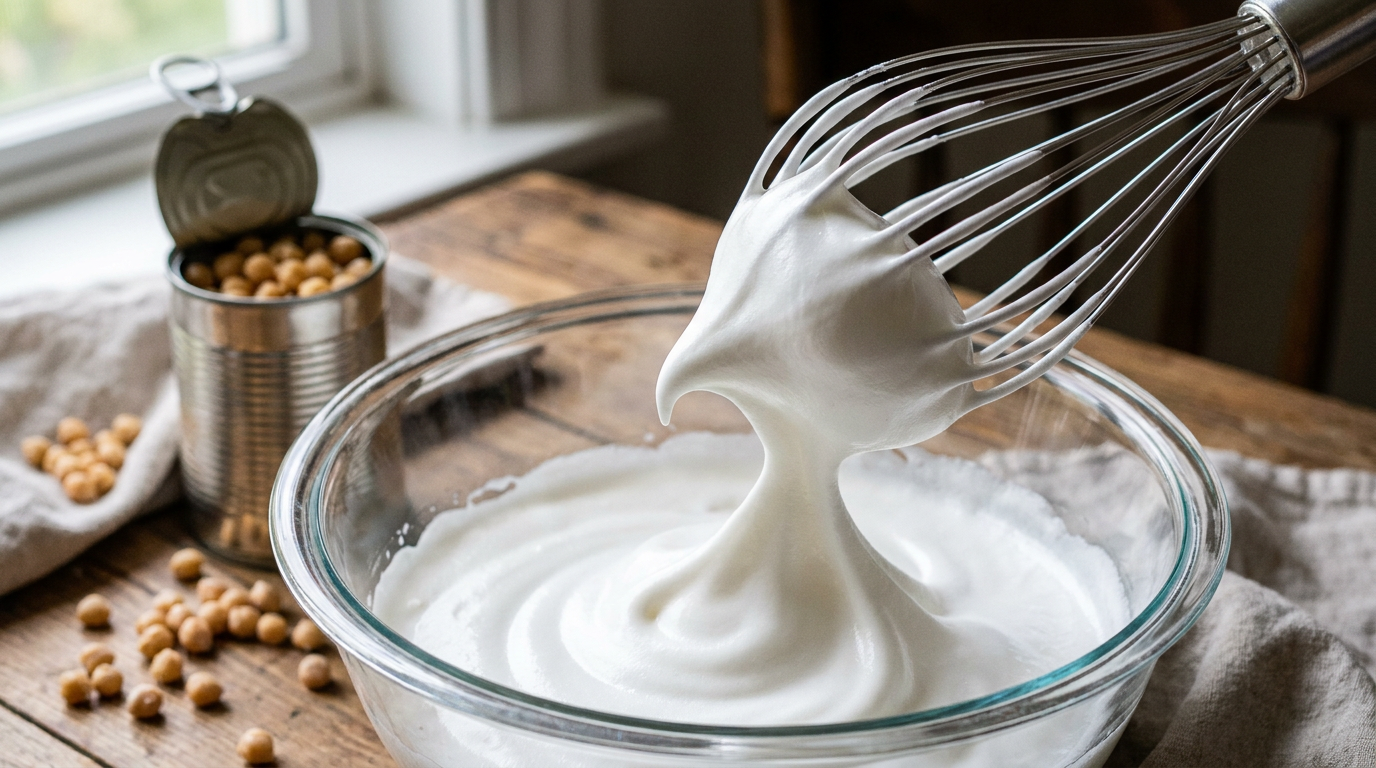
For decades, vegan bakers and those with severe egg allergies searched for the culinary holy grail: a plant-based substitute that could perfectly mimic the foaming, binding, and emulsifying properties of egg whites. They experimented with flaxseeds, chia seeds, and mashed bananas, but nothing could produce the airy, stable structure required for a delicate meringue or a fluffy mousse. Then, in 2014, a French chef named Joël Roessel discovered that the viscous liquid left over from canned chickpeas—a byproduct typically poured straight down the drain—could be whipped into stiff, glossy peaks.[3]
The discovery sparked a grassroots culinary revolution. In 2015, software engineer Goose Wohlt perfected the meringue recipe and coined the term "aquafaba," a portmanteau of the Latin words for water (aqua) and bean (faba). What started as an internet experiment quickly caught the attention of food scientists, who sought to understand exactly why this humble bean brine behaved so remarkably like an egg. The answer, it turns out, is a masterclass in colloid science and protein biochemistry.[1][3]
Peer-reviewed analyses reveal that aquafaba is remarkably simple in its macro-composition: it consists of roughly 92% to 95% water and just 5% to 8% dry matter. However, that tiny fraction of dry matter contains a highly specific, complex mixture of low-molecular-weight proteins, carbohydrates, and specialized plant compounds. Together, these elements perfectly mimic the functional properties of ovalbumin, the primary protein responsible for the structure of egg whites.[1][4]

The foaming capacity of aquafaba is primarily driven by heat-stable seed storage proteins, specifically globulins like vicilin and legumin, as well as water-soluble albumins. During the high-heat canning or pressure-cooking process, these proteins leach out of the chickpeas and into the surrounding water. More importantly, the intense thermal energy causes these tightly folded proteins to partially denature, or unfold, exposing their internal molecular structures to the surrounding liquid.[1][2][3]
These unfolded proteins are amphiphilic, meaning they possess both hydrophilic (water-loving) and hydrophobic (water-fearing) regions. When a cook vigorously whisks aquafaba, they introduce millions of tiny air bubbles into the liquid. The hydrophobic ends of the proteins immediately rush to escape the water, embedding themselves inside the newly formed air bubbles, while the hydrophilic ends remain firmly anchored in the surrounding liquid phase.[3][4]
This precise alignment creates a protective, elastic film around each air bubble, dramatically lowering the surface tension of the liquid and allowing the foam to expand rapidly. However, proteins alone are not enough to maintain the foam's long-term structure. Without additional support, gravity would quickly pull the water out from between the bubbles—a phenomenon known as syneresis, or weeping—causing the delicate foam to collapse back into a puddle.[2][4]

However, proteins alone are not enough to maintain the foam's long-term structure.
This is where aquafaba's carbohydrate content plays a crucial structural role. The dry matter in chickpea water contains a significant amount of polysaccharides and natural sucrose. These complex sugars dissolve into the water phase of the foam, significantly increasing its viscosity. This thickened liquid drains much more slowly, acting as a microscopic scaffolding that holds the protein-coated air bubbles in place and gives the foam its signature glossy, stable appearance.[1][2][4]
Aquafaba also contains a secret weapon that traditional eggs lack: saponins. Saponins are naturally occurring phytochemicals found in many legumes that act as powerful natural surfactants. The name "saponin" is derived from the Latin word for soap, and they behave in much the same way, creating a rich, creamy lather when agitated. In aquafaba, saponins work synergistically with the proteins to rapidly establish the foam during the crucial initial stages of whisking.[1][3]
Despite this robust chemical architecture, aquafaba foams are highly sensitive to their chemical environment. The natural pH of chickpea water hovers around 6.0 to 6.2, which is slightly acidic but not optimal for long-term foam stability in the oven. Food scientists and test kitchens have found that lowering the pH by adding an acid—such as cream of tartar (potassium bitartrate) or a few drops of lemon juice—alters the electrical charge of the proteins. This encourages them to bond more tightly to one another, preventing the foam from deflating when baking meringues or pavlovas.[2][3][4]

The system is also incredibly vulnerable to lipid contamination. Because aquafaba relies entirely on proteins and saponins to stabilize the air-water interface, the presence of even trace amounts of fat will instantly destroy the foam matrix. Oils and fats are highly hydrophobic and will aggressively compete for space at the air interface, displacing the proteins and causing the bubbles to pop. This is why bakers must ensure their glass or metal mixing bowls are meticulously clean, as even a microscopic film of residual butter or oil will prevent aquafaba from whipping.[3][4][5]
Beyond foaming, aquafaba is also a highly effective emulsifier, making it an ideal base for vegan mayonnaise and aioli. In an emulsion, the goal is to force two unmixable liquids—like oil and water—to blend smoothly. The amphiphilic proteins and saponins in aquafaba coat the microscopic droplets of oil as they are blended in, preventing them from coalescing and separating from the water. Recent studies have shown that aquafaba can produce mayonnaise with a firmness and physical stability nearly identical to traditional egg-yolk formulations.[1][2]

Not all aquafaba is created equal, however. The concentration of proteins and starches varies wildly depending on the brand of canned chickpeas, the ratio of water to beans, and the cooking time. Commercial canned chickpeas generally yield the most consistent results, as the industrial pressure-cooking process extracts an optimal level of starches. For home cooks boiling dried chickpeas, reducing the leftover cooking liquid on the stove until it reaches the viscous consistency of egg whites is often necessary to achieve the required 5% solid concentration.[3][4][5]
While the liquid from any cooked legume—such as white beans, lentils, or soybeans—can technically be whipped into a foam, chickpea water remains the undisputed gold standard. Chickpeas possess the ideal ratio of albumins to polysaccharides, and crucially, they have the most neutral flavor profile. The mild, earthy scent of chickpea aquafaba dissipates entirely during baking, allowing the delicate flavors of sugar and vanilla to shine through in pastries.[1][3][5]
The rise of aquafaba represents a significant victory for food waste valorization. By transforming a globally discarded industrial byproduct into a high-value culinary ingredient, aquafaba aligns perfectly with circular economy principles. It provides a sustainable, cholesterol-free, and allergy-friendly alternative to eggs, proving that some of the most profound culinary innovations require nothing more than a fresh scientific look at what we already have in our pantries.[4][5]
How we got here
2014
French chef Joël Roessel discovers that chickpea brine can be whipped into a foam.
March 2015
Software engineer Goose Wohlt perfects the meringue recipe and coins the term 'aquafaba'.
2018
The first peer-reviewed scientific papers are published detailing the chemical composition of aquafaba.
2021–Present
Aquafaba sees widespread commercial adoption as a plant-based emulsifier in vegan mayonnaise and commercial baking.
Viewpoints in depth
Food Scientists & Chemists
Focuses on the molecular interactions that make aquafaba functional.
From a biochemical perspective, aquafaba is a fascinating study in colloidal systems. Researchers emphasize that it is the precise synergy between low-molecular-weight proteins (which form the initial film around air bubbles), saponins (which lower surface tension), and polysaccharides (which increase viscosity to prevent drainage) that makes the foam stable. Chemists note that while eggs rely heavily on ovalbumin, aquafaba achieves the exact same physical result using an entirely different set of plant-based building blocks.
Culinary Innovators & Bakers
Focuses on the practical application and accessibility of the ingredient.
For the culinary community, the science is secondary to the results. Bakers view aquafaba as the most significant vegan baking breakthrough of the 21st century because it requires no specialized equipment or expensive hydrocolloids. By simply adhering to strict cleanliness rules (avoiding trace fats) and utilizing basic acid stabilizers like cream of tartar, home cooks can achieve patisserie-level results using an ingredient that costs pennies and is already sitting in their pantry.
Sustainability Advocates
Focuses on the environmental benefits of waste valorization.
Sustainability experts highlight aquafaba as a perfect example of the circular economy in action. Millions of gallons of nutrient-rich legume cooking water are discarded by the food industry every year. By repurposing this byproduct into a functional ingredient, the food system can simultaneously reduce industrial waste and decrease reliance on resource-intensive animal agriculture, offering a scalable solution for more sustainable food production.
What we don't know
- The exact molecular interactions between saponins and proteins during the initial milliseconds of foam formation are still being mapped.
- How to perfectly standardize the protein and starch concentrations of aquafaba across different commercial chickpea brands and crop years.
- Whether industrial extraction methods can be fully optimized to produce a highly concentrated aquafaba powder without losing its functional properties.
Key terms
- Aquafaba
- The viscous liquid left over from cooking legumes, most commonly chickpeas, used as a plant-based egg substitute.
- Amphiphilic
- A molecule that has both a water-loving (hydrophilic) and a water-fearing (hydrophobic) end, allowing it to interact with both water and air or oil.
- Denaturation
- The process by which proteins lose their natural folded structure due to heat or mechanical agitation, allowing them to form new bonds.
- Syneresis
- The extraction or expulsion of a liquid from a gel or foam, commonly seen when a meringue "weeps" or collapses.
- Saponins
- Naturally occurring plant compounds that act as surfactants, creating a soap-like lather when agitated in water.
- Emulsion
- A stable mixture of two or more liquids that are normally unmixable, such as oil and water, bound together by an emulsifier.
Frequently asked
What is the exact substitution ratio for aquafaba to eggs?
As a general rule, 30 grams (about two tablespoons) of aquafaba replaces one egg white, and 45 grams (about three tablespoons) replaces one whole egg.
Can I use the water from other types of canned beans?
Yes, the liquid from white beans, lentils, or soybeans will also whip into a foam. However, chickpea water is preferred because it has the most neutral flavor and the optimal starch-to-protein ratio.
Why did my aquafaba foam collapse while whipping?
The most common culprit is trace amounts of fat or oil on your mixing bowl or whisk, which destroys the protein matrix. Failing to add an acid stabilizer like cream of tartar can also cause the foam to deflate.
Does aquafaba make baked goods taste like chickpeas?
No. While raw aquafaba has a mild bean scent, the flavor and odor dissipate entirely during the baking process, allowing ingredients like sugar and vanilla to dominate.
Sources
Source coverage
5 outlets
3 viewpoints surfaced





[1]MDPIFood Scientists & Chemists
Aquafaba from Korean Soybean II: Physicochemical Properties and Composition Characterized by NMR Analysis
Read on MDPI →[2]NIHFood Scientists & Chemists
Physicochemical and structural properties of vegan mayonnaise prepared with peanut sprout oil and aquafaba
Read on NIH →[3]The Daily MealCulinary Innovators & Bakers
The Science Of Aquafaba
Read on The Daily Meal →[4]ResearchGateFood Scientists & Chemists
Aquafaba, the aqueous by-product of legume cooking: A review
Read on ResearchGate →[5]Factlen Editorial TeamFactlen Analytical Synthesis
Synthesis by Factlen editorial team
Read on Factlen Editorial Team →
Every angle. Every day.
Get food drink stories with full source coverage and perspective breakdowns delivered to your inbox.