
The Rise of the 'Trackless Tram': Inside the Autonomous Transit Tech Dividing City Planners
Marketed as a low-cost alternative to light rail, Autonomous Rapid Transit (ART) uses optical sensors to guide multi-carriage vehicles along virtual tracks. As cities from Dubai to Perth test the technology in 2026, transit experts are debating whether it represents a genuine revolution or just a cleverly repackaged bus.
By Factlen Editorial Team
- Urban Planners & Proponents
- View ART as a cost-effective, rapidly deployable solution to bridge the gap between standard buses and expensive rail.
- Transit Skeptics
- Argue that the technology is a 'gadgetbahn' that overpromises on autonomy and hides the true costs of road wear.
- Municipal Testers
- Taking a cautious, pilot-first approach to verify the technology's claims before committing to full fleet replacements.
What's not represented
- · Disability advocates assessing ride smoothness and boarding accessibility
- · Local taxpayers funding the pilot programs
Why this matters
Mid-sized cities desperately need high-capacity public transit but cannot afford the billion-dollar price tags of traditional rail. If trackless trams deliver on their promises, they could rapidly decarbonize urban corridors—but if they fail, cities risk wasting millions on proprietary technology that underperforms.
Key points
- Trackless trams use optical sensors to follow painted lines instead of steel rails.
- Proponents claim the technology costs one-fifth of traditional light rail systems.
- Cities in the UK, Australia, and the UAE are conducting pilot programs in 2025 and 2026.
- Critics argue the vehicles are simply heavy articulated buses with misleading marketing.
- The 51-tonne weight of the vehicles may require expensive road strengthening.
The modern urban transit dilemma is a matter of simple mathematics. Cities are growing, traffic is worsening, and the traditional solution—light rail—costs upwards of $20 million per kilometer. Digging up streets to lay steel tracks and overhead wires takes years, disrupts local businesses, and often drains municipal budgets before a single passenger boards.[7]
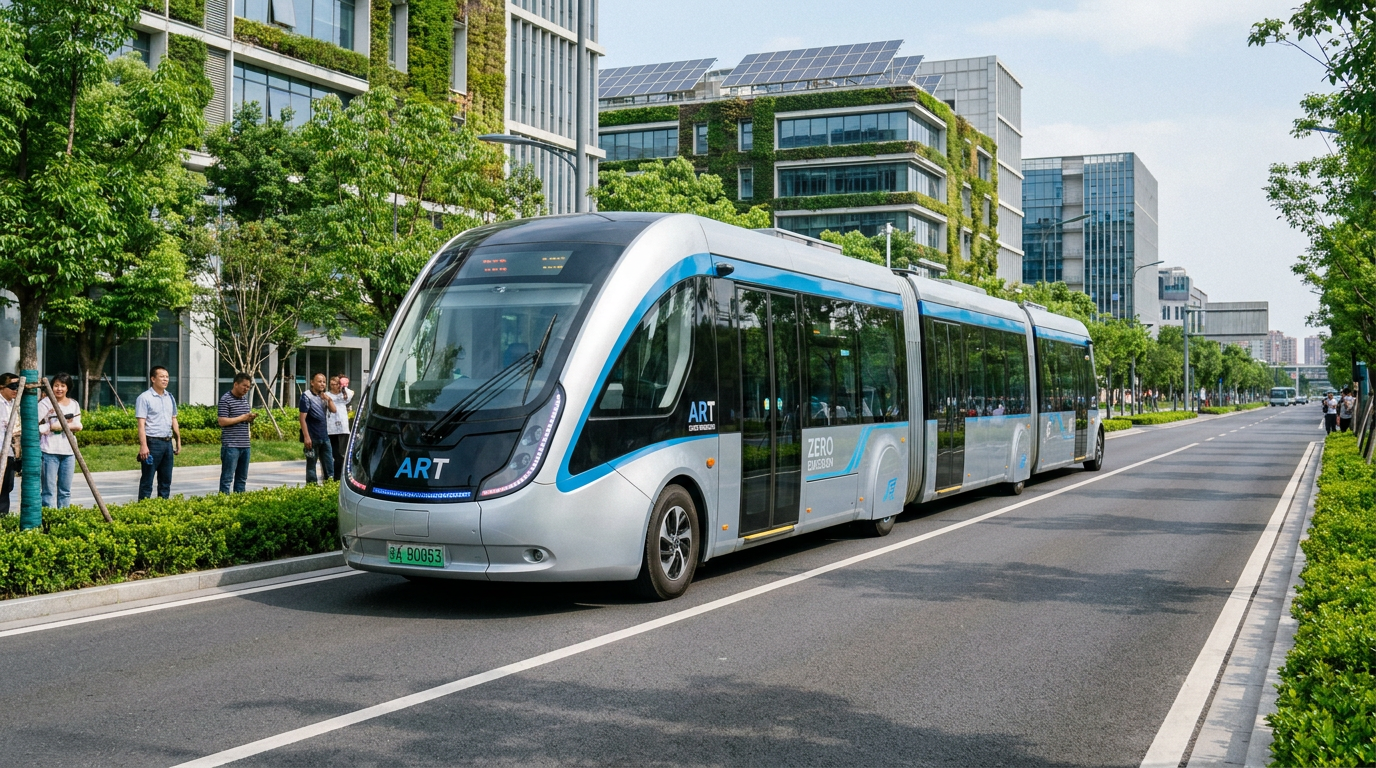
Enter Autonomous Rapid Transit (ART), frequently dubbed the "trackless tram." Developed by China's CRRC Zhuzhou Institute, the technology promises a tantalizing compromise: the sleek look, smooth ride, and high passenger capacity of a light rail system, but operating on standard asphalt.[4][6]
The mechanism behind ART relies on optical guidance rather than physical rails. The vehicles are equipped with LiDAR, GPS, and high-definition cameras that read double-dashed painted lines on the road. This "virtual track" allows the multi-carriage vehicle to navigate its route automatically, adjusting for obstacles in real-time while maintaining a precise path.[1][6]
Physically, an ART vehicle closely resembles a modern tram. A standard three-carriage configuration stretches roughly 31 meters long and can theoretically carry up to 300 passengers, reaching top speeds of 70 km/h. They are powered by either lithium-titanate batteries that fast-charge at stations or, in newer iterations, onboard hydrogen fuel cells.[4][6]

The primary appeal is financial. Proponents claim that by eliminating the need for steel rails and overhead catenary wires, an ART system can be deployed for roughly one-fifth the cost of a traditional tram network. Furthermore, the installation time is measured in months rather than decades, offering a rapid political and practical win for city planners.[1][4]
This value proposition has sparked a wave of global interest and pilot programs heading into 2026. In the United Arab Emirates, Dubai's Roads and Transport Authority recently unveiled its trackless tram plans, aiming to deploy the battery-powered vehicles across a 100-kilometer network to reduce congestion and modernize the city's infrastructure.[1]
In the United Kingdom, the Tees Valley is preparing for advanced testing of connected and automated mobility systems at Teesside Airport. Following extensive feasibility studies, the region plans to trial trackless trams in late 2025 and 2026, with hopes of integrating them into town centers by 2027.[2]
In the United Kingdom, the Tees Valley is preparing for advanced testing of connected and automated mobility systems at Teesside Airport.
Australia has also heavily investigated the technology. The City of Stirling in Perth conducted an extensive trial in late 2023, importing a 30-meter vehicle from Shanghai. Their business case, finalized in late 2024, identified ART as a catalyst for urban regeneration along major corridors, praising its maneuverability and lower barrier to entry.[3]

However, as the technology moves from controlled test tracks to public roads, a vocal contingent of transit researchers is pushing back against the hype. Critics argue that the terminology itself is misleading, pointing out that ART is neither fully autonomous nor a true rail system.[5][6]
"Strip away the marketing, however, and one finds a rather long bus," notes one critical analysis, classifying the system as a "gadgetbahn"—a term used by transit purists for overly complex proprietary technologies that solve problems standard buses already address. Because they run on rubber tires, ART vehicles are legally and functionally classified as bi-articulated buses in many jurisdictions.[5][6]
The autonomy claims have also faced real-world friction. While the optical guidance is sophisticated, the vehicles currently require human operators or "safety drivers" to intervene in complex urban traffic. In late 2024, Indonesia tested an ART vehicle for its future capital, Nusantara, but ultimately returned the unit to China after finding the autonomous control system required too much manual intervention.[2][6]
Then there is the issue of hidden infrastructure costs. While ART avoids steel tracks, a fully loaded three-carriage vehicle weighs 51 tonnes—roughly twice the legal limit for standard articulated buses. Researchers evaluating the system discovered that significant, costly road strengthening would be required to prevent the heavy vehicles from rutting the asphalt over time.[5]

Capacity metrics are similarly contested. While manufacturers advertise space for over 300 passengers, this figure assumes a crush-load density of eight people per square meter. When Western transit authorities recalculated the capacity using a more comfortable standard of four people per square meter, the actual capacity dropped to around 170—barely more than a conventional articulated bus.[5]
Despite these criticisms, the trackless tram occupies a unique and potentially valuable niche. Even if it functions primarily as a high-end Bus Rapid Transit (BRT) system, the tram-like aesthetics and smooth electric acceleration have proven more successful at attracting riders who typically avoid standard buses.[1][7]
Ultimately, the success of Autonomous Rapid Transit in 2026 and beyond will depend on transparent accounting. If cities acknowledge the necessary road reinforcements and treat the technology as an advanced bus network rather than a magical rail replacement, ART could become a vital tool for decarbonizing urban corridors without breaking municipal budgets.[7]
How we got here
June 2017
CRRC unveils the first Autonomous Rapid Transit (ART) system in Zhuzhou, China.
Late 2023
The City of Stirling in Perth, Australia, conducts a multi-week trial of an imported 30-meter trackless tram.
October 2024
Dubai's Roads and Transport Authority showcases its trackless tram plans at GITEX, aiming for a 100km network.
Late 2024
Indonesia tests an ART vehicle for its new capital, Nusantara, but returns it after finding it requires manual intervention.
2025–2026
The UK's Tees Valley prepares for advanced pilot testing of connected and automated trams at Teesside Airport.
Viewpoints in depth
Urban Planners & Proponents
Advocates who see ART as a budget-friendly way to achieve light-rail outcomes.
For municipal governments and transit developers, the appeal of ART is primarily economic and political. Traditional light rail requires tearing up city streets for years to lay tracks and overhead wires, often crippling local businesses in the process. Proponents argue that trackless trams deliver the same high-capacity, zero-emission service in a fraction of the time. By utilizing existing road networks and optical guidance, cities can theoretically spin up a new transit line in months rather than decades, making it an attractive 'mid-tier' solution for sprawling suburbs.
Transit Skeptics
Researchers who argue the technology is merely a heavy bus with deceptive marketing.
Transit purists and critical researchers often label ART a 'gadgetbahn'—a flashy, proprietary technology that reinvents the wheel without adding fundamental value. They point out that because the vehicles lack physical rails, they are legally and functionally just bi-articulated buses. Skeptics highlight the hidden costs of the system, noting that a 51-tonne vehicle will quickly destroy standard asphalt, requiring expensive road reinforcements that eat into the promised savings. Furthermore, they argue that the 'autonomous' label is currently a misnomer, as real-world deployments still require safety drivers.
What we don't know
- Whether the long-term maintenance costs of road wear will negate the initial infrastructure savings.
- When, or if, the technology will achieve true Level 4 or Level 5 autonomy without safety drivers.
- How well the optical guidance systems perform in heavy snow or severe weather conditions.
Key terms
- Autonomous Rapid Transit (ART)
- A multi-carriage, rubber-tired transit vehicle that uses optical sensors to follow virtual tracks painted on the road.
- LiDAR
- Light Detection and Ranging; a remote sensing method that uses pulsed lasers to measure distances and map the vehicle's surroundings.
- Gadgetbahn
- A derogatory term used by transit planners for a transportation concept that uses overly complex or proprietary technology to solve a problem that conventional trains or buses already handle.
- Bus Rapid Transit (BRT)
- A high-quality bus-based transit system that delivers fast, comfortable, and cost-effective services at metro-level capacities, often using dedicated lanes.
- Catenary Wires
- The overhead power lines used to supply electricity to traditional trams and light rail vehicles.
Frequently asked
Does a trackless tram run on rails?
No. Despite its train-like appearance, it runs on rubber tires on standard asphalt and is guided by optical sensors reading painted lines on the road.
Is the trackless tram fully autonomous?
Not currently. While the vehicle can steer itself along the painted lines, real-world deployments still require a human 'safety driver' to monitor the system and intervene in complex traffic.
How is it powered?
Most models are powered by lithium-titanate batteries that fast-charge at stations, though newer iterations utilize onboard hydrogen fuel cells for longer range.
Why not just build a normal light rail?
Traditional light rail is extremely expensive—often exceeding $20 million per kilometer—and requires years of disruptive construction to lay steel tracks. Trackless trams aim to provide similar benefits at a fraction of the cost.
Sources
Source coverage
7 outlets
3 viewpoints surfaced







[1]The NationalUrban Planners & Proponents
Dubai plans self-driving trams that run without tracks
Read on The National →[2]Gazette LiveMunicipal Testers
Trackless tram testing gets closer, but town centre use expected later than anticipated
Read on Gazette Live →[3]City of StirlingUrban Planners & Proponents
Trackless Tram Business Case
Read on City of Stirling →[4]MobilusUrban Planners & Proponents
Autonomous Rapid Transit (ART) System
Read on Mobilus →[5]ReinvantageTransit Skeptics
The Trackless Tram Illusion
Read on Reinvantage →[6]WikipediaTransit Skeptics
Autonomous rapid transit
Read on Wikipedia →[7]Factlen Editorial TeamMunicipal Testers
Synthesis by Factlen editorial team
Read on Factlen Editorial Team →
Every angle. Every day.
Get automotive stories with full source coverage and perspective breakdowns delivered to your inbox.