
The Rise of 'Sponge Cities': How Urban Design is Defeating Mega-Floods
As climate change accelerates urban flooding and drought, cities worldwide are replacing impermeable concrete with nature-based 'sponge' infrastructure to absorb, store, and reuse rainwater.
By Factlen Editorial Team
- Nature-Based Design Advocates
- Argue that restoring natural hydrological cycles is the only sustainable way to manage urban water.
- Hybrid Infrastructure Planners
- Believe green solutions must be paired with heavy engineering to handle extreme, unprecedented storms.
- Municipal Resilience Officials
- Focus on the economic and social urgency of retrofitting vulnerable cities against immediate flood threats.
What's not represented
- · Real estate developers facing new zoning mandates
- · Low-income communities vulnerable to green gentrification
Why this matters
Traditional concrete infrastructure is failing against modern climate extremes, leaving millions vulnerable to catastrophic flooding. The shift toward sponge cities offers a scalable, nature-based blueprint to protect homes, lower urban temperatures, and secure local water supplies.
Key points
- Sponge cities replace impermeable concrete with nature-based infrastructure to absorb, store, and reuse rainwater.
- The model helps mitigate catastrophic urban flooding by preventing traditional sewer systems from being overwhelmed.
- By capturing runoff, sponge cities recharge depleted groundwater aquifers, providing critical resilience during severe droughts.
- Vegetated infrastructure offers natural evaporative cooling, significantly reducing the deadly urban heat island effect.
- While highly effective, experts recommend a hybrid approach combining green spaces with engineered tunnels for extreme storms.
The modern metropolis was built on a fundamental premise: water is an enemy to be banished. For over a century, urban planners paved over wetlands, buried rivers in concrete pipes, and sealed the earth beneath millions of acres of impermeable asphalt. The goal was to channel rainwater into sewers and out to sea as rapidly as possible.[4][6]
But in an era of climate extremes, this "grey infrastructure" is failing. As global temperatures rise, the atmosphere holds more moisture, unleashing torrential downpours that easily overwhelm aging drainage systems. Up to 40% of global weather-related disasters are now linked to flooding, turning concrete cityscapes into dangerous, stagnant lakes.[1][2][4]
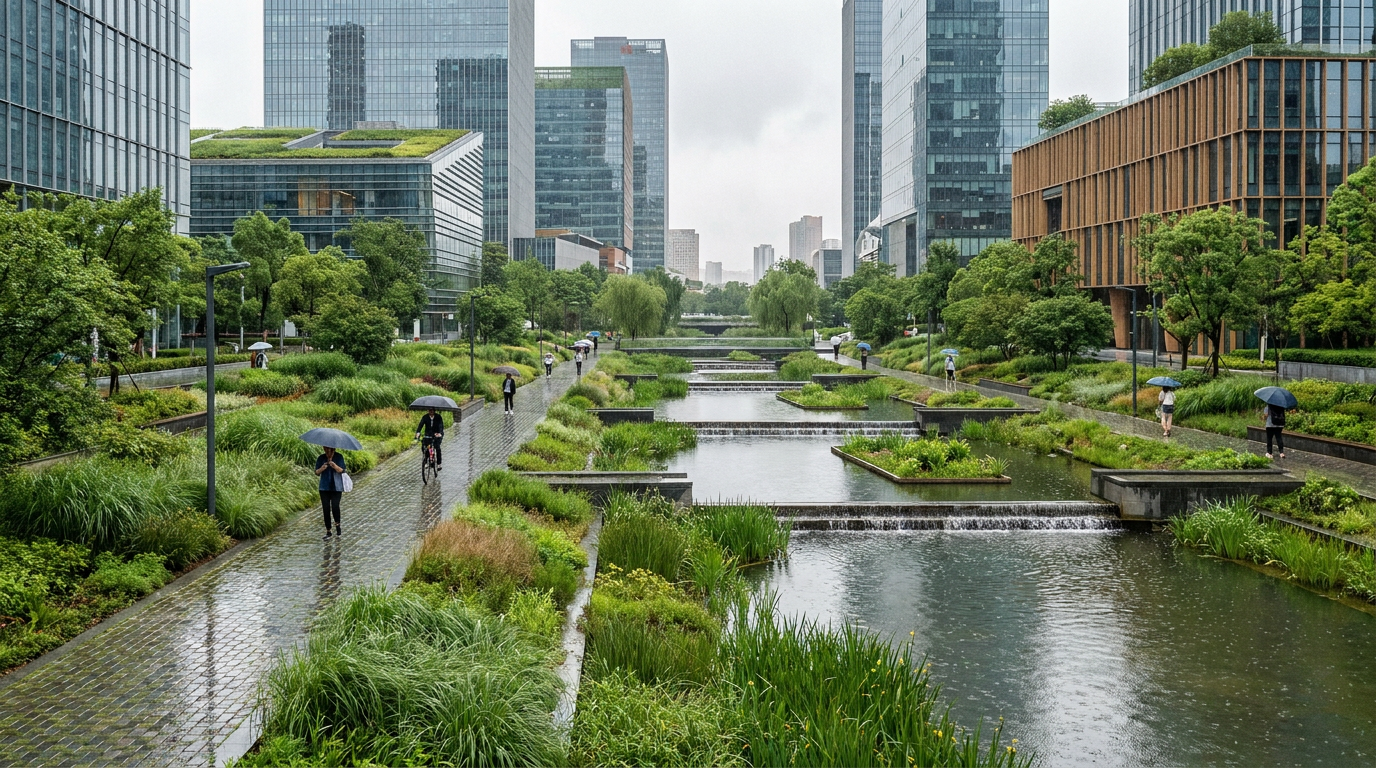
In response, a radical paradigm shift is sweeping global urban design: the "Sponge City." Rather than fighting water with higher walls and wider pipes, cities are being retrofitted to collaborate with nature. The objective is to transform urban landscapes into highly absorptive environments that soak up, store, and slowly release rainfall.[1][2][4][5][6]
The mechanics of a sponge city rely heavily on "green and blue infrastructure." Impermeable roads are replaced with permeable pavements that allow water to seep through into the soil below. Concrete plazas are redesigned as sunken rain gardens and bioswales—vegetated trenches that capture runoff and filter pollutants naturally. Roofs are covered in soil and plants to delay the flow of water to the streets.[1][2][3][4][5]

The concept was heavily popularized in 2013 by Chinese landscape architect Kongjian Yu. Observing the seasonal movement of natural waterways in rural China, Yu argued that the destruction of natural water systems was the primary driver of catastrophic urban flooding. By 2014, the sponge city model was adopted as a nationwide urban development policy in China.[1][4][6]
The scale of implementation in China has been unprecedented. The government designated dozens of pilot cities with a mandate to capture and utilize 80% of their rainwater by 2030. In northern China, the city of Harbin transformed 34 hectares of land into a massive stormwater park that collects and cleanses runoff while providing a thriving habitat for native biodiversity.[6][7]
Western cities have arrived at similar solutions, often spurred by disaster. In July 2011, Copenhagen was struck by a "once-in-a-millennium" cloudburst that dumped massive amounts of rain in just two hours, causing nearly $2 billion in damages. The catastrophe served as a costly wake-up call for the Danish capital.[1][5]
Western cities have arrived at similar solutions, often spurred by disaster.
Copenhagen responded with the "Skybrudsplan," or Cloudburst Management Plan. The city masterfully wove together green spaces, like parks designed to safely flood and hold water, with massive subterranean tunnels to redirect excess storm runoff. This hybrid approach acknowledges that while nature-based solutions are vital, extreme weather still requires engineered fail-safes.[1][5][8]

Beyond flood mitigation, the sponge city model addresses a secondary urban crisis: severe drought. Because traditional concrete cities repel water, they disrupt the natural hydrological cycle. Rainwater that should soak into the earth to replenish underground aquifers is instead flushed away, leaving cities highly vulnerable when dry seasons arrive.[2][4][6][8]
Mexico City serves as a stark example of this imbalance. In 2024, the city faced a severe drought that pushed key reservoirs to critical lows, prompting fears of a "Day Zero" water shutoff. Just one year later, in the summer of 2025, the city endured its rainiest month in decades, suffering massive floods. Sponge infrastructure breaks this cycle by capturing floodwater and allowing it to percolate down, recharging the groundwater supplies needed for times of drought.[2][8]
There is also a critical thermal benefit to these designs. The vast expanses of concrete and asphalt in traditional cities absorb solar radiation, creating an "urban heat island" effect that makes cities significantly hotter than surrounding rural areas. The vegetation in sponge cities provides shade and releases moisture through transpiration, offering natural evaporative cooling that lowers neighborhood temperatures and saves lives during heatwaves.[2][5][6]
The urgency of adoption is accelerating globally. In Vietnam, the coastal city of Da Nang is actively exploring sponge city models after historic floods in late 2025 inundated over 100,000 homes and caused $124 million in economic losses. Experts noted that Da Nang's rapid urban expansion and land filling had severely reduced its natural flood-retention capacity, necessitating a return to nature-based planning.[3]

Some cities are fortunate to possess natural "sponginess" without massive engineering. Auckland, New Zealand, frequently tops resilience indexes because its abundant parks, green spaces, and sandy soils naturally allow excess water to drain away quickly. For denser, highly paved metropolises, achieving this level of resilience requires deliberate, often expensive, retrofitting.[1][4]
Yet, the economics heavily favor the sponge city approach. Expanding traditional underground sewer networks to handle modern climate extremes is prohibitively expensive and endlessly disruptive. Investing in permeable pavements and vegetated corridors often costs less than expanding grey systems, while delivering immense co-benefits in public health, biodiversity, and property protection.[2][4]
Critics and municipal engineers caution that sponge cities are not a panacea. While they excel at managing moderate to heavy rainfall, they can still be overwhelmed by record-breaking, multi-day rainstorms. Comprehensive resilience requires a layered defense: green infrastructure to handle the majority of events, backed by robust emergency preparedness and targeted grey infrastructure for the extremes.[1][5][6][8]
Ultimately, the rise of the sponge city represents a profound philosophical shift in how humanity inhabits the earth. Instead of viewing nature as an adversary to be paved over and controlled, urban planners are recognizing that the only way to survive the climate realities of the 21st century is to invite nature back into the concrete jungle.[2][4][8]
How we got here
July 2011
A catastrophic cloudburst in Copenhagen causes $2 billion in damages, prompting the city's pioneering 'Skybrudsplan'.
2013-2014
Landscape architect Kongjian Yu popularizes the 'sponge city' concept, which is adopted as national policy in China.
October 2025
Historic floods in Da Nang, Vietnam, cause $124 million in losses, accelerating the city's shift toward sponge infrastructure.
June 2026
Global adoption accelerates as cities increasingly face the dual threats of severe drought and extreme rainfall.
Viewpoints in depth
Urban Planners & Architects
Advocates for integrating nature-based solutions into all new city developments.
This camp argues that the 20th-century model of 'grey infrastructure'—relying solely on concrete pipes and pumps to banish water—is fundamentally broken in an era of climate extremes. They push for mandatory green roofs, permeable pavements, and the unsealing of urban surfaces, viewing water as a resource to be captured locally rather than a nuisance to be expelled.
Municipal Engineers
Focuses on the practical limitations and the need for hybrid grey-green systems.
While supportive of nature-based solutions, municipal engineers caution that sponge infrastructure alone cannot absorb the volume of 'once-in-a-millennium' storms. They advocate for a hybrid approach, where green parks handle everyday heavy rainfall and aquifer recharge, but massive subterranean tunnels and high-capacity pumps remain in place as a fail-safe for catastrophic deluge.
Climate Adaptation Economists
Analyzes the cost-benefit ratio of retrofitting cities for resilience.
Economists highlight that the upfront costs of unsealing asphalt and building bioswales are dwarfed by the billions of dollars lost to flood damage and economic paralysis. They also point to the 'co-benefits'—such as reduced air conditioning costs due to mitigated urban heat islands and improved public health from expanded green spaces—as key factors that make sponge cities highly profitable investments.
What we don't know
- How existing megacities can affordably retrofit their densest, most heavily paved historic districts without massive disruption.
- Whether current sponge city designs can withstand the unprecedented, multi-day mega-storms predicted for the late 21st century.
- The long-term maintenance costs of widespread urban bioswales and permeable pavements compared to traditional concrete systems.
Key terms
- Grey Infrastructure
- Traditional engineered water management systems, such as concrete pipes, sewers, and dams, designed to move water away quickly.
- Green Infrastructure
- Nature-based solutions like parks, wetlands, and rain gardens that mimic natural processes to manage water.
- Permeable Pavement
- Paving materials that allow water to seep through the surface into the ground below, reducing runoff.
- Bioswale
- A vegetated, shallow landscape depression designed to capture, treat, and infiltrate stormwater runoff.
- Urban Heat Island
- A metropolitan area that is significantly warmer than its surrounding rural areas due to human activities and heat-absorbing concrete.
Frequently asked
Can sponge cities prevent all flooding?
No. While they significantly reduce the impact of moderate to heavy rainfall, unprecedented 'once-in-a-millennium' storms can still overwhelm natural absorption, requiring backup engineered systems.
How do sponge cities help with drought?
By allowing rainwater to seep into the ground rather than washing out to sea, sponge cities recharge local groundwater aquifers, storing water that can be extracted during dry periods.
Are sponge cities expensive to build?
While retrofitting existing cities requires upfront investment, green infrastructure is generally more cost-effective than continually expanding underground concrete sewer networks, especially when factoring in avoided flood damages.
Sources
Source coverage
8 outlets
3 viewpoints surfaced








[1]World Economic ForumHybrid Infrastructure Planners
How 'sponge cities' can help protect against flooding
Read on World Economic Forum →[2]Impact OneMunicipal Resilience Officials
Sponge Cities: Managing Floods, Heat, and Drought
Read on Impact One →[3]Vietnam News AgencyMunicipal Resilience Officials
Da Nang explores 'sponge city' model to tackle urban flooding
Read on Vietnam News Agency →[4]University of the Built EnvironmentNature-Based Design Advocates
What on earth are sponge cities?
Read on University of the Built Environment →[5]BAU MünchenHybrid Infrastructure Planners
Sponge city—a principle of sustainable urban development
Read on BAU München →[6]WikipediaNature-Based Design Advocates
Sponge city
Read on Wikipedia →[7]World Future CouncilNature-Based Design Advocates
Sponge Cities: What is it all about?
Read on World Future Council →[8]Factlen Editorial TeamHybrid Infrastructure Planners
Synthesis by Factlen editorial team
Read on Factlen Editorial Team →
Every angle. Every day.
Get environment stories with full source coverage and perspective breakdowns delivered to your inbox.