
The Rise of Biotech Beauty: How Lab-Grown Ingredients Are Reshaping Skincare
Precision fermentation and cell cultures are replacing traditional agriculture and animal extraction in the cosmetics industry. Lab-grown ingredients promise a future of highly effective, bio-identical skincare with a fraction of the environmental footprint.
By Factlen Editorial Team
- Biotech Innovators & Formulators
- Focus on the purity, consistency, and targeted efficacy of lab-grown molecules.
- Sustainable Beauty Advocates
- Focus on replacing resource-intensive animal and plant extraction with eco-friendly lab alternatives.
- Clinical Researchers
- Focus on the actual dermatological efficacy and safety of bio-identical compounds.
What's not represented
- · Traditional farmers of cosmetic botanicals
- · Regulatory bodies overseeing cosmetic safety
Why this matters
As the beauty industry reckons with its massive environmental footprint, biotechnology offers a rare win-win. Consumers get purer, more effective products, while the planet is spared the land and water depletion caused by traditional ingredient harvesting.
Key points
- Biotech beauty uses precision fermentation and cell cultures to grow skincare ingredients in laboratories.
- Lab-grown ingredients like squalane and hyaluronic acid are molecularly identical to natural compounds.
- This approach drastically reduces the land, water, and carbon footprint associated with traditional botanical extraction.
- Startups are now successfully producing human-identical collagen, offering a vegan alternative to animal-derived proteins.
- The global biotech ingredients market is projected to reach $95.2 billion by 2034.
For decades, the beauty industry has relied on a simple premise: the best ingredients are harvested from nature. But extracting active compounds from plants and animals requires massive amounts of land, water, and energy, often leading to over-harvesting and deforestation. Now, a quiet revolution is decoupling skincare from agriculture. Welcome to the era of "biotech beauty," where the most potent serums and creams are not farmed, but brewed in laboratories.[1][8]
At the heart of this shift is precision fermentation, a process that borrows heavily from the food and medical industries. Scientists genetically program microorganisms—such as yeast, bacteria, or microalgae—to produce specific complex molecules. By feeding these microbes sugars in a controlled bioreactor, they act as microscopic factories, churning out highly purified skincare actives. The result is a bio-identical ingredient that the human body recognizes, created without ever touching a field or an animal.[1][6][7]
The environmental calculus driving this transition is stark. Traditional botanical extraction is notoriously inefficient; it can take acres of petals or tons of roots to yield a single liter of essential oil or active extract. Biotech production, by contrast, drastically reduces the land and water footprint required to generate the same volume of product. It offers a way to satisfy the surging global demand for natural cosmetics without depleting fragile ecosystems or relying on petrochemical derivatives.[1][6][8]
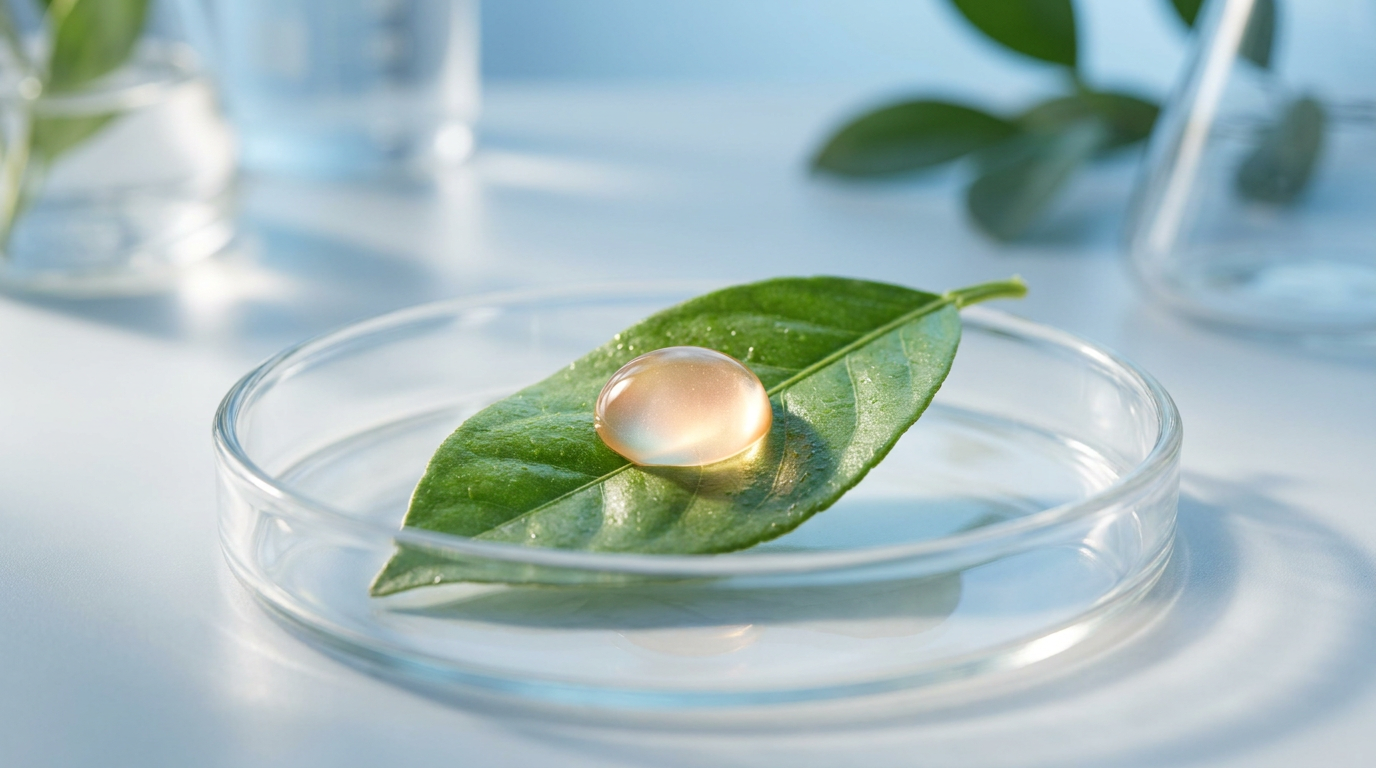
Squalane offers the clearest case study of this evolution. Historically, this highly prized moisturizing lipid was extracted from the livers of deep-sea sharks, a practice that devastated marine populations. The industry later pivoted to plant-based squalane derived from olives, but this required vast agricultural resources and suffered from crop variability. Today, leading biotech firms use genetically modified yeast to ferment sugarcane into pure, stable squalane, ensuring a sustainable and cruelty-free supply that is molecularly identical to the skin's natural lipids.[1][6]

Beyond sustainability, lab-grown ingredients solve one of the cosmetic industry's most persistent headaches: batch consistency. Natural extracts are at the mercy of the weather, soil quality, and harvest timing, meaning a serum bought in June might have a slightly different chemical profile than one bought in December. Biotech ingredients are cultivated in sterile, highly controlled environments, guaranteeing that every batch delivers the exact same potency and purity, free from heavy metals, pesticides, or allergens.[1][6][8]
This precision allows formulators to create highly targeted molecules that were previously impossible to source at scale. Hyaluronic acid, a staple for skin hydration, was once extracted from rooster combs; today, it is almost entirely produced via microbial fermentation. Similarly, bio-fermented peptides—short chains of amino acids that signal skin cells to build collagen—can be custom-designed to penetrate the skin barrier more effectively than their naturally occurring counterparts.[6][7]
This precision allows formulators to create highly targeted molecules that were previously impossible to source at scale.
The holy grail of biotech skincare, however, is lab-grown collagen. Collagen is a complex structural protein that gives skin its firmness, but it has historically been sourced from bovine hides or fish scales. Because these animal collagens have large molecular weights, they often sit on the surface of the skin rather than penetrating deeply. Furthermore, the extraction process raises ethical and environmental concerns for a growing demographic of eco-conscious and vegan consumers.[2][3][4]
Startups and established biotech firms are now successfully growing human-identical collagen in the lab. By inserting the specific genetic sequence for human collagen into a microbial host, scientists can cultivate a protein that is functionally and structurally identical to the collagen found in our own tissues. Early clinical trials suggest that these bioengineered micro-collagen peptides inhibit the enzymes that break down the skin's extracellular matrix, promoting better fibroblast adhesion and cellular repair.[2][4]
The economic momentum behind these innovations is massive. The global biotech ingredients market, which spans cosmetics, food, and pharmaceuticals, was valued at $64.8 billion in 2025 and is projected to reach $95.2 billion by 2034. The personal care and cosmetics sector accounts for nearly 39% of this market, driven by consumer demand for products that bridge the gap between clinical efficacy and environmental responsibility.[5]

Yet, the transition to lab-grown beauty is not without its uncertainties and edge cases. The research and development required to sequence, program, and scale a new biotech ingredient is astronomically expensive. This high barrier to entry means that many proprietary bio-actives are locked behind patents, keeping the cost of biotech skincare premium and limiting accessibility for the average consumer.[8]
There is also a nuanced debate regarding the true environmental impact of biotechnology. While it undeniably saves land and water, running industrial bioreactors requires significant amounts of electricity. Unless these facilities are powered entirely by renewable energy, the carbon footprint of large-scale fermentation could offset some of the ecological benefits gained by abandoning traditional agriculture.[6][8]

Furthermore, the regulatory landscape is still catching up to the science. As companies develop lab-grown human-identical proteins and genetically modified microbiome actives, regulatory bodies must determine how to classify and vet these novel compounds. Ensuring long-term safety and preventing unintended immune responses will require rigorous, decades-long clinical monitoring.[3][4]
The rise of biotech beauty also challenges the ideology of the "clean beauty" movement. For years, consumers have been conditioned to equate "chemical" or "lab-made" with "toxic," favoring products with ingredient lists that read like a farmer's market receipt. Biotech brands face the uphill battle of re-educating the public that a synthetic, lab-grown molecule can actually be safer, purer, and more sustainable than a raw, unadulterated plant extract.[1][6]

Ultimately, the shift toward cellular and molecular beauty represents a profound maturation of the skincare industry. By merging the wisdom of natural biology with the precision of modern engineering, biotech skincare is proving that we no longer have to choose between high-performance results and ethical consumption. The future of beauty, it seems, will not be harvested from the earth, but intelligently designed in a petri dish.[1][8]
How we got here
Early 2000s
Hyaluronic acid production shifts from animal extraction to microbial fermentation.
2012
Startups begin exploring precision fermentation to create vegan, lab-grown collagen.
2018
First major breakthroughs in producing human-identical collagen without animal products.
2024-2026
Biotech ingredients become mainstream in consumer skincare, driving a multi-billion dollar market.
Viewpoints in depth
Biotech Innovators & Formulators
Scientists and cosmetic chemists focused on the purity, consistency, and targeted efficacy of lab-grown molecules.
For cosmetic chemists, biotechnology solves the historical unreliability of natural ingredients. Botanical extracts are subject to seasonal variations, soil depletion, and contamination, making it difficult to guarantee a product's performance from batch to batch. By moving production to sterile bioreactors, formulators can isolate the exact molecule needed—such as a specific peptide or human-identical collagen—ensuring absolute purity. This camp argues that bio-identical ingredients are not just a sustainable alternative, but a clinical upgrade that allows for deeper skin penetration and fewer allergic reactions.
Sustainable Beauty Advocates
Environmentalists and consumers who view biotechnology as the only way to decouple the beauty industry from destructive agriculture.
This perspective emphasizes the ecological math of the beauty industry. Traditional harvesting requires massive tracts of land, billions of gallons of water, and often relies on petrochemical derivatives or animal exploitation (such as shark-derived squalane). Sustainable advocates champion precision fermentation because it drastically shrinks the industry's footprint. However, they also caution that biotech is not a perfect silver bullet; the energy required to run industrial bioreactors must eventually transition to 100% renewable sources to truly achieve a zero-impact supply chain.
Clinical Researchers
Dermatologists and researchers focused on the verifiable biological impact of lab-grown ingredients on human skin.
While the sustainability claims of biotech beauty are well-documented, clinical researchers are primarily concerned with efficacy. Their focus is on how bio-identical molecules, such as lab-grown human collagen, actually interact with the skin's extracellular matrix. This camp conducts the rigorous, long-term studies needed to prove that fermented peptides and bio-engineered actives can successfully inhibit matrix-degrading enzymes and stimulate fibroblast production. They maintain a cautious optimism, emphasizing that while early in-vitro results are highly promising, extensive human trials are required to fully map the long-term benefits and optimal dosages of these novel compounds.
What we don't know
- The long-term environmental impact of the energy required to run industrial-scale bioreactors.
- Whether the high R&D costs of biotech ingredients will eventually drop enough to make them accessible in drugstore skincare.
- How regulatory bodies will classify and standardize novel, lab-grown human-identical proteins in the coming years.
Key terms
- Precision Fermentation
- A process that uses genetically programmed microorganisms to produce specific complex molecules, like skincare actives.
- Bio-identical
- A lab-grown molecule that is structurally and functionally exactly the same as one found in nature or the human body.
- Bioreactor
- A controlled, sterile vessel where microorganisms are cultivated to produce biotech ingredients.
- Extracellular Matrix
- The biological scaffolding in the skin, primarily made of collagen and elastin, that provides structural support.
- Fibroblasts
- Cells within the skin's dermal layer responsible for generating connective tissue and collagen.
Frequently asked
Are lab-grown skincare ingredients safe?
Yes. Because they are produced in sterile, controlled environments, they are often purer than natural extracts and free from pesticides, heavy metals, and allergens.
Is biotech skincare vegan?
Almost always. Precision fermentation uses microorganisms like yeast or bacteria instead of animal derivatives, making ingredients like lab-grown collagen entirely vegan.
Why is biotech beauty considered more sustainable?
It drastically reduces the land, water, and agricultural resources needed to produce ingredients, preventing over-harvesting and deforestation.
Sources
Source coverage
8 outlets
3 viewpoints surfaced





[1]Marie Claire UKSustainable Beauty Advocates
Biotech Ingredients: The Next Big Thing In Skincare & Beauty
Read on Marie Claire UK →[2]FoodBev MediaSustainable Beauty Advocates
Interview: Lab-grown collagen is more than skin deep
Read on FoodBev Media →[3]FuturismSustainable Beauty Advocates
Lab-Grown Collagen Is Vegan and Eco-Friendly — and Identical to the Real Stuff
Read on Futurism →[4]News-MedicalClinical Researchers
Can collagen supplements really improve your skin?
Read on News-Medical →[5]IMARC GroupBiotech Innovators & Formulators
Biotech Ingredients Market Size, Trends and Forecast 2034
Read on IMARC Group →[6]CultiplyBiotech Innovators & Formulators
Biotechnology in cosmetics: key benefits & trends
Read on Cultiply →[7]Alfa ChemistryBiotech Innovators & Formulators
Active Ingredients from Biotechnology in Cosmetics
Read on Alfa Chemistry →[8]SeppicBiotech Innovators & Formulators
Biotechnology in cosmetics: ingredients, benefits and challenges
Read on Seppic →
Every angle. Every day.
Get lifestyle stories with full source coverage and perspective breakdowns delivered to your inbox.