
The Quiet Resurgence of Classical Education in American Schools
A 2,500-year-old pedagogical model focused on the Western canon, moral virtue, and screen-free learning is rapidly expanding across U.S. charter and private schools.
By Factlen Editorial Team
- Classical Proponents
- View the model as a return to academic rigor, moral virtue, and the foundations of Western thought.
- Pragmatic Families
- Choose the model for its structured environment, screen-free classrooms, and strong academic outcomes.
- Public Education Watchdogs
- Argue the movement is Eurocentric and serves as a vehicle for conservative cultural agendas.
- Neutral Analysts
- Observe the trend as a significant market shift driven by parental demand for alternative pedagogical models.
What's not represented
- · Secular progressive educators
- · Non-Western history scholars
Why this matters
As millions of families rethink their approach to K-12 schooling, the classical education movement is reshaping local school boards, charter networks, and even college admissions testing. Understanding this model provides crucial insight into the future of American educational philosophy and the growing demand for rigorous, screen-free classrooms.
Key points
- Classical education enrollment in the U.S. has surged, surpassing 677,000 students, with projections reaching 1.4 million by 2035.
- The model relies on the "Trivium," a three-stage approach focusing on grammar, logic, and rhetoric.
- Classrooms emphasize the "Great Books" of Western civilization, cursive handwriting, and face-to-face debate while strictly limiting screen time.
- The movement is heavily championed by conservative organizations, though proponents argue the curriculum is universally beneficial and pre-political.
- Critics express concern that the classical approach is overly Eurocentric and serves as a vehicle for right-wing cultural agendas in public charter schools.
The K-12 education landscape in the United States is experiencing a quiet but profound shift. Amid ongoing debates over curriculum standards and screen time, a 2,500-year-old pedagogical model is surging in popularity. Classical education—an approach rooted in the traditions of ancient Greece and Rome—is drawing families away from conventional public districts and toward a curriculum centered on historical texts, moral virtue, and rigorous debate.
The numbers reflect a movement transitioning from a niche alternative to a major educational force. Across charter schools, private academies, and homeschooling networks, enrollment in classical education topped 677,000 students during the 2023–2024 academic year. Industry projections suggest this figure could double to 1.4 million students by 2035, representing a multi-billion dollar sector that is rapidly reshaping how communities approach learning.[1]
At its core, classical education rejects the modern, utilitarian approach to schooling. Instead of focusing primarily on standardized testing, workforce preparation, or personalized digital learning, the model aims to cultivate character and civic responsibility. The philosophy operates on the premise that education should not merely transfer information, but should actively form a student's moral compass and capacity for reasoned judgment.[8]
This philosophy is executed through a structured, three-stage developmental model known as the Trivium. The first phase, the Grammar stage, encompasses roughly kindergarten through sixth grade. During these years, the focus is on absorbing foundational knowledge. Young students memorize facts, master the rules of phonics, and study the basic building blocks of language, mathematics, and history.[1][5]

As students enter middle school, they transition into the Logic stage. Here, the pedagogical focus shifts from memorization to analytical thinking. Recognizing that adolescents naturally begin to question authority and seek independence, the curriculum channels this energy into formal logic. Students are taught to interrogate premises, construct valid arguments, and understand the complex relationships between the historical facts they memorized in their earlier years.[1][5]
Finally, high school students enter the Rhetoric stage. The emphasis moves toward persuasive expression and the synthesis of ideas. Through the rigorous application of the Socratic method, students engage in deep, guided dialogue. They learn to articulate complex arguments clearly, defend their positions using concrete evidence, and communicate with eloquence and precision.[1][5]
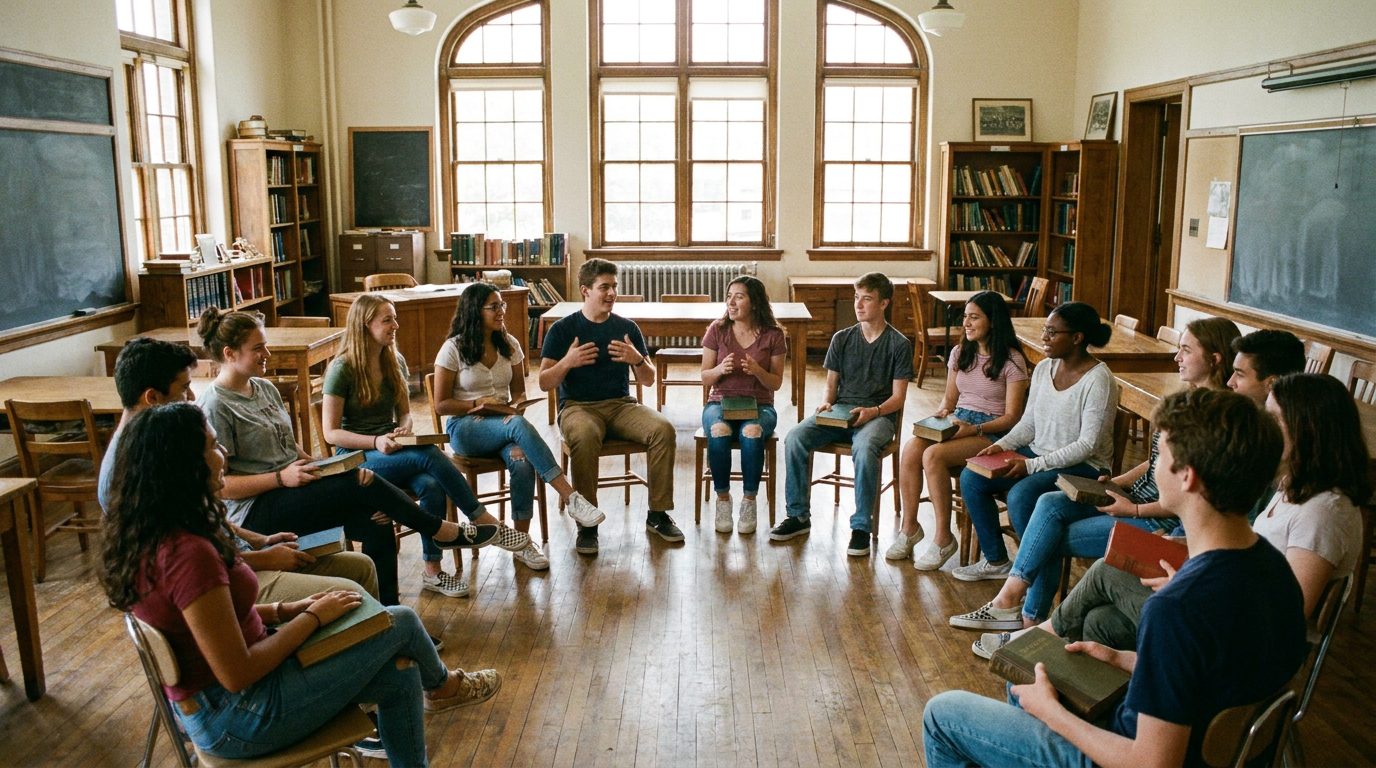
The content of a classical classroom looks starkly different from a typical modern school environment. Textbooks are frequently replaced by primary source documents and the "Great Books" of the Western canon. Students read Homer, Plato, and Shakespeare, alongside foundational American texts like the Federalist Papers and the U.S. Constitution, engaging directly with the authors who shaped Western civilization.[2][3]
The content of a classical classroom looks starkly different from a typical modern school environment.
Technology is intentionally minimized to foster deep focus and a sense of reverence for the material. Screens, tablets, and digital whiteboards are often absent. Instead, students read physical books, write in cursive, and participate in face-to-face debates. The physical environment frequently reflects this traditionalism, with classrooms featuring portraits of historical figures rather than digital displays.[2]

For many parents, the appeal lies in this back-to-basics rigor. Following the disruptions of the pandemic, a growing cohort of families expressed frustration with relaxed grading policies, screen-heavy instruction, and shifting pedagogical fads. They are increasingly seeking out schools that offer a stable, demanding curriculum and a clear framework for behavioral expectations and character development.[2][3]
The movement has found particularly strong resonance among conservative families and policymakers. Proponents argue that classical education inherently celebrates American ideals, Western civilization, and objective truths—values they feel are increasingly marginalized or critiqued in mainstream public education. For these advocates, preserving "the best that has been thought and said" is a vital cultural imperative.[2][3]
Institutions like Hillsdale College have become powerful engines for this nationwide growth. Through its Barney Charter School Initiative, the Michigan-based liberal arts college provides comprehensive K–12 classical curricula and specialized teacher training to dozens of affiliated charter schools across the country, entirely free of charge, provided the schools adhere to specific pedagogical standards.[7]
State-level policy is also accelerating the trend, particularly in the Sun Belt. In states like Florida and Texas, classical charter schools are expanding at a breakneck pace. Texas alone witnessed a sevenfold increase in classical charter school enrollment over the last decade, significantly outpacing the growth of the broader charter school sector in the state.[6]

The movement's influence has even extended into the realm of college admissions, spawning its own standardized testing ecosystem. The Classic Learning Test (CLT) has emerged as a viable alternative to the SAT and ACT. The exam, which heavily features passages from classical literature and historical texts, is now accepted by hundreds of colleges and was recently approved for use by the entire Florida state university system.[3]
However, this rapid expansion has not been without controversy. Critics argue that the classical model's heavy emphasis on the Western canon can be overly Eurocentric, potentially sidelining the histories, literature, and voices of non-Western cultures and minority groups in an increasingly diverse nation.[2]
Furthermore, some public education advocacy groups have raised concerns that classical charter schools are serving as a vehicle for conservative ideology. They point to the involvement of right-leaning politicians and think tanks in the sector's expansion, arguing that the schools are using taxpayer dollars to advance a specific cultural and political agenda under the guise of traditional education.[4]
Advocates push back strongly against these political labels, arguing that the study of history, logic, and philosophy is inherently pre-political and universally beneficial. They note that classical charter schools in urban centers often serve highly diverse, majority-minority student populations, providing them with a rigorous academic foundation that consistently yields exceptional test scores and college readiness metrics.[5]
Regardless of the ongoing debates surrounding its curriculum, the classical education movement shows no signs of slowing its momentum. As families continue to seek out educational alternatives that prioritize character formation, deep literacy, and academic rigor, this ancient approach to learning is firmly cementing its place as a major, transformative pillar of the modern American educational landscape.[1][8]
How we got here
2010
Hillsdale College launches the Barney Charter School Initiative to provide classical curricula to public charter schools nationwide.
2015
The Classic Learning Test (CLT) is introduced as an alternative standardized college entrance exam rooted in the classical tradition.
2020–2021
The COVID-19 pandemic accelerates parental interest in alternative education models, sparking a surge in classical school enrollment.
2023
The Florida university system officially approves the Classic Learning Test for college admissions, placing it on par with the SAT and ACT.
2024
Enrollment in classical education models surpasses 677,000 students across the United States.
Viewpoints in depth
Classical Education Proponents
Advocates who view the model as a necessary return to academic rigor, moral virtue, and the foundations of Western thought.
This camp, which includes organizations like the Heritage Foundation and Hillsdale College, argues that modern education has lost its way by focusing too heavily on utilitarian skills and progressive pedagogical fads. They believe that immersing students in the 'Great Books' and the Trivium equips them with unparalleled critical thinking skills and a strong moral compass. For these advocates, classical education is not about partisan politics, but about preserving the intellectual inheritance of Western civilization and forming capable, virtuous citizens.
Pragmatic Families
Parents choosing the model primarily for its academic outcomes, structured environment, and screen-free classrooms.
Many families flocking to classical charter schools are driven less by ideology and more by practical concerns. Frustrated by relaxed grading standards, behavioral issues, and the pervasive use of tablets in traditional public schools, these parents seek a back-to-basics approach. They value the emphasis on phonics, cursive writing, and direct teacher-led instruction, viewing the classical model as a reliable pathway to college readiness and strong personal discipline.
Public Education Watchdogs
Critics who argue the movement promotes a Eurocentric worldview and serves as a vehicle for conservative ideology.
Organizations like the Network for Public Education express deep concern over the rapid proliferation of classical charter schools. They argue that the curriculum's heavy focus on the Western canon inherently marginalizes the histories and contributions of non-Western cultures. Furthermore, they point to the strong backing of the movement by conservative politicians and think tanks, warning that these publicly funded charter schools are being used to advance a specific right-wing cultural agenda under the banner of traditional learning.
What we don't know
- Whether the rapid expansion of classical charter schools will face increased regulatory pushback in blue states.
- How colleges outside of conservative or state-mandated systems will weigh the Classic Learning Test (CLT) in the long term.
- If the classical model can maintain its rigorous, screen-free standards as it scales to serve over a million students.
Key terms
- Trivium
- A foundational three-part educational model comprising grammar, logic, and rhetoric, designed to align with a student's cognitive development.
- Socratic Method
- A form of cooperative argumentative dialogue where teachers ask probing questions to stimulate critical thinking and draw out underlying presumptions.
- Western Canon
- The body of high-culture literature, music, philosophy, and works of art that have historically shaped Western civilization.
- Classic Learning Test (CLT)
- A standardized college admissions test that emphasizes classical texts and logic, serving as an alternative to the SAT and ACT.
Frequently asked
What is the Trivium in classical education?
The Trivium is a three-stage teaching model tailored to child development. It consists of the Grammar stage (memorizing foundational facts), the Logic stage (analytical thinking and argumentation), and the Rhetoric stage (persuasive expression and synthesis).
Are all classical schools religious?
No. While many classical schools are private Christian academies, there is a rapidly growing sector of secular, publicly funded classical charter schools that focus on the Western canon and civic virtue without religious instruction.
What is the Classic Learning Test (CLT)?
The CLT is a standardized college entrance exam designed as an alternative to the SAT and ACT. It tests reading, grammar, and mathematics using passages drawn heavily from classical literature and historical texts.
Why do classical schools restrict technology?
Classical educators believe that heavy screen use distracts from deep learning and interpersonal engagement. They prioritize physical books, cursive handwriting, and face-to-face Socratic dialogue to foster focus and critical thinking.
Sources
Source coverage
8 outlets
4 viewpoints surfaced







[1]ForbesNeutral Analysts
The Business Case For Classical Christian Education Market Growth
Read on Forbes →[2]The Washington PostPragmatic Families
Classical schools focus on Western content and American ideals
Read on The Washington Post →[3]Heritage FoundationClassical Proponents
Classical Education: The Best That Has Been Thought and Said
Read on Heritage Foundation →[4]Network for Public EducationPublic Education Watchdogs
A Sharp Turn Right: A New Breed of Charter Schools Delivers the Conservative Agenda
Read on Network for Public Education →[5]Manhattan InstituteClassical Proponents
Classical Education: An Alternative to the District Public School
Read on Manhattan Institute →[6]Texas Public Policy FoundationClassical Proponents
The Demand of Texas Parents for Classical Charter Schools
Read on Texas Public Policy Foundation →[7]Hillsdale CollegeClassical Proponents
Barney Charter School Initiative
Read on Hillsdale College →[8]Factlen Editorial TeamNeutral Analysts
Synthesis by Factlen editorial team
Read on Factlen Editorial Team →
Every angle. Every day.
Get perspectives stories with full source coverage and perspective breakdowns delivered to your inbox.