
The Physics of Solar Sails: How Sunlight is Propelling the Next Generation of Spacecraft
NASA and other space agencies are bypassing the limitations of chemical rockets by deploying massive, mirror-like sails that harness the momentum of light itself.
By Factlen Editorial Team
- Propulsion Physicists
- Focus on the theoretical limits of radiation pressure and the long-term potential for continuous acceleration to enable interstellar travel.
- Mission Engineers
- Prioritize solving the immediate materials-science bottlenecks, such as thermal distortion and the reliable deployment of composite booms.
- Citizen Space Advocates
- Emphasize how propellantless propulsion lowers the cost of deep-space missions, democratizing access for universities and non-profits.
What's not represented
- · Commercial Satellite Operators
- · Space Debris Trackers
Why this matters
By eliminating the need for heavy chemical fuels, solar sails dramatically lower the cost of deep-space exploration. This technology paves the way for early-warning space weather satellites and, eventually, the first human probes capable of reaching neighboring star systems.
Key points
- Solar sails harness the momentum of photons to provide continuous, propellantless acceleration in the vacuum of space.
- Unlike chemical rockets, solar sails never run out of fuel, allowing them to reach unprecedented terminal velocities over long durations.
- NASA's ACS3 mission recently demonstrated a new carbon-fiber boom architecture that is 75% lighter and highly resistant to thermal distortion.
- By eliminating the need for heavy onboard propellants, solar sailing drastically lowers the cost of deep-space exploration for smaller organizations.
- Future iterations of the technology could be pushed by Earth-based lasers, potentially enabling the first human probes to reach neighboring star systems.
For more than half a century, humanity’s reach into the cosmos has been strictly dictated by the tyranny of the rocket equation. To go faster or farther, a spacecraft must carry more chemical propellant, which in turn makes the spacecraft heavier, requiring even more fuel just to lift the added weight. This compounding mathematical trap has kept our fastest probes confined to a crawl relative to the vast distances of interstellar space. But a quiet revolution is unfolding in low Earth orbit and beyond, fundamentally altering how we navigate the void. Instead of riding atop controlled explosions of heavy chemicals, a new generation of spacecraft is learning to sail on light itself. By harnessing the subtle, continuous push of solar radiation, engineers are proving that propellantless propulsion is not just a theoretical curiosity, but a viable architecture for the future of deep-space exploration.[4][5]
The mechanism driving this paradigm shift is known as solar radiation pressure. While it is a fundamental fact of quantum mechanics that photons—the basic particles of light—possess no mass, they do carry momentum. When a photon strikes a highly reflective surface and bounces off, it transfers a minuscule fraction of that momentum to the surface. On Earth, this force is entirely imperceptible, washed out by gravity, atmospheric friction, and the sheer mass of everyday objects. But in the frictionless vacuum of space, this continuous microscopic push accumulates. If a spacecraft can deploy a large enough mirror-like membrane, the relentless bombardment of sunlight will slowly but steadily accelerate the vehicle.[4][5]
Unlike a conventional chemical rocket, which burns through its entire fuel supply in a matter of minutes to provide a single, violent burst of acceleration, a solar sail accelerates continuously for as long as the light shines upon it. In the first few days of a mission, a solar sail might be outpaced by almost any conventional thruster. However, because the sail never runs out of fuel, its velocity compounds month after month, year after year. Over a long enough timeline, a spacecraft propelled by light can achieve terminal velocities that dwarf those of the most powerful chemical rockets ever built, opening up the possibility of reaching the outer planets—or even neighboring star systems—in a fraction of the time currently required.[4][5]

The concept of sailing on sunlight is remarkably old, first proposed by the astronomer Johannes Kepler in 1608 after he observed that comet tails always point away from the sun, correctly deducing that solar rays were exerting a physical force. Yet it took exactly four centuries to translate that observation into a functional spacecraft. In 2010, the Japan Aerospace Exploration Agency (JAXA) achieved a historic milestone with the launch of IKAROS, the world’s first successful interplanetary solar sail. Deployed alongside a Venus-bound probe, IKAROS unfurled a 200-square-meter membrane using the centrifugal force of its own rotation. It successfully demonstrated that a spacecraft could not only accelerate using photon pressure but also steer itself by dynamically altering the reflectivity of liquid crystal panels embedded in the sail's edges.[3][5]
Following the success of IKAROS, the focus shifted toward miniaturization and democratization. In 2019, The Planetary Society, a non-profit space advocacy group, launched LightSail 2. Funded entirely by citizen donations, this mission proved that solar sailing was viable for CubeSats—small, standardized, and inexpensive satellites that have revolutionized access to space. Packed into a chassis roughly the size of a loaf of bread, LightSail 2 deployed a 32-square-meter aluminized Mylar sail in low Earth orbit. By precisely tilting its sail toward and away from the sun during different phases of its orbit, the spacecraft successfully raised its orbital apogee using sunlight alone, validating a low-cost propulsion method that could allow universities and small organizations to send probes beyond Earth's immediate vicinity.[2][6]

Following the success of IKAROS, the focus shifted toward miniaturization and democratization.
Despite these triumphs, scaling up solar sails for heavy payloads or deep-space missions has presented a severe materials-science bottleneck. The challenge lies not in the sail material itself, which can be manufactured to be thinner than a human hair, but in the structural booms required to hold the sail taut. Historically, these booms were made of metallic alloys that, while strong, were relatively heavy and highly susceptible to thermal distortion. In the harsh environment of space, where temperatures can swing wildly depending on whether a component is bathed in sunlight or cast in shadow, metallic booms tend to warp and bend. If the booms warp, the sail loses its flat, mirror-like shape, drastically reducing its aerodynamic efficiency and making the spacecraft nearly impossible to steer.[1][5]
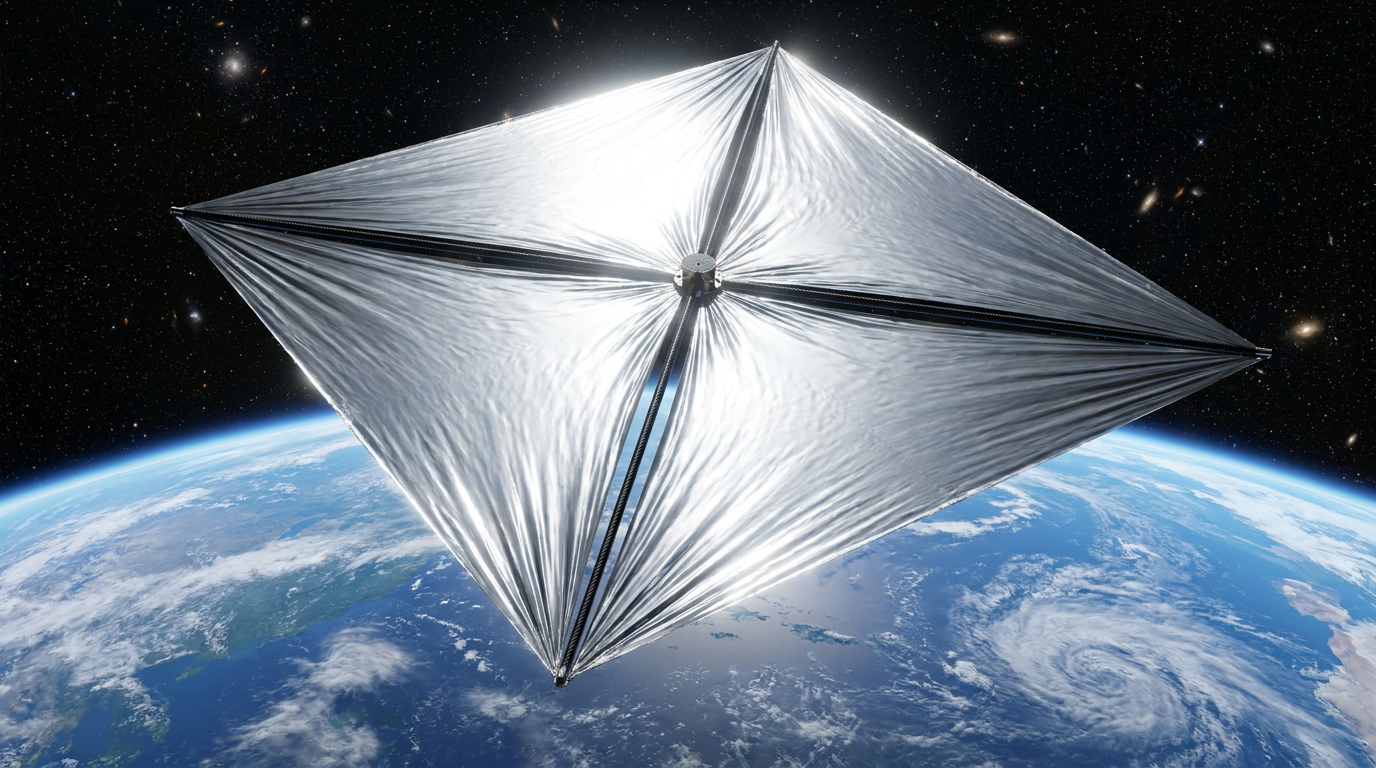
To solve this structural crisis, NASA recently launched the Advanced Composite Solar Sail System (ACS3), a technology demonstration mission designed to test a radical new approach to sail architecture. Deployed into orbit in mid-2024, ACS3 is built around a novel boom system constructed from flexible polymers and carbon fiber. These composite booms are designed to be flattened and rolled up like a tape measure around a central spindle for launch, taking up minimal volume inside the spacecraft's toaster-sized chassis. Once in orbit, the spindle unspools, and the booms snap into a rigid, tubular shape, pulling the four triangular quadrants of the sail outward to form a massive, taut diamond.[1][7]
The engineering metrics of the ACS3 composite booms represent a generational leap over previous designs. Weighing just 900 grams for a seven-meter length, the carbon fiber structures are 75 percent lighter than their metallic predecessors. More importantly, they are engineered to be 100 times less susceptible to in-space thermal distortion. This thermal stability ensures that the 80-square-meter sail—roughly half the size of a tennis court—remains perfectly flat regardless of the extreme temperature gradients it encounters. By proving that lightweight, warp-resistant composites can reliably deploy and maintain a large surface area, NASA is clearing the primary technical hurdle that has previously prevented the construction of truly massive solar sails.[1][5]

The success of the ACS3 architecture is not an endpoint, but a foundational stepping stone for a dramatic scaling up of the technology. Mission planners at NASA and other space agencies are already using the data gathered from the composite booms to design follow-on missions featuring sails as large as 2,000 square meters. At that scale, a solar sail could generate enough continuous thrust to power early-warning space weather satellites, allowing them to maintain artificial orbits closer to the sun than gravity alone would permit. These "station-keeping" missions could provide Earth with crucial extra minutes or hours of warning before devastating solar flares or coronal mass ejections strike our planet's electrical grids.[1][5]
Looking further ahead, the implications of advanced solar sailing extend to the very edges of our solar system and beyond. Because the thrust generated by solar radiation pressure decreases with the square of the distance from the sun, a sailcraft exploring the outer planets would eventually lose its primary source of acceleration. However, propulsion physicists have proposed a bold solution: decoupling the light source from the spacecraft entirely. By building massive arrays of high-powered lasers on Earth or the moon, engineers could beam a concentrated, artificial "sunlight" directly at a departing solar sail. This directed-energy approach could theoretically accelerate a lightweight probe to a significant fraction of the speed of light, shrinking the travel time to the nearest star system, Alpha Centauri, from tens of thousands of years to just a few decades.[4][5]

Naturally, the transition from Earth-orbit demonstrations to interstellar laser-sailing remains fraught with immense technical challenges. A laser powerful enough to push a spacecraft across light-years would require gigawatts of energy and unprecedented targeting precision to keep the beam focused on a sail millions of miles away. Furthermore, the sail material itself would need to be nearly perfectly reflective; absorbing even a tiny fraction of a gigawatt laser beam would instantly vaporize the spacecraft. Researchers are currently exploring advanced metamaterials and photonic crystals that can reflect specific wavelengths of light with extreme efficiency, but manufacturing these materials at the scale of a large sail remains a distant goal.[4][5]
Despite the hurdles that lie ahead, the successful deployments of IKAROS, LightSail 2, and ACS3 have definitively moved propellantless propulsion from the realm of science fiction into the domain of applied engineering. By learning to harness the momentum of photons, we are fundamentally changing the economics and the physics of spaceflight. The rocket equation, which has constrained human ambition for over a century, is finally being bypassed by a technology that relies on the most abundant resource in the universe. As these shimmering, mirror-like kites continue to unfurl in the dark, they carry with them the promise of a new era of exploration—one where humanity no longer just launches into the void, but truly sails across it.[1][2][3][4][5]
How we got here
1608
Astronomer Johannes Kepler observes comet tails pointing away from the sun and first proposes the concept of sailing on solar rays.
May 2010
JAXA launches IKAROS, the world's first spacecraft to successfully demonstrate solar sail propulsion in interplanetary space.
June 2019
The Planetary Society launches LightSail 2, proving that crowdfunded CubeSats can use solar sailing to alter their orbits.
April 2024
NASA launches the Advanced Composite Solar Sail System (ACS3) to test lightweight, warp-resistant carbon fiber booms.
August 2024
ACS3 successfully deploys its 80-square-meter sail in low Earth orbit, validating the new composite boom architecture.
Viewpoints in depth
Propulsion Physicists
Focus on the theoretical limits of radiation pressure and the long-term potential for continuous acceleration.
For theoretical physicists, the true value of solar sailing lies in its ability to bypass the Tsiolkovsky rocket equation. Because chemical rockets must carry their own heavy propellant, there is a hard mathematical limit to how fast they can go. Physicists argue that radiation pressure, while incredibly weak in the short term, offers the only currently viable mechanism for continuous acceleration. By decoupling the energy source from the spacecraft—either by relying on the sun or by building massive laser arrays to push the sails—they believe humanity can eventually achieve the relativistic speeds necessary to reach neighboring star systems within a human lifetime.
Mission Engineers
Prioritize solving the immediate materials-science bottlenecks, such as thermal distortion and boom deployment.
Aerospace engineers view the grand visions of interstellar travel through the pragmatic lens of materials science. Their primary concern is the structural integrity of the sail and its deployment mechanisms. In the vacuum of space, temperature differentials can cause traditional metallic booms to warp, which ruins the sail's aerodynamic profile and makes navigation impossible. Engineers argue that the immediate future of solar sailing depends entirely on the success of advanced composites—like the flexible carbon-fiber polymers tested on the ACS3 mission—that can withstand extreme thermal stress while remaining light enough to be packed into a CubeSat.
Citizen Space Advocates
Emphasize how propellantless propulsion lowers the cost of deep-space missions, democratizing access.
For non-profit organizations and academic institutions, solar sailing represents a profound democratization of space exploration. Historically, any mission requiring orbital changes or deep-space trajectories required hundreds of millions of dollars in heavy launch vehicles and chemical propellants. Advocates point to crowdfunded missions like LightSail 2 as proof that small, standardized CubeSats can now perform maneuvers that were once the exclusive domain of superpower space agencies. By eliminating the need for onboard fuel, they argue that solar sails will allow universities and smaller nations to launch their own interplanetary probes, dramatically expanding the global scientific community's reach.
What we don't know
- Whether advanced metamaterials can be manufactured at a large enough scale to reflect high-powered laser beams without vaporizing the sail.
- How effectively massive solar sails (exceeding 2,000 square meters) can be steered and stabilized over multi-decade missions.
- The exact timeline for when directed-energy laser arrays will become economically and technologically feasible to build on Earth or the moon.
Key terms
- Solar Radiation Pressure (SRP)
- The mechanical pressure exerted upon any surface due to the exchange of momentum between the object and the electromagnetic radiation (light) that strikes it.
- CubeSat
- A class of miniaturized, standardized spacecraft built in modular units (typically 10x10x10 centimeters) that drastically lower the cost of launching payloads into orbit.
- Propellantless Propulsion
- Any method of moving a spacecraft that does not require carrying chemical fuel or exhaust mass onboard, instead relying on external forces like light or gravity.
- Thermal Distortion
- The warping or bending of a material caused by extreme temperature changes, a major challenge for spacecraft structures moving between direct sunlight and shadow.
- Tsiolkovsky Rocket Equation
- A mathematical formula that describes the fundamental limitation of chemical rockets: to carry more fuel, a rocket becomes heavier, requiring even more fuel to lift the added weight.
Frequently asked
Do solar sails use the solar wind to move?
No. While the term 'sail' implies wind, solar sails are actually pushed by solar radiation pressure—the momentum of light particles (photons) bouncing off the reflective surface. The solar wind, which consists of charged particles, provides a negligible amount of thrust compared to the light itself.
How fast can a solar sail spacecraft go?
Because a solar sail accelerates continuously as long as light hits it, its top speed is theoretically limited only by the distance from the light source. While current prototypes move relatively slowly, future sails pushed by powerful Earth-based lasers could potentially reach a fraction of the speed of light.
Can a solar sail travel toward the sun?
Yes. By tilting the angle of the sail relative to the sun, engineers can use the radiation pressure to slow the spacecraft's orbital velocity. As the spacecraft slows down, gravity pulls it into a lower orbit, allowing it to spiral inward toward the sun.
What happens to a solar sail in deep space?
As a spacecraft moves further from the sun, the intensity of the sunlight decreases, and the acceleration provided by the sail drops significantly. To explore the outer solar system or beyond, a solar sail would likely need to be pushed by artificial directed energy, such as a high-powered laser.
Sources
Source coverage
7 outlets
3 viewpoints surfaced







[1]NASAMission Engineers
Advanced Composite Solar Sail System (ACS3)
Read on NASA →[2]The Planetary SocietyCitizen Space Advocates
LightSail: Flight by Light for CubeSats
Read on The Planetary Society →[3]JAXAMission Engineers
Small Solar Power Sail Demonstrator 'IKAROS'
Read on JAXA →[4]arXivPropulsion Physicists
Propellantless space exploration
Read on arXiv →[5]Factlen Editorial TeamPropulsion Physicists
Synthesis by Factlen editorial team
Read on Factlen Editorial Team →[6]Space.comCitizen Space Advocates
LightSail 2 Beams 1st Photos Home from Orbit!
Read on Space.com →[7]UNISTELLARCitizen Space Advocates
Spot ACS3: NASA's Solar Sail in the Sky
Read on UNISTELLAR →


Every angle. Every day.
Get science stories with full source coverage and perspective breakdowns delivered to your inbox.