
How NASA's New Solar Sail Uses the Physics of Light to Navigate Deep Space
NASA's Advanced Composite Solar Sail System (ACS3) is currently testing propellant-free propulsion in orbit, proving that the momentum of massless photons can push spacecraft to the edges of the solar system.
By Factlen Editorial Team
- Propulsion Engineers
- Focused on the mechanical deployment and structural integrity of the sail.
- Deep Space Scientists
- Focused on the unprecedented mission profiles enabled by propellant-free flight.
- Theoretical Physicists
- Focused on the relativistic mechanics of photon momentum transfer.
What's not represented
- · Commercial Satellite Operators
- · Space Debris Trackers
Why this matters
By eliminating the need for heavy, expensive rocket fuel, solar sails dramatically lower the cost of deep-space exploration and enable missions that can last for decades. This technology could serve as the foundation for humanity's first interstellar probes.
Key points
- NASA's ACS3 mission is currently testing a propellant-free solar sail in low Earth orbit.
- Solar sails use the momentum of massless photons to generate a continuous, gentle thrust.
- The mission features new carbon fiber composite booms that are lighter and stiffer than legacy metallic designs.
- By eliminating heavy rocket fuel, solar sails could enable decades-long missions to the outer solar system.
For decades, space exploration has been handcuffed by a fundamental physics problem known as the tyranny of the rocket equation. To make a spacecraft go faster or travel farther, engineers must equip it with more fuel. However, fuel is inherently heavy. Adding more propellant increases the mass of the spacecraft, which in turn requires even more fuel just to lift that additional weight off the launchpad. This exponential trap makes deep-space missions incredibly expensive, physically massive, and strictly limited in their operational lifespans.[4]
Once a traditional probe burns through its finite supply of chemical or electrical propellant, its primary mission is effectively over. It becomes a drifting derelict, unable to adjust its orbit, correct its trajectory, or accelerate toward new scientific targets. But what if a spacecraft didn't need to carry its fuel at all? What if the energy required to traverse the solar system was already abundant, free, and continuously streaming through the vacuum of space? This is the exact promise of propellant-free propulsion, a concept that shifts the burden of energy from the spacecraft to the environment itself.[4]
Enter the solar sail. Just as maritime explorers once used vast sheets of canvas to catch the wind and cross the Earth's oceans, aerospace engineers are now deploying massive, ultra-thin mirrors in orbit to catch sunlight. By harnessing the continuous outward pressure exerted by our star, these spacecraft can theoretically accelerate indefinitely. This elegant solution opens up entirely new trajectories and mission profiles that would be mathematically impossible for conventional rockets to achieve, fundamentally rewriting the rules of orbital mechanics and deep-space navigation.[1]
The concept might sound like a relic of science fiction, but it is actively being tested above our heads right now. In April 2024, NASA launched the Advanced Composite Solar Sail System, commonly referred to as ACS3, into a Sun-synchronous low Earth orbit. Riding aboard a Rocket Lab Electron rocket launched from the Mahia Peninsula in New Zealand, the mission was explicitly designed to prove that next-generation, propellant-free propulsion is finally ready for the harsh rigors of deep space exploration. The launch marked a pivotal milestone in a decades-long effort to make solar sailing a practical reality.[1][4]
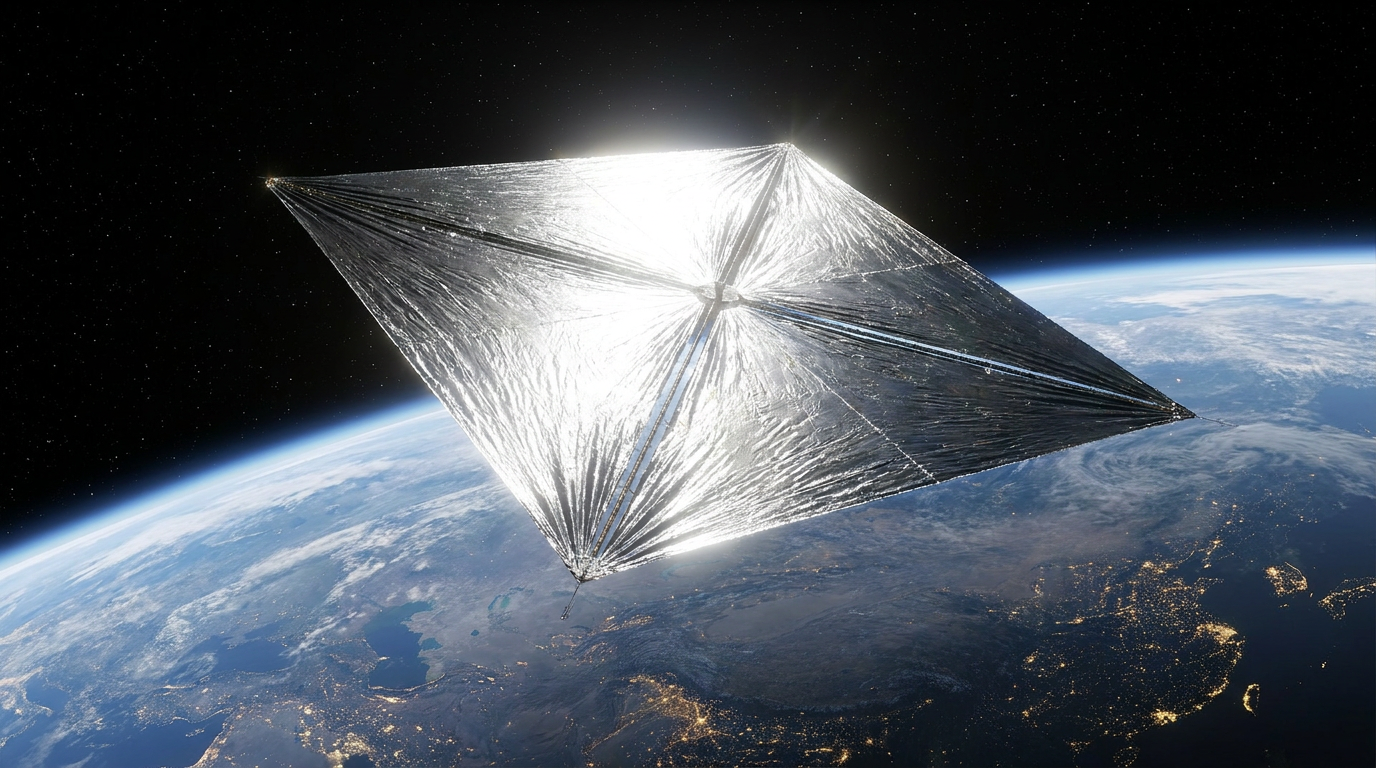
By August 2024, the ACS3 spacecraft achieved its primary mechanical objective in orbit. Originally packed tightly into a 12-unit CubeSat—a standardized satellite chassis roughly the size of a standard microwave oven—the system successfully unfurled an 800-square-foot reflective sail. Fully deployed, the ultra-thin metallic sheet spans an area roughly half the size of a tennis court, transforming the tiny satellite into a sprawling, highly visible structure capable of catching the Sun's rays. Ground-based observatories and space debris tracking networks immediately began monitoring the newly expanded profile as it reflected sunlight back toward Earth.[1][6]

To understand how a microwave-sized box can pull itself through the vacuum of space without a traditional engine, we have to address a common misconception about the fundamental nature of light. Many people learn in introductory high school physics that momentum is strictly defined as mass multiplied by velocity. Following that classical logic, since photons—the fundamental quantum particles that make up light—have absolutely no resting mass, it seems entirely counterintuitive that they could exert a physical push against a solid object. If there is no mass, how can there be any momentum to transfer?[2][3]
However, that classical Newtonian equation is an oversimplification that breaks down when dealing with particles moving at the speed of light. Under Albert Einstein's theory of special relativity, energy and momentum are inextricably linked in a more comprehensive framework. The full relativistic equation reveals that because photons carry kinetic energy, they inherently carry momentum. This momentum can be calculated simply by dividing the photon's energy by the constant speed of light, proving definitively that physical mass is not a strict prerequisite for exerting a mechanical force on an object in space.[2][3][7]
When a photon from the Sun strikes the highly reflective, mirror-like surface of a solar sail, it does not simply absorb into the material; it bounces off. In that microscopic moment of reflection, the photon reverses its direction and, in doing so, transfers a tiny fraction of its momentum directly to the sail to conserve the total momentum of the system. This phenomenon, known in astrophysics as radiation pressure, provides a literal physical push against the spacecraft in the exact direction the light was originally traveling.[2][3]
When a photon from the Sun strikes the highly reflective, mirror-like surface of a solar sail, it does not simply absorb into the material; it bounces off.
A single photon's push is, of course, infinitesimally small—far too weak to be felt on Earth, where gravity and atmospheric friction easily overwhelm such delicate quantum forces. But in the pristine vacuum of space, the physics environment is entirely different. There is no air resistance or aerodynamic drag to slow a spacecraft down. When trillions upon trillions of photons pelt the expansive surface of the sail every single second, that continuous, gentle pressure begins to accumulate into a measurable and highly effective thrust that alters the vehicle's trajectory.[2]

Over time, this relentless push results in constant, compounding acceleration. While a traditional chemical rocket provides a violent, short-lived burst of speed that lasts only a few minutes before the fuel tanks run dry, a solar sail provides a gentle, never-ending push that lasts for years. Because the thrust never stops, the velocity continuously builds. After a month of continuous exposure to unobstructed sunlight, a solar sail can reach speeds of thousands of miles per hour, eventually outpacing conventional rockets on long-duration journeys through the outer solar system.[2][4]
The true technological breakthrough of the ACS3 mission, however, isn't just the reflective sail material itself—it is the underlying skeleton holding the entire apparatus together. Historically, the structural booms used to support experimental solar sails were made of heavy metallic materials. These legacy designs were notoriously bulky and highly prone to thermal expansion when exposed to the extreme temperature swings of space, which often caused them to bend, warp, or jam entirely during the critical deployment phase in orbit, jeopardizing the entire mission.[1]
To solve this persistent engineering hurdle, NASA's new system utilizes advanced composite booms manufactured from a flexible polymer interwoven with high-strength carbon fiber. These next-generation booms are significantly lighter and stiffer than their metallic predecessors, offering a vastly superior strength-to-weight ratio. Crucially, they can be rolled up as tightly as a standard tape measure inside the cramped CubeSat chassis, storing immense potential energy before snapping outward into their rigid, extended structural shape once the spacecraft reaches its designated orbit and initiates the deployment sequence.[1][4]
The deployment of ACS3 was not entirely flawless, highlighting the inherent difficulties of testing novel mechanical systems in the unforgiving environment of microgravity. Following the successful unfurling of the sail in late August, mission operators noted that the spacecraft was slowly tumbling through its orbit. Furthermore, onboard diagnostic cameras detected what appeared to be a slight bend in one of the four composite booms, likely a result of the immense mechanical tension applied as the massive reflective sheet was suddenly pulled taut against the structural supports.[1][6]
Despite these minor mechanical anomalies, NASA engineers consider the primary objective—the successful deployment of the composite structure in the vacuum of space—a major operational victory. The mission team predicts that the slight bend will not inhibit the spacecraft's ability to execute its planned orbital maneuvers. Once the attitude control system is fully reengaged and the tumbling is stabilized, the team plans to actively angle the sail to catch the sunlight, demonstrating the unprecedented ability to raise and lower its orbit on demand without burning a single drop of fuel.[1][6]
The success of these lightweight composite materials opens the door to vastly larger sails in the near future. While the current ACS3 demonstrator spans a modest 800 square feet, the underlying boom technology is specifically designed to scale up dramatically. Follow-on missions are already in active development that will support sails as large as 21,500 square feet—roughly half the area of a professional soccer field. These massive next-generation sails will be capable of generating significantly more thrust, allowing them to carry much heavier scientific payloads across the solar system.[1][4]

With sails of that magnitude, the types of scientific missions we can launch fundamentally change. Researchers are already drafting ambitious concepts like the 'Mercury Scout,' which would use a massive solar sail to hover in a highly stable orbit around the Sun's closest planet. By relying on constant radiation pressure rather than finite thruster fuel, the probe could map Mercury's surface in unprecedented high resolution for years without ever running dry, solving one of the most difficult orbital challenges in planetary science.[5]
Other proposed mission architectures include daring 'sun-diving' probes that would utilize the sail's unique capabilities to the absolute limit. These spacecraft would intentionally drop dangerously close to the Sun's surface to catch an incredibly intense blast of concentrated radiation pressure. This maneuver would act as a massive gravitational and photonic slingshot, hurling the probes outward at unprecedented speeds toward the heliopause—the very edge of our solar system where the solar wind finally gives way to the vast, uncharted expanse of the interstellar medium.[4]
Closer to home, solar sails could serve as vital early-warning sentinels for severe space weather. By using the constant push of sunlight to artificially hold a spacecraft in a non-Keplerian orbit closer to the Sun, we could establish permanent monitoring stations that defy standard orbital mechanics. These sentinels would detect dangerous coronal mass ejections and severe solar storms much earlier than current satellites, providing critical lead time to protect Earth's vulnerable power grids, communication networks, and orbital infrastructure from catastrophic electromagnetic damage.[1][4]

Ultimately, the ACS3 mission represents a profound paradigm shift in how humanity navigates the cosmos. By leaving the heavy, limiting fuel tanks behind and learning to ride the light of our own star, we are transitioning from brute-force rocketry to elegant orbital sailing. As the technology matures and the sails grow exponentially larger, these silent, shimmering mirrors may very well serve as the foundation for humanity's first true interstellar probes, carrying our scientific instruments to neighboring stars on a gentle, never-ending breeze of photons.[4][7]
How we got here
May 2010
Japan's IKAROS spacecraft becomes the first to successfully demonstrate solar sail propulsion in interplanetary space.
July 2019
The Planetary Society's LightSail 2 successfully uses a solar sail to raise its orbit around Earth.
April 2024
NASA launches the Advanced Composite Solar Sail System (ACS3) aboard a Rocket Lab Electron rocket.
August 2024
The ACS3 spacecraft successfully deploys its 800-square-foot sail and composite booms in low Earth orbit.
Viewpoints in depth
Propulsion Engineers
Focused on the mechanical deployment and structural integrity of the sail.
For aerospace engineers, the physics of light is secondary to the materials science of the booms. Legacy metallic booms were too heavy and prone to thermal warping, which doomed earlier solar sail concepts. The ACS3 mission is primarily a test of the new flexible polymer and carbon fiber composite booms. Even with the slight bend observed in orbit, engineers view the deployment as a massive success that proves the viability of rolling up large structures inside standard CubeSats.
Deep Space Scientists
Focused on the unprecedented mission profiles enabled by propellant-free flight.
Planetary scientists and astrophysicists view solar sails as the key to unlocking the outer solar system. Without the constraints of the rocket equation, probes can hover in non-standard orbits, such as the proposed Mercury Scout, or execute sun-diving maneuvers to reach the heliopause. For this camp, the sail is a means to an end: a way to gather continuous, high-resolution data on space weather and distant planets for decades without running out of fuel.
Theoretical Physicists
Focused on the relativistic mechanics of photon momentum transfer.
For physicists, solar sailing is a beautiful, macroscopic demonstration of Einstein's special relativity. It proves that energy and momentum are fundamentally linked, allowing massless photons to exert a physical force. This camp emphasizes the elegance of radiation pressure, noting that while the push of a single photon is infinitesimally small, the frictionless vacuum of space allows that quantum-scale momentum to accumulate into thousands of miles per hour of macroscopic acceleration.
What we don't know
- How the flexible polymer and carbon fiber composite booms will degrade over years of exposure to intense solar radiation and extreme temperature fluctuations.
- Whether the slight tumbling and boom bending observed in the ACS3 deployment will significantly impact its ability to execute precise orbital maneuvers.
Key terms
- Photon
- A fundamental quantum particle of light that carries energy and momentum, despite having no physical mass.
- Radiation Pressure
- The mechanical pressure exerted upon any surface due to the exchange of momentum between the object and the electromagnetic field (light) striking it.
- CubeSat
- A class of miniaturized spacecraft built to standard dimensions, often used to test new space technologies inexpensively.
- Heliopause
- The theoretical boundary where the Sun's solar wind is stopped by the interstellar medium; the edge of our solar system.
Frequently asked
Do solar sails use the solar wind?
No. Solar sails are pushed by the momentum of photons (light), not the solar wind. The solar wind consists of ionized particles ejected by the Sun, which move much slower than light and provide less than one percent of the force generated by light pressure.
How does a solar sail steer or change direction?
A solar sail steers much like a sailboat on Earth. By changing the angle of the sail relative to the Sun, the spacecraft can alter the direction of the photon push, allowing it to raise or lower its orbit.
Can a solar sail work far away from the Sun?
Yes, but its acceleration decreases. As the spacecraft moves further from the Sun, the intensity of the sunlight drops, meaning fewer photons hit the sail. However, because space has no friction, the spacecraft will maintain whatever speed it has already built up.
Sources
Source coverage
7 outlets
3 viewpoints surfaced







[1]NASAPropulsion Engineers
Advanced Composite Solar Sail System (ACS3)
Read on NASA →[2]Astronomy MagazineTheoretical Physicists
How do photons propel solar sails?
Read on Astronomy Magazine →[3]The Planetary SocietyDeep Space Scientists
What is solar sailing?
Read on The Planetary Society →[4]Science AlertPropulsion Engineers
NASA Is Set to Launch Its Next-Gen Solar Sail Into Deep Space
Read on Science Alert →[5]Universe TodayDeep Space Scientists
Mercury Scout Mission Concept with Solar Sail Propulsion
Read on Universe Today →[6]Space Debris Research LabPropulsion Engineers
Optical Observations of Advanced Composite Solar Sail System (ACS3)
Read on Space Debris Research Lab →[7]Factlen Editorial TeamTheoretical Physicists
Synthesis by Factlen editorial team
Read on Factlen Editorial Team →

More in science
See all 5 stories →GLP-1 Therapeutics
Beyond Weight Loss: The Clinical Evidence for GLP-1 Drugs in Heart Disease, Addiction, and Parkinson's
0 sources

Turf Science
The Agronomy and Biomechanics Behind the 2026 World Cup's Unprecedented Grass Experiment
0 sources

Sports Agronomy
The Multimillion-Dollar Science Behind the 2026 World Cup's Perfect Pitch
0 sources
Every angle. Every day.
Get science stories with full source coverage and perspective breakdowns delivered to your inbox.