
The High-Tech Return of Wind Power to Global Shipping
Faced with strict emission targets and volatile fuel costs, the commercial shipping industry is retrofitting massive cargo vessels with rigid wing sails and spinning rotors.
By Factlen Editorial Team
- Maritime Innovators
- Focus on the aerodynamic physics, verifiable fuel savings data, and the potential to scale up to 50% savings on optimal routes.
- Shipowners & Operators
- Prioritize the capital expenditure, the return-on-investment timeline, and the logistical headaches of port compatibility and tight schedules.
- Regulatory & Academic
- Emphasize standardized measurement of thrust, safety protocols, and ensuring that claimed emissions reductions are mathematically verifiable.
What's not represented
- · Port Authority Operators
- · Traditional Marine Engineers
Why this matters
Global shipping accounts for roughly 3% of global greenhouse gas emissions. The successful deployment of wind-assisted propulsion proves that heavy industry can decarbonize using existing natural resources, potentially lowering the cost of global trade while cleaning the air.
Key points
- The maritime industry is retrofitting cargo ships with high-tech sails and spinning rotors to cut emissions.
- Wind-assisted propulsion can reduce a vessel's fuel consumption by up to 30 percent on optimal routes.
- These systems act as hybrids, supplementing traditional engines rather than replacing them entirely.
- AI weather routing is now used to plot paths that maximize wind capture, even if it means sailing further.
- Engineers have developed complex folding mechanisms so the massive sails can clear bridges and port cranes.
For over a century, the silhouette of a commercial cargo ship has been defined by its smokestacks. The transition from sail to steam, and eventually to cheap, energy-dense diesel fuel, built the modern globalized economy. But as the environmental toll of burning heavy fuel oil becomes mathematically incompatible with global climate targets, the maritime industry is looking backward to move forward. Across the world's oceans, a new generation of cargo vessels is harnessing the wind, trading canvas and rigging for towering cylinders of spinning steel and rigid composite wings.[1][7]
The scale of the challenge is immense. More than 50,000 commercial ships navigate the globe, collectively responsible for roughly three percent of all global greenhouse gas emissions. If the shipping industry were a country, it would be the sixth-largest polluter on Earth. Under mounting pressure from the International Maritime Organization (IMO) to reach net-zero emissions by or around 2050, shipowners have been scrambling for solutions. While alternative fuels like green methanol and ammonia are in development, they remain expensive and scarce, prompting a surge of interest in free, abundant wind energy.[2][3]
This is not a return to the romantic era of clipper ships. Modern Wind-Assisted Ship Propulsion (WASP) relies on cutting-edge aerodynamics and automated control systems. The goal is not to replace the main engines entirely, but to supplement them, creating a hybrid propulsion system that significantly reduces the load on the ship's generators. By capturing wind energy to generate forward thrust, these systems allow vessels to throttle down their engines while maintaining their scheduled cruising speeds.[1][4]
One of the most visually striking technologies being deployed is the Flettner rotor. Invented in the 1920s by German engineer Anton Flettner, these are tall, vertical cylinders mounted on the deck of a ship. Mechanical motors spin the cylinders at high speeds. As wind hits the spinning surface, the air is accelerated on one side and decelerated on the other, creating a pressure differential. This phenomenon, known as the Magnus effect—the same physics that causes a curveball to swerve in baseball—generates a powerful forward thrust perpendicular to the wind direction.[6]

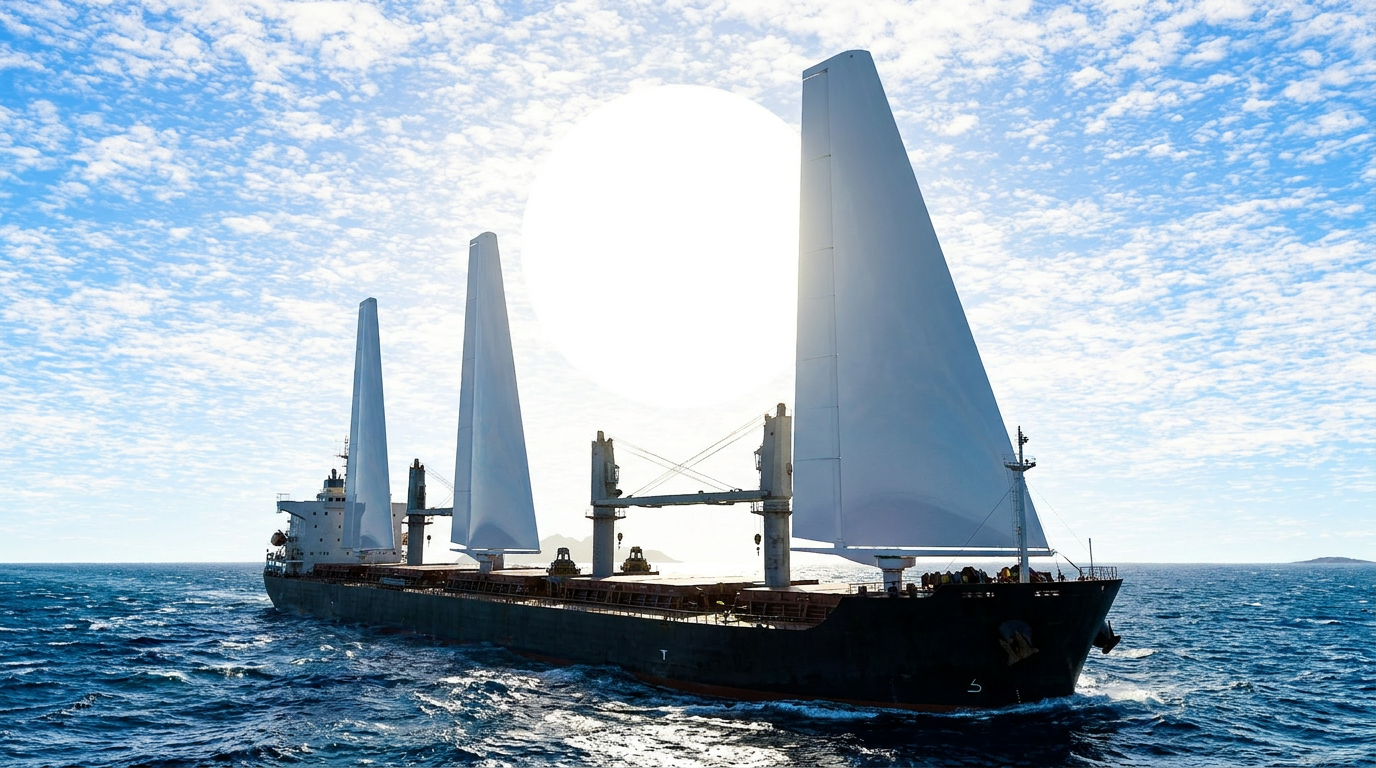
Another prominent design involves rigid wing sails, which function much like airplane wings standing upright. Constructed from steel and glass composites, these massive structures can tower up to 150 feet above the deck. Unlike traditional cloth sails that require a crew to manually trim lines, rigid wings are fully automated. Onboard computers continuously monitor wind speed and direction, pivoting the wings in real-time to capture the optimal aerodynamic angle of attack, maximizing thrust without human intervention.[5]
The technological diversity in the WASP sector is expanding rapidly. Beyond rotors and rigid wings, engineers are testing automated kite systems that fly high above the vessel to catch stronger, more consistent high-altitude winds. Others are experimenting with suction sails, which use internal fans to draw boundary-layer air through vents in a vertical foil, dramatically increasing aerodynamic lift. This scattershot approach to innovation reflects an industry eager to find the right fit for different vessel types, from bulk carriers to oil tankers.[4][6]
The theoretical promise of wind propulsion is now being backed by concrete operational data. Following high-profile pilot programs, such as the 2023 launch of the retrofitted bulk carrier Pyxis Ocean, maritime data analysts have spent the last few years tracking performance across varied weather conditions. The results have been highly encouraging. On optimal routes, such as the North Atlantic or trans-Pacific crossings, vessels equipped with modern wind systems are consistently recording fuel savings of 20 to 30 percent.[5][7]
The theoretical promise of wind propulsion is now being backed by concrete operational data.
These fuel savings translate directly to the bottom line, fundamentally altering the economic calculus for shipowners. Fuel is traditionally the single largest operating expense for a commercial vessel. Furthermore, with the inclusion of maritime shipping in the European Union's Emissions Trading System (ETS), carbon emissions now carry a direct financial penalty. The combination of reduced fuel consumption and avoided carbon taxes has shortened the return-on-investment timeline for wind installations from a decade down to just three to five years.[3][7]

Despite the optimism, the operational reality of wind-assisted shipping involves significant compromises. The global supply chain relies on strict, predictable schedules; a factory in Germany cannot halt production simply because a cargo ship in the Atlantic encountered a week of doldrums. Because wind is inherently intermittent, these vessels must retain robust traditional engines to guarantee arrival times. Wind is treated as a fuel-saving bonus rather than a primary, reliable baseload power source.[1][3]
To maximize that bonus, the maritime industry is undergoing a digital revolution in weather routing. Historically, ships sailed the shortest possible distance between two ports—a straight line on a map. Today, vessels equipped with wind propulsion use advanced AI algorithms to plot dynamic routes. A ship might deliberately sail hundreds of miles out of its way to catch a favorable weather system, calculating that the extra distance will be more than offset by the massive fuel savings generated by the wind.[4][5]
Port infrastructure presents one of the most stubborn hurdles to widespread adoption. Modern cargo ports are highly optimized environments built around massive overhead gantry cranes that load and unload containers with inches of clearance. A ship arriving with 150-foot fixed towers on its deck simply cannot be serviced at most terminals. To solve this, engineers have developed complex hydraulic systems that allow rigid sails and rotors to fold down flat against the deck or tilt horizontally when approaching a port.[3][7]
Bridge clearances pose a similar logistical headache. Major maritime chokepoints, such as the bridges spanning the Panama Canal, the Bosporus Strait, or the entrance to major harbors, have strict air draft limits. The necessity of folding mechanisms adds significant weight, mechanical complexity, and capital cost to wind propulsion systems. Every moving part in a corrosive saltwater environment represents a potential maintenance failure, requiring robust engineering and frequent inspection.[1][5]

The industry is currently split between retrofitting existing ships and designing entirely new vessels. Retrofitting is faster and addresses the immediate emissions of the current fleet, but it is inherently inefficient. Slapping sails onto a hull designed purely for engine propulsion often compromises cargo space and stability. Conversely, newbuilds can be designed from the keel up to optimize wind power, featuring specialized hull shapes that counteract the sideways drift caused by large sails, though these ships take years to design and construct.[4]
Regulatory frameworks are slowly catching up to the technology. The IMO's Energy Efficiency Design Index (EEDI) mandates a minimum energy efficiency level per capacity mile for different ship type and size segments. Initially, the formulas struggled to accurately account for the variable nature of wind power. Recent updates to the regulatory guidance have standardized how wind-assisted thrust is measured and verified, giving shipowners the legal certainty they need to invest millions of dollars into these systems.[2]
The human element of this transition is equally critical. Modern seafarers are primarily mechanics and engineers trained to maintain massive diesel engines. The introduction of complex aerodynamic systems requires a fundamental shift in crew training. Captains must learn to balance engine thrust with wind angles, while deckhands must be trained to maintain hydraulic folding mechanisms and composite materials. Maritime academies are rapidly updating their curricula to produce a new generation of hybrid-propulsion sailors.[6][7]
Looking ahead, wind propulsion is increasingly viewed not as a standalone solution, but as a vital bridge to a zero-emission future. The next generation of clean marine fuels—such as green ammonia and e-methanol—are projected to be significantly more expensive and less energy-dense than current fossil fuels. By using wind to slash a vessel's total energy demand by 20 to 30 percent, shipowners can drastically reduce the volume of expensive green fuel they need to purchase and store onboard.[2][3]

The return of the sail represents a rare, highly visible victory in the fight against industrial climate change. It is a synthesis of ancient maritime wisdom and 21st-century aerospace engineering. As more of these hybrid vessels slip quietly out of ports around the world, they offer a tangible demonstration that the global economy can continue to move goods across the oceans without leaving a trail of carbon in its wake.[1][4]
How we got here
1920s
Anton Flettner invents the rotor ship, but the abundance of cheap diesel fuel halts widespread commercial adoption.
2018
The International Maritime Organization sets initial targets to significantly reduce shipping greenhouse gas emissions by 2050.
2023
The Pyxis Ocean becomes the first commercial cargo ship retrofitted with large-scale WindWings, beginning extensive sea trials.
2025
Wind-assisted propulsion installations surpass 100 commercial vessels globally as carbon taxes alter the economic landscape.
2026
Next-generation AI algorithms become standard, routing wind-assisted ships dynamically to maximize aerodynamic thrust.
Viewpoints in depth
Maritime Innovators
Engineers and tech providers focused on maximizing aerodynamic efficiency and decarbonization.
For the engineers designing these systems, the ocean is a massive, untapped reservoir of free kinetic energy. They point to data proving that on optimal routes—like the North Atlantic in winter—wind assistance can slash fuel consumption by up to 30 percent. Their argument is that while zero-emission fuels like green ammonia are decades away from global scale, wind is available immediately. They advocate for aggressive deployment, arguing that the physics are proven and the only remaining barriers are a lack of imagination and an unwillingness to change traditional maritime operations.
Shipowners & Operators
The companies that own the vessels, focused on capital costs, reliability, and port logistics.
Shipowners operate on razor-thin margins and strict delivery schedules. While they welcome fuel savings, they view wind propulsion through a lens of capital expenditure and risk. A retrofit can cost millions of dollars, and the added mechanical complexity of hydraulic folding sails introduces new maintenance liabilities. Furthermore, operators stress that a ship's primary duty is to arrive on time; they cannot afford to be becalmed. For this camp, wind is a useful supplementary tool to hedge against carbon taxes, but it does not solve the fundamental need for reliable, energy-dense baseload fuel.
Regulatory & Academic
Organizations focused on standardizing the measurement of emissions reductions and ensuring safety.
Regulatory bodies like the IMO and maritime academics are focused on the math. Because wind is variable, it is incredibly difficult to certify exactly how much carbon a wind-assisted ship will save over its lifespan. This camp is working to create standardized formulas within the Energy Efficiency Design Index (EEDI) so that shipbuilders can legally prove their vessels meet international climate targets. They are also heavily focused on safety, studying how 150-foot sails affect a ship's center of gravity, radar cross-section, and stability during severe ocean storms.
What we don't know
- How the long-term maintenance costs of complex hydraulic folding mechanisms will impact the overall return on investment.
- Whether the global supply of green fuels will eventually become cheap enough to render wind-assist systems economically unnecessary.
Key terms
- Flettner Rotor
- A spinning vertical cylinder mounted on a ship that uses the Magnus effect to generate forward thrust from crosswinds.
- Magnus Effect
- The observable phenomenon where a spinning object drags air faster around one side, creating a pressure difference that results in thrust.
- Energy Efficiency Design Index (EEDI)
- An International Maritime Organization standard mandating a minimum energy efficiency level for new commercial ships.
- Air Draft
- The distance from the surface of the water to the highest point on a vessel, determining whether it can pass safely under a bridge.
Frequently asked
Can these cargo ships sail entirely on wind power?
No. Modern wind-assisted propulsion systems are designed to supplement traditional engines, reducing fuel consumption rather than replacing it entirely.
What happens when there is no wind?
The ship relies entirely on its primary engines, which run on fuel oil, LNG, or green methanol, to maintain its scheduled speed and arrival time.
How do these giant sails fit under bridges?
Most rigid sails and rotor systems are engineered with heavy hydraulics that allow them to fold down flat against the deck or tilt horizontally to allow safe passage under bridges and port cranes.
Sources
Source coverage
7 outlets
3 viewpoints surfaced







[1]Factlen Editorial TeamRegulatory & Academic
Synthesis by Factlen editorial team
Read on Factlen Editorial Team →[2]International Maritime OrganizationRegulatory & Academic
Wind-Assisted Propulsion Systems (WAPS) Guidance and EEDI
Read on International Maritime Organization →[3]ReutersShipowners & Operators
Shipping industry turns to wind power to meet emission targets
Read on Reuters →[4]TradeWindsMaritime Innovators
Wind propulsion installations double in 2025 as fuel costs bite
Read on TradeWinds →[5]The Maritime ExecutiveMaritime Innovators
Data confirms 20% fuel savings for WindWings retrofits
Read on The Maritime Executive →[6]Journal of Marine Science and EngineeringRegulatory & Academic
Aerodynamic Performance of Flettner Rotors on Commercial Vessels
Read on Journal of Marine Science and Engineering →[7]BloombergShipowners & Operators
The New Age of Sail: How Cargo Giants are Harnessing the Wind
Read on Bloomberg →
Every angle. Every day.
Get transportation stories with full source coverage and perspective breakdowns delivered to your inbox.