
The Green-Collar Boom: How Vocational Schools Are Powering the Energy Transition
As global demand for electric vehicles, heat pumps, and renewable energy surges, vocational schools and apprenticeship programs are rapidly scaling up to train a new generation of 'green-collar' workers.
By Factlen Editorial Team
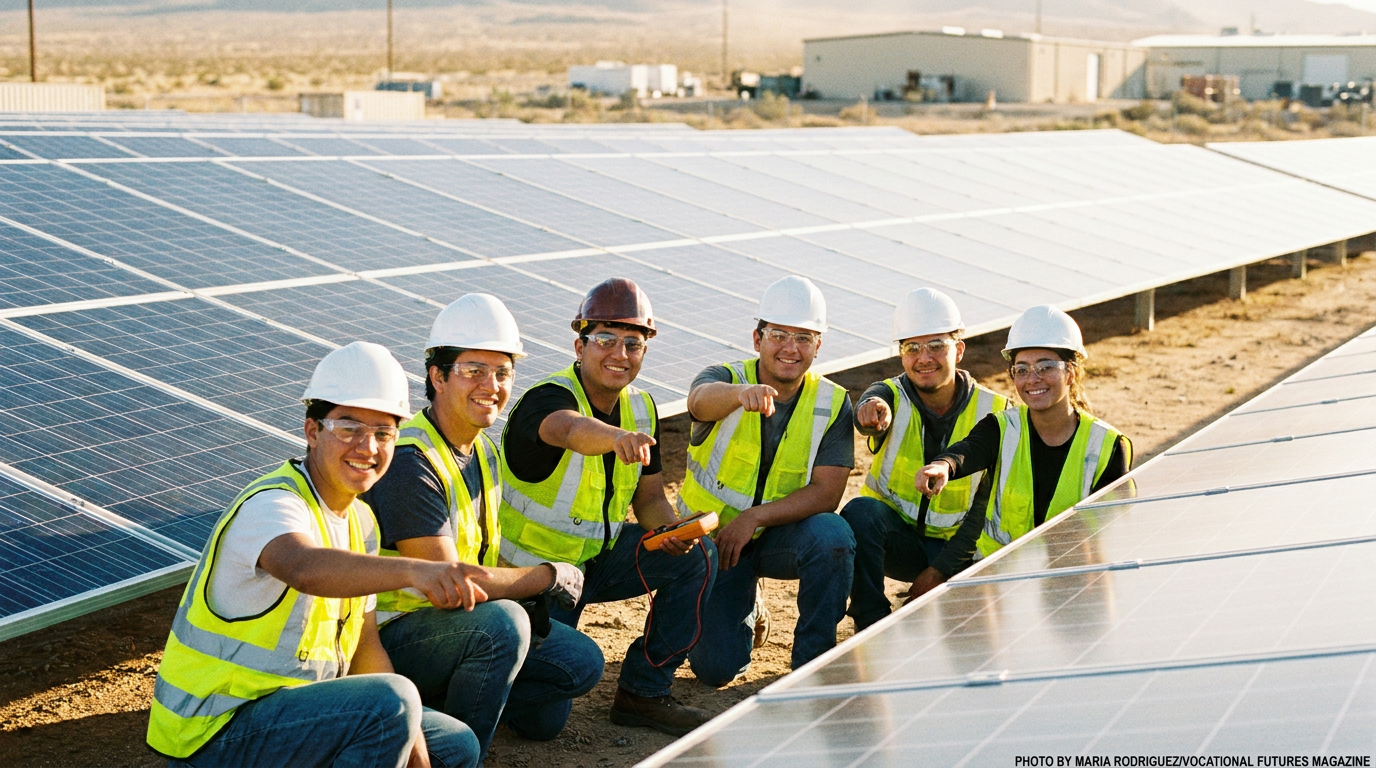
- Vocational Educators & Institutions
- Focuses on the need to rapidly modernize curriculums and secure state funding to build expensive high-voltage training labs.
- Clean Energy Employers
- Emphasizes the acute shortage of specialized labor and the preference for dedicated green apprenticeships over retraining traditional fossil-fuel mechanics.
- Policymakers & Climate Advocates
- Views workforce development as the primary bottleneck to achieving net-zero targets, necessitating massive public investment in skills.
What's not represented
- · Traditional Fossil-Fuel Mechanics
- · Homeowners and Consumers
Why this matters
The transition to renewable energy cannot happen without the skilled labor to build, install, and maintain the infrastructure. For workers, this represents a massive economic opportunity to secure high-paying, future-proof careers without the debt of a four-year university degree.
Key points
- Vocational schools are rapidly expanding programs to train 'green-collar' workers for the energy transition.
- The Bureau of Labor Statistics projects up to 68% job growth for solar and wind technicians by 2030.
- Accelerated programs, including those using VR, are retraining auto mechanics to safely service high-voltage electric vehicles.
- The UK has launched a dedicated low-carbon heating apprenticeship to meet the demand for 123,000 new heat pump installers by 2035.
- Governments are heavily subsidizing these programs, offering thousands in funding per apprentice to build specialized training labs.
The global transition away from fossil fuels is rapidly moving from international policy agreements to the pavement, and it is bringing a massive economic shift with it. As governments and corporations pour billions into renewable energy, electric vehicles, and sustainable infrastructure, a critical bottleneck has emerged: the world simply does not have enough trained professionals to build and maintain it. This reality has sparked a renaissance in vocational education, giving rise to the "green-collar" workforce. Across community colleges, trade schools, and union halls, curriculums are being rewritten to prepare a new generation of workers for careers that blend traditional hands-on labor with advanced environmental technology.[7]
A green-collar job represents the evolution of the traditional blue-collar trade. Instead of turning wrenches on internal combustion engines or fitting pipes for gas boilers, these workers are diagnosing high-voltage battery arrays, calibrating smart-grid software, and installing complex thermal systems. Because these roles often require specialized technical certifications rather than a four-year university degree, they are widely considered "middle-skill" jobs. This classification makes them highly accessible, offering a direct pathway to the middle class without the burden of crippling student loan debt.[1][7]
The sheer scale of the demand is staggering. According to the U.S. Bureau of Labor Statistics, careers like solar panel installation and wind turbine maintenance are projected to see job growth of up to 68% by the year 2030. This astronomical growth rate far outpaces the national average for other occupations. To meet this demand, educational institutions are racing to expand their capacity, recognizing that the energy transition is as much a labor challenge as it is a technological one.[1]

Nowhere is this shift more visible than in the automotive sector. As electric vehicle sales continue to climb globally, the traditional auto mechanic is being forced to adapt. Internal combustion engines, with their thousands of moving mechanical parts, are being replaced by high-voltage drivetrains, lithium-ion battery packs, and sophisticated thermal management systems. Servicing these vehicles requires an entirely new set of skills, prioritizing electrical engineering fundamentals and strict safety protocols over traditional mechanical repair.[2][8]
Community colleges are stepping up to fill this specific void. For example, Oakland Community College in Michigan recently launched a dedicated 14-week Electric Vehicle Technician Training Program. Costing around $7,500—often offset by state workforce grants—the program immerses students in the fundamentals of EV concepts, automated manufacturing, and programmable logic controllers. By focusing heavily on hands-on experience, these accelerated programs are designed to take students from the classroom to the garage floor in a matter of months.[2]
To safely train students on potentially lethal high-voltage systems, some vocational programs are turning to cutting-edge technology. Educational platforms like ImmerseLearn have integrated Virtual Reality (VR) into their 15-week EV technician courses. By shipping VR headsets directly to students, these programs allow trainees to practice complex diagnostics, troubleshoot battery arrays, and service drivetrains in a completely safe, simulated environment before they ever touch a live vehicle.[8]

Beyond transportation, the decarbonization of home heating is creating its own massive labor shortage. In the United Kingdom, the government has set an ambitious target of installing 600,000 electric heat pumps annually by 2028 to phase out natural gas boilers. However, installing a heat pump requires a deep understanding of thermodynamics, electrical wiring, and low-temperature heating distribution—skills that many traditional plumbers and gas engineers simply do not possess.[4][5]
Beyond transportation, the decarbonization of home heating is creating its own massive labor shortage.
Recent industry data highlights the severity of this shortfall. While the UK saw over 9,000 individuals complete a recognized heat pump qualification in 2024, projections indicate that an additional 123,000 trained installers will be needed by 2035 to meet the nation's net-zero targets. The current workforce is aging, and relying solely on retraining existing fossil-fuel engineers has proven insufficient to meet the escalating consumer demand.[3]
In response, the UK government and industry leaders collaborated to launch the country's first dedicated "low-carbon heating technician apprenticeship." Rather than treating renewable heating as an add-on course for traditional plumbers, this multi-year apprenticeship treats it as a distinct, specialized trade from day one. The program's importance was even recognized with a King's Coronation emblem, highlighting its role in building a sustainable national economy.[4][5]

To ensure vocational schools have the resources to teach these new skills, significant financial incentives are being deployed. The UK Department for Education allocated a funding band that grants colleges up to £22,000 for each low-carbon heating apprentice they train. This generous funding—which notably exceeds the subsidies provided for traditional fossil-fuel heating apprenticeships—allows institutions to build the expensive, state-of-the-art laboratories required for hands-on heat pump training.[5]
Similar public investments are driving the green-collar boom in the United States. In Illinois, the landmark Climate and Equitable Jobs Act (CEJA) has distributed over $40 million to the state's community college system specifically for green workforce development. This funding is establishing clean jobs workforce network programs, ensuring that the state has the human capital necessary to achieve its goal of a carbon-free power sector by 2045.[1]
The push for green vocational training is also crossing international borders. The European Union recently unveiled the T-MED initiative, which aims to mobilize €25 billion by 2035 to develop renewable energy and modern electricity networks across the Mediterranean region. Crucially, this infrastructure investment is paired with a dedicated "Skills Agenda" designed to modernize technical and vocational education systems, ensuring that the projected 100,000 new clean energy jobs are filled by a capable local workforce.[6]
Demographically, these green-collar programs are proving highly attractive. They appeal to recent high school graduates looking for lucrative, future-proof careers without the crushing burden of university tuition. Simultaneously, they are drawing mid-career professionals from declining industries who are seeking to re-skill. The promise of job security in a sector that is virtually guaranteed to grow over the next three decades is a powerful recruitment tool.[7]
Despite the optimism, challenges remain in scaling these programs. Training in green-collar fields is often expensive and time-consuming. Furthermore, some smaller contracting businesses are hesitant to take on apprentices until local consumer demand for technologies like heat pumps and EVs becomes more consistent. Bridging the gap between training capacity and immediate employer hiring remains a delicate balancing act for policymakers.[3][4]
Ultimately, the success of the global energy transition will be determined by the hands of the workers installing the infrastructure. As government subsidies continue to lower the cost of green technologies for consumers, the vocational education sector is proving to be the critical engine of the new economy. By aligning climate policy with workforce development, the green-collar boom is offering a rare convergence of environmental progress and middle-class job creation.[7]
How we got here
2021
Illinois passes the Climate and Equitable Jobs Act, directing millions to community college green workforce programs.
2023
The UK launches its first dedicated low-carbon heating technician apprenticeship to meet net-zero targets.
2024
UK heat pump sales increase by 63%, highlighting the urgent need for more trained installers.
2026
The EU announces the T-MED initiative, mobilizing €25 billion for Mediterranean renewable infrastructure and skills training.
Viewpoints in depth
Vocational Educators' View
Institutions emphasize the need for modernized curriculums and state funding to build expensive high-voltage labs.
For community colleges and trade schools, the energy transition represents both a massive opportunity and a logistical hurdle. Educators argue that teaching green-collar skills requires entirely new infrastructure—such as high-voltage battery labs and thermodynamic testing environments—which are incredibly expensive to build. They advocate for sustained government grants, like the Illinois CEJA funds, to ensure that public institutions can offer these cutting-edge programs affordably to students from all socioeconomic backgrounds.
Clean Energy Employers' View
Industry leaders focus on the acute skills shortage and the preference for dedicated apprenticeships.
Contractors and renewable energy firms are sounding the alarm over a severe labor bottleneck. Many employers argue that simply offering weekend retraining courses to traditional plumbers or auto mechanics is insufficient for the complexities of modern heat pumps and EVs. Instead, they are pushing for dedicated, multi-year apprenticeships that treat green technology as a distinct trade from day one, ensuring a pipeline of workers who are natively fluent in high-voltage safety and smart-grid integration.
Climate Policymakers' View
Governments view workforce development as the primary bottleneck to achieving national net-zero targets.
For policymakers, the green-collar boom is the linchpin of climate strategy. Officials recognize that aggressive targets—such as the UK's goal of 600,000 heat pump installations per year—are physically impossible without a massive expansion of the skilled labor pool. Consequently, they are shifting their focus from merely subsidizing consumer purchases of green tech to heavily subsidizing the vocational training required to install it, viewing these investments as a dual victory for both the environment and middle-class job creation.
What we don't know
- Whether consumer demand for green technologies will scale fast enough to provide immediate employment for all newly trained apprentices.
- How quickly traditional fossil-fuel mechanics and plumbers will choose to re-skill versus aging out of the workforce.
- If government funding for vocational programs will be sustained long-term once initial climate infrastructure bills expire.
Key terms
- Green-Collar Worker
- A worker employed in the environmental sectors of the economy, particularly in renewable energy, energy efficiency, and sustainable infrastructure.
- Heat Pump
- A highly efficient electric heating and cooling system that transfers heat between the indoors and outdoors, replacing traditional fossil-fuel boilers.
- High-Voltage Diagnostics
- The specialized process of testing and repairing the powerful electrical systems found in electric vehicles, requiring strict safety protocols.
- Apprenticeship
- A system of training a new generation of practitioners of a trade or profession with paid, on-the-job training and accompanying classroom study.
Frequently asked
What is a green-collar job?
A green-collar job is a career focused on sustainability and renewable energy, such as solar installation or EV maintenance. These roles often require specialized technical skills but not necessarily a four-year university degree.
How long does EV technician training take?
Many community college and certificate programs can be completed in 14 to 15 weeks. These accelerated courses focus heavily on high-voltage safety, battery diagnostics, and automated manufacturing.
Why is there a shortage of heat pump installers?
Installing heat pumps requires different skills than traditional gas boilers, including advanced thermodynamics and electrical wiring. This means the existing plumbing workforce needs dedicated retraining, or new apprentices must enter the field.
Do green-collar jobs require a university degree?
No. Most green-collar jobs are considered "middle-skill" positions, meaning they require more than a high school diploma but less than a four-year degree, often relying on vocational training, apprenticeships, or community college certificates.
Sources
Source coverage
8 outlets
3 viewpoints surfaced








[1]University of IllinoisVocational Educators & Institutions
Green-Collar Jobs and the Role of Vocational Training
Read on University of Illinois →[2]Oakland Community CollegeVocational Educators & Institutions
Electric Vehicle (EV) Technician Training Program
Read on Oakland Community College →[3]Energy Systems CatapultClean Energy Employers
Projecting the Future Heat Pump Workforce
Read on Energy Systems Catapult →[4]Solar Power PortalClean Energy Employers
New apprenticeship to fill heat pump skills shortage
Read on Solar Power Portal →[5]Renewable Energy InstallerClean Energy Employers
Installers encouraged to commit to new low carbon heating apprenticeship
Read on Renewable Energy Installer →[6]European CommissionPolicymakers & Climate Advocates
T-MED: Accelerating the energy transition in the Mediterranean
Read on European Commission →[7]Factlen Editorial TeamPolicymakers & Climate Advocates
Synthesis by Factlen editorial team
Read on Factlen Editorial Team →[8]ImmerseLearnVocational Educators & Institutions
Electric Vehicle Technician Certification with Hands-On Training
Read on ImmerseLearn →

More in education
See all 7 stories →EdTech Efficacy
AI Tutors Are Drastically Improving University Pass Rates, But Long-Term Retention Questions Remain
0 sources

STEM Education
The Evidence for Active Learning: How STEM Education is Moving Beyond the Lecture
0 sources

Literacy Policy
How the 'Science of Reading' is Rewiring K-12 Classrooms
0 sources

Green Collar Jobs
The Rise of 'New Collar' Green Jobs: How Vocational Training is Powering the Energy Transition
0 sources
Every angle. Every day.
Get education stories with full source coverage and perspective breakdowns delivered to your inbox.