
The Era of the $250 Million Women's Sports Franchise Has Arrived
Driven by record broadcast deals and institutional investment, expansion fees and team valuations in the WNBA and NWSL have multiplied at an unprecedented rate, signaling a massive market correction.
By Factlen Editorial Team
- Market Analysts
- Focus on the macro-economic trends, revenue projections, and the structural market correction driving the boom.
- Institutional Investors
- View women's sports franchises as highly lucrative, undervalued assets with massive growth potential.
- Labor Advocates
- Argue that skyrocketing franchise valuations must translate into equitable revenue sharing and higher salaries for the athletes.
What's not represented
- · City municipalities subsidizing stadium infrastructure
- · Fans priced out by rising ticket costs
Why this matters
The exponential rise in women's sports valuations proves that investing in female athletes is no longer viewed as a charitable endeavor, but as one of the most lucrative growth opportunities in modern finance. This influx of capital will fundamentally reshape stadium infrastructure, broadcast availability, and athlete compensation for generations.
Key points
- WNBA expansion fees have surged from $50 million to $250 million in just 18 months.
- The NWSL's Angel City FC is currently the world's most valuable women's sports team at $340 million.
- Global elite women's sports revenue is projected to cross $3 billion in 2026, a 340% increase since 2022.
- Commercial sponsorships and merchandise account for nearly half of all global revenue.
- Athletes and labor unions are expected to use these rising valuations to demand a larger share of league revenue.
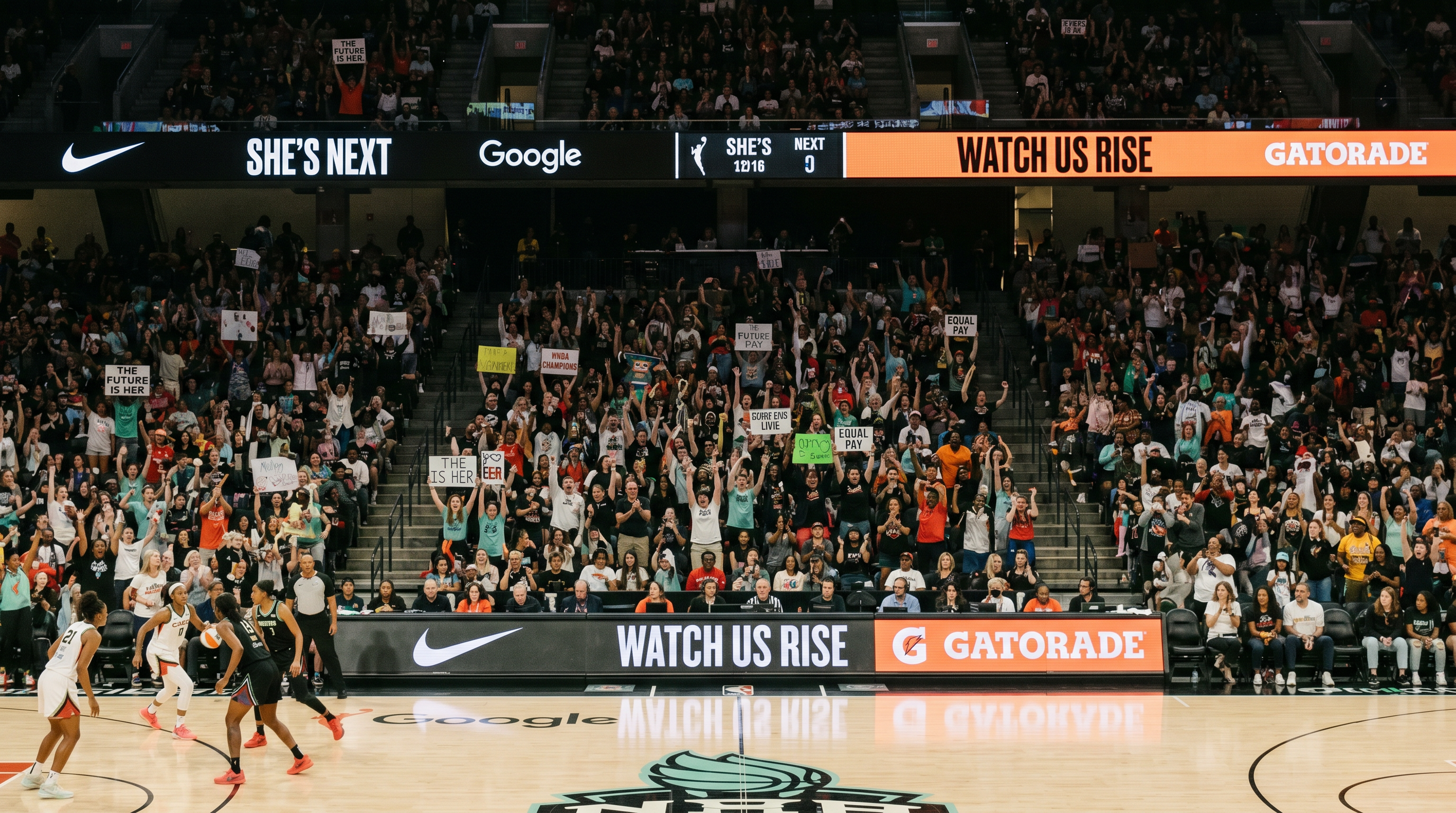
In 1974, it took the NBA 28 years of existence to see a franchise sell for the modern equivalent of $35 million. In 2026, the Women's National Basketball Association (WNBA)—also in its 28th year—is commanding expansion fees of $250 million. The milestone represents far more than a single transaction; it marks the moment institutional capital fully awakened to the most undervalued asset class in global entertainment.[7]
The numbers represent a paradigm shift in the business of sports. Over the past 18 months, the cost of entry into elite women's leagues has multiplied at a rate rarely seen in modern finance, driven by a confluence of surging viewership, cultural relevance, and aggressive billionaire investment.[4][5]
The WNBA's recent expansion announcements perfectly illustrate this hyper-growth. When the Golden State Valkyries joined the league to begin play in 2025, their ownership group paid a $50 million expansion fee. At the time, it was considered a massive leap forward for a league that had not expanded since 2008.[4]
Just months later, the market shifted again. The upcoming Portland Fire and Toronto Tempo franchises, slated to join the league in 2026, commanded expansion fees of $125 million and $115 million, respectively. The price of admission had more than doubled in less than a year.[5]

Now, the next wave of expansion teams in Cleveland, Detroit, and Philadelphia—scheduled to debut between 2028 and 2030—have each agreed to pay a staggering $250 million to secure their spots. When factoring in the cost of building dedicated practice facilities, the true financial commitment for these new ownership groups exceeds $300 million.[4][5]
This explosion is not confined to basketball. The National Women's Soccer League (NWSL) is experiencing an identical gold rush, with franchise price tags skyrocketing across the board as private equity and celebrity investors jostle for entry.[1][2]
In 2024, the Los Angeles-based Angel City FC was sold to Walt Disney CEO Bob Iger and USC Dean Willow Bay in a deal that valued the club at $250 million. It was a landmark transaction that shattered the previous NWSL record and established a new benchmark for women's soccer globally.[6]
By early 2026, Forbes reported that Angel City's valuation had already climbed another 21% to $340 million. The rising tide lifted the entire league, pushing the median NWSL franchise value to $192 million—a 79% increase from the previous year.[1]

What is driving this sudden influx of capital? According to financial analysts, it is a structural market correction. For decades, women's sports were systematically underpriced, under-marketed, and under-resourced. Today's investors are simply pricing in the actual demand that was always there.[3][7]
According to financial analysts, it is a structural market correction.
Deloitte's 2026 "Game Changers" report projects that global elite women's sports revenues will surpass $3 billion this year. That figure represents a staggering 340% increase since 2022, confirming that the industry has moved beyond proving its value and into a phase of sustained, scalable growth.[3]
Commercial revenue, including sponsorships, partnerships, and merchandise, remains the largest engine, accounting for roughly $1.4 billion of that total. Brands have realized that women's sports fans offer incredibly high engagement and brand affinity, leading to multi-million dollar jersey patch deals and top-tier corporate partnerships.[3]
Matchday revenue is also surging, projected to hit $911 million globally in 2026. Teams are no longer playing in secondary college venues or training grounds; they are selling out major professional arenas and, increasingly, building their own dedicated facilities.[3]

The Kansas City Current of the NWSL provided a blueprint for this infrastructure shift. By opening CPKC Stadium—the first arena in the world built specifically for a women's professional sports team—the Current took control of their own revenue streams, seeing their valuation skyrocket to $275 million.[2]
Broadcast rights are the final piece of the revenue triad. Historically, women's leagues often had to pay networks for airtime or accept minimal rights fees just to gain visibility. The leverage has now completely flipped.[7]
Today, media companies are paying a premium for live inventory. The WNBA recently secured a domestic broadcast deal worth at least $200 million annually starting in 2026, representing a 250% increase over its previous contract.[5]
Similarly, the NWSL is operating under a $240 million multi-platform agreement with CBS, ESPN, Prime Video, and Amazon MGM Studios. Broadcasters view live women's sports as one of the few remaining properties capable of delivering consistent, growing audiences in a fragmented media landscape.[2][7]

However, this rapid financial escalation brings new tensions, particularly regarding labor. As franchise valuations soar into the hundreds of millions and owners reap massive returns on investment, athletes are demanding a larger, more equitable share of the pie.[6][7]
In the WNBA, players currently receive roughly 20% to 25% of basketball-related income. This stands in stark contrast to the approximately 50% revenue split enjoyed by their male counterparts in the NBA.[4]
With the league's collective bargaining agreement on the horizon, the disparity between $500 million team valuations—like that of the Golden State Valkyries—and the players' current compensation structure will be a central battleground. Labor advocates argue that the athletes who built the product must share in its financial windfall.[4][6]
How we got here
2020
Angel City FC is founded with a $20 million seed investment.
2022
The WNBA completes a $75 million capital raise, valuing the league at $1 billion.
Oct 2023
The Golden State Valkyries agree to a $50 million expansion fee to join the WNBA.
Jul 2024
Disney CEO Bob Iger and Willow Bay purchase Angel City FC at a record $250 million valuation.
Apr 2026
Deloitte projects global women's sports revenue will cross $3 billion for the year.
Viewpoints in depth
Institutional Investors
Viewing women's sports as a massively undervalued asset class.
For private equity firms and billionaire ownership groups, the current boom is seen as a long-overdue market correction. Investors point to the fact that women's sports have historically lacked the capital required to market their product effectively. Now that institutional money is flowing in, these groups believe that franchise valuations will continue to multiply, driven by highly engaged fanbases and untapped commercial sponsorship opportunities.
Labor Advocates
Demanding that rising valuations translate to player compensation.
As expansion fees and team valuations soar into the hundreds of millions, athletes and their unions are preparing for aggressive collective bargaining. Labor advocates highlight the stark contrast between $500 million team valuations and the fact that athletes in leagues like the WNBA currently receive only 20% to 25% of league revenue. They argue that the financial windfall must be shared equitably, rather than solely enriching ownership groups.
Media Strategists
Positioning women's sports as the ultimate live-audience growth engine.
Broadcasters and streaming platforms view live women's sports as one of the few remaining properties capable of delivering consistent, growing audiences in a fragmented media landscape. Strategists note that the recent multi-hundred-million-dollar rights deals for the WNBA and NWSL are not charity; they are calculated investments to capture a demographic that demonstrates immense brand loyalty and high live-viewership retention.
What we don't know
- Whether the upcoming collective bargaining agreements will result in a 50/50 revenue split for athletes.
- How quickly international women's soccer leagues will catch up to the franchise valuations seen in the US-based NWSL.
Key terms
- Expansion Fee
- The upfront price an ownership group pays to a league for the right to create and operate a new franchise.
- Valuation
- The estimated total financial worth of a sports franchise, calculated based on its revenue, assets, and market demand.
- Basketball-Related Income (BRI)
- The total revenue generated by a league and its teams, which is split between owners and players through a collective bargaining agreement.
- Value-to-Revenue Multiple
- A financial metric used to value a company by dividing its total estimated value by its annual revenue.
Frequently asked
Why are WNBA expansion fees rising so quickly?
A combination of record viewership, a new $200 million annual broadcast deal, and high demand from billionaire investors has driven fees from $50 million to $250 million in just 18 months.
What is the most valuable women's sports team?
As of 2026, Forbes values the NWSL's Angel City FC at $340 million, making it the highest-valued women's sports franchise globally.
Do the athletes share in these rising valuations?
Currently, WNBA players receive about 20% to 25% of league revenue, compared to roughly 50% in the NBA. This disparity is expected to be a major point of contention in upcoming labor negotiations.
Sources
Source coverage
7 outlets
3 viewpoints surfaced







[1]ForbesInstitutional Investors
The Most Valuable NWSL Teams 2026
Read on Forbes →[2]SporticoMarket Analysts
NWSL Team Values 2024: Angel City Leads, Average Jumps 57%
Read on Sportico →[3]DeloitteMarket Analysts
Women's Elite Sports Revenues Expected to Reach at Least US$3 Billion in 2026
Read on Deloitte →[4]Front Office SportsInstitutional Investors
WNBA Expansion Teams Are Surprising the League Again
Read on Front Office Sports →[5]SportsProInstitutional Investors
WNBA expansion: Why the league is growing now and what $250m fees mean
Read on SportsPro →[6]The GuardianLabor Advocates
NWSL's Angel City sold for record-breaking $250m to Disney CEO Bob Iger
Read on The Guardian →[7]Factlen Editorial TeamMarket Analysts
Synthesis by Factlen editorial team
Read on Factlen Editorial Team →

More in sports
See all 309 stories →Training Science
The Zone 2 Training Revolution: Why Cyclists Are Riding Slower to Get Faster
7 sources

USWNT
USWNT Embraces Chaos in Brazil, Splitting Friendly Series Amid Eight Red Cards
6 sources
NBA Finals
New York Knicks Complete Largest Comeback in NBA Finals History to Take 3-1 Lead
7 sources

USL Super League
USL Super League Aligns Calendar with NWSL as American Women's Soccer Prepares for 2031 World Cup
8 sources

Every angle. Every day.
Get sports stories with full source coverage and perspective breakdowns delivered to your inbox.