
The End of the NISQ Era: How 2026 Became the Year Quantum Computing Solved Its Error Problem
A series of breakthroughs in quantum error correction has dramatically reduced the hardware overhead required for logical qubits, shifting quantum computing from a physics experiment to a scalable engineering discipline.
By Factlen Editorial Team
- Hardware Engineers
- Focused on the engineering challenge of scaling physical systems, improving coherence times, and building the massive cryogenic and control infrastructure required for commercial systems.
- Quantum Theorists
- Focused on the mathematical foundations of error correction, developing more efficient codes, and proving that fault tolerance is theoretically sound before scaling up.
- Enterprise & Security Adopters
- Focused on the practical timeline for cryptanalytically relevant quantum computers and urging immediate migration to post-quantum cryptography.
What's not represented
- · Classical Supercomputing Manufacturers
- · Cryptocurrency Developers
Why this matters
By proving that quantum computers can reliably correct their own errors without requiring millions of physical components, the industry has drastically accelerated the timeline for commercial quantum utility. This brings breakthroughs in drug discovery, battery design, and the urgent need for post-quantum cryptography years closer to reality.
Key points
- The quantum computing industry has officially transitioned from the Noisy Intermediate-Scale Quantum (NISQ) era to the fault-tolerant era.
- Researchers have proven that adding more physical qubits to a system can now exponentially decrease error rates.
- A collaboration between QuEra, Harvard, and MIT achieved an unprecedented 2:1 physical-to-logical qubit ratio.
- Microsoft and Quantinuum successfully demonstrated logical qubits with error rates 800 times lower than their physical counterparts.
- The rapid reduction in physical overhead has accelerated timelines, with major players now targeting scalable commercial systems by 2029.
For decades, quantum computing has been trapped in a paradox: the very properties that make quantum bits—or qubits—so powerful also make them incredibly fragile. The slightest environmental noise, from a stray photon to a microscopic temperature fluctuation, can cause a qubit to lose its state, a phenomenon known as decoherence.[7]
Because of this extreme fragility, the industry has spent the last several years stuck in what physicists call the Noisy Intermediate-Scale Quantum (NISQ) era. Companies could build processors with hundreds of physical qubits, but the error rates were simply too high to run deep, complex algorithms without the calculations eventually collapsing into static.[7]
In 2026, that era officially ended. Across multiple competing hardware architectures and research laboratories, the industry has crossed the "fault-tolerant threshold"—the mathematical tipping point where adding more physical qubits to a system actually reduces the overall error rate rather than amplifying the noise.[7]
"The era in which technology companies merely sought to increase the sheer number of uncorrected, error-prone physical qubits is over," notes recent industry analysis. The focus has decisively shifted from raw physical qubit counts to the creation of stable, error-corrected "logical qubits."[2][7]
A logical qubit is not a physical object; it is a virtual construct. By grouping multiple noisy physical qubits together and applying sophisticated error-correcting codes, engineers can create a single, highly reliable logical qubit. If one physical qubit in the group flips or fails, the others can detect and correct the error without disrupting the ongoing calculation.[7]
The challenge has always been the massive hardware overhead required to pull this off. Historically, theoretical models suggested it might take thousands of physical qubits to sustain just one logical qubit. Scaling a machine to the millions of physical qubits required for commercial applications seemed decades away.[4][7]

But recent breakthroughs have radically altered that math. A collaboration between QuEra Computing, Harvard University, and MIT recently demonstrated a staggering physical-to-logical qubit ratio of approximately 2:1.[4]
Using a family of quantum Low-Density Parity-Check (qLDPC) codes on neutral-atom hardware, the Harvard-led team successfully encoded hundreds of logical qubits with minimal physical overhead. They achieved error rates entering the "Teraquop" regime—roughly one error per trillion logical operations.[4]
Meanwhile, a joint effort between Microsoft and Quantinuum achieved a similar milestone using a completely different hardware approach. By applying Microsoft's qubit-virtualization system to Quantinuum's ion-trap hardware, the team created logical qubits with error rates 800 times lower than their physical counterparts.[5][6]
Meanwhile, a joint effort between Microsoft and Quantinuum achieved a similar milestone using a completely different hardware approach.
The Microsoft-Quantinuum collaboration successfully squeezed 48 logical qubits out of just 98 physical qubits. They then ran 14,000 independent instances of a quantum circuit entirely error-free, proving that highly reliable computation is possible on near-term hardware.[5][6]
Google has also provided definitive proof of scalability. Using its 105-qubit Willow processor, Google demonstrated that logical error rates decrease exponentially as the surface-code lattice size increases. This was the first hardware-scale proof that fault-tolerant quantum computing obeys the scaling curves theorists predicted years ago.[7]

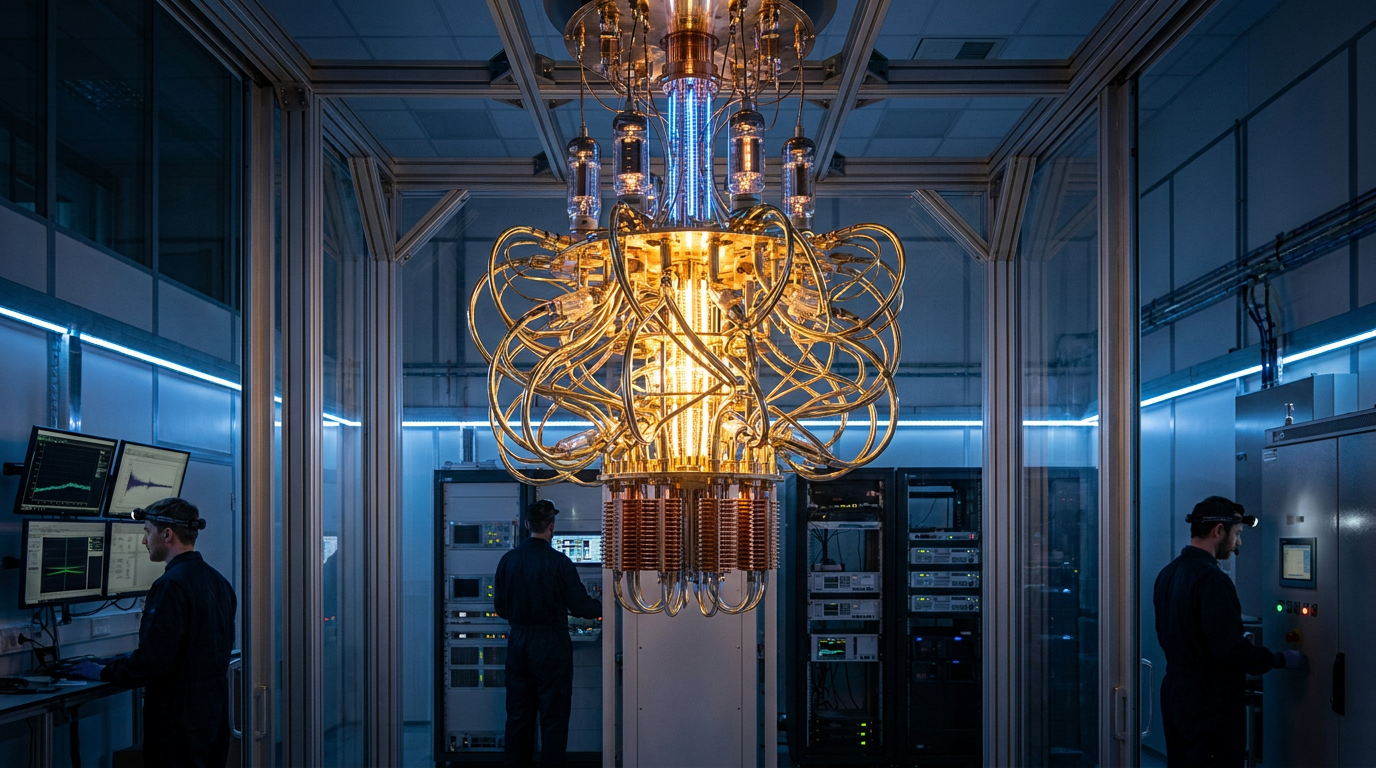
The hardware race is now diversifying rapidly as these error-correction techniques prove viable across different mediums. While Google and IBM rely on superconducting circuits chilled to near absolute zero, QuEra uses neutral atoms manipulated by lasers, and Microsoft is pursuing "topological" qubits.[1][3]
Microsoft recently unveiled its Majorana 2 chip, which utilizes topological qubits that offer hardware-level protection against noise. The company claims a 1,000-fold increase in stability, with qubits maintaining coherence for an average of 20 seconds—an absolute eternity in quantum mechanics.[1]
This rapid progress has forced the industry to aggressively revise its timelines. Microsoft, which previously targeted 2033 for a scalable machine, has moved its target to 2029. Other major players are similarly accelerating their roadmaps to deliver commercial fault-tolerant systems.[1][2]
The implications for enterprise and national security are profound. The mathematical threshold to break standard RSA-2048 encryption—the backbone of secure internet communications—lies in the range of a few thousand logical qubits.[2]
With the physical-to-logical overhead shrinking dramatically, the timeline for "Q-Day"—the moment quantum computers can break classical encryption—is accelerating. Security experts warn that adversaries are already harvesting encrypted data today with the intention of decrypting it once fault-tolerant hardware matures.[2][7]

Beyond cryptography, the arrival of stable logical qubits unlocks the true promise of quantum computing: simulating nature at the molecular level. Fault-tolerant systems will enable pharmaceutical companies to model complex protein interactions and materials scientists to design next-generation batteries without relying on physical trial and error.[3][7]
Challenges remain, of course. Scaling these systems from dozens of logical qubits to the tens of thousands required for the most complex algorithms will require massive engineering feats in cryogenics, laser control, and classical control electronics.[7]
Furthermore, logical qubits require logical operations. Executing complex algorithms requires "magic state distillation," a resource-intensive process of generating high-quality quantum states to perform universal gate operations. While Harvard and MIT recently demonstrated this at the logical level, scaling the "magic-state factories" remains a formidable hurdle.[4][7]
How we got here
Dec 2023
Harvard and QuEra demonstrate 48 logical qubits, proving early error correction on neutral-atom hardware.
Apr 2026
QuEra and MIT publish research achieving a 2:1 physical-to-logical qubit ratio using qLDPC codes.
Jun 2026
Microsoft and Quantinuum demonstrate logical qubits with 800x better error rates than physical qubits.
Jun 2026
Microsoft unveils the Majorana 2 chip and accelerates its scalable quantum timeline to 2029.
Viewpoints in depth
Hardware Engineers
Focused on the physical challenges of scaling quantum systems.
For hardware engineers, the breakthrough in logical qubits shifts the bottleneck from fundamental physics to classical engineering. The challenge now lies in building the massive cryogenic infrastructure, precise laser control systems, and classical control electronics required to manage tens of thousands of physical qubits simultaneously. They argue that while the theoretical math of error correction is solved, the physical footprint and energy requirements of commercial-scale quantum data centers remain a formidable hurdle.
Quantum Theorists
Focused on optimizing the mathematical codes that protect quantum information.
Theoretical physicists and mathematicians view the 2026 milestones as validation of decades of abstract work. Their focus is now on developing even more efficient quantum Low-Density Parity-Check (qLDPC) codes and improving "magic state distillation" protocols. They argue that further software-level algorithmic optimization can continue to drive down the physical overhead, making fault-tolerant quantum computing viable on even smaller, near-term hardware.
Enterprise & Security Adopters
Focused on the timeline for practical utility and the urgency of post-quantum cryptography.
For enterprise leaders and cybersecurity experts, the rapid reduction in logical qubit overhead is a blaring alarm. They point out that the mathematical threshold to break standard RSA-2048 encryption lies in the range of a few thousand logical qubits. With hardware timelines accelerating toward 2029, this camp argues that organizations must immediately migrate to post-quantum cryptography to defend against adversaries who are already harvesting encrypted data today to decrypt it tomorrow.
What we don't know
- Whether the massive cryogenic and laser infrastructure required for these systems can be economically scaled for commercial data centers.
- Exactly how long it will take to scale from today's dozens of logical qubits to the thousands required to break classical encryption.
- Which hardware architecture—superconducting, neutral atoms, or topological—will ultimately dominate the commercial market.
Key terms
- Physical Qubit
- The actual hardware component, such as an atom or superconducting circuit, that stores quantum information.
- Logical Qubit
- A highly stable, virtual qubit created by grouping multiple physical qubits together with error-correcting codes.
- Decoherence
- The process by which a quantum system loses its delicate quantum state due to environmental noise.
- Fault Tolerance
- The ability of a quantum computer to continue operating accurately even when individual physical components fail.
- Magic State Distillation
- A complex protocol used to generate the high-quality quantum states required to perform universal logical operations.
Frequently asked
Why are quantum computers so prone to errors?
Qubits rely on delicate quantum states like superposition, which are easily disrupted by microscopic changes in temperature, electromagnetic fields, or even stray photons.
What is the fault-tolerant threshold?
It is the mathematical tipping point where adding more physical qubits to an error-correcting code actually decreases the overall error rate, rather than adding more noise.
When will quantum computers be practically useful?
With recent breakthroughs reducing the physical overhead required for logical qubits, major hardware developers like Microsoft are now targeting the end of the decade (around 2029) for scalable, useful machines.
Will quantum computers break current encryption?
Yes. A fault-tolerant quantum computer with a few thousand logical qubits could break standard RSA encryption, prompting an urgent industry shift toward post-quantum cryptography.
Sources
Source coverage
7 outlets
3 viewpoints surfaced







[1]ForbesHardware Engineers
Microsoft releases its second-generation quantum chip
Read on Forbes →[2]ComputingEnterprise & Security Adopters
The era of error-prone physical qubits is over
Read on Computing →[3]Harvard UniversityQuantum Theorists
Harvard researchers realize key milestone in quest for stable, scalable quantum computing
Read on Harvard University →[4]QuEra ComputingQuantum Theorists
QuEra, Harvard, and MIT Demonstrate 2:1 Physical-to-Logical Qubit Ratio
Read on QuEra Computing →[5]QuantinuumHardware Engineers
Quantinuum and Microsoft achieve breakthrough in making fault tolerant quantum computing a reality
Read on Quantinuum →[6]Quantum ZeitgeistEnterprise & Security Adopters
Quantinuum's Logical Qubit Performance Surpasses Physical Qubits by 800x
Read on Quantum Zeitgeist →[7]Factlen Editorial TeamEnterprise & Security Adopters
Synthesis by Factlen editorial team
Read on Factlen Editorial Team →
Every angle. Every day.
Get technology stories with full source coverage and perspective breakdowns delivered to your inbox.