
The End of the Green Screen: How LED Volumes Are Reshaping Television Production
Powered by video game engines and massive LED screens, 'virtual production' is allowing television studios to shoot digital worlds in real time, saving millions while reducing their carbon footprint.
By Factlen Editorial Team
- Virtual Production Advocates
- Studios and tech vendors who view LED volumes as the sustainable, efficient future of filmmaking.
- Traditional Cinematographers
- Directors of photography who value the technology but caution against over-reliance on digital environments.
- Industry Analysts
- Market researchers tracking the explosive financial growth and logistical hurdles of the XR sector.
What's not represented
- · Below-the-line set builders
- · Location scouts
Why this matters
Virtual production is fundamentally changing the economics of the entertainment industry. By drastically reducing the need for location shoots and post-production, it allows networks to produce cinematic-quality television faster, cheaper, and with a significantly lower environmental impact.
Key points
- LED volumes use video game engines to render digital backgrounds that respond to camera movement in real time.
- The technology eliminates green screen 'spill' by using the LED panels to naturally light the actors.
- Virtual production drastically reduces the logistical costs and carbon footprint associated with location shooting.
- The VP market is projected to grow from $3.3 billion in 2026 to $18.5 billion by 2035.
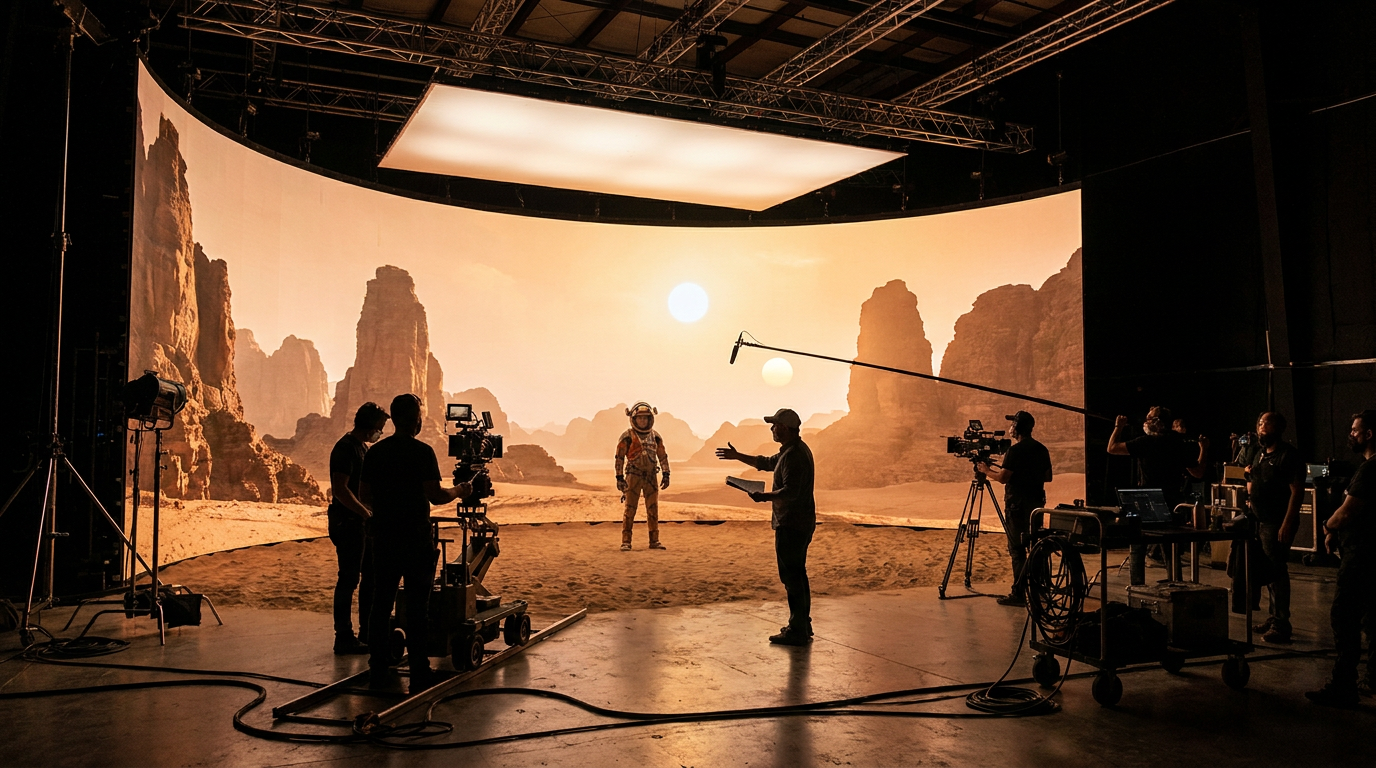
The magic of television has always relied on a fundamental illusion: making the audience believe the characters are somewhere they are not. For decades, this meant either expensive, logistically complex location shoots or the sterile, abstract void of a green screen. But a quiet revolution has fundamentally rewired how television is made. The technology known as "Virtual Production" (VP), powered by massive, immersive LED screens called "volumes," has moved from a bleeding-edge experiment to an industry standard. It is reshaping the economics, the environmental footprint, and the creative boundaries of modern storytelling.
What began as a bespoke, highly experimental solution developed by Industrial Light & Magic for Disney's The Mandalorian has rapidly proliferated across the global entertainment landscape. By the end of 2023, there were over 200 permanent LED in-camera visual effects (ICVFX) volumes installed globally, with Europe accounting for a third of the market. The economic footprint of this shift is staggering. Industry analysts project the virtual production market will reach $3.3 billion in 2026, doubling to $6.5 billion by 2030, and surging to an estimated $18.5 billion by 2035.[1][2]
To understand why studios are pouring billions of dollars into this technology, one must understand the underlying mechanism. An LED volume is not simply a large television acting as a static backdrop. It is a massive, architectural array of high-definition LED panels arranged in curved walls, and often encompassing ceilings and floors, that wrap the actors in a fully realized digital environment. The true magic lies in the software integration. Powered by real-time rendering engines originally built for the video game industry—most notably Epic Games' Unreal Engine—the digital backgrounds respond instantaneously to the physical camera's movement on the soundstage.[3]

This real-time synchronization creates perfect "parallax." In the physical world, if a camera pushes in on an actor, the distant mountains in the background shift perspective at a different rate than the objects in the foreground. The LED volume replicates this optical physics perfectly. The result is what the industry calls "in-camera compositing" or achieving "final pixel" on set. Instead of shooting actors against a green void and spending months in post-production digitally painting the world behind them, the final environment is captured live through the camera lens, exactly as the audience will eventually see it.[3][4]
This workflow solves one of the most notorious and persistent problems of traditional green screen acting: lighting contamination. When an actor stands in front of a bright green wall, green light inevitably spills onto their skin, their hair, and any reflective props they are holding. In an LED volume, the screen itself provides the ambient lighting. If a scene is set during a fiery, apocalyptic sunset, the LED panels emit the exact amber and crimson hues of that sunset, wrapping the actors and the physical set pieces in authentic, interactive light that requires zero digital correction.[4]
HBO's fantasy epic House of the Dragon utilized this technology to spectacular effect, proving its viability for massive scale television. For the show's complex dragon-riding sequences and sprawling environments like the Dragonstone bridge, the production relied heavily on Warner Bros.' massive V Stage at Leavesden. Cinematographers on the series noted that the volume allowed them to judge the background and foreground simultaneously. They could light the physical set pieces—such as a stone parapet or a saddle—to match the digital extensions perfectly, creating a seamless blend between what was built by carpenters and what was rendered by computers.[5][8]

HBO's fantasy epic House of the Dragon utilized this technology to spectacular effect, proving its viability for massive scale television.
The integration of virtual production also fundamentally changes the dynamic for the actors. Performing in front of a green screen often requires a massive leap of imagination, forcing talent to react to tennis balls on sticks while pretending they are looking at a sweeping vista or a terrifying monster. Inside an LED volume, the actors can actually see the environment they are supposed to be inhabiting. This tangible visual feedback allows for more grounded, nuanced performances, as the cast can react organically to the digital world unfolding around them in real time.[6]
Beyond the immediate creative control, the financial and logistical incentives driving the adoption of virtual production are profound. The technology drastically reduces the need for "company moves"—the incredibly expensive and time-consuming process of relocating hundreds of crew members, trucks, and equipment to physical locations. In a single day, a production can shoot a complex dialogue scene in a digital Tunisian desert before lunch, and a tense standoff in a digital Brazilian rainforest after, all without ever leaving a climate-controlled soundstage in London or Los Angeles.[2]
This logistical efficiency translates directly to the bottom line, particularly for episodic television where budgets are tightly managed. According to industry reports, the FX television series Snowfall saved up to $49,000 per episode by utilizing virtual production to reduce transportation man-hours, location fees, and crew loads. By creating a highly controlled environment where almost all costs can be planned for in advance, studios are mitigating the unpredictable variables of location shooting, such as sudden weather changes, lost daylight, or permitting delays.[2]

The environmental impact of this shift is equally significant and increasingly relevant to modern studios. By eliminating the need for international flights for massive crews, reducing the fleet of diesel trucks required for location shoots, and minimizing the physical materials needed to build sprawling, single-use sets, LED volumes offer a substantially lower carbon footprint. The shift to virtual sets eliminates a vast amount of physical waste, aligning visual storytelling with the sustainability goals that many major broadcasting and streaming corporations have publicly committed to achieving over the next decade.[1][3]
However, the technology is not without its friction points and growing pains. The upfront capital expenditure required to build a state-of-the-art LED volume is immense, often running into the millions of dollars for the panels, processing units, and tracking hardware alone. Furthermore, operating these stages requires a highly specialized crew of XR (Extended Reality) technicians and Unreal Engine operators. The industry is currently facing a skills shortage in this specific intersection of filmmaking and video game design, which can drive up the daily operational costs for productions that lack experienced supervisors.[2][6]
Cinematographers also point out that LED panels have distinct physical limitations. While they excel at providing soft, ambient light and realistic reflections, the panels cannot always produce the harsh, directional shadows required for certain dramatic lighting setups. The light from the screens spreads out, meaning traditional film lighting fixtures must still be carefully integrated into the volume to shape the actors' faces and create depth. It requires a delicate balancing act between the digital illumination of the wall and the physical illumination of the stage.[6][8]

As the technology matures, the industry is bifurcating in its approach to the hardware. While massive mega-stages continue to be built—such as a recently unveiled 5,000-square-meter facility in China featuring a 270-degree curved wall that is the size of four basketball courts—there is a rapidly growing demand for smaller, modular setups. These nimble configurations allow independent productions, advertising agencies, and lower-budget television shows to rent a 10-by-20-foot screen for a specific driving sequence or a single window backdrop, democratizing access to the technology.[7]
Ultimately, the LED volume is not a complete replacement for location shooting, nor is it a magic bullet that can fix a poorly written script. It is, as veteran cinematographers describe it, another incredibly powerful tool in the filmmaking tool belt. But it has fundamentally rewritten the grammar of television production. By merging the physical and digital worlds in real time, virtual production has proven that the future of storytelling will not just be filmed—it will be rendered live.[6][9]
How we got here
2019
Industrial Light & Magic debuts the StageCraft LED volume system on Disney+'s The Mandalorian.
2021
The Nostradamus Report predicts virtual production will be completely normalized across the industry by 2026.
2023
Global installations of permanent LED volumes surpass 200 facilities.
2025
The world's largest LED virtual production volume, spanning 5,000 square meters, opens in China.
Viewpoints in depth
Virtual Production Advocates
Studios and tech vendors who view LED volumes as the sustainable, efficient future of filmmaking.
This camp argues that the ability to achieve 'final pixel' on set fundamentally streamlines the production pipeline. By eliminating the unpredictability of weather, the massive carbon footprint of location travel, and the lengthy delays of post-production compositing, they believe virtual production is an economic and environmental necessity. They point to the rapid proliferation of both mega-stages and modular setups as proof that the industry is permanently moving away from traditional green screens.
Traditional Cinematographers
Directors of photography who value the technology but caution against over-reliance on digital environments.
While acknowledging the incredible utility of in-camera compositing, this camp emphasizes the physical limitations of LED panels. They argue that screens cannot replicate the hard, directional shadows of natural sunlight or traditional film fixtures, requiring a hybrid approach to lighting. Furthermore, they caution that virtual sets should not entirely replace location shooting, as the serendipity and authentic texture of the real world cannot always be perfectly rendered by an algorithm.
Industry Analysts
Market researchers tracking the explosive financial growth and logistical hurdles of the XR sector.
Analysts focus on the staggering economic projections, noting the market's trajectory toward $18.5 billion by 2035. However, they also highlight the significant friction points slowing universal adoption: the massive upfront capital required to build a volume and a severe shortage of technicians trained in Unreal Engine. They predict that future growth will be driven not just by massive studio tentpoles, but by smaller, medium-sized facilities catering to episodic television and commercial advertising.
What we don't know
- Whether the skills shortage for Unreal Engine technicians will bottleneck the rapid expansion of smaller volume stages.
- How quickly the cost of high-resolution LED panels will drop to make the technology universally accessible to micro-budget indie films.
Key terms
- LED Volume
- A physical stage surrounded by high-definition LED screens that display digital environments in real time.
- In-Camera Compositing
- The process of capturing the final visual effect directly through the camera lens during filming, rather than adding it later in post-production.
- Parallax
- The visual effect where objects in the background appear to shift perspective at a different rate than objects in the foreground as the camera moves.
- Unreal Engine
- A powerful real-time 3D creation tool developed by Epic Games, widely used to render the digital environments displayed on LED volumes.
Frequently asked
What exactly is an LED volume?
An LED volume is a massive array of high-definition screens arranged in curved walls and ceilings that display real-time digital environments behind actors during filming.
Does this mean green screens are obsolete?
Not entirely. While LED volumes are replacing green screens for many environmental shots, traditional green screens are still used for specific visual effects that require complex post-production manipulation.
How does virtual production save money?
It eliminates the need to travel to physical locations, reduces the size of the crew required, and drastically cuts down the time and money spent adding digital backgrounds in post-production.
What software powers these virtual sets?
Most LED volumes are powered by real-time rendering engines originally developed for video games, with Epic Games' Unreal Engine being the industry standard.
Sources
Source coverage
9 outlets
3 viewpoints surfaced









[1]Futuresource ConsultingIndustry Analysts
Virtual Production & XR report
Read on Futuresource Consulting →[2]Garden StudiosVirtual Production Advocates
The landscape of virtual production in 2026
Read on Garden Studios →[3]MediumIndustry Analysts
The future is rendered live: From physical sets to virtual studios
Read on Medium →[4]VU StudioVirtual Production Advocates
Benefits of LED walls for virtual production
Read on VU Studio →[5]British CinematographerTraditional Cinematographers
House of the Dragon virtual production
Read on British Cinematographer →[6]VFX VoiceTraditional Cinematographers
Virtual Production in 2026
Read on VFX Voice →[7]AVIXAVirtual Production Advocates
World's largest LED virtual production volume unveiled
Read on AVIXA →[8]Post PerspectiveTraditional Cinematographers
House of the Dragon LED volume
Read on Post Perspective →[9]Factlen Editorial TeamVirtual Production Advocates
Synthesis by Factlen editorial team
Read on Factlen Editorial Team →


Every angle. Every day.
Get entertainment stories with full source coverage and perspective breakdowns delivered to your inbox.