
Smart Ring vs. Smartwatch: How to Choose the Right Health Tracker in 2026
The wearable market has split into two distinct philosophies: the passive, sleep-focused smart ring and the active, screen-based smartwatch. Understanding the trade-offs in comfort, accuracy, and battery life is essential to finding the device that fits your daily routine.
By Factlen Editorial Team
- Passive Health Trackers
- Prioritize comfort, sleep optimization, and low-friction data collection over real-time coaching.
- Active Fitness Enthusiasts
- Value real-time feedback, GPS tracking, and on-screen workout metrics for athletic performance.
- Clinical Data Analysts
- Focus on the raw accuracy of sensor placement, comparing finger PPG signals to wrist-based algorithms.
- Factlen Editorial Team
- Synthesizes the market landscape to provide actionable buying guidance based on lifestyle fit.
What's not represented
- · Traditional watchmakers losing wrist real estate
- · Medical professionals diagnosing sleep disorders
Why this matters
Choosing the right wearable fundamentally changes how you interact with your health data. Picking the wrong form factor often leads to an abandoned device sitting in a drawer, while the right choice seamlessly integrates into your lifestyle to provide actionable insights for better sleep, recovery, and fitness.
Key points
- Smart rings excel at sleep and recovery tracking due to their lightweight, comfortable design.
- Smartwatches dominate active fitness tracking with real-time screens and built-in GPS.
- Finger-based sensors provide cleaner resting heart rate data than wrist-based sensors.
- Smartwatches require frequent charging, which can create gaps in continuous health data.
- Many smart rings require ongoing monthly subscriptions to access full health insights.
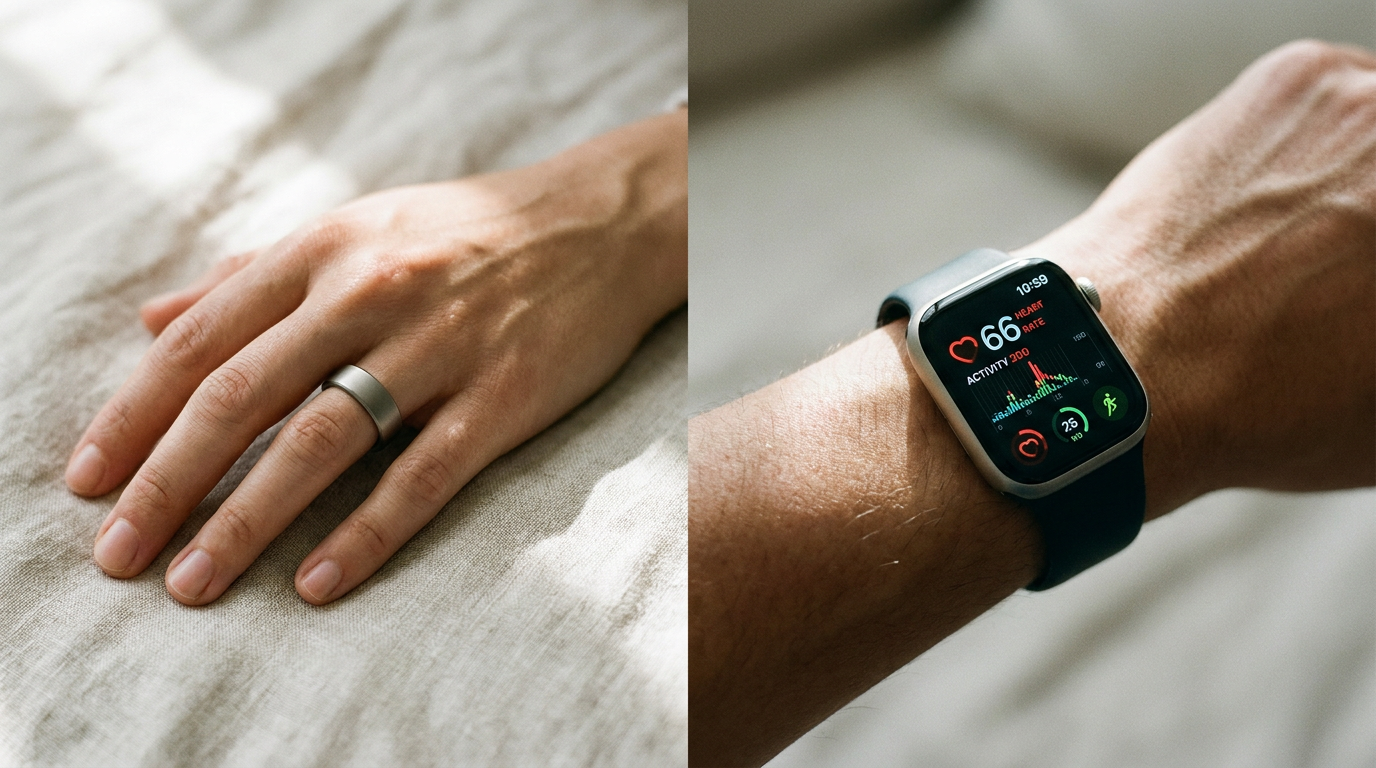
The wearable health technology market has decisively split into two distinct form factors by 2026, forcing consumers to choose between fundamentally different approaches to self-quantification. On one side is the smartwatch, an active, screen-based wrist computer designed to coach users through their days. On the other side is the smart ring, a passive, screenless piece of jewelry engineered to observe biometric data from the background. Deciding between devices like the Apple Watch Series 11 and the Oura Ring 4 is no longer just a matter of aesthetics; it is a choice about how individuals want to interact with their health data.[1][4]
The philosophical divide between the two categories centers on the concept of friction. Smartwatches are active companions that demand attention, delivering real-time data, notifications, and workout coaching directly to the wrist. They are designed to be looked at and interacted with constantly. Smart rings, conversely, operate on a principle of passive observation. Weighing as little as four grams, they sit quietly on the finger, collecting continuous telemetry without ever buzzing with an email alert or displaying a screen. The data is only accessed when the user actively opens a companion smartphone app.[2][5]
The case for smart rings is strongest in the realm of sleep and recovery tracking, where comfort directly dictates data quality. Consistent nighttime wear is the foundational requirement for accurate sleep telemetry, and compliance rates are significantly higher for rings than for bulky wrist wearables. Many users find sleeping with a forty-gram smartwatch uncomfortable, leading to nights where the device is left on the nightstand. A smart ring, however, is easily forgotten once worn, ensuring uninterrupted data collection night after night, which allows algorithms to build highly accurate baseline models of a user's circadian rhythm.[2][3]

The evidence supporting ring accuracy during rest is rooted in human anatomy. The arteries in the finger are closer to the skin's surface and feature a denser capillary network than the wrist. This physiological advantage provides the photoplethysmography sensors in smart rings with a remarkably clean signal, free from the noise of ambient light or excessive motion. Clinical validation studies from 2025 and 2026 have consistently shown that smart rings outperform wrist-based trackers in measuring resting heart rate and heart rate variability, achieving near-parity with medical-grade electrocardiography during sleep.[3][6]
However, the case against smart rings becomes apparent the moment a user begins an active workout. Because they lack screens, rings cannot provide real-time feedback. A runner attempting to stay within a specific aerobic heart rate zone cannot glance at their finger to adjust their pace. Furthermore, the very anatomical advantage that makes rings so accurate at rest becomes a liability during heavy physical exertion. Gripping a barbell, holding bicycle handlebars, or performing rapid hand movements can shift the ring, breaking the sensor's contact with the skin and introducing significant data gaps during peak activity.[1][4]
This is exactly where the case for smartwatches becomes undeniable. For active fitness enthusiasts, a smartwatch acts as a dynamic dashboard. Devices like the Apple Watch or Garmin models provide immediate, on-wrist visibility into heart rate zones, pacing, interval timers, and distance covered. This real-time coaching loop is essential for athletes who need to adjust their effort mid-workout. The inclusion of built-in GPS further cements the smartwatch's dominance for outdoor activities, allowing runners and cyclists to map their routes and track elevation without needing to carry a smartphone.[5][6]
This is exactly where the case for smartwatches becomes undeniable.
The evidence for smartwatch efficacy during exercise is robust. While wrist sensors may struggle slightly more with resting heart rate variability than finger sensors, they excel at capturing high-intensity heart rates. Independent testing data shows that during moderate to vigorous exercise, wrist devices maintain ninety-four to ninety-seven percent accuracy compared to chest straps. Additionally, the sheer processing power housed within a smartwatch allows for complex, real-time algorithmic adjustments that filter out the "noise" of arm swings during a sprint, ensuring that the displayed heart rate remains reliable when the user needs it most.[4][6]

The primary argument against the smartwatch lies in its power consumption. The vibrant screens, continuous GPS tracking, and constant smartphone synchronization require immense energy, creating a severe battery bottleneck. Most mainstream smartwatches require charging every eighteen to thirty-six hours. This creates inevitable gaps in data collection, often occurring overnight or during the workday while the device sits on a charging puck. In contrast, smart rings easily sustain operations for five to eight days on a single charge, providing a seamless, uninterrupted stream of physiological data that paints a more complete picture of overall health.[1][7]
Financial trade-offs also play a critical role in the comparison, as the true cost of ownership often extends beyond the initial purchase price. Smartwatches generally demand a higher upfront investment, typically ranging from three hundred to eight hundred dollars, but rarely require ongoing subscriptions to access basic health data. Smart rings often feature a lower entry price of two hundred to four hundred dollars, but market leaders frequently lock their most valuable insights behind a monthly paywall. A six-dollar monthly subscription adds over one hundred and forty dollars to the cost of a ring over two years, fundamentally altering the value proposition.[4][7]
Ultimately, the smart ring fits well when a user's primary goals are sleep optimization, recovery tracking, and long-term health awareness. It is the ideal choice for individuals who want a device that disappears into their daily routine, collecting data passively without adding another screen to their lives. It is also the perfect solution for watch enthusiasts who want to track their health without giving up their traditional mechanical timepieces, allowing them to wear a classic watch on their wrist and a tracker on their finger.[2][5]

Conversely, the smart ring does not fit when a user requires real-time workout metrics, relies on GPS for outdoor training, or wants the convenience of wrist-based notifications. Runners, cyclists, and individuals who leave their phones behind during exercise will find the screenless, passive nature of a smart ring deeply frustrating and inadequate for their active coaching needs.[1][6]
The smartwatch fits well when a user trains regularly and relies on immediate feedback to guide their physical exertion. It is the superior choice for anyone who views their wearable as an extension of their smartphone, valuing the ability to check messages, control music, and follow guided workouts directly from their wrist. For the active athlete who needs a dashboard for their body, the smartwatch remains the undisputed champion.[4][5]
However, the smartwatch does not fit when a user suffers from sleep disturbances and finds glowing screens or bulky wristwear irritating at night. It is also a poor choice for individuals who experience "notification fatigue" and want to disconnect from the digital world, or for those who simply cannot commit to the daily charging routine required to keep a high-powered wrist computer operational.[3][7]

For a growing segment of data-driven biohackers in 2026, the answer is not a choice between the two, but an integration of both. By wearing a smartwatch during the day for active workout tracking and notifications, and switching to a smart ring at night for precise, comfortable sleep telemetry, users are bridging the gap. While this dual-device approach requires a significant financial investment and the management of multiple health apps, it represents the ultimate, uncompromising solution for capturing the most accurate physiological data across every phase of the human experience.[6][7]
How we got here
2015
The first generation of smart rings is introduced, focusing primarily on basic step counting and notifications.
2020
Apple Watch introduces native sleep tracking, validating the wrist as a 24/7 health monitor.
2022
Clinical studies confirm finger-based PPG sensors match medical-grade ECGs for resting heart rate accuracy.
2024
Samsung enters the smart ring market, pushing the screenless form factor into mainstream consumer awareness.
2026
The wearable market solidifies into distinct active (watch) and passive (ring) tracking philosophies.
Viewpoints in depth
The Passive Tracking Philosophy
Advocates for wearables that collect data without demanding user attention.
Proponents of passive tracking argue that health technology should operate in the background. By removing screens and notifications, smart rings reduce digital fatigue and anxiety. This camp believes that the most valuable health data is collected continuously over months and years, which requires a device so comfortable that the user forgets they are wearing it. For them, the lack of a screen is a feature, not a bug, ensuring that sleep and recovery metrics are gathered without the distraction of a glowing wrist.
The Active Coaching Philosophy
Believes wearables must provide real-time feedback to actively change behavior.
The active coaching camp views wearables as dynamic tools for immediate performance improvement. They argue that data is only useful if it can be acted upon in the moment—such as slowing down a run when a heart rate zone is exceeded, or standing up when prompted by a wrist vibration. This perspective values the smartwatch as a motivational dashboard, asserting that the friction of interacting with a screen is a necessary component of staying engaged with one's fitness goals.
What we don't know
- Whether smart rings will eventually incorporate non-invasive blood glucose monitoring.
- If subscription models for hardware will remain viable as competition in the ring market increases.
- How quickly battery technology will advance to allow smartwatches to match the multi-day lifespan of rings.
Key terms
- Photoplethysmography (PPG)
- A technology that uses light to measure changes in blood flow, commonly used in wearables to track heart rate.
- Heart Rate Variability (HRV)
- The variation in time between consecutive heartbeats, used as a key indicator of physical recovery and stress.
- Sleep Telemetry
- The automated collection and transmission of data regarding a person's sleep stages, duration, and quality.
- Form Factor
- The physical size, shape, and design of a hardware device.
Frequently asked
Can a smart ring track my running distance?
Most smart rings lack built-in GPS and screens, meaning they rely on your phone's location data and cannot show you real-time pacing while you run.
Do I have to pay a monthly fee to use a smart ring?
It depends on the brand; some market leaders require a monthly subscription to access detailed health insights, while others offer subscription-free models.
Which device is better for tracking weightlifting?
Smartwatches are generally better, as gripping heavy barbells can shift a smart ring, breaking sensor contact and potentially scratching the device.
Can I wear both a smartwatch and a smart ring?
Yes, many data-focused users wear a watch during the day for active tracking and a ring at night for comfortable, highly accurate sleep monitoring.
Sources
Source coverage
7 outlets
4 viewpoints surfaced







[1]ForbesPassive Health Trackers
Oura Ring 4 Vs. Apple Watch Series 11: Which Health Tracker Is Best?
Read on Forbes →[2]TechRadarPassive Health Trackers
Smart ring vs smart watch: Sleep tracking, energy and wellbeing
Read on TechRadar →[3]The Better Sleep ClinicClinical Data Analysts
Sleep Trackers & Sleep Measurement: How Accurate Are They?
Read on The Better Sleep Clinic →[4]JointCorpClinical Data Analysts
Smart Ring vs Fitness Tracker vs Smartwatch: Ultimate Comparison 2026
Read on JointCorp →[5]AskVoraActive Fitness Enthusiasts
The 2026 Wearable Decision Guide
Read on AskVora →[6]Bio-OSActive Fitness Enthusiasts
Wearable Comparison 2026: Apple Watch, Oura Ring, Whoop, Garmin
Read on Bio-OS →[7]Factlen Editorial TeamFactlen Editorial Team
Synthesis by Factlen editorial team
Read on Factlen Editorial Team →


Every angle. Every day.
Get shopping stories with full source coverage and perspective breakdowns delivered to your inbox.