
Why Mixing Up Your Study Subjects Is the Secret to Long-Term Memory
Cognitive scientists have found that "interleaved practice"—mixing related topics together rather than studying them one at a time—creates a desirable difficulty that drastically improves long-term retention.
By Ivan Smirnov

In short
- Blocked practice (studying one topic at a time) creates an illusion of mastery but leads to poor long-term retention.
- Interleaving mixes related topics together, forcing the brain to work harder to retrieve the correct strategy.
- This 'desirable difficulty' improves the brain's ability to discriminate between different types of problems.
Almost every student has experienced the ritual of the night-before cram session. The standard approach is to conquer one topic at a time: read the chapter on the French Revolution, master it, and then move on to the Industrial Revolution.
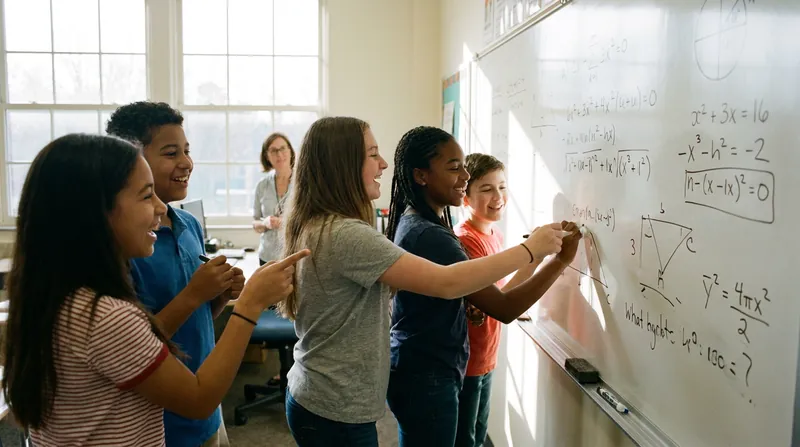
In mathematics, this looks like solving twenty algebra problems in a row before turning the page to geometry. Cognitive scientists call this "blocked practice," and surveys suggest that up to 99 percent of students rely on it as their primary study method. It is intuitive, it is highly organized, and in the short term, it feels incredibly effective.
But this feeling of rapid mastery is largely an illusion. When a learner focuses exclusively on a single concept for an extended period, the brain settles into a robotic rhythm. The correct strategy remains active in short-term memory, allowing the student to plug in numbers or facts without deeply processing the underlying logic.
It is the academic equivalent of hitting a tennis forehand from a ball machine that always fires to the exact same spot. The student performs flawlessly in practice, but when the actual exam presents a randomized mix of questions, the illusion of mastery shatters.
An alternative approach, backed by decades of cognitive psychology research, is quietly revolutionizing how experts recommend we learn. It is called "interleaved practice," and it involves deliberately mixing multiple related subjects or problem types within a single study session.
Instead of practicing in a blocked sequence—completing all the 'A' problems, then all the 'B' problems—an interleaved session scrambles the material into a mixed sequence like A-B-C-D. While it sounds chaotic, this simple rearrangement of information has been shown to drastically improve long-term retention and the ability to transfer knowledge to entirely new situations.[2][3]
The secret to interleaving's success lies in a concept called "discrimination learning." In the real world—and on cumulative exams—problems do not arrive neatly labeled with the strategy required to solve them. A student must first identify what kind of problem they are facing before they can apply the correct formula.
Blocked practice bypasses this crucial step entirely; if you are on the "multiplication" worksheet, you already know you need to multiply. Interleaving forces the brain to constantly compare and contrast different types of problems, teaching the learner not just how to use a strategy, but when to use it.[1][2]
Furthermore, interleaving capitalizes on a mechanism known as "retrieval strength." Every time a learner switches from topic A to topic B, and then back to topic A, the brain must work to reload the rules for topic A from long-term memory. This constant loading and unloading strengthens the neural pathways associated with the information. Cognitive psychologists refer to this friction as a "desirable difficulty." By making the initial learning process slightly more arduous and effortful, the brain builds more durable, flexible memory associations that resist forgetting.[1]
The empirical evidence for interleaving is striking, particularly in mathematics. In a landmark study led by cognitive scientist Doug Rohrer, researchers tested the method in middle school classrooms in Tampa, Florida. Students were taught algebra and geometry concepts, but their weekly homework assignments were structured differently. Half the students received traditional blocked worksheets focusing on a single topic, while the other half received interleaved worksheets containing a randomized mix of problem types they had learned previously.[1]
The results defied the students' own expectations. When tested one day later, the interleaved group scored 25 percent higher than the blocked group. But the true power of the method emerged over time. When the researchers administered a surprise test a full month later, the interleaving advantage skyrocketed to 76 percent. The students who had practiced in blocks suffered massive forgetting, while the interleaved students retained their mastery, proving that the friction of mixed practice pays massive dividends.[1]
The benefits of interleaving extend far beyond the math classroom. Motor learning researchers have found that athletes acquire physical skills more effectively when practice is randomized. In a classic study of badminton serves, players who interleaved three different types of serves during practice initially performed worse than those who practiced one serve at a time. However, when tested later in novel situations, the interleaved group demonstrated vastly superior recall and adaptability, proving that the brain learns physical patterns better when forced to constantly adjust.[3]
Similar effects have been observed in visual categorization and the humanities. In a foundational 2008 study, researchers asked participants to learn the distinct styles of various painters. Those who viewed paintings interleaved across different artists were significantly better at identifying the creators of unseen paintings later, compared to those who studied each artist's portfolio in a dedicated block. The brain's ability to tease out subtle stylistic differences was supercharged by the constant juxtaposition of different visual inputs.[2][3]
Despite this mountain of evidence, interleaving faces a massive public relations problem: students universally hate it. Because the method introduces friction and prevents the smooth, robotic rhythm of blocked practice, learners frequently feel like they are failing. In surveys, students consistently rate interleaved practice as less effective, more time-consuming, and highly frustrating. They prefer the immediate gratification of blocking, entirely unaware that their short-term fluency is coming at the direct expense of long-term retention.[1]
Educators emphasize that interleaving is not a wholesale replacement for traditional instruction. A student cannot interleave concepts they have not yet been introduced to. The consensus among learning scientists is to use a hybrid approach: begin with a brief period of blocked practice to establish a foundational understanding of a new concept, and then quickly transition to interleaved practice to cement the knowledge and build vital discrimination skills.[2][4]
For everyday learners, implementing interleaving requires a deliberate shift in study habits. Rather than devoting a three-hour session to a single subject, a student might spend 45 minutes on chemistry, 45 minutes on history, and 45 minutes on mathematics, cycling back through related concepts. It requires trusting the science of cognitive friction over the subjective feeling of ease. By embracing the struggle of mixed practice, learners can finally trade the fleeting comfort of the cram session for knowledge that actually lasts.[3][4]
Key terms
- Interleaved Practice
- A learning strategy where multiple related topics or problem types are mixed together during a single study session.
- Blocked Practice
- A traditional study method that focuses on mastering one single concept or skill at a time before moving on to the next.
- Desirable Difficulty
- A concept in cognitive psychology describing learning tasks that require a considerable but desirable amount of effort, thereby improving long-term retention.
- Discrimination Learning
- The ability to notice subtle differences between similar concepts, allowing a learner to know which specific strategy to apply to a given problem.
- Retrieval Strength
- How easily and reliably the brain can pull a piece of information from long-term memory into active working memory.
Reader questions
What is the difference between interleaving and blocking?
Blocking involves studying one topic or skill thoroughly before moving on to the next. Interleaving mixes multiple related topics or skills together in a single study session.
Does interleaving take more time than traditional studying?
No, it uses the exact same amount of study time. The difference is entirely in how the practice problems or subjects are arranged and sequenced during that time.
Can I use interleaving for subjects other than math?
Yes. Research shows interleaving is highly effective for learning languages, categorizing visual information (like art or biology), and acquiring physical motor skills in sports.
Why does interleaving feel so frustrating?
It prevents the brain from settling into a repetitive rhythm. By forcing you to constantly recall different rules and strategies, it creates a 'desirable difficulty' that feels harder but builds stronger memories.
Where opinion splits
Cognitive Scientists' view
Focuses on the neural mechanisms of learning, viewing the struggle of mixed practice as a necessary feature.
Cognitive psychologists argue that the human brain learns best when it is forced to overcome friction. They point to mechanisms like 'retrieval strength' and 'discrimination learning' as the core engines of memory. From this perspective, the frustration students feel during interleaved practice is not a sign of failure, but a 'desirable difficulty' indicating that deep, structural neural connections are being forged.
Educators' view
Advocates for a balanced classroom approach, using initial blocking to introduce concepts before transitioning to interleaving.
Teachers and instructional designers recognize the power of interleaving but caution against abandoning blocked practice entirely. They argue that a student cannot interleave a concept they do not yet understand. The pedagogical consensus is a hybrid model: introduce a new topic with a short block of focused practice to build confidence and basic understanding, then rapidly integrate it into an interleaved review cycle to ensure it is not forgotten.
Learners' view
Focuses on the subjective experience, noting that interleaving feels frustrating and counterproductive in the moment.
For the student actually doing the work, interleaving feels terrible. Because the brain is constantly shifting gears, learners make more mistakes during practice and feel a lack of fluency. This subjective experience leads many students to falsely conclude that the method isn't working, causing them to revert to the comfortable, robotic rhythm of blocked practice—even though the science proves they are sacrificing long-term retention for short-term comfort.
- Cognitive Scientists
- Focus on the neural mechanisms of learning, viewing the struggle of mixed practice as a necessary feature for long-term retention.
- Educators
- Advocate for a balanced classroom approach, using initial blocking to introduce concepts before transitioning to interleaving.
- Learners
- Often experience interleaving as frustrating and counterproductive in the moment, leading to a preference for easier study methods.
Perspectives this story doesn't cover
- EdTech Developers
- Special Education Specialists
Sources
Source coverage
4 outlets
3 viewpoints surfaced




- [1]Scientific AmericanCognitive Scientists
The Interleaving Effect: Mixing It Up Boosts Learning
Read on Scientific American → - [2]EdutopiaEducators
How to Use Interleaving to Foster Deeper Learning
Read on Edutopia → - [3]CourseraLearners
What Is Interleaving? How to Use This Deeper Learning Tool
Read on Coursera → - [4]Factlen Editorial Team
Synthesis by Factlen editorial team
Read on Factlen Editorial Team →

More in Education
See all →Federal Grants
OMB Proposes Overhaul of Federal Research Grants, Shifting Power from Peer Review to Political Appointees
4 sources

Education Finance
The $190 Billion 'Fiscal Cliff': How the End of Pandemic Relief is Forcing Schools to Rethink EdTech
2 sources

Numeracy Mandates
The Evidence on Numeracy: How States Are Mandating Early Screening and Advanced Access to Combat Math Deficits
2 sources
AI Adoption
The Evidence on AI's Policy Gap: 90% of Students and Teachers Adopt AI Tools Ahead of Formal Guidance
7 sources

Comments
Every angle. Every day.
Get Education stories with full source coverage and perspective breakdowns, free every day.