
How Next-Generation Geothermal Energy Works
By borrowing advanced drilling techniques from the oil and gas industry, Enhanced Geothermal Systems (EGS) are unlocking a nearly inexhaustible source of 24/7 clean energy.
By Factlen Editorial Team
- Geothermal Developers & Engineers
- Focused on scaling the technology and driving down drilling costs to make EGS globally competitive.
- Climate & Energy Policy Advocates
- View next-generation geothermal as the missing puzzle piece for a fully decarbonized grid.
- Fossil Fuel Transition Advocates
- See geothermal as the ideal bridge for the oil and gas workforce to enter the clean energy economy.
- Geological Risk Skeptics
- Urge caution regarding the upfront costs and the potential for induced earthquakes.
What's not represented
- · Local communities near proposed EGS sites concerned about induced seismicity
- · Water conservationists monitoring the aquifer impact of hydro-shearing
Why this matters
As the world races to phase out fossil fuels, the grid desperately needs 'firm' power that runs 24/7 when the sun isn't shining and the wind isn't blowing. Next-generation geothermal could provide that baseload, utilizing a fraction of the land required by other renewables while offering a direct transition for the oil and gas workforce.
Key points
- Conventional geothermal energy is limited to rare locations with natural underground heat, water, and permeability.
- Enhanced Geothermal Systems (EGS) bypass these limits by drilling into hot, dry rock and injecting fluid to create artificial reservoirs.
- The U.S. Department of Energy aims to reduce the cost of EGS to $45 per megawatt-hour by 2035, making it competitive with solar and wind.
- Next-generation geothermal provides 24/7 'firm' power, requires minimal land, and utilizes the existing skills of the oil and gas workforce.
The electrical grid's biggest challenge in the 21st century isn't just generating clean energy; it is generating it reliably when the sun isn't shining and the wind isn't blowing. To fully phase out fossil fuels, the world requires "firm" power—electricity that flows continuously, 24 hours a day, seven days a week. While massive battery arrays can bridge short gaps, long-duration baseload power remains the holy grail of the energy transition.[8]
For decades, geothermal energy seemed like the perfect solution, but it was geographically cursed. Conventional geothermal plants require a rare geological lottery to function: naturally occurring underground heat, abundant water, and highly permeable rock. Because these three elements rarely align, traditional geothermal has been confined to volcanic hotspots like Iceland, Kenya, or California's Geysers, severely limiting its global footprint.[3]
Now, a suite of technologies known collectively as "next-generation geothermal" is breaking those geographic chains. By borrowing advanced drilling techniques from the oil and gas industry, engineers are no longer hunting for natural hot springs. Instead, they are building them from scratch, unlocking the ability to generate clean power almost anywhere on Earth.[3][8]

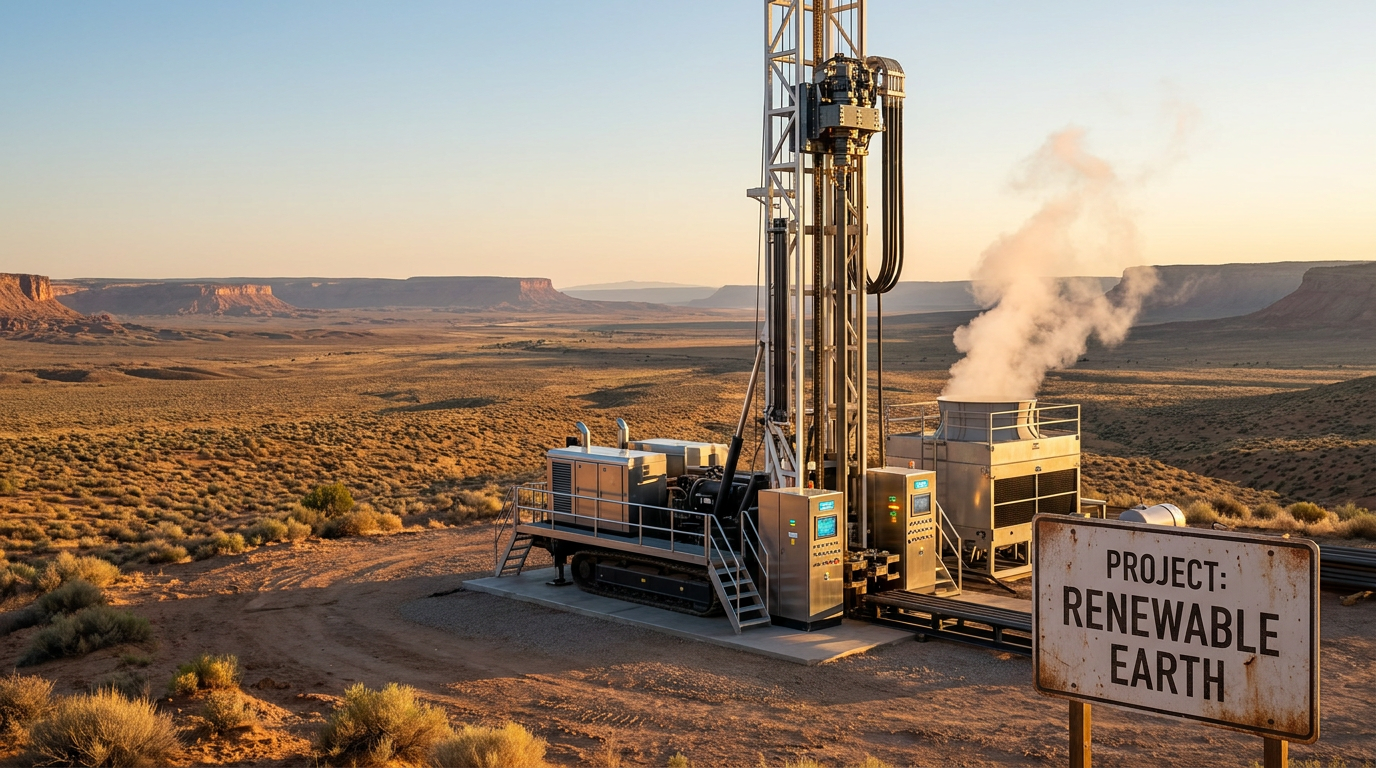
The most mature of these new approaches is the Enhanced Geothermal System (EGS). In an EGS, operators drill deep into hot, dry, and impermeable crystalline rock. Because there is no natural water flow, they inject fluid under high pressure to create or reopen a network of microscopic fractures in the rock—a process known as hydro-shearing.[1][3]
Once the artificial fracture network is established, cold water is pumped down an injection well. As the water flows through the newly created cracks, it absorbs the earth's immense ambient heat. A secondary production well then brings the superheated water back to the surface.[1]
At the surface, the heat is typically extracted using a "binary cycle" power plant. The hot geothermal fluid passes through a heat exchanger, transferring its thermal energy to a secondary working fluid with a much lower boiling point. This secondary fluid vaporizes, spins a turbine to generate electricity, and is then cooled and recycled in a closed loop, while the cooled geothermal water is injected back underground to repeat the cycle.[8]
These concepts are already moving rapidly from theory to commercial reality. Fervo Energy, a leading EGS developer, recently proved the commercial viability of its technology with a historic 30-day well test in Nevada, achieving unprecedented flow rates and demonstrating that artificial reservoirs can sustain high-output power generation without rapid thermal depletion.[5]
Fervo is now constructing Cape Station, a massive project in Utah permitted for up to 2 gigawatts (GW) of capacity. Backed by $255 million in recent funding and power purchase agreements with tech giants like Google, Cape Station is slated to begin generating electricity by 2026, marking a watershed moment for the industry.[5]
Fervo is now constructing Cape Station, a massive project in Utah permitted for up to 2 gigawatts (GW) of capacity.
The economic trajectory of EGS mirrors the early days of solar and wind. According to the World Resources Institute, drilling costs for early projects have already plummeted from $1,000 per foot to $400 per foot as companies move down the learning curve and optimize their horizontal drilling techniques.[3]

Recognizing this immense potential, the U.S. Department of Energy launched the "Enhanced Geothermal Shot," a federal initiative aimed at slashing the cost of EGS by 90% to $45 per megawatt-hour by 2035. Achieving this target would make enhanced geothermal fully cost-competitive with solar paired with battery storage.[1]
If EGS reaches these cost targets, the impact on the national grid would be staggering. A recent Princeton University analysis concluded that enhanced geothermal could deploy over 250 GW of capacity by 2050—supplying up to 20% of all U.S. electricity and emerging as the third-largest clean energy source behind wind and solar.[2]
Beyond EGS, engineers are also exploring "Advanced Geothermal Systems" (AGS), commonly referred to as closed-loop systems. Unlike EGS, which relies on fracturing rock and circulating fluid through the earth, AGS functions like a massive underground radiator. Sealed pipes are embedded in hot rock, and a working fluid circulates entirely within the pipes, absorbing heat conductively without ever touching the rock itself.[7]
The ultimate frontier, however, lies in "superhot rock" or supercritical systems. By drilling even deeper—to depths where temperatures exceed 375°C and pressures are immense—water enters a supercritical state, behaving simultaneously as both a liquid and a gas.[6][7]

The Clean Air Task Force notes that supercritical fluid holds significantly more enthalpy than standard hot water. This means a single superhot well could produce five to ten times the energy of a conventional geothermal well, potentially making it one of the most energy-dense and efficient power sources on the planet.[6]
Geothermal also boasts the lowest land-use footprint of any renewable energy technology. BloombergNEF highlights that a next-generation geothermal plant requires a mere fraction of the surface area needed for a comparable solar or wind farm, minimizing ecological disruption and avoiding the intense zoning battles that often plague sprawling renewable projects.[4]
Furthermore, the industry is uniquely positioned to absorb the existing oil and gas workforce. The same roughnecks, petroleum engineers, and drillers who powered the shale boom possess the exact skills needed to scale EGS, offering a seamless and lucrative transition for fossil-fuel communities into the clean energy economy.[1][8]

Challenges do remain, particularly regarding upfront capital costs and the risk of induced seismicity—minor earthquakes triggered by high-pressure fluid injection. Developers must carefully map subsurface stresses, avoid major fault lines, and work closely with regulators to mitigate these geological risks.[3][8]
How we got here
September 2022
The U.S. Department of Energy launches the Enhanced Geothermal Shot, aiming to cut EGS costs by 90% by 2035.
July 2023
Fervo Energy completes a historic 30-day well test in Nevada, proving the commercial viability of its EGS technology.
June 2024
Princeton University publishes a study projecting that EGS could supply up to 20% of U.S. electricity by 2050.
January 2025
Fervo secures $255 million to scale Cape Station, a 2 GW geothermal project slated to begin operations in 2026.
Viewpoints in depth
Geothermal Developers & Engineers
Focused on scaling the technology and driving down drilling costs to make EGS globally competitive.
For the engineering community, the primary hurdle has shifted from fundamental science to operational efficiency. Developers like Fervo Energy argue that by adopting the horizontal drilling and sensing technologies perfected during the shale boom, EGS can rapidly move down the cost curve. They point to recent field tests as proof that artificial reservoirs can sustain high flow rates without rapid thermal depletion, positioning geothermal as the ultimate scalable baseload.
Climate & Energy Policy Advocates
View next-generation geothermal as the missing puzzle piece for a fully decarbonized grid.
Policy analysts and environmental think tanks emphasize that a grid powered entirely by wind and solar is vulnerable to weather lulls and requires massive, expensive battery storage. They champion EGS because it provides 'firm' power—electricity that is always on. Furthermore, organizations like the World Resources Institute highlight its incredibly small land footprint, which avoids the intense zoning battles and habitat destruction often associated with sprawling solar and wind farms.
Fossil Fuel Transition Advocates
See geothermal as the ideal bridge for the oil and gas workforce to enter the clean energy economy.
The Department of Energy and labor advocates stress the socioeconomic benefits of EGS. The technology relies on the exact same skill sets—drilling, reservoir engineering, and well casing—that currently sustain the fossil fuel industry. This camp argues that scaling geothermal offers a 'just transition,' allowing roughnecks and petroleum engineers to apply their expertise to zero-carbon energy without abandoning their communities or taking pay cuts.
Geological Risk Skeptics
Urge caution regarding the upfront costs and the potential for induced earthquakes.
While supportive of clean energy, some geologists and local advocates warn that hydro-shearing is not without risks. Injecting high-pressure fluid into fault lines has historically triggered minor earthquakes—a phenomenon known as induced seismicity. This camp demands rigorous subsurface mapping, strict regulatory oversight, and transparent community engagement before large-scale EGS projects are permitted near populated areas.
What we don't know
- How quickly the supply chain for specialized high-temperature drilling equipment can scale to meet projected demand.
- Whether the cost of drilling superhot rock (supercritical) systems can be reduced enough to make them commercially viable.
- The long-term thermal degradation rate of artificial EGS reservoirs over decades of continuous fluid circulation.
Key terms
- Enhanced Geothermal Systems (EGS)
- Human-made underground reservoirs created by injecting fluid into hot, dry rock to extract heat for electricity.
- Hydro-shearing
- Pumping high-pressure water into naturally fractured rock to expand pre-existing cracks and enhance permeability.
- Binary Cycle Power Plant
- A facility where hot geothermal fluid heats a secondary fluid with a lower boiling point, which vaporizes to spin a turbine.
- Supercritical Fluid
- A state of matter achieved at extreme temperatures and pressures where a substance exhibits properties of both a liquid and a gas, holding massive amounts of energy.
- Baseload Power
- The minimum amount of electric power needed to be supplied to the electrical grid at any given time.
Frequently asked
How is EGS different from oil and gas fracking?
While both use fluid to fracture rock, EGS uses 'hydro-shearing' to open existing fractures without chemical proppants, and it extracts heat rather than hydrocarbons.
Can next-generation geothermal be built anywhere?
In theory, yes, if you drill deep enough. However, current economics favor regions where hot rock is closer to the surface, such as the Western United States.
What is 'firm' power?
Firm power refers to electricity generation that is available 24/7 and can be dispatched on demand, unlike intermittent sources like wind and solar.
Sources
Source coverage
8 outlets
4 viewpoints surfaced








[1]U.S. Department of EnergyFossil Fuel Transition Advocates
Enhanced Geothermal Shot
Read on U.S. Department of Energy →[2]Princeton UniversityClimate & Energy Policy Advocates
Enhanced geothermal systems could supply 20% of US electricity by 2050
Read on Princeton University →[3]World Resources InstituteClimate & Energy Policy Advocates
How Do Next-Generation Geothermal Technologies Work?
Read on World Resources Institute →[4]BloombergNEFClimate & Energy Policy Advocates
Next-Generation Geothermal Energy Poised for Takeoff
Read on BloombergNEF →[5]ESG NewsGeothermal Developers & Engineers
Fervo Energy Secures $255 Million to Build World's Largest Geothermal Power Development
Read on ESG News →[6]Clean Air Task ForceClimate & Energy Policy Advocates
DOE announces investment in renewable geothermal energy, including support for superhot rock energy
Read on Clean Air Task Force →[7]ThinkGeoEnergyGeothermal Developers & Engineers
Concept and Working Principle of Advanced Geothermal Systems
Read on ThinkGeoEnergy →[8]Factlen Editorial TeamGeological Risk Skeptics
Synthesis by Factlen editorial team
Read on Factlen Editorial Team →
Every angle. Every day.
Get guides stories with full source coverage and perspective breakdowns delivered to your inbox.