
The Rise of Balcony Solar: How Plug-and-Play Panels Are Democratizing Energy
A new wave of plug-and-play solar kits is allowing renters and apartment dwellers to generate their own electricity simply by plugging panels into a standard wall outlet.
By Factlen Editorial Team
- DIY Solar Advocates
- Argue that plug-and-play solar democratizes clean energy, allowing renters to bypass utility red tape and lower their bills.
- European Regulators
- Focus on streamlining adoption through standardized 800-watt limits and protecting renters' rights to install systems.
- Utility Companies
- Express concern over unmonitored grid backfeeding and advocate for strict safety standards and interconnection agreements.
- Hardware Manufacturers
- Emphasize the technological safety of modern microinverters and the ease of tool-free installation.
What's not represented
- · Homeowners' Associations (HOAs)
- · Traditional Rooftop Solar Installers
Why this matters
For decades, generating solar power required owning a home and paying for expensive rooftop installations. Plug-and-play solar bypasses these barriers, allowing renters to lower their electric bills using affordable hardware that requires no permits or electricians.
Key points
- Balcony solar kits allow renters to generate their own electricity by plugging panels directly into a standard wall outlet.
- The systems use microinverters to convert DC power to AC power, instantly offsetting a home's baseline energy draw.
- A new UL 3700 safety standard ensures the plugs go dead instantly if disconnected, preventing electric shocks.
- Over 30 U.S. states have introduced legislation to reclassify the kits as household appliances, bypassing utility red tape.
- A basic setup costs around $400 and can save users $30 to $50 a month on their electric bills.
For decades, the financial and logistical benefits of solar energy have been locked behind a formidable barrier to entry: homeownership. If you didn't own a roof, have a pristine credit score, or possess the capital for a $20,000 installation, generating your own power was virtually impossible. Renters, condo owners, and apartment dwellers were entirely shut out of the renewable energy transition, left to absorb the brunt of utility rate hikes that have surged by roughly 30% since 2020.[1][3]
But a quiet, decentralized DIY revolution is upending that dynamic. Across Europe, and increasingly in the United States, a technology known as plug-and-play solar is democratizing electricity generation. In Germany, where the movement began, these setups are so ubiquitous they have their own cultural moniker: the "Balkonkraftwerk," or balcony power plant. An estimated four million of these miniature solar arrays are currently hanging from German apartment railings, collectively generating nearly a gigawatt of power.[4][5][7]
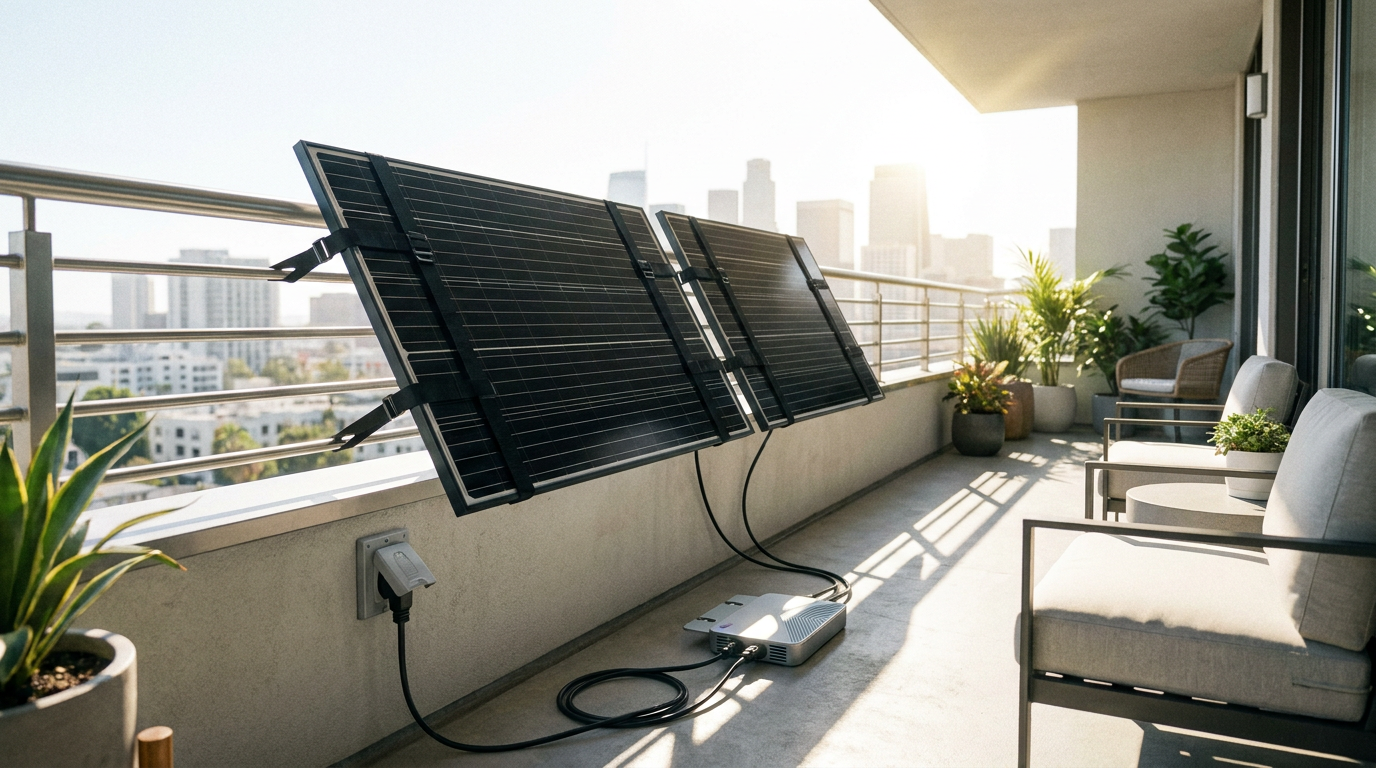
The premise of plug-and-play solar is radically simple. Unlike traditional rooftop arrays that require specialized mounting hardware, heavy-duty wiring, and a team of licensed electricians, a balcony solar kit is designed as a direct-to-consumer appliance. A standard kit consists of one to four lightweight, thin-film solar panels and a specialized microinverter. The entire package can weigh as little as 10 pounds per panel, making it easy for a single person to handle and maneuver.[3][5][6]
Installation requires no power tools and no structural modifications to the building. Users simply secure the panels to a balcony railing, patio fence, or backyard rack using heavy-duty straps or zip ties. The panels plug into the microinverter, and the microinverter plugs directly into a standard 120-volt outdoor wall outlet—the exact same way you would plug in a toaster or a string of patio lights. The entire setup process typically takes less than 15 minutes.[1][3]

The magic of the system lies in the microinverter. Traditional solar panels generate direct current (DC) electricity, which must be converted to alternating current (AC) to be usable in a home. In a plug-and-play setup, the microinverter handles this conversion locally and immediately synchronizes the electrical frequency with the home's existing grid. Once plugged into the wall, the system begins feeding 120-volt AC power backward through the outlet and into the home's circuitry.[2][3][6]
Because electricity follows the path of least resistance, the power generated by the balcony panels is consumed first by whatever appliances are running on that circuit—a refrigerator, a Wi-Fi router, or a television. By supplying this baseline power locally, the home draws less electricity from the external utility grid. The meter slows down, and the monthly electric bill drops, all without the need for a complex, hardwired interconnection to the main breaker panel.[1][3]
For years, the primary hurdle to plug-and-play solar in North America was safety anxiety. Utilities and regulators questioned what would happen if a user unplugged the system while it was generating power—would the exposed prongs of the plug carry a lethal charge? The industry solved this through a mechanism called anti-islanding. Modern microinverters are designed to detect the presence of the utility grid; if the plug is pulled from the wall, or if the neighborhood loses power, the microinverter cuts the current in less than a fraction of a second, rendering the prongs completely dead.[3][5]
For years, the primary hurdle to plug-and-play solar in North America was safety anxiety.
This technological safeguard was formally codified in the United States with the introduction of UL 3700, a rigorous safety standard published in December 2025. By January 2026, UL Solutions opened its testing and certification program specifically for "Interactive Plug-In Photovoltaic Equipment." This certification guarantees that approved systems will not overload standard household circuits and will safely shut down during grid outages, effectively neutralizing the primary arguments against their deployment.[3][5]
Despite these safety guarantees, the rollout in the U.S. has faced stiff resistance from utility monopolies. Many power companies have cited potential hazards to line workers and grid stability, arguing that unmonitored backfeeding could complicate grid management. Consumer advocates, however, dismiss these concerns as bureaucratic protectionism, pointing out that an 800-watt balcony system produces roughly the same electrical impact as a microwave, just in reverse.[4]

Frustrated by utility red tape, state legislatures have begun taking matters into their own hands. In 2025, Utah passed HB340, becoming the first state to officially legalize plug-in solar and strip utilities of the power to block them. This triggered a massive legislative wave. By mid-2026, 34 states and Washington D.C. had introduced similar bills, with successful legislation passing in Colorado, Connecticut, Maine, Maryland, New Hampshire, and Virginia.[1][4][5]
The core mechanism of these new laws is reclassification. Rather than treating a two-panel balcony setup as a "power generation facility"—which triggers months of waiting periods, permitting fees, and complex interconnection agreements—the new laws classify them as "household appliances." This legal shift entirely bypasses the utility company, allowing consumers to buy a kit online, plug it in, and start generating power the same day.[3]
The economics of balcony solar are highly accessible. A basic 400-watt kit from non-profits like Bright Saver or commercial brands typically starts between $300 and $400. For those with more space, a maximum-capacity 1,200-watt system costs between $1,000 and $1,500. Because the system is entirely DIY, the installation cost is zero, and the new state laws eliminate the permitting fees that often inflate the cost of traditional solar.[1][3][8]

While a balcony system won't take a home off the grid, it effectively shaves off the expensive top tier of a monthly power bill. Users typically see savings of $30 to $50 a month, depending on local electricity rates and the orientation of their balcony. In Europe, where electricity is generally more expensive, systems often pay for themselves in two to three years. In the U.S., the payback period hovers around four to five years, after which the panels provide free electricity for their remaining 15-to-20-year lifespan.[1][5]
One crucial technical requirement for users is ensuring they have a modern smart meter installed by their utility. Older, purely digital meters cannot distinguish between power consumed and power generated; if a balcony system pushes excess power back into the grid, an old meter might mistakenly register it as consumption, actually increasing the bill. Smart meters, which are now standard in most U.S. homes, correctly track the bidirectional flow of electricity.[2]
The next frontier for the Balkonkraftwerk movement is portable energy storage. As the market matures in 2026, manufacturers are increasingly pairing microinverters with compact lithium-iron-phosphate batteries. These units sit on the balcony and store excess solar power generated during the midday sun, discharging it into the home during the evening peak hours when electricity rates are highest, further accelerating the financial payback.[1][4]

The environmental aggregate of these tiny systems is staggering. In Germany alone, the million-plus registered balcony systems eliminate an estimated 310,000 metric tons of CO2 every year—the equivalent of taking 67,000 gas-powered cars off the road. By breaking solar power into bite-sized, affordable increments, the technology is mobilizing millions of citizens who previously had no way to participate in the green transition.[4][5]
Ultimately, the rise of plug-and-play solar represents a fundamental shift in the relationship between consumers and their energy. It transforms renters from passive ratepayers into active energy producers. As regulatory barriers continue to fall across the United States, the balcony power plant is poised to become as standard in the modern apartment as a window air conditioner—a simple, plug-in tool for personal energy independence.[1][4][8]
How we got here
2019
Germany creates the first formal legal framework allowing small plug-in solar systems.
2024
German regulations are simplified, raising the legal limit to 800 watts and granting renters the right to install systems.
March 2025
Utah passes HB340, becoming the first U.S. state to officially legalize plug-in solar and bypass utility interconnection rules.
January 2026
UL Solutions opens its testing program for the UL 3700 safety standard, providing a rigorous safety benchmark for U.S. systems.
Mid-2026
Over 30 U.S. states introduce legislation to reclassify balcony solar kits as household appliances.
Viewpoints in depth
DIY Solar Advocates
Argue that plug-and-play solar democratizes clean energy for renters and bypasses utility monopolies.
Advocates view balcony solar as a matter of personal energy independence and economic fairness. For decades, the financial benefits of clean energy subsidies and lower power bills were exclusively captured by wealthy homeowners who could afford $20,000 rooftop installations. By reducing solar to a $400 appliance that plugs into a wall, advocates argue the technology finally allows renters and lower-income households to participate in the green transition. They heavily lobby state legislatures to reclassify these systems as 'appliances' rather than 'power generation facilities,' a legal distinction that strips utility companies of their ability to demand expensive interconnection agreements, permitting fees, and months-long waiting periods.
Utility Companies
Express concern over unmonitored grid backfeeding and advocate for strict safety standards.
Power companies and grid operators approach the plug-and-play trend with deep caution. Their primary concern is grid stability and the safety of line workers. Utilities argue that if thousands of unmonitored devices are suddenly pushing power backward into the grid, it complicates load balancing and infrastructure planning. Furthermore, they worry about the influx of cheap, uncertified hardware from overseas markets that might lack proper anti-islanding protections. While the introduction of the UL 3700 standard has alleviated some of these fears, many utilities still lobby for mandatory registration of all plug-in systems, arguing that they need visibility into where power is being generated to safely manage the local distribution network.
European Regulators
Focus on streamlining adoption through standardized limits and protecting renters' rights.
European policymakers, particularly in Germany, have fully embraced balcony solar as a critical tool for meeting national climate targets and reducing reliance on imported natural gas. Rather than fighting the trend, they have focused on creating a frictionless regulatory environment. In 2024, Germany passed laws that explicitly prevent landlords and homeowners' associations from banning the systems without a severe structural justification. They also simplified the registration process to a five-question online form and raised the legal output limit to 800 watts. This regulatory embrace is based on the calculation that the collective gigawatts of power generated by millions of balconies far outweigh the minor administrative headaches of managing decentralized micro-generation.
What we don't know
- How quickly the remaining U.S. states will pass legislation protecting the right to install plug-in solar.
- Whether utility companies will attempt to introduce new grid-access fees specifically targeting plug-and-play solar users.
Key terms
- Microinverter
- A small device attached to a solar panel that converts the direct current (DC) electricity generated by the sun into the alternating current (AC) used by household appliances.
- Anti-islanding
- A safety feature in grid-tied solar systems that instantly shuts off power production if the grid goes down, preventing electricity from shocking utility line workers.
- Balkonkraftwerk
- German for 'balcony power plant,' referring to the massive cultural trend of renters installing small plug-in solar kits on their apartments.
- UL 3700
- A safety standard introduced in 2026 specifically for plug-in solar equipment, ensuring the systems won't overload household circuits.
- Smart Meter
- A modern digital electricity meter that can accurately track power flowing in both directions, essential for homes generating their own solar energy.
Frequently asked
Do I need an electrician to install balcony solar?
No. Plug-and-play systems are designed to be installed by anyone. The panels strap to a railing, and the inverter plugs directly into a standard wall outlet.
Will a balcony solar kit work during a power outage?
No. For safety reasons, the microinverter is required to shut down instantly if it detects a grid outage, preventing it from backfeeding power into dead power lines.
Can I take the solar panels with me if I move?
Yes. Because they are not permanently hardwired or bolted to a roof, you can simply unplug the system, unstrap the panels, and take them to your next apartment.
Can my landlord or HOA stop me from installing them?
It depends on your location. In Germany, renters have legal protection to install them. In the U.S., new state laws are increasingly preventing HOAs and landlords from banning balcony solar.
Sources
Source coverage
8 outlets
4 viewpoints surfaced








[1]The GuardianDIY Solar Advocates
Power to the people: how 'balcony solar' could help fight rising US utility costs
Read on The Guardian →[2]Solar Builder MagazineHardware Manufacturers
Current trends in the U.S. market for plug-in solar
Read on Solar Builder Magazine →[3]EcoFlowDIY Solar Advocates
Everything you need to know about balcony solar systems
Read on EcoFlow →[4]Skeptical ScienceUtility Companies
The 'Balkonkraftwerk' trend
Read on Skeptical Science →[5]WattBuildEuropean Regulators
Plug-in balcony solar regulatory breakthrough
Read on WattBuild →[6]APsystemsHardware Manufacturers
EZ1 Plug-In Microinverter for Balcony Solar
Read on APsystems →[7]PVProSolarEuropean Regulators
Legal framework for balcony power plants in Germany
Read on PVProSolar →[8]Bright SaverDIY Solar Advocates
Democratizing Solar with Plug-and-Play Kits
Read on Bright Saver →

Every angle. Every day.
Get home stories with full source coverage and perspective breakdowns delivered to your inbox.