
Local AI vs. Cloud AI: The 2026 Trade-Off Analysis
As open-weight models close the capability gap, the choice between running AI locally and using cloud APIs has shifted from a philosophical debate to a practical calculation of cost, privacy, and performance.
By Factlen Editorial Team
- Pragmatic Developers
- Focusing on cost-efficiency and using the right tool for the specific task.
- Privacy & Security Advocates
- Prioritizing data sovereignty and absolute control over sensitive information.
- Enterprise Cloud Adopters
- Valuing cutting-edge capability and zero-maintenance infrastructure.
What's not represented
- · Hardware Manufacturers
- · Regulatory Compliance Officers
Why this matters
Choosing the wrong AI infrastructure can lead to massive unnecessary API costs or critical data privacy leaks. Understanding when to run models locally versus in the cloud empowers developers and businesses to build more secure, cost-effective, and capable systems.
Key points
- Cloud AI models remain the best choice for complex reasoning and tasks requiring zero hardware setup.
- Local AI models offer absolute data privacy because prompts never leave the user's device.
- For high-volume tasks, the upfront cost of local hardware is significantly cheaper than recurring cloud API fees.
- Modern development teams are increasingly adopting hybrid architectures, routing simple tasks locally and complex tasks to the cloud.
- Tools like Ollama and LM Studio have made running local models accessible to non-technical users.
The artificial intelligence landscape in 2026 has shifted fundamentally, transforming what was once a philosophical debate about data privacy into a highly practical engineering decision. For anyone building or integrating AI, the default assumption that all workloads must be sent to a remote server is no longer absolute.[7]
In 2024, running a large language model on a personal computer was largely a hobbyist endeavor, fraught with complex configurations and slow response times. Today, highly optimized open-weight models like Llama 3.3, Qwen 2.5, and Mistral have closed the capability gap, making local deployment a viable, professional alternative to cloud giants like OpenAI and Anthropic.[2][3]
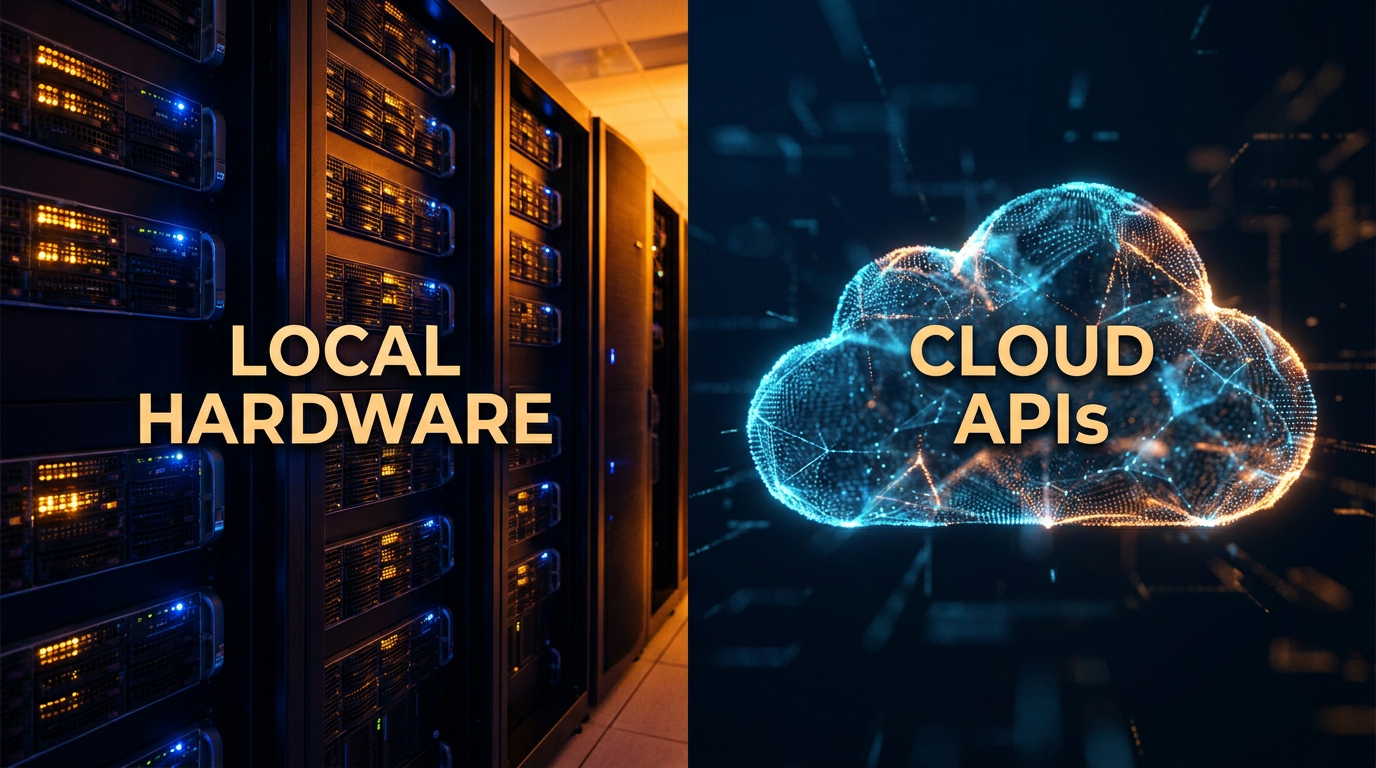
The choice between local and cloud AI is no longer about which is universally superior. Instead, it requires a calculated architectural trade-off involving data sovereignty, operational cost, network latency, and raw reasoning capability.[1][6]
The argument for cloud AI remains formidable. Cloud models—such as GPT-4o, Claude 3.7 Sonnet, and Gemini 2.0 Ultra—are the undisputed champions of raw intelligence. They consistently excel at complex reasoning, multi-file code refactoring, and advanced multimodal tasks that require massive computational overhead.[2][4]

Furthermore, cloud inference requires zero upfront hardware investment. Users simply pay a standard monthly subscription or a per-token API fee, making it the most accessible entry point for individuals and startups prototyping new applications without capital expenditure.[5]
However, the evidence against relying solely on the cloud centers on the "network tax" and scaling costs. Every prompt must travel to a remote server, adding hundreds of milliseconds of latency. At high volumes—processing millions of tokens daily—those seemingly cheap API costs can compound aggressively into tens of thousands of dollars.[1][6]
Local AI flips this paradigm by running the model's inference entirely on infrastructure you control, whether that is a developer workstation, an on-premise server, or an Apple Silicon laptop.[1][3]
The ecosystem powering this local revolution is split between command-line efficiency and graphical ease. Tools like Ollama have emerged as the developer favorite for seamless API integration, while LM Studio provides a highly polished, beginner-friendly desktop interface for testing models locally.[4][5]
The ecosystem powering this local revolution is split between command-line efficiency and graphical ease.
The strongest argument for local deployment is absolute data sovereignty. Because prompts never leave the device, local models provide the only viable, mathematically secure choice for handling sensitive healthcare records, proprietary codebases, and confidential legal documents.[1][5]
Economically, local AI requires a significant upfront investment in capable hardware, such as high-end GPUs or unified memory architecture. Yet, once that hardware is acquired, the marginal cost per token drops effectively to zero.[2][6]

For high-volume, repetitive tasks, the evidence shows that local hardware often pays for itself within 12 to 24 months. If an application processes millions of tokens daily, the fixed cost of a local server is vastly cheaper than accumulating endless cloud API charges.[3][6]
Despite these advantages, the argument against local models highlights distinct limitations. They are typically three to six months behind frontier cloud models in complex reasoning and require users to manage their own hardware, electricity, and system maintenance.[2][4]
Rather than treating this as a binary choice, sophisticated teams in 2026 are adopting hybrid architectures. They treat AI models much like databases, routing tasks dynamically based on specific requirements.[1][7]

The evidence supporting this hybrid approach is clear in developer adoption rates. Teams are actively routing routine operations, high-volume data formatting, and privacy-sensitive queries to local models, handling the "fast path" with minimal latency and no recurring costs.[5][6]
Conversely, when a task requires deep reasoning, massive context windows, or cutting-edge capabilities, the system must fall back to cloud APIs. This "hard path" ensures the highest quality output where it matters most, balancing cost with capability.[1][4]
In the final analysis, cloud AI fits well when you need maximum reasoning capability, are working with low request volumes, or want to avoid managing hardware entirely. It does not fit when absolute data privacy is required. Local AI fits well when data sovereignty is non-negotiable, when operating offline, or when processing massive volumes of predictable data. It does not fit when you need cutting-edge multimodality or lack the upfront capital for capable hardware.[2][7]

How we got here
2023
Cloud models like GPT-4 dominate the landscape, while local models remain experimental and difficult to run.
Early 2024
Open-weight models like Llama 3 begin closing the performance gap for routine tasks.
Late 2025
Tools like Ollama and LM Studio make one-click local AI deployment accessible to non-technical users.
2026
Hybrid architectures become the industry standard, seamlessly routing tasks between local and cloud models.
Viewpoints in depth
Privacy & Security Advocates
Prioritizing data sovereignty and absolute control over sensitive information.
For this camp, the decision begins and ends with data boundaries. Sending proprietary code, patient healthcare records, or confidential legal documents to a third-party server is viewed as an unacceptable risk. They argue that local models, even if slightly less capable than frontier cloud APIs, provide the only true guarantee against data leakage and vendor lock-in.
Pragmatic Developers
Focusing on cost-efficiency and using the right tool for the specific task.
This group rejects the binary choice between local and cloud, advocating instead for hybrid architectures. They point to the economics of scale: using cloud APIs for complex, low-volume reasoning tasks, while offloading high-volume, repetitive data processing to local hardware. Their primary metric is total cost of ownership combined with acceptable latency.
Enterprise Cloud Adopters
Valuing cutting-edge capability and zero-maintenance infrastructure.
For enterprise teams focused on rapid deployment, the overhead of managing local GPU clusters, updating model weights, and handling hardware depreciation is a distraction. They argue that the monthly subscription or API costs of frontier models like GPT-4o or Claude 3.5 are easily justified by the superior reasoning capabilities, multimodality, and immediate scalability.
What we don't know
- Whether future hardware advancements will make running frontier-level models locally affordable for average consumers.
- How cloud providers might adjust their API pricing models to compete with the rising popularity of free local inference.
Key terms
- Local LLM
- A large language model that runs entirely on your own hardware rather than a remote server.
- Inference
- The computational process of running live data through a trained AI model to generate a response.
- Quantization
- A compression technique that reduces the memory footprint of an AI model so it can run efficiently on consumer hardware.
- Open-weight model
- An AI model whose underlying architecture and parameters are publicly available for anyone to download and use.
- API
- Application Programming Interface; the mechanism used to send prompts to and receive responses from cloud-based AI models over the internet.
Frequently asked
Do I need an internet connection to run a local LLM?
No. Once the model weights are downloaded to your machine, local LLMs run entirely offline, making them ideal for air-gapped or secure environments.
Can a regular laptop run local AI models?
Yes, modern laptops with at least 16GB of RAM (especially Apple Silicon Macs) can comfortably run smaller models like Llama 3 8B, though larger models require dedicated GPUs.
Is local AI cheaper than paying for ChatGPT or Claude?
It depends entirely on volume. For casual use, a $20/month cloud subscription is cheaper than buying hardware. For high-volume automated tasks, local AI saves thousands in API fees.
Sources
Source coverage
7 outlets
3 viewpoints surfaced







[1]Decode AgencyPrivacy & Security Advocates
Local LLM vs cloud LLM: a practical comparison
Read on Decode Agency →[2]MindStudioEnterprise Cloud Adopters
The Gap Between Local and Cloud AI Is Closing
Read on MindStudio →[3]IJRASETEnterprise Cloud Adopters
Local LLM vs. Cloud LLM – Key Trade-Offs
Read on IJRASET →[4]Open Source AIPragmatic Developers
Local AI vs ChatGPT: When to run open models locally
Read on Open Source AI →[5]AskimoPrivacy & Security Advocates
ChatGPT vs Claude vs Gemini vs Ollama: Which AI Model Is Best?
Read on Askimo →[6]Reddit CommunityPragmatic Developers
The Real Trade-Off: Local LLMs vs Cloud (And How We Think About It)
Read on Reddit Community →[7]Factlen Editorial TeamPragmatic Developers
Synthesis by Factlen editorial team
Read on Factlen Editorial Team →

Every angle. Every day.
Get meta stories with full source coverage and perspective breakdowns delivered to your inbox.