
Sinner and Andreeva Lead Tennis Standings as Tours Pivot to Crucial Grass-Court Swing
Following dramatic results at Roland Garros, Jannik Sinner and Mirra Andreeva top the calendar-year standings as the ATP and WTA tours begin their sprint toward the year-end finals.
By Factlen Editorial Team
- Established Guard Advocates
- Commentators emphasizing the sustained excellence of Jannik Sinner, Alexander Zverev, and Elena Rybakina.
- Youth Movement Champions
- Analysts who see teenagers like Mirra Andreeva and Rafael Jodar as the new dominant forces.
- Surface Specialists
- Experts who view the abrupt shift to grass as the ultimate equalizer that can upend the current standings.
What's not represented
- · Lower-ranked players who rely on the grass-court season for their primary income and ranking points.
- · Tournament organizers managing the logistical challenges of maintaining grass courts during a condensed schedule.
Why this matters
The transition from clay to grass is the most abrupt shift in professional tennis. For fans tracking the sport, the next six weeks will definitively shape who qualifies for the prestigious year-end championships in Turin and Riyadh, while offering massive ranking opportunities for surface specialists.
Key points
- Jannik Sinner leads the ATP Race to Turin with 5,950 points following a dominant 37-3 start to the 2026 season.
- Alexander Zverev jumped to second place in the men's standings after capturing his first Grand Slam title at Roland Garros.
- 19-year-old Mirra Andreeva seized the number one spot in the WTA Race to Riyadh after her shocking French Open victory.
- Elena Rybakina remains a heavy favorite as the tour transitions to grass, boasting a 73% career win rate on the surface.
- The short, volatile grass-court swing offers a crucial opportunity for players to rapidly accumulate points before Wimbledon.
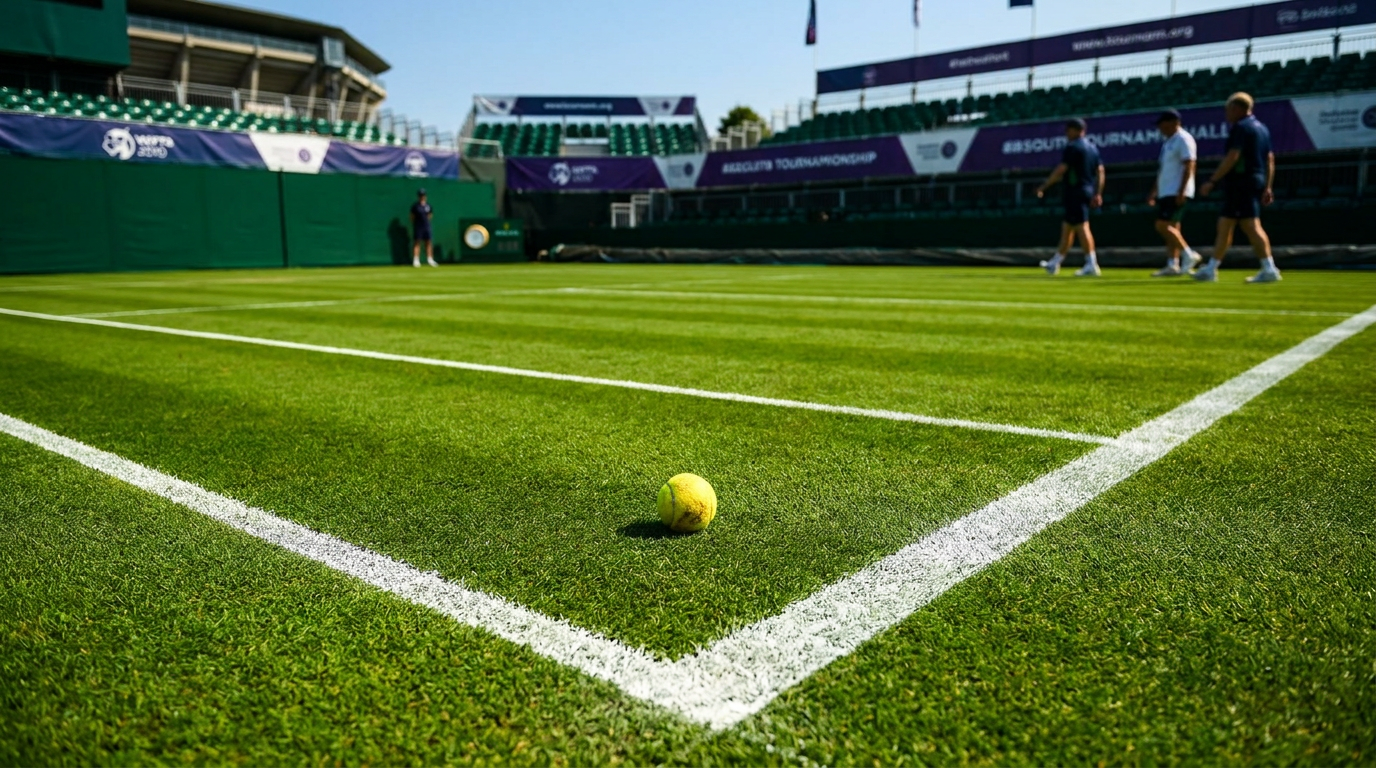
The red clay of Paris has barely been swept away, but the global tennis calendar waits for no one. As mid-June 2026 arrives, the ATP and WTA tours have executed their annual, abrupt pivot to the lush lawns of the grass-court season. With the surface change comes a critical juncture in the sport's overarching narrative: the race to qualify for the year-end championships. The standings for both the ATP Race to Turin and the WTA Race to Riyadh have been dramatically reshaped by the results of Roland Garros, setting up a high-stakes sprint through the shortest, most unpredictable swing of the year.[1][2]
On the men's side, the summit is currently occupied by Italy's Jannik Sinner, who commands the PIF ATP Live Race to Turin with 5,950 points. Sinner's 2026 campaign has been nothing short of historic; prior to the grass season, he compiled an astonishing 37-3 win-loss record, including a 30-match winning streak that stretched from Indian Wells to the early rounds of the French Open. Although a surprise second-round exit in Paris briefly halted his momentum, his sheer volume of victories keeps him comfortably ahead of his peers.[1][4]
The most significant mover on the ATP Tour is Alexander Zverev, who vaulted into second place with 5,040 points after a career-defining fortnight at Roland Garros. By defeating Italy's Flavio Cobolli in the championship match, the 29-year-old captured his first major title, joining Boris Becker and Michael Stich as the only German men to win a Grand Slam in the Open Era. The 2,000 points earned in Paris not only erased the ghosts of his past injuries but firmly entrenched him as a lock for the Nitto ATP Finals.[1]

Carlos Alcaraz holds steady in third place with 3,650 points, despite being forced to skip the French Open due to injury. Below the top trio, the standings are being aggressively disrupted by a youth movement. Nineteen-year-old Spaniard Rafael Jodar, who started the year outside the top 600, has surged to 12th in the Race to Turin. After winning his first ATP title in Marrakech and reaching the quarterfinals in Madrid, Rome, and Paris, Jodar is now testing his heavy baseline game on the unfamiliar lawns of the Queen's Club Championships.[1][8]
If the men's standings reflect a blend of established dominance and rising challengers, the women's WTA Race to Riyadh has been entirely upended by teenage brilliance. Nineteen-year-old Mirra Andreeva stunned the tennis establishment by capturing her maiden Grand Slam title at Roland Garros, dismantling Maja Chwalinska in a highly anticipated final. The victory yielded a massive 2,000-point windfall, catapulting Andreeva straight to the number one spot in the year-to-date standings. For a player who was grinding through the junior ranks just a few seasons ago, the triumph practically guarantees her a debut appearance at the prestigious WTA Finals in Saudi Arabia.[3][5]
If the men's standings reflect a blend of established dominance and rising challengers, the women's WTA Race to Riyadh has been entirely upended by teenage brilliance.
Andreeva's sudden ascension displaced the heavyweights who had monopolized the early months of 2026. Elena Rybakina, who boasts a 31-8 record and titles at the Australian Open and Stuttgart, slipped to second place in the Race. Yet, as the tour transitions to grass, Rybakina is widely viewed as the most dangerous player in the draw. Armed with a towering serve and flat, penetrating groundstrokes that skid perfectly off the turf, the 2022 Wimbledon champion holds a formidable 73% career win rate on grass.[4][6]

The six-week grass-court window is notoriously volatile, rewarding a highly specific skill set that can neutralize baseline grinders. Tournaments in Stuttgart, Halle, Berlin, and Nottingham offer rapid-fire tennis where quick reactions and first-strike aggression are paramount. For players hovering on the qualification bubble for Turin or Riyadh, these events present a golden opportunity. A title run at a WTA 500 or ATP 500 event can yield enough points to leapfrog half a dozen competitors in a single weekend.[2][4]
The stakes are magnified by the ATP and WTA's rolling 52-week ranking system, which forces players to defend the points they earned during the same weeks in 2025. This dynamic creates hidden advantages for players who underperformed last summer. Zverev, for instance, is defending a mere 210 points during this grass swing, giving him a mathematical runway to potentially overtake Sinner for the world number one ranking if he strings together deep runs in Halle and Wimbledon.[9]

Conversely, players who thrived on grass last year face immense pressure to replicate their success or risk plummeting down the standings. The margins for error on grass are razor-thin; a single bad bounce or a hot-serving opponent can result in an early exit, evaporating hundreds of ranking points in an afternoon. This urgency is palpable across the practice courts of Europe, where specialists and clay-courters alike are frantically adjusting their footwork and shortening their swings.[4][9]
As the summer progresses toward the grand stage of Wimbledon, the global tennis landscape remains wonderfully fractured. The established guard is fighting to maintain its grip, while a fearless new generation proves capable of winning on the sport's biggest stages. Whether it is Sinner's clinical precision, Zverev's newfound major-winning confidence, or Andreeva's fearless shot-making, the race to the year-end championships promises to be a thrilling, surface-spanning marathon.[1][3][5]
How we got here
Jan 2026
Elena Rybakina captures the Australian Open title, establishing an early lead in the WTA Race.
Apr 2026
Rafael Jodar wins his first ATP Tour title in Marrakech, sparking his rapid climb up the rankings.
Jun 7, 2026
Alexander Zverev wins Roland Garros, vaulting to second in the ATP Race to Turin.
Jun 8, 2026
19-year-old Mirra Andreeva wins the French Open, taking the number one spot in the WTA Race to Riyadh.
Jun 15, 2026
The grass-court season officially begins with tournaments in Stuttgart, 's-Hertogenbosch, and Nottingham.
Viewpoints in depth
Youth Movement Champions
Analysts who see teenagers like Mirra Andreeva and Rafael Jodar as the new dominant forces.
This camp argues that the 2026 season marks a definitive generational changing of the guard. Proponents point to 19-year-old Mirra Andreeva's stunning Roland Garros victory and Rafael Jodar's rapid ascent into the ATP top 25 as evidence that fearlessness and modern baseline power are overwhelming tour veterans. They believe these teenagers will not only qualify for the year-end finals but actively contend for the titles in Turin and Riyadh, unburdened by the accumulated fatigue that plagues older players.
Established Guard Advocates
Commentators emphasizing the sustained excellence of Jannik Sinner, Alexander Zverev, and Elena Rybakina.
Traditional analysts maintain that over a grueling 11-month season, consistency and physical resilience ultimately win out. They highlight Jannik Sinner's staggering 37-3 win-loss record and Elena Rybakina's proven pedigree on multiple surfaces as the true benchmarks of the sport. From this perspective, teenage breakthroughs are exciting but volatile; the year-end championships will inevitably be decided by the seasoned champions who know how to manage their bodies and peak during the biggest weeks of the calendar.
Surface Specialists
Experts who view the abrupt shift to grass as the ultimate equalizer that can upend the current standings.
Grass-court purists emphasize that the next six weeks are a completely different sport. Because grass demands lower bounces, shorter rallies, and superior net play, they argue that current clay-court momentum is largely irrelevant. This camp focuses on players with massive serves and flat groundstrokes, suggesting that the standings will experience massive turbulence before Wimbledon concludes, as clay-court specialists drop early and grass-court naturals hoard the available points.
What we don't know
- Whether Carlos Alcaraz will fully recover from his injury in time to defend his points during the grass-court swing.
- How 19-year-old Mirra Andreeva will adapt her game to the fast, low-bouncing grass courts after her triumph on clay.
- Which lower-ranked grass-court specialists might disrupt the standings with a surprise deep run at Wimbledon.
Key terms
- ATP Race to Turin
- A calendar-year ranking system that tracks points earned only during the current season to determine the eight men who qualify for the year-end ATP Finals.
- WTA Race to Riyadh
- The women's equivalent of the calendar-year rankings, determining the eight players who will compete in the season-ending WTA Finals in Saudi Arabia.
- Open Era
- The current era of professional tennis, which began in 1968 when Grand Slam tournaments allowed professional players to compete alongside amateurs.
- Grass-Court Swing
- A brief, six-week period in the tennis calendar during June and July where tournaments are played on natural grass, culminating at Wimbledon.
Frequently asked
How many players qualify for the year-end finals?
The top eight singles players and top eight doubles teams in the calendar-year Race standings qualify for both the ATP Finals in Turin and the WTA Finals in Riyadh.
Why are the Race standings different from the official world rankings?
The official world rankings use a rolling 52-week system, while the Race standings only count points earned since the beginning of the current calendar year.
How many points does a Grand Slam winner receive?
The champion of a Grand Slam tournament, such as Roland Garros or Wimbledon, receives 2,000 ranking points.
Why is the grass-court season so short?
Grass courts are difficult and expensive to maintain, and they wear down quickly under heavy play, limiting the viable window for professional tournaments to just a few weeks each summer.
Sources
Source coverage
9 outlets
3 viewpoints surfaced









[1]ATP TourEstablished Guard Advocates
Zverev climbs to second in Live Race following Roland Garros triumph
Read on ATP Tour →[2]WTA TourEstablished Guard Advocates
Grass-Court Swing 411: Dates, draws, prize money and everything you need to know
Read on WTA Tour →[3]Tennis365Youth Movement Champions
WTA Rankings Race To Riyadh: Andreeva soars to No 1
Read on Tennis365 →[4]TennisnerdSurface Specialists
Grass power rankings: 2026 ATP Tour
Read on Tennisnerd →[5]Tennis Up To DateYouth Movement Champions
WTA Race Update: Mirra Andreeva takes first place as Iga Swiatek drops out of the top-10
Read on Tennis Up To Date →[6]The IX SportsSurface Specialists
The WTA Race to Riyadh stretch run, explained
Read on The IX Sports →[7]Perfect TennisEstablished Guard Advocates
ATP and WTA Rankings - See The Latest 2026 World Rankings
Read on Perfect Tennis →[8]Next Gen ATPYouth Movement Champions
Jodar Queens Club 2026 Preview
Read on Next Gen ATP →[9]Tennis World USASurface Specialists
ATP Rankings: Points being dropped by Sinner, Alcaraz, Zverev during grass-court season
Read on Tennis World USA →

More in sports
See all 11 stories →Injury
Tour de France Injury Report: Van Aert Sidelined as Key Riders Race to Recover
8 sources
Standings
Pogačar and Del Toro Dominate June Standings as the 2026 Tour de France Looms
6 sources
Women's Rugby
The 2026 WXV Global Series: How World Rugby is Transforming the Women's Game
6 sources

Women's Wrestling
How Women's Wrestling Became the Fastest-Growing Sport in America
5 sources
Every angle. Every day.
Get sports stories with full source coverage and perspective breakdowns delivered to your inbox.