
The Great American AI Act of 2026: The Evidence Behind the Federal Push to Preempt State Laws
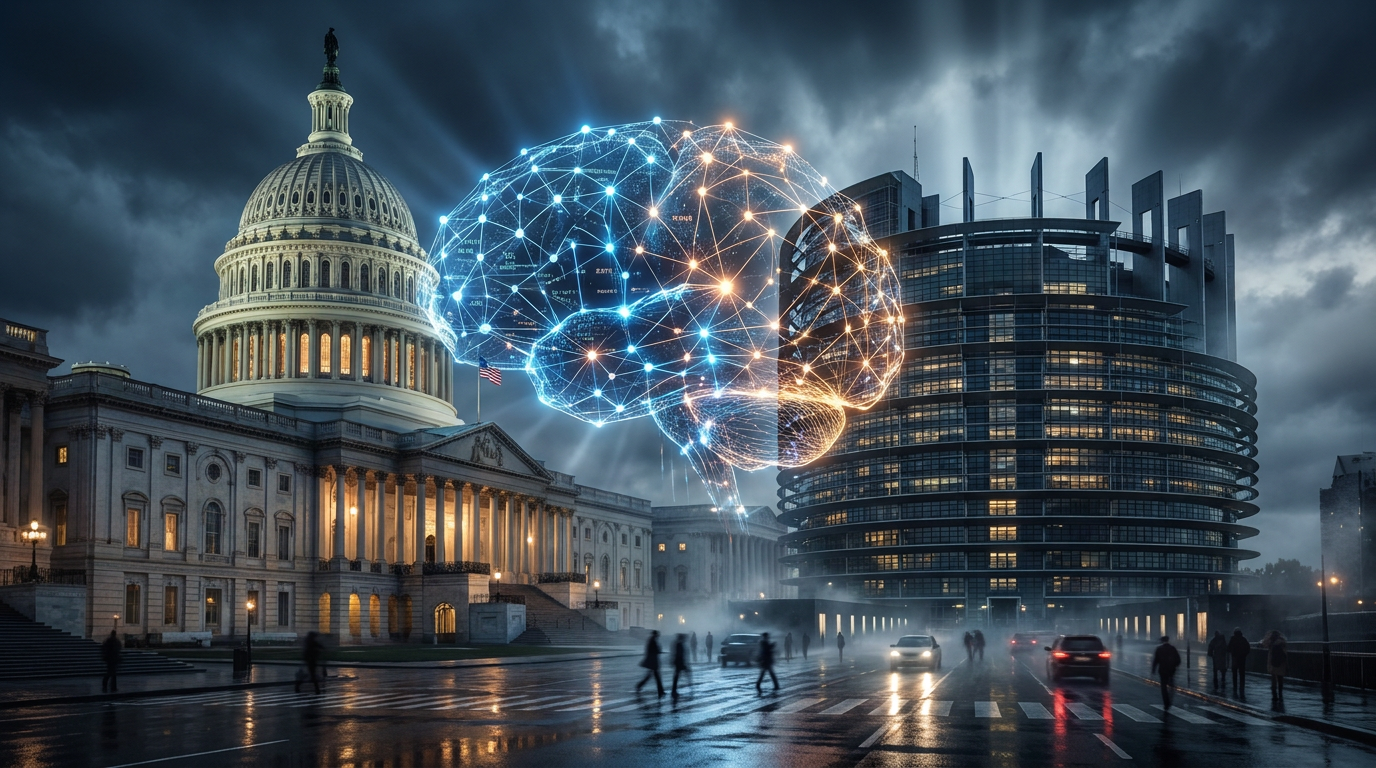
As the EU prepares to enforce strict AI bans and U.S. states implement their own regulations, Congress has introduced a sweeping bipartisan bill to nationalize artificial intelligence oversight.
By Factlen Editorial Team
- Unified Compliance Advocates
- Support federal preemption to create a single, navigable regulatory framework for AI.
- National Security Hawks
- View frontier AI models as critical defense assets requiring strict export controls.
- Labor & Civil Rights Protectors
- Prioritize immediate state-level action to prevent algorithmic bias and job displacement.
- Global Regulatory Enforcers
- Focus on strict, extraterritorial enforcement of high-risk AI systems via the EU AI Act.
What's not represented
- · Open-source AI developers facing compliance burdens
- · Small-to-medium enterprise (SME) AI deployers
Why this matters
The rules governing artificial intelligence are shifting from theoretical debates to enforceable laws with massive financial penalties. Whether you are a developer building models, an employer using automated hiring tools, or a consumer interacting with AI, these overlapping federal, state, and international regulations will directly dictate what technology you can access and how your data is used.
Key points
- The Great American AI Act of 2026 proposes a three-year preemption of state-level AI development laws.
- California has ordered the creation of an 'early warning' dashboard to track AI-driven job displacement.
- The U.S. Supreme Court has definitively ruled that AI systems cannot be granted copyright protection.
- The Trump administration blocked foreign access to Anthropic's newest models, sparking pushback at the G7 summit.
- The EU AI Act's strict high-risk enforcement begins in August 2026, carrying fines up to €35 million.
June 2026 has emerged as the most consequential month for artificial intelligence governance since the technology's commercial breakout. Across three continents, a collision of federal legislation, state-level executive orders, and international summits is replacing theoretical AI ethics with hard legal boundaries. At the center of this shift is the newly drafted Great American Artificial Intelligence Act of 2026, a 269-page bipartisan effort to nationalize AI oversight and preempt a fracturing landscape of state laws.[1][3]
The primary claim driving the federal push is that a patchwork of state-level regulations fundamentally stifles algorithmic innovation. The evidence for this fragmentation is strong. In recent months, Colorado replaced its landmark AI Act with the broader Automated Decision-Making Technology Act, while California, Illinois, and Connecticut advanced their own distinct compliance regimes. The Great American AI Act attempts to resolve this by preempting state laws that specifically regulate AI development for a three-year period, while preserving general state authority over post-deployment activities.[1][3]
However, the evidence supporting the efficacy of federal preemption remains contested. Civil society organizations argue that stalling state laboratories of democracy leaves consumers vulnerable, while industry groups like the Business Software Alliance maintain that unified national standards are the only way to scale frontier models. The draft bill pairs this preemption with mandatory transparency reports, whistleblower protections, and critical safety incident reporting for large-scale developers, mirroring the most stringent state requirements but applying them uniformly.[1][3]
The Great American AI Act's fourth title specifically addresses the evidentiary gap in AI training. It mandates provisions related to public data usage and requires developers to maintain transparent logs of the datasets used to train frontier models. This aligns with growing bipartisan sentiment—highlighted by an Annenberg Public Policy Center survey showing 65 percent of Americans believe the government has done too little to regulate AI—that the black-box nature of model development is no longer acceptable.[1]

A second major claim dominating the June policy landscape is that frontier AI models now constitute critical national security assets requiring strict export controls. The evidence for this shift materialized sharply when the Trump administration issued a directive preventing foreign nationals from accessing Anthropic's newest and most powerful models, Fable 5 and Mythos 5. The administration cited undisclosed security vulnerabilities, effectively treating commercial AI weights as classified munitions.[2]
The uncertainty surrounding this national security framing erupted at the Group of Seven (G7) summit in Evian-les-Bains, France. French President Emmanuel Macron publicly challenged the U.S. directive, labeling it a "strictly nationalist" reaction that threatens global democratic cooperation. Macron argued that cutting off allied access to frontier models could artificially depress the valuations of U.S. tech firms while forcing Europe to aggressively fund sovereign AI alternatives. OpenAI CEO Sam Altman echoed the need for an international forum to draw up guardrails, warning that safety cannot be left solely to the companies building the systems.[2]
Domestically, the claim that AI will cause imminent, large-scale labor displacement has moved from academic theory to executive action. The evidence here is rooted in preemptive state measures rather than historical job-loss data. On May 21, California Governor Gavin Newsom signed Executive Order N-6-26, directing state agencies to draft concrete policies on severance standards, expansions to the Worker Adjustment and Retraining Notification (WARN) Act, and potential revenue-sharing models for AI companies.[4]
Domestically, the claim that AI will cause imminent, large-scale labor displacement has moved from academic theory to executive action.
Beyond California, the patchwork of employment-related AI laws is already active. Colorado's regulations take effect in June 2026, while Illinois and New Jersey have staggered implementations running through the end of the year. These laws impose distinct requirements for risk assessment and anti-discrimination testing whenever automated decision tools are used in hiring or firing, forcing national employers to adopt the strictest state standard as their baseline.[4]

The uncertainty regarding actual workforce impact is explicitly acknowledged in the California order. Rather than acting on definitive job-loss figures, the state has mandated the creation of an "early warning system" dashboard within 90 days to track AI's sector-by-sector impact on employment. This reflects a broader regulatory consensus: governments lack the empirical data to prove AI's exact economic toll, but the political risk of being caught unprepared has necessitated immediate legislative scaffolding.[4][7]
California's executive order also explores radical new economic models to offset AI's societal costs. By October 2026, state agencies must present options for altering incentive structures, including mandatory programs that would direct a portion of revenue generated by AI companies to support beneficial public deployments. This represents a shift from merely mitigating AI's harms to actively redistributing the financial gains of automation.[4]
In the realm of intellectual property, the claim that AI systems cannot hold copyright has now been cemented by the highest judicial authority in the United States. The evidence is definitive: on March 2, 2026, the U.S. Supreme Court denied certiorari in Thaler v. Perlmutter, ending a years-long legal battle to secure copyright protection for artwork autonomously generated by an AI system named the "Creativity Machine."[6]
By refusing to hear the case, the Supreme Court left intact the D.C. Circuit's ruling that human authorship is a "bedrock requirement" of the Copyright Act. While this provides strong legal certainty that AI is merely a tool rather than an author, it leaves open the complex evidentiary question of exactly how much human prompting, editing, or direction is required to copyright an AI-assisted work. The U.S. Copyright Office maintains that prompts alone function merely as unprotectable ideas, forcing businesses to meticulously document their human creative workflows.[6]

Finally, the claim that the European Union will dictate global AI compliance standards is about to be tested by hard enforcement. The evidence for this global shift is anchored in the August 2026 deadline for the EU AI Act's high-risk system obligations. Systems used in employment, critical infrastructure, and law enforcement must now feature documented risk management, human oversight controls, and conformity assessments before entering the European market.[5]
The extraterritorial reach of the EU AI Act means these rules apply not just to European companies, but to any developer whose AI system affects the EU market. U.S. firms that fail to map their AI coding tools or customer service bots against the EU's Annex III high-risk categories face immediate exposure. Engineering teams are now required to implement traceability and logging mechanisms that were previously considered proprietary internal processes.[3][5]
To operationalize this, EU member states are rapidly standing up domestic enforcement architectures. On June 17, Ireland—home to the European headquarters of major U.S. tech firms—published the Regulation of Artificial Intelligence Bill 2026. The legislation establishes the AI Office of Ireland as an independent statutory body empowered to investigate breaches and levy administrative sanctions.[5]
The stakes for non-compliance are existential for smaller developers and highly punitive for tech giants. The EU framework allows regulators to impose fines of up to €35 million or 7 percent of a company's global turnover for severe infringements. As the U.S. debates the Great American AI Act and the G7 fractures over export controls, the EU's transition from theoretical rule-making to active policing ensures that August 2026 will serve as the true stress test for global algorithmic accountability.[5][7]
How we got here
August 2024
The European Union's Artificial Intelligence Act officially becomes law.
March 2026
The U.S. Supreme Court denies certiorari in Thaler v. Perlmutter, affirming AI cannot hold copyrights.
May 2026
California Governor Gavin Newsom signs an executive order to address AI's impact on the state's workforce.
June 4, 2026
U.S. lawmakers release the discussion draft of the Great American Artificial Intelligence Act of 2026.
June 17, 2026
Ireland publishes its AI regulation bill to enforce the EU framework, while the G7 debates AI export controls in France.
August 2026
Full enforcement of the EU AI Act's high-risk system obligations begins.
Viewpoints in depth
Federal Preemption Advocates
Tech industry groups and federal lawmakers arguing for a unified national AI standard.
Supporters of the Great American AI Act, including the Business Software Alliance, argue that a patchwork of 50 different state laws makes compliance mathematically impossible for AI developers. They contend that preempting state laws is the only way to maintain U.S. leadership in frontier model development, as fragmented rules drain resources away from research and into legal overhead.
State-Level Regulators
Governors and state legislatures pushing immediate local safeguards.
State officials in California, Colorado, and New York argue that Congress moves too slowly to address the immediate harms of algorithmic bias and labor displacement. By implementing executive orders and local automated decision-making laws, they aim to create 'laboratories of democracy' that protect vulnerable populations right now, rather than waiting for federal consensus.
International Cooperatists
European leaders and multinational CEOs advocating for borderless AI safety frameworks.
Figures like French President Emmanuel Macron and OpenAI's Sam Altman argue that frontier AI models are a global species of technology that cannot be contained by nationalist export controls. They view unilateral actions—such as the U.S. blocking foreign access to Anthropic's models—as damaging to democratic alliances, advocating instead for a unified international forum to govern AI safety and deployment.
What we don't know
- Whether the Great American AI Act will pass Congress before the end of the legislative session.
- How much human input is legally required to copyright an AI-assisted work, as the Supreme Court only ruled on purely autonomous AI.
- The exact nature of the security vulnerabilities that prompted the U.S. to restrict Anthropic's Fable 5 and Mythos 5 models.
Key terms
- Frontier AI Models
- Highly capable, large-scale artificial intelligence systems that match or exceed the capabilities of the most advanced models currently available.
- Federal Preemption
- A legal doctrine where federal law supersedes and invalidates conflicting state or local laws.
- EU AI Act Annex III
- The section of the European Union's AI law that lists 'high-risk' use cases, such as employment screening and biometric identification, which require strict compliance.
- WARN Act
- The Worker Adjustment and Retraining Notification Act, a U.S. labor law that requires employers to provide advance notice of mass layoffs.
Frequently asked
What does the Great American AI Act of 2026 do?
It is a bipartisan draft bill that would nationalize AI oversight, mandate transparency reports, and preempt state laws specifically regulating AI development for three years.
When does the EU AI Act take full effect?
While some bans started in 2025, the strict obligations for 'high-risk' AI systems become fully enforceable in August 2026.
Can an AI hold a copyright for artwork?
No. In March 2026, the U.S. Supreme Court declined to hear a case on the matter, cementing the rule that copyright protection requires human authorship.
Why did the U.S. block access to Anthropic's new models?
The Trump administration issued a directive preventing foreign nationals from using the Fable 5 and Mythos 5 models, citing undisclosed national security vulnerabilities.
Sources
Source coverage
7 outlets
4 viewpoints surfaced





[1]TechPolicy.PressUnified Compliance Advocates
The Great American Artificial Intelligence Act of 2026
Read on TechPolicy.Press →[2]The Washington PostNational Security Hawks
Macron urges U.S. not to keep cutting-edge AI to itself
Read on The Washington Post →[3]Goodwin LawUnified Compliance Advocates
The Expanding Landscape of US AI Regulation
Read on Goodwin Law →[4]K&L GatesLabor & Civil Rights Protectors
California Executive Order N-6-26 on AI Workforce Impacts
Read on K&L Gates →[5]Department of Enterprise, Trade and EmploymentGlobal Regulatory Enforcers
Publication of the Regulation of Artificial Intelligence Bill 2026
Read on Department of Enterprise, Trade and Employment →[6]Morgan Lewis
Supreme Court Denies AI Authorship Claim
Read on Morgan Lewis →[7]Factlen Editorial TeamGlobal Regulatory Enforcers
Synthesis by Factlen editorial team
Read on Factlen Editorial Team →
Every angle. Every day.
Get ai stories with full source coverage and perspective breakdowns delivered to your inbox.