
EV vs. PHEV in 2026: The Ultimate Buyer's Guide to the Plug-In Dilemma
As electric ranges soar and plug-in hybrids offer a bridge to the future, choosing between an EV and a PHEV comes down to charging access, reliability data, and your daily commute.
By Factlen Editorial Team
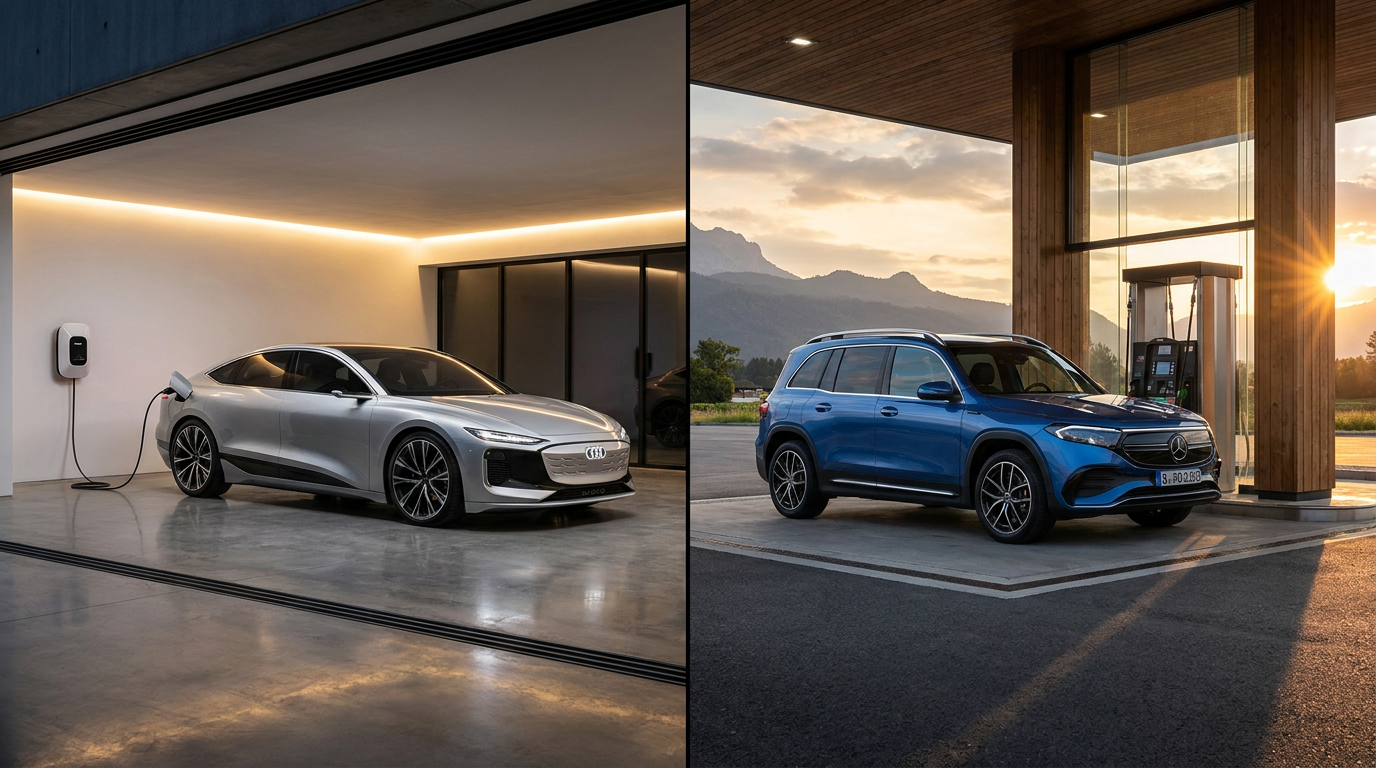
- EV Purists
- Argue that fully electric vehicles offer the best long-term savings, lowest emissions, and superior mechanical simplicity.
- Pragmatic Commuters
- Value the plug-in hybrid as the perfect transitional vehicle, eliminating range anxiety while still allowing for electric daily driving.
- Consumer Advocates
- Focus on total cost of ownership, warning that PHEVs can be more expensive upfront and suffer from higher reliability issues.
What's not represented
- · Apartment Dwellers
- · Rural Drivers
Why this matters
Choosing the right electrified vehicle is one of the largest financial decisions a household will make this decade. Understanding the hidden costs, reliability data, and daily charging realities ensures buyers don't pay a premium for technology that doesn't fit their lifestyle.
Key points
- Fully electric vehicles (EVs) offer the lowest running costs and mechanical simplicity, but require reliable charging access.
- Plug-in hybrids (PHEVs) eliminate range anxiety by combining a short-range electric battery with a traditional gas engine.
- Recent reliability data shows PHEVs experience roughly 70 to 80 percent more issues than standard gas cars due to dual-powertrain complexity.
- PHEVs are increasingly carrying higher upfront purchase prices than comparable fully electric models.
- A PHEV only delivers its promised environmental and financial benefits if it is plugged in and charged daily.
The automotive landscape of 2026 has moved decisively past the internal combustion engine, leaving buyers with a new, high-stakes dilemma: fully electric or plug-in hybrid. As traditional gas-powered cars fade from showroom floors, the decision is no longer about whether to plug in, but how much to rely on the plug. This choice represents one of the most significant financial and lifestyle decisions a household will make this decade, requiring a careful weighing of daily habits against long-term costs.[1]
To navigate this transition, it is essential to understand the core mechanical differences. Battery Electric Vehicles (EVs) rely entirely on electricity stored in a large battery pack, completely eliminating the need for gasoline. Plug-in Hybrid Electric Vehicles (PHEVs), on the other hand, straddle both worlds. They feature a smaller battery designed for short electric trips—typically 20 to 50 miles—paired with a traditional gasoline engine that seamlessly takes over for longer journeys.[1][8][9]
The argument for the fully electric vehicle centers heavily on mechanical simplicity and long-term savings. The evidence here is compelling: because an EV lacks an internal combustion engine, it does not require oil changes, spark plug replacements, or traditional transmission fluid flushes. With fewer moving parts, the routine maintenance burden drops precipitously, allowing owners to bypass the service center for years at a time.[1][8]
Furthermore, the day-to-day running costs of an EV provide a stark financial advantage. Evidence shows that charging an EV at home—particularly on an off-peak, overnight electricity tariff—yields the lowest possible cost per mile of any vehicle on the road. For the average driver, this can translate to more than $1,500 in annual fuel savings compared to a traditional gasoline vehicle, rapidly offsetting any initial purchase premium.[7][8][9]

Against the EV, the primary argument remains the unpredictability of the public charging infrastructure. While flagship 2026 EVs boast impressive ranges of 300 to 400 miles, the evidence shows that relying on public fast chargers can occasionally be frustrating and expensive. During peak travel times, public charging rates can sometimes equal the cost of gasoline, temporarily erasing the EV's financial edge for apartment dwellers or frequent road-trippers who cannot charge at home.[2][7]
For the plug-in hybrid, the strongest case is built around the "80/20 rule" of driving. Evidence suggests that because the vast majority of daily commutes are under 30 miles, a PHEV can operate entirely on clean, cheap electricity for 80 percent of a driver's routine needs. It offers the quiet, smooth acceleration of an EV for the school run and the grocery trip, provided it is plugged in every night.[1][8][9]
For the plug-in hybrid, the strongest case is built around the "80/20 rule" of driving.
For the remaining 20 percent of driving—weekend getaways, holiday road trips, or unexpected long journeys—the PHEV's gasoline engine eliminates range anxiety entirely. The evidence here is purely psychological but incredibly powerful: drivers have the flexibility to refuel at any of the nation's thousands of gas stations in under five minutes, making the PHEV an ideal transitional vehicle for one-car households.[1][9]
Against the PHEV, the evidence points directly to mechanical complexity. By housing both a high-voltage electric powertrain and a traditional combustion engine, a PHEV essentially carries two distinct propulsion systems. This means owners must still pay for routine gasoline engine maintenance, while also managing the health of a lithium-ion battery pack.[3][4]
Recent data highlights the real-world consequences of this complexity. According to 2025 and 2026 reliability surveys from Consumer Reports, PHEVs experience roughly 70 to 80 percent more reliability issues than traditional combustion vehicles. While pure EVs are steadily improving their reliability scores as automakers master battery technology, the intricate dance between gas and electric systems in a PHEV continues to present engineering challenges and higher long-term repair risks.[3][4][6]

The upfront cost equation has also shifted dramatically in recent years. While PHEVs were once marketed as the cheaper stepping stone to full electrification, recent market analysis reveals a surprising inversion. Many popular PHEVs now carry a higher upfront purchase price than their fully electric counterparts, challenging the assumption that hybrids are the more economical choice off the lot.[2][7]
Depreciation is another critical factor in the evidence column. Used EV prices have stabilized into highly affordable territory, making them excellent second-hand purchases with remarkably low total costs of ownership. Conversely, PHEVs currently hold their value slightly better on the used market due to lingering consumer hesitation about the charging grid, though this dynamic is expected to shift as public infrastructure improves.[7]
Environmental performance also requires a nuanced look. While EVs produce zero tailpipe emissions regardless of how they are driven, PHEVs only deliver their promised environmental benefits if they are plugged in daily. Evidence shows that if a PHEV is driven primarily on gasoline, it is simply hauling around a heavy, uncharged battery, which drastically reduces its fuel efficiency and results in higher real-world emissions than a standard hybrid.[2][9]

Ultimately, the fully electric vehicle fits well when a buyer has dedicated home charging, predictable daily routes, and a desire for the lowest possible maintenance costs. It is the definitive choice for multi-car households where the EV can serve as the primary daily driver. It does not fit well for drivers who lack reliable overnight charging access and frequently drive cross-country on tight schedules.[1][8][9]
Conversely, the plug-in hybrid fits well for drivers who want to commute on electricity but regularly travel into rural areas with sparse charging infrastructure. It serves perfectly as a family's sole vehicle, capable of handling both the local commute and the summer road trip. It does not fit well for buyers who rarely bother to plug in, as they will end up paying a premium for electric technology they never actually use.[1][8][9]
How we got here
2010
The first mass-market EVs and PHEVs, like the Nissan Leaf and Chevy Volt, are introduced to consumers.
2020
Battery costs drop significantly, allowing EVs to achieve 250+ miles of range and become mainstream viable.
2024
Automakers pivot heavily toward hybrids and PHEVs as consumer range anxiety slows pure EV adoption.
2026
Consumer reliability data reveals the long-term maintenance complexities of dual-powertrain PHEVs, shifting the market calculus again.
Viewpoints in depth
The EV Purist's View
Focuses on the transition away from fossil fuels, the joy of one-pedal driving, and the plummeting costs of battery manufacturing.
For EV purists, the plug-in hybrid is an unnecessary half-measure that clings to outdated technology. They argue that by keeping the internal combustion engine alive, buyers are saddling themselves with the worst of both worlds: the weight of a battery pack combined with the maintenance burden of oil changes, spark plugs, and exhaust systems. With modern EVs easily clearing 300 miles of range and battery degradation proving to be a non-issue over a 10-year lifespan, purists believe the financial and environmental math heavily favors going fully electric today.
The Pragmatic Commuter's View
Highlights the reality of the current charging grid and the need for a safety net on family road trips.
Pragmatic commuters argue that while the EV is the future, the public charging infrastructure of 2026 is still not reliable enough for a one-car family. They view the PHEV as the ultimate lifehack: a vehicle that operates as a cheap, zero-emission EV for 90 percent of the year, but transforms into a go-anywhere road-tripper for summer vacations. For these drivers, paying a slight premium in maintenance is entirely worth the peace of mind that comes with never having to wait in line for a broken fast-charger.
The Consumer Advocate's View
Looks strictly at the math and reliability data, warning buyers about the hidden costs of dual powertrains.
Consumer advocates take a hard look at the total cost of ownership and sound a note of caution regarding PHEVs. They point to glaring reliability data showing that housing two distinct propulsion systems in one vehicle inevitably leads to more frequent trips to the mechanic. Furthermore, they warn that many buyers purchase PHEVs for the perceived flexibility, but fail to plug them in daily—resulting in a vehicle that costs more upfront, requires more maintenance, and gets worse gas mileage than a standard, non-plug-in hybrid.
What we don't know
- How the used market for PHEVs will hold up once public fast-charging infrastructure becomes universally reliable.
- Whether automakers will continue to invest in complex PHEV powertrains as solid-state EV batteries begin to enter the market.
Key terms
- BEV (Battery Electric Vehicle)
- A car powered entirely by electricity stored in a large battery pack, with no gasoline engine.
- PHEV (Plug-in Hybrid Electric Vehicle)
- A car with both an electric motor and a gasoline engine, featuring a battery large enough to drive short distances on electricity alone before the gas engine takes over.
- Regenerative Braking
- A system that captures the kinetic energy usually lost during braking and uses it to recharge the vehicle's battery.
- Level 2 Charging
- A 240-volt charging system, commonly installed in homes, that can fully recharge an EV overnight.
Frequently asked
Do I need a special charger at home for a PHEV?
No. Because PHEV batteries are relatively small, they can usually be fully charged overnight using a standard 120-volt household outlet.
Are EVs cheaper to maintain than PHEVs?
Yes. EVs lack an internal combustion engine, meaning they do not require oil changes, spark plug replacements, or traditional transmission servicing.
What happens if I never plug in my PHEV?
It will operate like a standard hybrid, but with worse fuel economy due to the extra weight of the large, uncharged battery pack.
How long do EV batteries last?
Modern EV batteries are designed to last 15 to 20 years, and federal law mandates they be covered by a warranty for at least 8 years or 100,000 miles.
Sources
Source coverage
9 outlets
3 viewpoints surfaced





[1]EdmundsPragmatic Commuters
Hybrid vs. Plug-In Hybrid vs. EV: Which Is Right for You?
Read on Edmunds →[2]CarwowConsumer Advocates
Plug-in hybrids now more expensive to buy than EVs, study finds
Read on Carwow →[3]Consumer ReportsConsumer Advocates
Annual Auto Reliability Survey: EVs and PHEVs Continue to Experience Growing Pains
Read on Consumer Reports →[4]Tech BrewConsumer Advocates
Consumer Reports finds reliability issues with EVs, PHEVs
Read on Tech Brew →[5]Motor IllustratedConsumer Advocates
Hybrid, PHEV, and EV Models Dominate Consumer Reports' Best Cars of 2025
Read on Motor Illustrated →[6]Green Car ReportsEV Purists
Hybrids continue to excel in reliability, while plug-in hybrids and electric vehicles are improving
Read on Green Car Reports →[7]CarmoolaConsumer Advocates
Are plug-in hybrid cars cheaper to run?
Read on Carmoola →[8]Pod PointEV Purists
Cost of buying a BEV vs PHEV
Read on Pod Point →[9]ZenithPragmatic Commuters
EV vs PHEV at a glance
Read on Zenith →
Every angle. Every day.
Get guides stories with full source coverage and perspective breakdowns delivered to your inbox.