
Penn Physicists Create Light-Matter Particle to Drastically Cut AI Energy Use
Researchers at the University of Pennsylvania have developed a hybrid quasiparticle called an exciton-polariton that allows computing operations to run entirely on light. The breakthrough could eliminate the massive energy bottlenecks of modern AI hardware by performing logic switching without relying on electricity.
By Factlen Editorial Team
- AI Infrastructure Analysts
- Focused on the urgent need to reduce the unsustainable power consumption of modern AI data centers.
- Photonic Researchers
- Focused on the fundamental physics of coupling light and matter to achieve optical logic.
- Technology Observers
- Focused on the historical significance of moving from electron-based computing to light-based computing.
What's not represented
- · Semiconductor Manufacturers
- · Data Center Operators
Why this matters
As artificial intelligence models grow larger, their energy consumption is straining global power grids and driving up data center emissions. This optical computing breakthrough offers a viable path to run advanced AI systems at a fraction of their current energy cost, making the technology far more sustainable.
Key points
- University of Pennsylvania physicists have created a hybrid light-matter quasiparticle called an exciton-polariton.
- The particle allows computing systems to perform logic switching entirely with light, bypassing traditional electronic transistors.
- Researchers demonstrated all-optical switching using just four quadrillionths of a joule, a fraction of the energy used by current chips.
- The breakthrough could eliminate the massive energy and heat bottlenecks currently constraining the growth of artificial intelligence.
- If scaled, the technology could allow AI chips to process visual data directly from cameras without converting it to electricity.
Eighty years after the University of Pennsylvania birthed the electronic computing era with ENIAC, researchers at the same institution are attempting to rewrite the hardware playbook. A team of physicists has successfully created a hybrid light-matter particle capable of performing the core logic operations required for artificial intelligence, using a fraction of the energy of traditional chips.[1][2]
Modern AI has a severe power problem. Every time a large language model generates text, processes an image, or orchestrates an agentic workflow, servers push electrons through silicon chips. Because electrons carry an electrical charge, they encounter resistance and generate massive amounts of heat as they move through materials.[2][3]
As AI models scale, this thermal and energy bottleneck becomes increasingly unsustainable. Data centers are already straining local power grids and requiring massive cooling infrastructure to prevent hardware from melting down. The tech industry has long looked to photons—the massless particles that make up light—as a potential savior, since they can carry information at high speeds with near-zero energy loss.[4][5]
However, the very neutrality that makes photons so efficient for fiber-optic cables also makes them terrible at computing. Because they do not interact with each other, photons cannot easily perform the nonlinear "switching" operations that form the basis of computer logic and AI decision-making.[1][5]

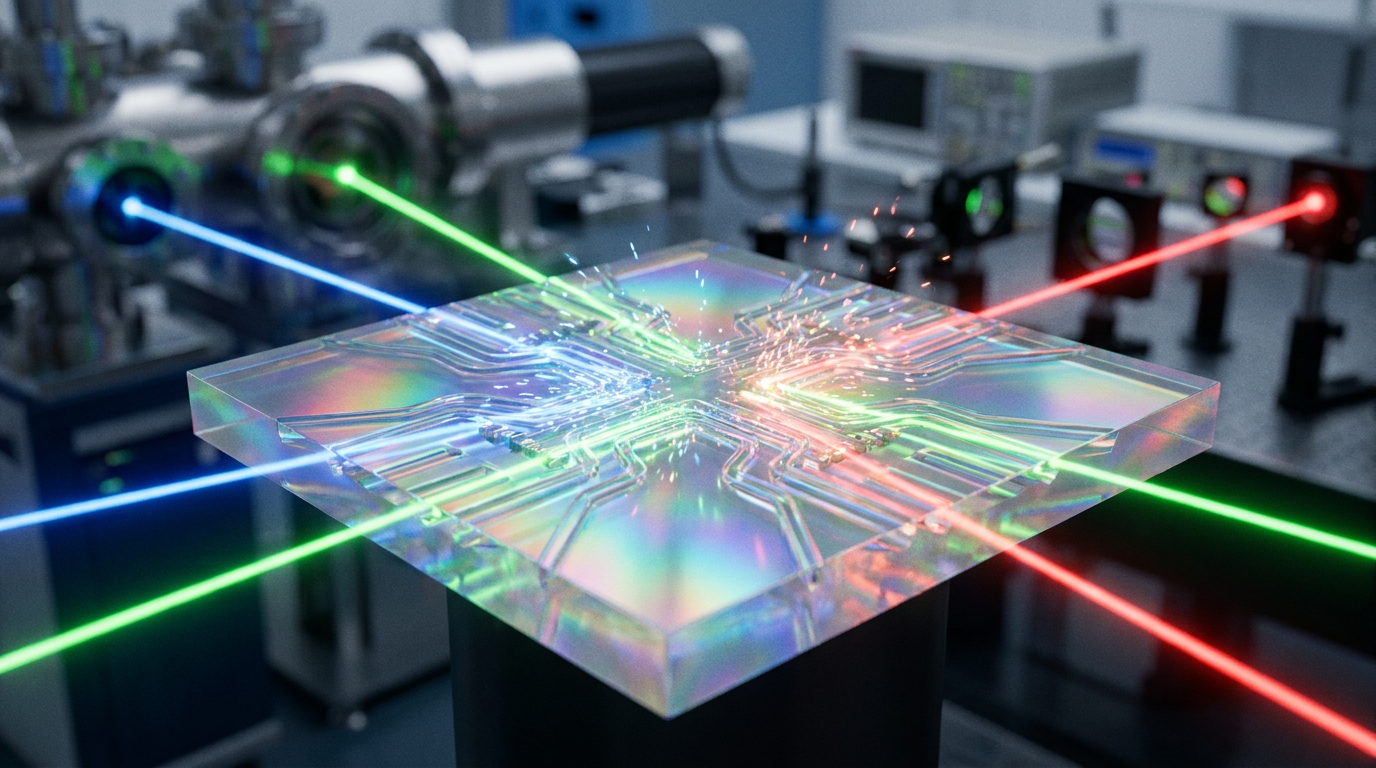
To solve this, the Penn team, led by physicist Bo Zhen, engineered a quasiparticle called an "exciton-polariton." By trapping light inside a nanoscale cavity and forcing it to interact with an atomically thin semiconductor material, the researchers strongly coupled photons with electrons.[1][6]
The resulting exciton-polariton is effectively half-light and half-matter. It retains the blistering speed and low-loss transport of a photon, but inherits the electron's ability to interact strongly with its environment. This allows the hybrid particle to perform actual computational switching without losing its optical advantages.[3][6]
The resulting exciton-polariton is effectively half-light and half-matter.
The efficiency gains demonstrated in the lab are staggering. The Penn researchers achieved all-optical switching using just four quadrillionths of a joule (four femtojoules) per operation. This is orders of magnitude less energy than what is required to briefly illuminate a microscopic LED, let alone power a traditional silicon transistor.[1][2][7]

Currently, experimental photonic AI chips exist, but they suffer from a fatal flaw: they must constantly convert light signals back into electrical signals to perform nonlinear activation steps. This repeated conversion acts like a bullet train that must turn into a bus at every station, destroying the speed and efficiency benefits of optical computing.[3][7]
The exciton-polariton eliminates this conversion tax entirely. By allowing the logic switching to happen natively within the optical domain, future AI accelerators could process data from start to finish without ever translating it back into electricity.[5][7]
If successfully scaled, this architecture could allow chips to ingest optical data directly from cameras or sensors and process it immediately. This would be transformative for autonomous vehicles, robotics, and edge computing, where latency and battery life are critical constraints.[1][2]

Beyond standard AI workloads, the researchers note that these quasiparticles exhibit quantum coherence properties that purely electronic systems cannot replicate. This opens the door to supporting basic quantum computing functions on the same semiconductor platforms in the future.[2][4]
While the breakthrough is currently confined to the laboratory, it provides a clear physical mechanism for overcoming the looming "power wall" in artificial intelligence. As the AI industry shifts from software optimization to fundamental hardware redesign, light-matter computing offers a sustainable blueprint for the next generation of intelligence.[3][6]
How we got here
1945
Penn researchers J. Presper Eckert and John Mauchly develop ENIAC, the first general-purpose electronic computer.
2010s
The tech industry begins heavily investing in silicon photonics for data transfer, though logic switching remains electronic.
Early 2020s
The generative AI boom dramatically accelerates data center energy consumption, exposing the thermal limits of electron-based chips.
May 2026
Penn physicists publish their exciton-polariton breakthrough in Physical Review Letters, demonstrating ultra-low-energy optical switching.
Viewpoints in depth
Photonic Researchers
Focused on the fundamental physics of coupling light and matter to achieve optical logic.
For physicists and materials scientists, the creation of the exciton-polariton solves a decades-old puzzle in optical computing. By successfully trapping light in a nanoscale cavity and forcing it to interact with an atomically thin semiconductor, they have proven that photons can be engineered to perform nonlinear switching. This camp views the breakthrough as a fundamental validation of light-matter coupling, proving that the speed of light and the interactivity of electrons do not have to be mutually exclusive in computing architectures.
AI Infrastructure Analysts
Focused on the urgent need to reduce the unsustainable power consumption of modern AI data centers.
Industry analysts view this development through the lens of the looming 'power wall.' With AI data centers already straining municipal power grids and driving up carbon emissions, analysts argue that software optimizations alone cannot solve the energy crisis. They see all-optical switching as a commercial necessity, noting that eliminating the constant conversion between light and electricity is the only viable path to scaling AI models without requiring dedicated nuclear power plants for every server farm.
Technology Observers
Focused on the historical significance of moving from electron-based computing to light-based computing.
Technology historians and observers highlight the poetic symmetry of the discovery. Eighty years ago, the University of Pennsylvania launched the electronic computing era with ENIAC, fundamentally changing human history by harnessing the electron. Now, as the electron reaches its physical and thermal limits, observers note that the same institution is pioneering its massless successor, potentially kicking off a new era of photonic intelligence that will define the next century of computing.
What we don't know
- How long it will take to scale this laboratory breakthrough into mass-manufacturable commercial chips.
- Whether the atomically thin semiconductor materials required can be produced cost-effectively at an industrial scale.
- How existing software architectures will need to be rewritten to take full advantage of all-optical processing.
Key terms
- Exciton-polariton
- A hybrid quasiparticle formed by strongly coupling a photon (light) with an electron (matter), combining the speed of light with the interactive properties of matter.
- Photon
- A fundamental particle of light that carries no electrical charge and has zero rest mass, making it highly efficient for transmitting information.
- Nonlinear switching
- The core decision-making logic in computing where an output is not directly proportional to the input; traditionally difficult to achieve with pure light.
- Femtojoule
- One quadrillionth of a joule, an incredibly small unit of energy used to measure the efficiency of microscopic computing operations.
Frequently asked
Will this make my laptop faster?
Not in the near term. This research is currently focused on solving the massive energy bottlenecks in large-scale AI data centers, rather than consumer electronics.
Why can't we just use regular light to compute?
Because photons carry no electrical charge, they do not interact with each other easily. This makes them great for sending data through fiber-optic cables, but terrible at performing the logic switching required for computation.
How much energy does this actually save?
The researchers demonstrated optical switching using just four quadrillionths of a joule per operation, which is orders of magnitude more efficient than traditional electronic transistors.
Sources
Source coverage
7 outlets
3 viewpoints surfaced







[1]ScienceDailyPhotonic Researchers
Combining Light and Matter for AI Computing
Read on ScienceDaily →[2]Penn TodayPhotonic Researchers
Making 'light' work of computing
Read on Penn Today →[3]ShuffleCuriosityAI Infrastructure Analysts
Penn Just Built a Tiny Light-Matter Switch That Could Make Future AI Chips Way Less Hungry
Read on ShuffleCuriosity →[4]DataconomyAI Infrastructure Analysts
Penn researchers create exciton-polaritons combining photons and electrons
Read on Dataconomy →[5]YourWeatherTechnology Observers
How a new light-matter particle could solve AI's massive energy problem
Read on YourWeather →[6]Note TechnologyTechnology Observers
The discovery of the 'exciton-polariton' breaks through the limits of electrons
Read on Note Technology →[7]Reddit TechnologyTechnology Observers
University of Pennsylvania Physicists Created a Light-Matter Particle That Performs AI Computing Operations
Read on Reddit Technology →

Every angle. Every day.
Get ai stories with full source coverage and perspective breakdowns delivered to your inbox.