
The Science of Sleep Tourism: How Hotels Are Engineering the Perfect Night's Rest
As sleep tourism becomes a $75.7 billion industry, hotels are deploying circadian lighting, acoustic cocooning, and AI climate control to turn the guest room into a passive recovery zone.
By Factlen Editorial Team
- Hospitality Innovators
- Hotels and designers treating sleep as a measurable performance asset.
- Sleep Technologists
- Engineers and scientists focused on the biological mechanisms of rest.
- Wellness Equity Advocates
- Observers concerned about the commodification and accessibility of restorative sleep.
What's not represented
- · Budget travelers who cannot afford premium sleep-optimized suites
- · Housekeeping staff who must maintain and operate complex in-room sleep technologies
Why this matters
Poor sleep is linked to chronic health issues, weakened immunity, and cognitive decline. By understanding the science behind sleep-optimized environments, travelers can make better decisions about where they stay and how they design their own bedrooms for restorative rest.
Key points
- Sleep tourism is a $75.7 billion market focused on travel for restorative rest.
- Hotels are replacing passive amenities with active neuro-architecture to improve guest sleep.
- Circadian lighting systems shift from cool morning light to warm evening tones to protect melatonin production.
- AI-powered mattresses and intelligent HVAC systems dynamically adjust temperature and firmness without waking the guest.
- Wellness advocates warn of a 'sleep divide' if these health technologies remain exclusive to luxury suites.
For decades, the hotel industry operated on a simple premise: a comfortable bed and a quiet room were enough. But a phenomenon known as the "first-night effect" has long plagued travelers. Unfamiliar environments, ambient noise, and harsh lighting can reduce sleep efficiency by 10 to 20 percent in hotel settings. Now, the hospitality sector is undergoing a radical shift, treating restorative rest not as a soft perk, but as a highly engineered performance asset.[6][10]
Welcome to the era of "sleep tourism," a travel segment where the primary goal is not sightseeing or adventure, but achieving deeply restorative rest. The global sleep tourism market reached $75.7 billion in 2024 and is projected to grow at over 8 percent annually. Major hospitality brands have taken notice, with Hilton officially dubbing the movement "Sleep Tourizzzm 2.0" in its 2025 trend reports.[7][8][10]
The demand is driven by a widespread modern exhaustion. Between late-night emails, chronic jet lag, and digital overstimulation, business and leisure travelers alike are seeking environments that actively repair their bodies. Gaining eight hours of uninterrupted sleep has transitioned from a basic biological function to the ultimate aspirational luxury of 2026.[1]
But what separates a true "sleep hotel" from a standard luxury suite? The answer lies in neuro-architecture and biological alignment. Rather than relying on scented candles or pillow menus, forward-thinking properties are integrating medical-grade technology into the very walls of the room, targeting the environmental disruptors that ruin sleep.[5][10]

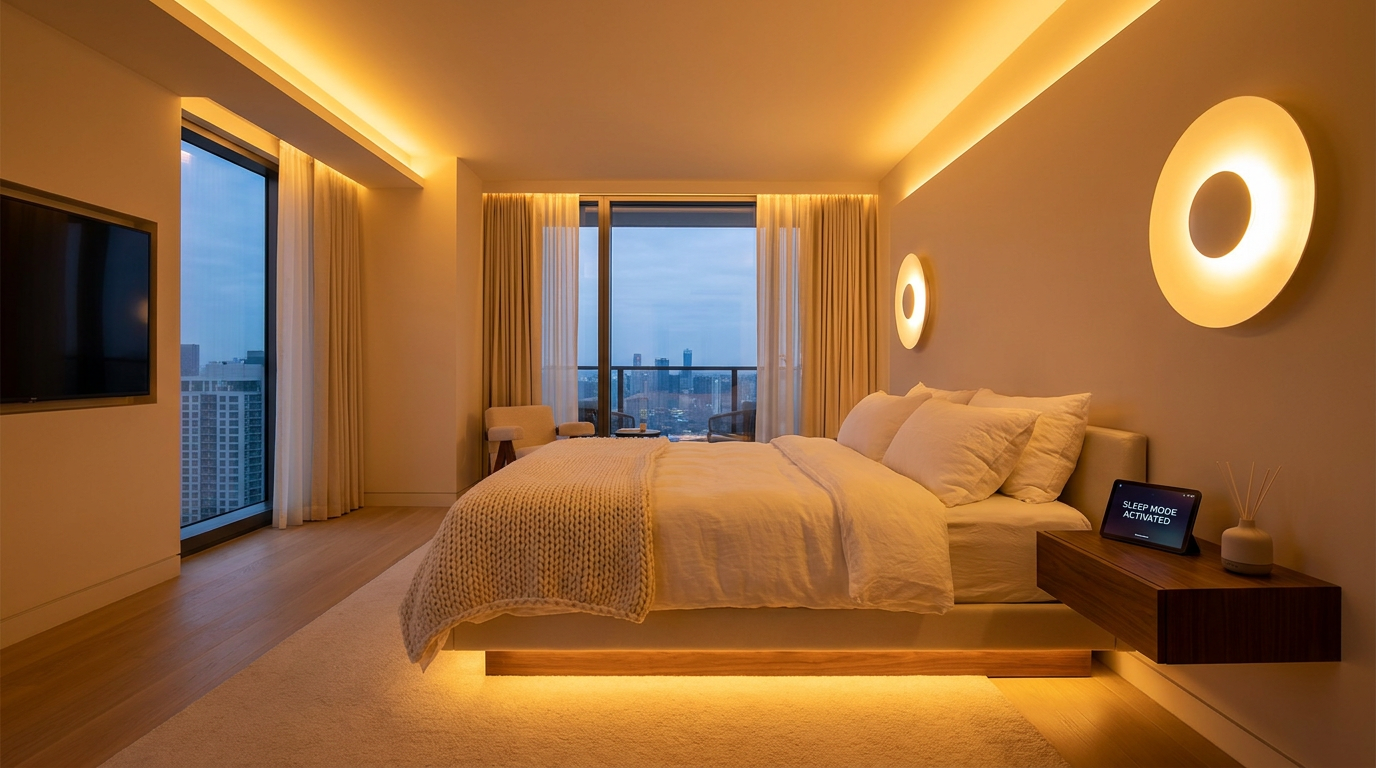
The foundation of this new approach is circadian lighting. The human body's 24-hour clock is governed by the suprachiasmatic nucleus in the brain, which relies heavily on light cues to regulate melatonin production. Traditional hotel lighting, often left on too long or emitting harsh blue spectrums, actively suppresses this vital hormone.[5][9]
Modern circadian lighting systems solve this by automatically shifting color temperature and intensity throughout the day. In the morning, the room fills with crisp, cool light to stimulate alertness. As evening approaches, the system transitions to warm, amber tones that cue the body for rest. Lighting designers emphasize that this is less about optimization and more about "risk reduction"—preventing the nighttime biological shock that keeps travelers awake.[9][10]
Beyond light, acoustic engineering has become a critical focus. Noise pollution from city streets, elevators, and neighboring rooms is a primary culprit of fragmented sleep. To combat this, luxury properties are investing heavily in "acoustic cocooning," utilizing triple-glazed windows, sound-absorbing wall materials, and padded headboards to create a hushed, tranquil sanctuary.[10]
Beyond light, acoustic engineering has become a critical focus.
Temperature control is another vital frontier. Sleep specialists note that body temperature is arguably the most controllable variable in sleep quality. However, traditional hotel air conditioning systems are often loud, drafty, and imprecise, forcing guests to wake up and adjust the thermostat.[3][4]

To solve this, hotels are deploying intelligent HVAC systems powered by artificial intelligence. These systems use interior sensors to detect changes in humidity and ambient heat, adjusting the climate seamlessly without blasting loud fans. By maintaining optimal conditions passively, these AI systems not only improve guest comfort but can also reduce a hotel's energy costs by up to 30 percent.[3]
The most intimate piece of sleep technology, however, is the bed itself. The mattress has evolved from a passive cushion into an active biometric device. AI-powered smart beds, such as those developed by Bryte and Orion, are now being installed in premium hotel suites across the globe.[4][5]
These smart mattresses track a guest's sleep patterns, heart rate, and body temperature in real time. If the system detects a pressure imbalance or a shift out of deep REM sleep, it dynamically adjusts the bed's firmness, elevation, and thermal zones to gently nudge the sleeper back into a restorative state.[4][5]
Hospitality brands are bundling these technologies into comprehensive wellness programs. Properties like Rosewood and Six Senses offer dedicated "sleep retreats" that combine biometric tracking with sleep coaching, meditation, and customized environmental controls. For executives recovering from red-eye flights, these programs offer a measurable return on investment in the form of sharper focus and reduced jet lag.[1][2][5]

Yet, the rapid rise of sleep tourism has sparked concerns about accessibility. The Global Wellness Institute warns of a growing "sleep divide," noting that the broader sleep economy is now valued at over $585 billion. If the most advanced restorative environments are gated behind expensive luxury suites, high-quality sleep risks becoming a highly stratified commodity.[2]
Advocates argue that the benefits of the sleep revolution should not be limited to those who can afford premium wellness retreats. There is a growing push to democratize these innovations, with proponents suggesting that circadian lighting and acoustic insulation should become standard building codes rather than exclusive amenities.[2][10]
Fortunately, the technology is beginning to scale. Startups engineering AI sleep suites are explicitly designing their products to be more affordable, with the stated goal of making temperature-regulating beds as ubiquitous as standard air conditioning within the next five years.[4]

Ultimately, the sleep tourism trend represents a profound shift in how we view travel and recovery. The hospitality industry is realizing that the most valuable amenity they can offer is not an active distraction, but the guarantee of passive recovery. By turning the hotel room into a science-backed sanctuary, they are ensuring that travelers return home more capable, rested, and resilient than when they arrived.[10]
How we got here
2017
The Journal of Clinical Sleep Medicine publishes landmark data quantifying the 'first-night effect' in unfamiliar hotel environments.
2023
Luxury properties begin installing early-generation AI mattresses that adjust firmness based on biometric feedback.
2024
The global sleep tourism market reaches a valuation of $75.7 billion, driven by post-pandemic wellness demands.
2025
Major hospitality brands like Hilton officially designate 'Sleep Tourism' as a top global travel trend.
2026
Hotels increasingly adopt passive AI climate control and circadian lighting to engineer full-room restorative environments.
Viewpoints in depth
Hospitality Innovators
Hotels and designers treating sleep as a measurable performance asset.
For major brands like Hilton, Accor, and Six Senses, sleep is no longer a passive byproduct of a hotel stay—it is the primary product. These innovators argue that modern travelers are exhausted by digital overload and multi-flight journeys. By investing in neuro-architecture, acoustic cocooning, and biometric tracking, they aim to transform the hotel room from a simple place to crash into an active recovery zone that measurably improves guest health.
Sleep Technologists
Engineers and scientists focused on the biological mechanisms of rest.
This camp views poor sleep as an engineering problem that can be solved with data. Companies developing AI mattresses and intelligent HVAC systems emphasize that human behavior is unreliable, so the environment must do the work. By using sensors to monitor body temperature, heart rate, and melanopsin-sensitive retinal responses, they argue that technology can automatically nudge a sleeper's environment toward the ideal state, bypassing the need for conscious habits.
Wellness Equity Advocates
Observers concerned about the commodification and accessibility of restorative sleep.
While celebrating the advancements in sleep science, organizations like the Global Wellness Institute warn of a growing 'sleep divide.' They point out that if the most restorative environments are gated behind $1,700-a-night luxury suites, high-quality sleep becomes a stratified luxury rather than a fundamental human right. This camp advocates for democratizing these technologies, pushing for innovations like circadian lighting and acoustic insulation to become standard building codes rather than premium upgrades.
What we don't know
- Whether advanced sleep technologies will successfully scale down to budget and mid-tier hotel chains.
- The long-term health impacts of relying on AI-driven environmental nudges versus developing natural sleep habits.
- How quickly building codes might adapt to mandate circadian lighting and acoustic standards in residential construction.
Key terms
- Circadian Rhythm
- The body's internal 24-hour clock that regulates the sleep-wake cycle, heavily influenced by environmental light.
- Suprachiasmatic Nucleus (SCN)
- A tiny region in the brain that acts as the master pacemaker for the circadian rhythm, controlling melatonin release.
- Melanopsin
- A light-sensitive protein in the eye that signals the brain to suppress melatonin when exposed to blue light.
- Acoustic Cocooning
- The architectural practice of using specialized insulation, windows, and materials to completely isolate a room from external noise.
- First-Night Effect
- A biological phenomenon where unfamiliar environments, noises, and lights cause a temporary reduction in sleep efficiency during the first night in a new place.
- Sleep Divide
- The growing socioeconomic gap in access to optimal sleep environments and restorative health technologies.
Frequently asked
What is sleep tourism?
Sleep tourism is a growing travel trend where the primary goal of the trip is to achieve deeply restorative rest and improve sleep habits, rather than traditional sightseeing.
How does circadian lighting work in hotels?
Circadian lighting systems automatically adjust color temperature throughout the day, using crisp blue light in the morning to stimulate alertness and warm amber tones in the evening to promote melatonin production.
What is an AI smart mattress?
An AI smart mattress uses biometric sensors to track a guest's heart rate, temperature, and sleep stages, dynamically adjusting firmness and climate zones throughout the night to prevent wake-ups.
Why is acoustic engineering important for sleep?
Noise pollution is a primary cause of fragmented sleep. Hotels use acoustic cocooning—such as triple-glazed windows and sound-absorbing materials—to block out city and hallway noise.
What is the 'sleep divide'?
The 'sleep divide' refers to the concern that as advanced sleep technologies become premium hotel amenities, high-quality, restorative rest may become a luxury accessible only to the wealthy.
Sources
Source coverage
10 outlets
3 viewpoints surfaced










[1]ForbesHospitality Innovators
Sleep Tourism Is The Latest Aspirational Form Of Luxury
Read on Forbes →[2]Global Wellness InstituteWellness Equity Advocates
Sleep Tourism and the Growing Sleep Divide
Read on Global Wellness Institute →[3]Hotel DiveSleep Technologists
AIIR launches AI-powered HVAC system for hotels
Read on Hotel Dive →[4]EntrepreneurSleep Technologists
Better sleep for everyone: Orion's AI sleep suites
Read on Entrepreneur →[5]Hospitality Financial and Technology ProfessionalsSleep Technologists
AI-Powered Sleep Technology: Elevating Hotel Comfort
Read on Hospitality Financial and Technology Professionals →[6]Journal of Clinical Sleep MedicineSleep Technologists
The First-Night Effect in Unfamiliar Environments
Read on Journal of Clinical Sleep Medicine →[7]Hilton 2025 Travel TrendsHospitality Innovators
Sleep Tourizzzm 2.0
Read on Hilton 2025 Travel Trends →[8]AccorHospitality Innovators
The Rise of Sleep Tourism
Read on Accor →[9]TecoliteSleep Technologists
What Circadian Lighting Really Means in Hospitality Contexts
Read on Tecolite →[10]Factlen Editorial TeamWellness Equity Advocates
Synthesis by Factlen editorial team
Read on Factlen Editorial Team →

Every angle. Every day.
Get travel stories with full source coverage and perspective breakdowns delivered to your inbox.