
How to Buy a Used EV in 2026: Battery Health, Tax Credits, and Charging Standards Explained
The used electric vehicle market has matured into a buyer's paradise in 2026, offering massive depreciation discounts. However, securing a reliable EV requires shifting focus from the odometer to battery health diagnostics and understanding the new charging standard landscape.
By Factlen Editorial Team
- Independent Diagnostics & Evaluators
- Advocates for standardized, third-party battery testing to replace dashboard estimates.
- Consumer Finance & Insurance
- Focuses on the total cost of ownership, depreciation curves, and shifting tax incentives.
- EV Infrastructure Experts
- Prioritizes charging compatibility and the transition to the NACS standard.
What's not represented
- · Independent auto mechanics adapting to EV repairs
- · Apartment renters who cannot charge at home
Why this matters
With used EV prices dropping up to 50% from their pandemic peaks, 2026 is the best time in history to transition to electric driving—provided you know how to navigate battery health checks, expired tax incentives, and changing plug standards.
Key points
- Used EV prices have dropped 30 to 50 percent since 2023, making them highly competitive with gas cars.
- Battery State of Health (SoH) has replaced mileage as the most critical metric for evaluating a used EV.
- The $4,000 federal used EV tax credit expired in late 2025, replaced by a loan interest deduction.
- Buyers of older non-Tesla EVs will need NACS-to-CCS adapters to use the Supercharger network.
- EV-specific tires wear faster due to the vehicle's weight and instant torque, requiring close inspection.
The used electric vehicle market has undergone a dramatic transformation by 2026, shifting from a niche gamble into a buyer’s paradise. Following a period of steep depreciation between 2023 and 2025, prices for second-hand EVs have dropped by as much as 30 to 50 percent. Early adopters absorbed the steepest part of the depreciation curve, meaning that models like the Tesla Model 3, Volkswagen ID.4, and Hyundai Kona are now available at price parity with their gasoline or diesel equivalents. For consumers willing to navigate a slightly different purchasing process, the secondary market offers unprecedented value and significantly lower running costs.[1][7]
However, evaluating a used electric car requires a fundamental shift in mindset: buyers must stop looking at the odometer and start looking at the battery. In a combustion engine, mileage and oil changes dictate the vehicle's remaining lifespan. In an EV, the critical metric is the State of Health (SoH)—a percentage indicating how much of the battery's original capacity remains. A battery with a 90 percent SoH will deliver roughly 90 percent of its original factory range. Because the high-voltage battery is the single most expensive component in the vehicle, its condition dictates both the car's real-world utility and its financial value.[1][3]

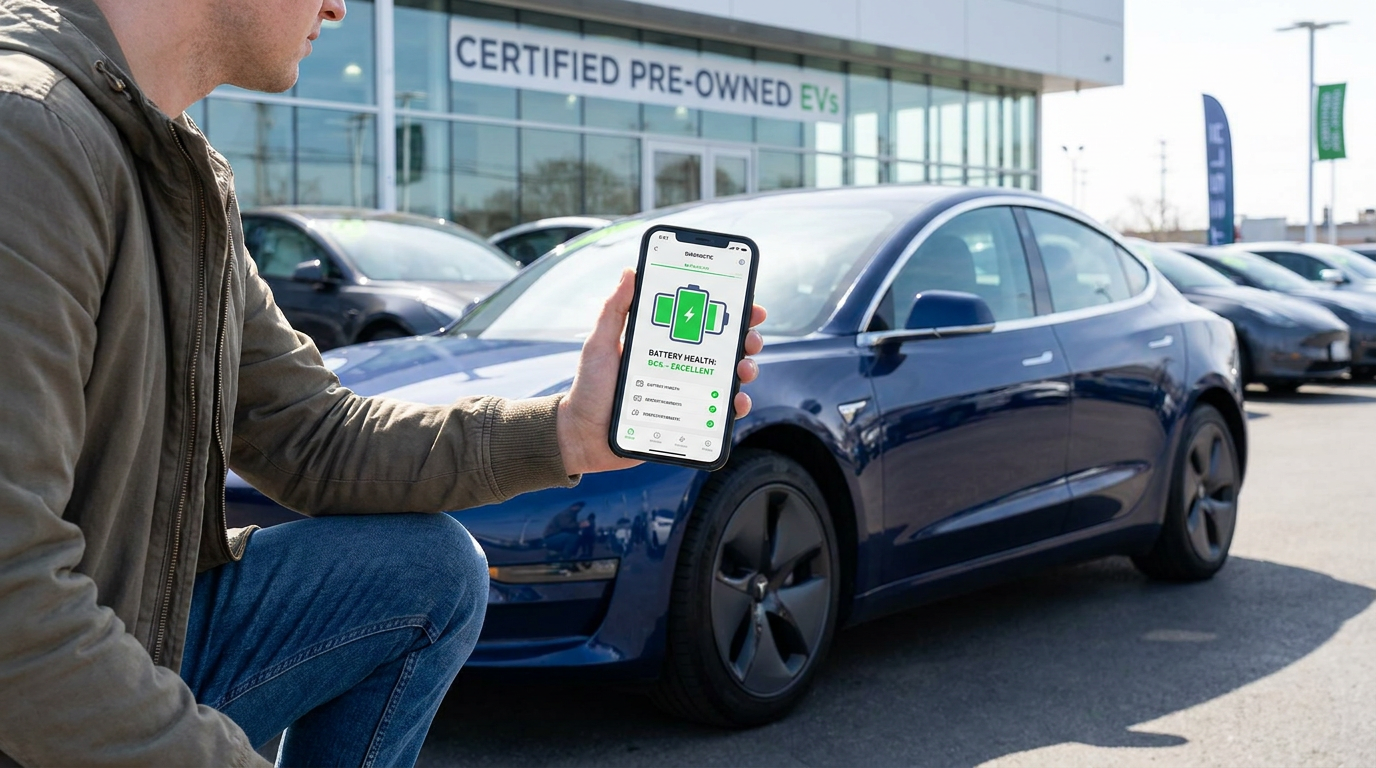
Fortunately, the days of relying on a dashboard guess-o-meter are over. The diagnostic industry has rapidly matured, with independent testing organizations offering standardized, third-party battery health certificates. These tests, which can often be completed in about 15 minutes, measure the battery under load to provide a true, cell-level assessment rather than relying on the vehicle's internal software estimates. For buyers inspecting a car privately, inexpensive OBD-II dongles paired with smartphone apps can read live battery data, revealing the exact number of charge cycles and any cell voltage imbalances within seconds.[3][4][7]
Experts generally recommend looking for a used EV with a State of Health between 80 and 100 percent. While EV batteries naturally degrade by roughly 1 to 2 percent per year, catastrophic failures remain exceedingly rare. Data from thousands of independent tests show that most modern EV batteries easily outlast their standard 8-year or 100,000-mile warranties, often retaining over 80 percent capacity well past the 200,000-mile mark. The primary culprits for accelerated degradation are frequent exposure to extreme heat and an over-reliance on high-speed public fast chargers, which stress the battery's thermal management systems more than slow, overnight home charging.[3][8]

Experts generally recommend looking for a used EV with a State of Health between 80 and 100 percent.
Beyond the battery, the financial calculus of buying a used EV shifted significantly at the end of 2025. The popular $4,000 federal tax credit for previously owned clean vehicles officially expired on September 30, 2025, following the passage of the One Big Beautiful Bill Act (OBBBA). Shoppers entering the market in 2026 can no longer claim this point-of-sale discount. Instead, the federal government pivoted to a multi-year loan interest deduction of up to $10,000 annually, specifically targeted at financing American-made vehicles. While this new deduction helps middle-income earners offset borrowing costs, buyers must now rely more heavily on state, local, and utility-level rebates to reduce the upfront purchase price.[2][6]
Another critical factor for 2026 buyers is navigating the great charging standard transition. The North American Charging Standard (NACS), officially standardized as SAE J3400, has definitively won the format war. Originally developed by Tesla, the compact, single-plug NACS design is now being natively integrated into new 2026 models from Ford, General Motors, Rivian, and others. However, the vast majority of used non-Tesla EVs currently on the market still feature the older, bulkier Combined Charging System (CCS1) port.[5][9]

Purchasing a used CCS1 vehicle is still a highly viable option, provided the buyer understands the adapter ecosystem. Major automakers have secured access to the expansive Tesla Supercharger network for their legacy CCS1 vehicles, but utilizing these stations requires a heavy-duty NACS-to-CCS adapter. While these adapters bridge the physical gap, industry analysts note that they can occasionally introduce thermal bottlenecks or communication faults during peak summer travel. Buyers who plan to charge primarily at home will rarely notice the difference, but frequent road-trippers should factor the cost and logistics of adapter management into their decision.[5][9]
Finally, while electric vehicles boast significantly lower maintenance costs due to their lack of spark plugs, timing belts, and multi-gear transmissions, they are not entirely maintenance-free. The instant torque and heavy curb weight of an EV—often hundreds of pounds heavier than a comparable gas car due to the battery pack—can accelerate tire wear dramatically. Buyers should inspect the tread depth closely and ensure the vehicle is fitted with EV-specific tires designed to handle the load and reduce rolling resistance. Additionally, verifying that the vehicle has received all over-the-air software updates and routine coolant flushes for the battery's thermal management system ensures the car is genuinely ready for its second life on the road.[6][7][8]
How we got here
2023–2024
New EV prices drop and supply increases, triggering steep depreciation in the secondary market.
May 2024
Major automakers begin announcing the shift to the Tesla-designed NACS charging standard.
September 2025
The $4,000 federal tax credit for used EVs officially expires under new legislation.
Early 2026
Independent battery health testing becomes a standard offering at major dealerships and auctions.
Viewpoints in depth
Independent Diagnostics & Evaluators
Advocates for standardized, third-party battery testing to replace dashboard estimates.
This camp argues that the traditional used-car inspection is obsolete. Organizations like DEKRA and AVILOO stress that a vehicle's internal software often masks true battery degradation. They push for mandatory, independent State of Health (SoH) certificates at the point of sale, arguing that cell-level transparency is the only way to build long-term consumer trust and stabilize resale values in the secondary EV market.
Consumer Finance & Insurance
Focuses on the total cost of ownership, depreciation curves, and shifting tax incentives.
Financial analysts view the 2026 used EV market as a massive opportunity for budget-conscious buyers, noting that early adopters have already absorbed the brutal 30 to 50 percent depreciation hit. However, they caution buyers to look beyond the sticker price. With the expiration of the $4,000 federal point-of-sale rebate, this camp emphasizes factoring in the new OBBBA loan interest deductions, increased tire replacement costs, and insurance premiums to calculate the true cost of ownership.
EV Infrastructure Experts
Prioritizes charging compatibility and the transition to the NACS standard.
Infrastructure specialists warn that the shift to the North American Charging Standard (NACS) creates a bifurcated used market. While legacy CCS1 vehicles are heavily discounted, experts point out that relying on NACS-to-CCS adapters at Superchargers can introduce thermal bottlenecks and communication errors. They advise that buyers who rely heavily on public fast-charging should prioritize native NACS vehicles, while CCS1 cars remain excellent bargains for those who charge primarily at home.
What we don't know
- How the secondary market will price older CCS1 vehicles long-term as the NACS standard becomes ubiquitous.
- Whether state and local incentives will expand to fill the gap left by the expired federal used EV tax credit.
Key terms
- State of Health (SoH)
- A percentage metric indicating how much of an EV battery's original capacity remains available for use.
- NACS (SAE J3400)
- The North American Charging Standard, originally developed by Tesla, which features a compact plug and is becoming the industry standard in 2026.
- CCS1
- The Combined Charging System, an older, bulkier fast-charging plug standard used by most non-Tesla EVs built before 2025.
- OBD-II Dongle
- A small diagnostic device that plugs into a car's onboard computer port to read live data, including battery health.
Frequently asked
Can I still get the $4,000 federal used EV tax credit?
No. The $4,000 point-of-sale federal tax credit expired on September 30, 2025. It has been replaced by a loan interest deduction for American-made vehicles.
How long do EV batteries actually last?
Data shows most EV batteries outlast their 8-year/100,000-mile warranties, typically degrading only 1 to 2 percent per year and lasting well past 200,000 miles.
Can I charge a used CCS car at a Tesla Supercharger?
Yes, but you will need a compatible NACS-to-CCS adapter, and charging speeds may occasionally be limited by the adapter's thermal capacity during peak summer heat.
Sources
Source coverage
9 outlets
3 viewpoints surfaced








[1]WHEELSTREETEV Infrastructure Experts
Used Electric Cars 2026: Complete Buyer's Guide
Read on WHEELSTREET →[2]Kelley Blue BookConsumer Finance & Insurance
Used Electric Car Tax Credits Explained for 2026
Read on Kelley Blue Book →[3]DEKRAIndependent Diagnostics & Evaluators
Used Electric Cars – What about Battery Health?
Read on DEKRA →[4]NRMAIndependent Diagnostics & Evaluators
Buying a used EV? Here's how to check the battery health
Read on NRMA →[5]Industrial Control AcademyEV Infrastructure Experts
NACS vs CCS in 2026: Best Guide for EV Drivers
Read on Industrial Control Academy →[6]Mercury InsuranceConsumer Finance & Insurance
Tips to Know Before Buying a Used Electric Car (EV)
Read on Mercury Insurance →[7]Green Car GuideIndependent Diagnostics & Evaluators
Buying a Used EV in 2026? How to Verify the Service History
Read on Green Car Guide →[8]CarMaxConsumer Finance & Insurance
How do used EVs hold up?
Read on CarMax →[9]Lectron EVEV Infrastructure Experts
NACS vs CCS - which one is better?
Read on Lectron EV →

More in shopping
See all 5 stories →


Every angle. Every day.
Get shopping stories with full source coverage and perspective breakdowns delivered to your inbox.