
Pharmacological Hypothermia: How Cooling Drugs Could Pause Brain Damage During a Stroke
Researchers have successfully used a two-drug combination to induce a hibernation-like state in stroke patients, bypassing the dangerous shivering reflex caused by physical cooling. This breakthrough could buy doctors precious hours to save brain tissue.
By Factlen Editorial Team
- Neurocritical Care Specialists
- Focus on the clinical hurdles of physical cooling, emphasizing that avoiding shivering and heavy sedation is the holy grail of stroke care.
- Pharmacological Researchers
- View chemical cooling as an elegant biological hack that resets the body's thermostat rather than fighting it with brute force.
- Emergency Responders
- Advocate for treatments that can be administered in the ambulance, buying critical time before the patient reaches a surgical center.
What's not represented
- · Stroke Survivors
- · Pharmaceutical Developers
Why this matters
Stroke is a leading cause of long-term disability worldwide, largely because treatments must be administered within a tiny time window. A drug that safely pauses brain metabolism could turn a devastating, life-altering stroke into a highly treatable emergency.
Key points
- A new two-drug combination successfully induces therapeutic hypothermia without causing violent shivering.
- The drugs act on the hypothalamus to lower the body's metabolic rate and dilate blood vessels.
- In animal models and a small human trial, the treatment safely delayed brain damage from ischemic stroke.
- Cooling the brain slows cellular metabolism, reducing oxygen demand and preventing toxic inflammation.
- If validated in larger trials, the drugs could be administered by paramedics to pause stroke damage in the field.
Every minute an ischemic stroke goes untreated, the human brain loses roughly 1.9 million neurons. This brutal arithmetic has defined stroke neurology for decades, limiting treatments to a frantic race to restore blood flow via clot-busting drugs or surgical extraction. The medical mantra "time is brain" dictates everything from ambulance routing to emergency room protocols.[6]
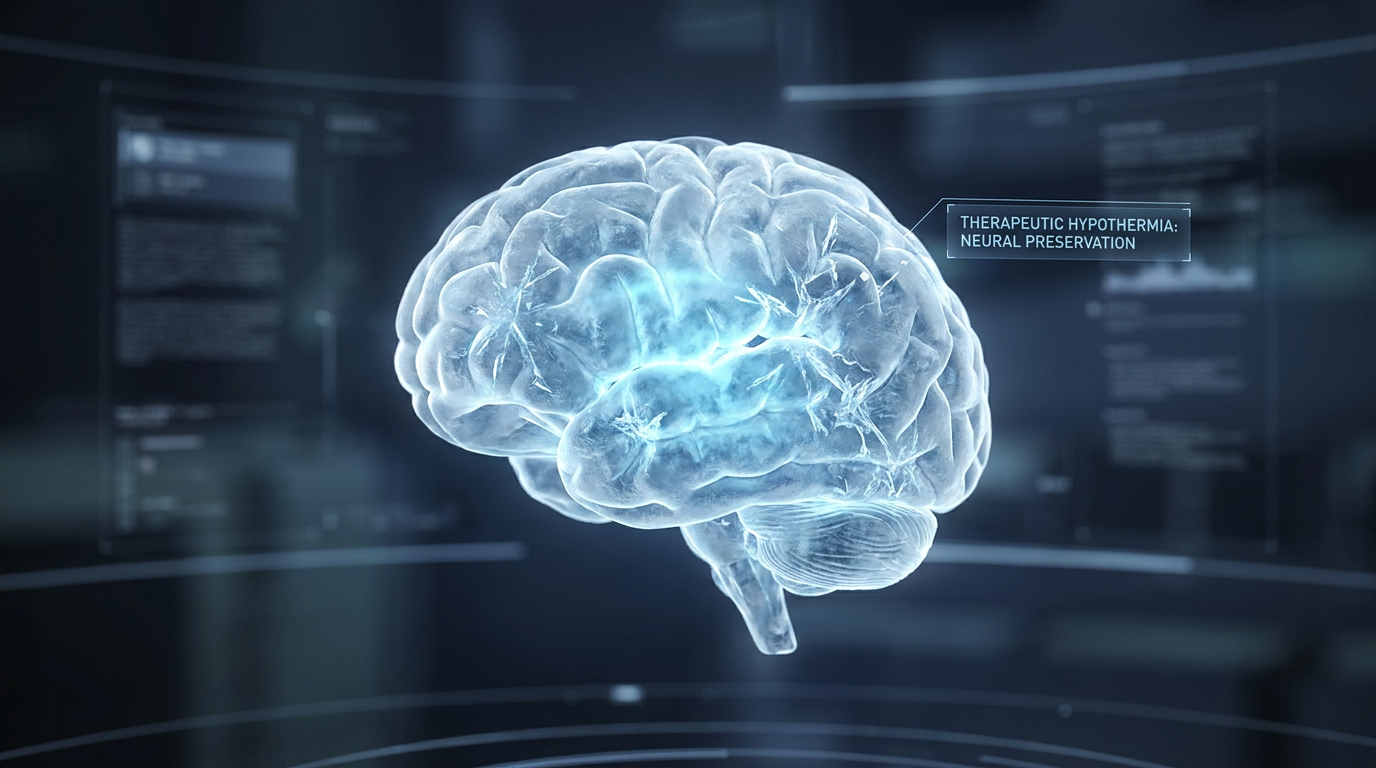
But what if doctors could pause the clock? For years, medical science has flirted with the concept of therapeutic hypothermia—deliberately cooling the brain to slow its metabolic rate and put dying cells into a temporary state of suspended animation.[4]
The neuroprotective power of cold is undisputed in other contexts. In survivors of cardiac arrest, chilling the comatose body to 33–35°C (91–95°F) routinely saves brain function and improves survival rates. Yet, applying this life-saving technique to awake stroke patients has hit a formidable biological wall: the human body actively fights the cold.[4]
When wrapped in cooling blankets or infused with chilled saline, a conscious stroke patient will inevitably begin to shiver violently. Shivering spikes the body's metabolic rate, increases oxygen demand, and raises intracranial pressure, entirely negating the neuroprotective benefits of the cold. To stop the shivering, doctors must use heavy sedation, chemically paralyze the patient, and insert a breathing tube—a highly risky proposition for someone suffering an acute brain injury.[4][5]

Now, a breakthrough published this week in Science Translational Medicine and highlighted by Nature offers an elegant bypass to this physiological roadblock: pharmacological hypothermia.[1][2]
Rather than freezing the body from the outside in, a team of researchers from the Beijing Institute for Brain Disorders has successfully used a two-drug combination to cool the body from the inside out. By targeting the brain's internal thermostat, they have induced a state of therapeutic hypothermia without triggering the body's defensive reflexes.[2]
The team utilized a combination of chlorpromazine, a first-generation antipsychotic, and promethazine, an established antihistamine. Together, these compounds lower the body's metabolic rate and dilate blood vessels, allowing core body heat to escape rapidly through the skin.[2][3]
Crucially, because these drugs act directly on the hypothalamus—the brain's central temperature control center—the body does not perceive the sudden temperature drop as a threat. The violent shivering reflex is bypassed entirely. The patient simply enters a calm, hibernation-like state.[5]
In rigorous preclinical trials involving mice and rhesus macaques, this chemical cooling rapidly induced hypothermia and significantly delayed the cascade of brain damage following an experimentally induced stroke. The animals maintained stable vital signs while their brains were shielded from the worst effects of oxygen deprivation.[1][2]
The animals maintained stable vital signs while their brains were shielded from the worst effects of oxygen deprivation.
Moving beyond animal models, the researchers also conducted a preliminary safety trial in a small cohort of human stroke patients. The drug combination was well-tolerated, successfully lowering core temperatures without the severe physiological stress and shivering associated with traditional physical cooling methods.[2][3]

To understand why this pharmacological hack is so vital, one must look at how a stroke actually destroys brain tissue. The initial blood clot starves a core area of oxygen, causing immediate and irreversible cell death. But the surrounding tissue, known as the ischemic penumbra, dies slowly over several hours.[4]
This penumbra is destroyed by a toxic cascade of inflammation, oxidative stress, and apoptosis—programmed cell death. Furthermore, when doctors successfully remove the clot, the sudden rush of oxygen-rich blood back into the starved tissue can trigger "reperfusion injury," a massive inflammatory response that can be just as damaging as the initial blockage.[4][5]
Hypothermia acts as a broad-spectrum shield against both of these destructive processes. By dropping the temperature just a few degrees, cellular metabolism slows to a crawl. The neurons require less oxygen, produce fewer toxic free radicals, and halt their self-destruct sequences.[5]
According to extensive meta-analyses of animal models published in the American Heart Association Journals, cooling the brain to 34°C can reduce the ultimate size of the stroke infarct by up to 45%. Until now, unlocking that massive 45% reduction in humans has been logistically impossible in standard emergency settings.[4]
The advent of a simple, injectable drug cocktail changes the treatment paradigm entirely. If proven effective in larger Phase III clinical trials, pharmacological hypothermia could become a standard, frontline pre-hospital intervention.[6]

Imagine a paramedic diagnosing a stroke in a patient's living room and immediately administering the cooling drugs via an IV. By the time the ambulance reaches the comprehensive stroke center, the patient's brain is already in a protective, low-energy state, buying neurosurgeons precious hours to remove the clot safely.[3][6]
The implications of this breakthrough extend far beyond ischemic stroke. Neurocritical care specialists are already eyeing pharmacological hypothermia for traumatic brain injuries, severe hemorrhages, and neonatal hypoxic-ischemic encephalopathy—conditions where physical cooling is currently utilized but remains cumbersome and stressful for the patient.[4][5]
While the researchers caution that larger, multi-center randomized trials are required to definitively prove that this specific drug combination improves long-term functional recovery in a broad human population, the proof-of-concept is a monumental leap forward.[2][3]

For decades, the medical community has viewed therapeutic hibernation as an unattainable staple of science fiction. Today, it is a tangible pharmacological reality, offering a profound new weapon in the fight to preserve human cognition and mobility in the face of catastrophic injury.[6]
How we got here
1990s-2000s
Therapeutic hypothermia becomes a standard of care for preserving brain function in comatose cardiac arrest survivors.
2010s
Multiple clinical trials attempt to use physical cooling blankets on awake stroke patients, but struggle with the severe shivering reflex.
2016-2019
Researchers begin testing neurotensin receptor agonists and other compounds in rodents to induce chemical hypothermia.
June 2026
Scientists publish data showing a two-drug combo safely induces hypothermia and limits stroke damage in mice, macaques, and a small human cohort.
Viewpoints in depth
Neurocritical Care Specialists
Focus on the clinical hurdles of physical cooling, emphasizing that avoiding shivering and heavy sedation is the holy grail of stroke care.
For doctors in the ICU, the neuroprotective benefits of hypothermia have never been in doubt—the problem has always been delivery. When a conscious patient is cooled with ice blankets or chilled saline, the body's thermoregulatory system fights back violently. Shivering increases metabolic demand, entirely defeating the purpose of cooling the brain. To counter this, doctors must heavily sedate and intubate the patient, introducing severe risks like ventilator-associated pneumonia. Neurocritical care specialists view pharmacological hypothermia as the ultimate workaround, allowing them to reap the benefits of cooling without the dangerous physiological tug-of-war.
Pharmacological Researchers
View chemical cooling as an elegant biological hack that resets the body's thermostat rather than fighting it with brute force.
Researchers developing these drug combinations focus on the elegance of the mechanism. Instead of applying external cold, drugs like chlorpromazine and promethazine act directly on the hypothalamus, the brain's internal thermostat. By chemically lowering the body's set-point, the patient's system naturally radiates heat and accepts the lower temperature as normal. This 'hibernation-like' state is seen as a profound shift in medical science, moving away from blunt physical interventions toward precise, receptor-level control of human metabolism.
Emergency Responders
Advocate for treatments that can be administered in the ambulance, buying critical time before the patient reaches a surgical center.
Paramedics and EMTs operate under the unforgiving rule that 'time is brain.' Currently, there is very little they can do to halt brain damage in the field; their primary role is rapid transport to a stroke center. Emergency medicine advocates are highly enthusiastic about pharmacological hypothermia because it is deliverable via a simple IV push. If proven safe for pre-hospital use, EMS teams could initiate neuroprotection in the patient's living room, effectively pausing the stroke's progression and drastically expanding the window for successful surgical intervention.
What we don't know
- Whether the drug combination will definitively improve long-term mobility and cognitive recovery in a large, diverse human population.
- Exactly how long the pharmacological hibernation state can be safely maintained without adverse side effects.
- If the treatment is equally effective for hemorrhagic strokes (brain bleeds) as it is for ischemic strokes (clots).
Key terms
- Ischemic Stroke
- A type of stroke caused by a blockage in a blood vessel supplying the brain, starving tissue of oxygen.
- Infarct
- An area of dead tissue resulting from a failure of blood supply.
- Penumbra
- The area of damaged but still-living brain tissue surrounding the dead core of a stroke, which doctors try to save.
- Reperfusion Injury
- Tissue damage caused when blood supply returns to the tissue after a period of lack of oxygen, triggering massive inflammation.
- Hypothalamus
- A small region of the brain that acts as the body's command center for autonomic functions, including temperature regulation.
Frequently asked
What is therapeutic hypothermia?
It is a medical treatment that deliberately lowers the body's core temperature to slow metabolism and protect the brain from damage after a loss of blood flow.
Why isn't cooling used for all stroke patients today?
Awake patients naturally fight the cold by shivering violently, which raises blood pressure and metabolism. Stopping the shivering requires heavy sedation and a ventilator, which is too risky for most acute stroke patients.
How do the new drugs work?
The combination of chlorpromazine and promethazine acts on the brain's temperature control center (the hypothalamus), lowering the body's thermostat so it accepts the cold without shivering.
Is this treatment available in hospitals now?
Not yet. While early safety trials in humans have been successful, larger Phase III clinical trials are required to prove it improves long-term recovery before it becomes standard care.
Sources
Source coverage
6 outlets
3 viewpoints surfaced






[1]NaturePharmacological Researchers
Freezing brain damage in its tracks: cooling drugs limit stroke injury in mice
Read on Nature →[2]Science Translational MedicinePharmacological Researchers
Pharmacologically induced hypothermia protects against ischemic brain injury
Read on Science Translational Medicine →[3]GizmodoEmergency Responders
The Next Great Stroke Treatment Might Borrow a Bit From Science Fiction
Read on Gizmodo →[4]American Heart Association JournalsNeurocritical Care Specialists
Therapeutic Hypothermia in Acute Ischemic Stroke
Read on American Heart Association Journals →[5]Frontiers in NeuroscienceNeurocritical Care Specialists
Pharmacological Hypothermia for Brain Protection
Read on Frontiers in Neuroscience →[6]Factlen Editorial TeamEmergency Responders
Synthesis by Factlen editorial team
Read on Factlen Editorial Team →


Every angle. Every day.
Get science stories with full source coverage and perspective breakdowns delivered to your inbox.