
US Overhauls Nuclear Regulations to Power the AI Boom
The Nuclear Regulatory Commission has finalized sweeping updates to its licensing frameworks, aiming to accelerate the deployment of advanced microreactors for energy-hungry data centers.
By Wei Zhang

The United States is fundamentally rewriting its Cold War-era nuclear regulations to accommodate the staggering energy demands of the artificial intelligence boom. Driven by a bipartisan legislative mandate and recent executive orders, the U.S. Nuclear Regulatory Commission (NRC) has finalized and proposed sweeping changes to how advanced reactors and microreactors are licensed.
For decades, the nuclear industry has been constrained by a regulatory apparatus built for massive, bespoke infrastructure projects. Now, as hyperscale data centers require gigawatts of uninterrupted power, federal regulators are pivoting to a model that prioritizes speed and scalability without compromising public safety. This regulatory modernization represents a critical turning point, aligning government oversight with the rapid technological advancements of the private sector to solve an impending energy crisis.[1]
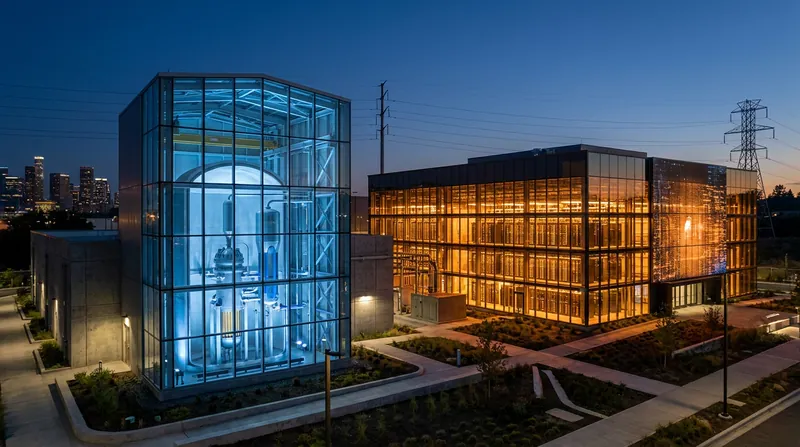
The shift marks a definitive departure from a rigid, decades-old framework that treated factory-built small modular reactors (SMRs) with the same burdensome scrutiny as massive, grid-scale light-water plants. By introducing technology-inclusive, risk-informed pathways, the federal government is attempting to clear the runway for a completely new asset class of nuclear power designed to operate directly alongside hyperscale data centers.
Instead of requiring every new reactor to undergo a unique, years-long environmental and safety review, the updated rules allow for the approval of standardized designs that can be manufactured in bulk and deployed rapidly. This approach mirrors the mass-production techniques that drove down the costs of solar panels and wind turbines, applying them to the most energy-dense power source available.[6]
The primary claim driving this regulatory overhaul is that artificial intelligence requires baseload clean power at an unprecedented scale. The evidence for this demand is robust and widely accepted across both the technology and energy sectors. According to the International Energy Agency, global data center electricity consumption is projected to more than double from 415 terawatt-hours in 2024 to roughly 945 terawatt-hours by 2030.
This surge is largely attributed to the computationally intensive nature of training and running large language models, which require vast arrays of specialized processors running continuously. As these AI facilities scale from megawatt to gigawatt capacities, they are effectively becoming industrial-scale power consumers, rivaling the energy footprints of entire mid-sized cities.[4]
Renewable sources like wind and solar, while expanding rapidly and crucial to broader decarbonization efforts, struggle to meet the strict 24/7 requirements of AI training clusters without massive and currently cost-prohibitive battery storage. Nuclear power offers dense, uninterrupted generation with zero carbon emissions, making it the preferred solution for tech giants looking to balance their immense power needs with aggressive climate pledges.
Consequently, major technology companies, including Meta, Microsoft, Amazon, and Google, have collectively committed tens of billions of dollars to nuclear power projects as of early 2026. These investments signal a profound shift in corporate energy procurement, moving beyond purchasing renewable energy credits to actively financing the next generation of nuclear infrastructure.[4][5][6]
Proponents of the reform argue that the legacy regulatory framework was the primary bottleneck to deployment, effectively suffocating innovation in the nuclear sector. The evidence here is strong, supported by historical project failures and decades of stagnant construction.
The NRC's foundational rule, Part 50, was finalized in 1956 and was inherently biased toward water-cooled reactors, making it fundamentally ill-suited for modern, factory-built reactors that utilize alternative cooling methods like liquid metal or molten salt. Forcing next-generation designs through a regulatory maze designed for 1950s technology required developers to file countless exemption requests, adding years of delay and millions of dollars in legal and administrative costs before a single shovel hit the ground.
This mismatch contributed directly to onerous costs and wait times that scared off private investment. For example, the Carbon Free Power Project, once expected to be the first U.S. commercial SMR rollout, began its design certification review in 2018 but did not receive final approval until 2023.
During that five-year regulatory window, projected costs ballooned from roughly $60 to $90 per megawatt-hour due to inflation, rising interest rates, and schedule risks, ultimately leading to the project's cancellation as utility partners withdrew. This high-profile failure underscored the reality that even the most promising nuclear technologies cannot survive a regulatory process that moves slower than the financial markets financing them.
The central promise of the new NRC rules, known as Part 53 and Part 57, is that they will drastically cut costs and timelines, making advanced nuclear power economically viable. The evidence for the regulatory shift is concrete, though the projected financial savings remain theoretical until the first new plants are built.
In March 2026, the NRC finalized Part 53, the first major update to reactor licensing standards since 1956, establishing a performance-based framework for advanced commercial plants. This rule shifts the focus from prescriptive engineering requirements to overall safety performance, allowing developers to utilize innovative safety features without being penalized by outdated compliance checklists.[6]
Following this foundational update, in May 2026, the NRC published the proposed Part 57 rule, specifically targeting microreactors of 100 megawatts or smaller. NRC Chairman Ho K. Nieh stated that the new frameworks are built for "safety, scale, and speed," allowing for the approval of fleets of identical reactors rather than requiring bespoke, site-specific reviews for every single installation.
This fleet-based approval process is the holy grail for SMR developers, as it enables the economies of scale necessary to drive down manufacturing costs and compete with natural gas on a level playing field.[1][3]
The agency estimates that Part 57 could save the industry up to $11.8 billion by significantly reducing the need for exemption requests and streamlining environmental reviews for projects deemed to have low impacts.
If implemented as designed, the rule could shorten construction permit and operating license timelines to one year or less, a fraction of the historical average that often stretched to half a decade. By providing regulatory certainty and a predictable timeline, the NRC is effectively de-risking the sector for venture capital and institutional investors, who have historically shunned nuclear energy due to its open-ended timeline risks.[3]
Market analysts claim that tech companies are already capitalizing on the anticipated regulatory easing, and the market evidence is highly visible. Meta recently announced agreements to secure up to 6.6 gigawatts of nuclear capacity, including funding a massive 1.2-gigawatt nuclear technology campus in Ohio that will utilize Oklo microreactors. This level of corporate commitment provides the crucial demand signal needed to kickstart domestic supply chains for specialized nuclear components, which have atrophied over the past thirty years due to a lack of new construction.
Similarly, Google and Kairos Power are advancing plans to deploy an advanced nuclear plant tied to the Tennessee Valley Authority's grid, while startups like Aalo Atomics are developing factory-built SMRs specifically designed to operate on or near large energy users. The Department of Energy is actively supporting this momentum, running a pilot program aimed at moving at least three advanced reactor concepts toward criticality by July 2026. The convergence of private capital, guaranteed off-take agreements from hyperscalers, and federal support creates a highly favorable environment for these first-of-a-kind deployments.[4]
Despite the momentum, transparent uncertainty remains regarding grid interconnection and local cost-sharing. While reactor licensing is accelerating at the federal level, the physical infrastructure connecting these new power sources to the broader grid presents a weaker link in the deployment chain.
The technologies that consume electricity, such as modular data centers, can often arrive much faster than the complex substations and high-voltage transmission lines needed to serve them. This timing mismatch threatens to create localized bottlenecks where power is available but cannot be legally or physically routed to the facilities that need it.[5]
A national debate about artificial intelligence is quickly becoming a localized fight over whether regional grids can keep up and who should ultimately pay for the necessary upgrades. The Federal Energy Regulatory Commission (FERC) is currently rewriting rules on how very large electricity users connect to the interstate grid, with a critical order expected by the end of June 2026.
Utility companies and residential ratepayers are increasingly vocal about their reluctance to subsidize the massive infrastructure investments required to support corporate AI ambitions, demanding that tech companies bear the full cost of their grid impacts.[2][5]
FERC has previously signaled that co-located data centers must pay their fair share of transmission and reliability services, even if they draw power directly from an adjacent nuclear plant. How these costs are apportioned will heavily influence where hyperscalers choose to build and whether the economics of co-located SMRs remain viable. If data centers are forced to pay steep grid-connection tariffs despite generating their own power on-site, the financial models underpinning these multi-billion-dollar nuclear investments could be severely compromised.[2][5]
Ultimately, the alignment of federal regulators, tech capital, and nuclear startups represents the most significant revitalization of the U.S. atomic energy sector in half a century. If the NRC's new frameworks succeed in moving reactors from bespoke, multi-billion-dollar mega-projects to factory-produced commodities, the AI boom may inadvertently solve one of the hardest challenges in the clean energy transition.
Key points
- The U.S. Nuclear Regulatory Commission has finalized sweeping updates to its licensing frameworks to accommodate advanced reactors.
- The reforms are driven by the massive, uninterrupted energy demands of artificial intelligence data centers.
- New rules like Part 53 and Part 57 shift from rigid engineering checklists to risk-informed, performance-based safety evaluations.
- The streamlined process aims to cut licensing timelines to under a year and save the industry billions in administrative costs.
What we don’t know
- Whether the theoretical cost savings of the new NRC frameworks will materialize once actual construction begins.
- How the Federal Energy Regulatory Commission will ultimately apportion the costs of grid upgrades between hyperscalers and residential ratepayers.
- If the domestic supply chain for specialized nuclear components can scale quickly enough to meet the sudden surge in corporate demand.
How we got here
1956
The Atomic Energy Commission issues Part 50, establishing the foundational, water-centric regulatory framework that governed U.S. nuclear plants for decades.
2023
The Carbon Free Power Project, intended to be the first U.S. commercial SMR, is canceled after a five-year regulatory review process causes costs to balloon.
March 2026
The NRC finalizes Part 53, marking the first major update to reactor licensing standards in over half a century and introducing a performance-based framework.
May 2026
The NRC proposes Part 57, a streamlined licensing pathway specifically designed to approve fleets of microreactors for industrial uses like AI data centers.
- Advanced Nuclear Developers
- Startups and reactor manufacturers advocating for factory-built models and rapid licensing.
- Hyperscale Tech Companies
- Major cloud and AI providers seeking reliable, zero-carbon baseload power.
- Federal Regulators
- Agencies balancing the mandate to accelerate deployment with safety and grid stability.
- Grid Infrastructure Advocates
- Analysts focused on the physical grid constraints and the economic impact on local ratepayers.
Perspectives this story doesn't cover
- Environmental groups concerned about localized nuclear waste from distributed microreactors
- Fossil fuel operators facing long-term displacement by co-located nuclear power
Sources
Source coverage
6 outlets
4 viewpoints surfaced






- [1]BloombergFederal Regulators
US Looks to Expand Nuclear Power as AI Drives Up Energy Demand
Read on Bloomberg → - [2]ForbesFederal Regulators
The New Energy War: Why The AI Grid Is The New Battleground
Read on Forbes → - [3]Engineering News-RecordAdvanced Nuclear Developers
NRC Proposes Streamlined Microreactor Licensing to Boost Data Center Energy
Read on Engineering News-Record → - [4]World Economic ForumHyperscale Tech Companies
What's the relationship between AI, data centres and nuclear power?
Read on World Economic Forum → - [5]Goldwater InstituteGrid Infrastructure Advocates
Powering the AI Boom
Read on Goldwater Institute → - [6]C3 SolutionsGrid Infrastructure Advocates
Recent NRC Rulemakings Can Help Unlock Advanced Nuclear Energy
Read on C3 Solutions →

More in Technology
See all →Nuclear Policy
US Nuclear Regulatory Commission Overhauls Licensing to Meet AI Energy Demand
6 sources
Right to Repair
The Evidence Pack: Do 'Right to Repair' Mandates Actually Reduce E-Waste and Save Money?
5 sources

Patent Mechanics
The Mechanics of Standard-Essential Patents: How FRAND Licensing and Royalty Stacking Actually Work
5 sources

Antitrust Law
Google Fights to Keep $1.7 Billion EU Antitrust Fine Annulled in Top Court Hearing
7 sources
Comments
Every angle. Every day.
Get Technology stories with full source coverage and perspective breakdowns, free every day.