
How Fractional Platforms and Tokenization Are Democratizing Real Estate Investing
Fractional real estate platforms and blockchain tokenization are dismantling traditional barriers to property investing, allowing anyone to buy shares of rental homes for as little as $10. By turning illiquid buildings into tradable digital assets, the industry is opening a wealth-building tool previously reserved for the affluent.
By Factlen Editorial Team
- Retail Investors
- Everyday individuals seeking passive income without the burden of property management.
- Blockchain Advocates
- Technologists and investors focused on the liquidity and transparency benefits of tokenization.
- Institutional Finance
- Large-scale financial entities building the regulatory and technical infrastructure for tokenized assets.
- Real Estate Technologists
- Industry analysts focused on the structural shift from physical deeds to digital ledgers.
What's not represented
- · Traditional real estate agents losing commission volume
- · Tenants living in fractionally-owned properties
Why this matters
For decades, building wealth through real estate required massive down payments and the willingness to manage tenants. Fractional investing removes these hurdles, allowing everyday people to diversify their savings into income-producing properties without taking on a mortgage.
Key points
- Fractional platforms allow investors to buy shares of rental properties for as little as $10.
- Investors earn passive income through rental dividends and long-term property appreciation.
- Blockchain tokenization is creating secondary markets, allowing 24/7 trading of real estate shares.
- Platform fees and secondary market volatility remain key considerations for new investors.
For generations, the path to real estate wealth has been guarded by a steep financial moat. Buying an investment property traditionally required a 20% down payment, a pristine credit score, and the stomach to handle midnight plumbing emergencies or tenant disputes. It was an asset class that reliably built generational wealth and hedged against inflation, but it remained largely inaccessible to those who did not already have significant capital to spare. The average retail investor was effectively priced out of direct ownership, forced to rely on volatile equities or low-yield savings accounts.[7][9]
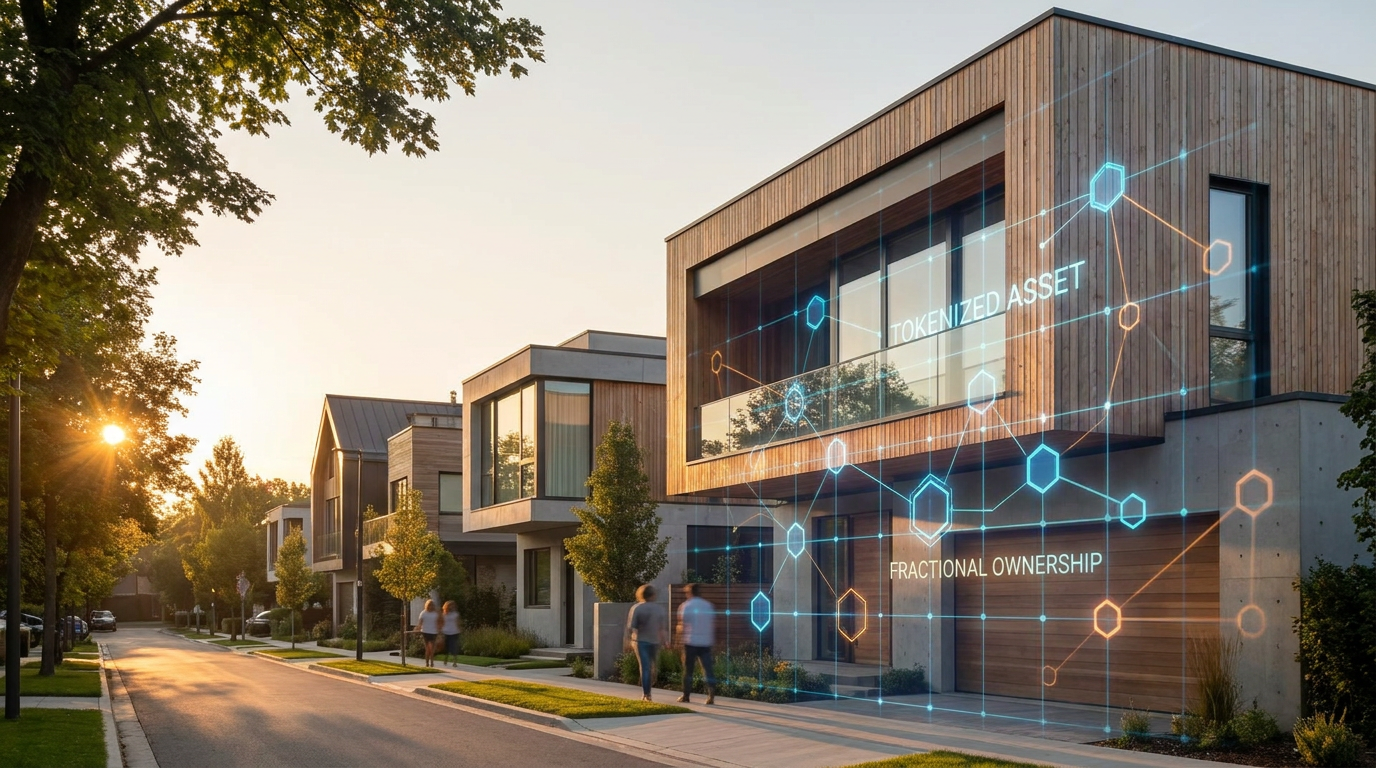
In 2026, that financial moat is being systematically dismantled. A surge of fractional real estate platforms and blockchain-based tokenization networks has transformed physical buildings into divisible, digital assets. Today, an investor can purchase a stake in a single-family rental home in Atlanta, a commercial high-rise in Europe, or a vacation villa in Bali for as little as $10 to $100, entirely from their smartphone. This shift is democratizing access to property markets, allowing everyday people to build diversified real estate portfolios without ever taking out a mortgage or dealing with a leaky roof.[1][3]
This movement is no longer a niche experiment or a speculative crypto fad. The tokenized real estate market alone is projected to surge from $3.5 billion in 2024 to nearly $19.4 billion by 2033, representing a massive 21% compound annual growth rate. What began a few years ago as a novel way to crowdfund property purchases has rapidly matured into a robust, institutional-grade financial infrastructure. Today, the ecosystem is supported by SEC-registered funds, major institutional backing, and increasingly sophisticated secondary trading markets that provide unprecedented flexibility.[3][4]
To understand how this democratization works, it helps to look at the underlying legal plumbing. When a fractional platform acquires a property, it places that specific building into a Special Purpose Vehicle (SPV), typically structured as a Limited Liability Company (LLC). Instead of buying the physical house, investors purchase shares of that specific LLC. For example, if a rental property costs $300,000 to acquire and renovate, the platform might issue 3,000 shares priced at $100 each. This legal structure isolates the financial risk to the single property, protecting investors from broader corporate liabilities.[1][7]

Once the shares are purchased, investors earn returns through two primary channels: ongoing rental income and long-term property appreciation. The platform itself, or a contracted third-party property management firm, handles all the operational headaches—finding tenants, collecting rent, managing repairs, and maintaining the accounting books. Every quarter, the net rental income is distributed to shareholders as a cash dividend. When the platform eventually decides to sell the property, the capital gains are split proportionally among the shareholders, mirroring the financial benefits of traditional ownership without the labor.[1][2]
The current market is broadly divided into two primary investment models. The first is the diversified fund approach, pioneered by massive platforms like Fundrise. In this model, investors buy into an electronic Real Estate Investment Trust (eREIT) that owns dozens or even hundreds of properties simultaneously. This provides instant, automatic diversification across various asset classes, including residential homes, commercial spaces, and new development projects. It is designed to be a highly passive, hands-off strategy for investors who want broad exposure to the real estate market without making granular decisions.[1][8]
The second model focuses on direct property selection, championed by companies like Arrived, which boasts backing from high-profile figures like Jeff Bezos. On these platforms, investors browse a digital marketplace of individual homes, reviewing detailed property photos, neighborhood economic data, and projected rental yields before deciding exactly which addresses to fund. This approach appeals heavily to investors who want the control of picking specific markets—such as betting on population growth in the Sun Belt—without taking on the massive financial burden of whole-home ownership.[1][8]
The second model focuses on direct property selection, championed by companies like Arrived, which boasts backing from high-profile figures like Jeff Bezos.
But the most disruptive evolution taking place in 2026 is the integration of tokenization. Platforms like Lofty and RealT are taking the fractional LLC model and placing those ownership shares directly onto a blockchain. By converting traditional legal shares into digital tokens, these platforms are solving the oldest and most stubborn problem in the real estate industry: deep illiquidity. Tokenization bridges the gap between the slow-moving world of physical property and the high-speed efficiency of modern digital finance.[2][6]

Traditional real estate is notoriously slow and expensive to move. Selling a physical house typically takes months of staging, inspections, appraisals, and escrow delays. Even the early, non-tokenized fractional platforms often require investors to lock up their capital for five to seven years, with early redemptions treated as rare exceptions that incur penalty fees. For decades, investors simply accepted that money put into real estate was money they could not access in an emergency.[2][8]
Tokenization fundamentally changes that math by enabling active secondary markets. Because ownership is recorded on a secure, decentralized ledger, investors can buy and sell their property tokens 24 hours a day, seven days a week, much like trading stocks on a brokerage app. If an investor suddenly needs cash, they can list their shares of a Dallas rental home on a digital exchange and potentially sell them to another user in a matter of minutes, completely bypassing traditional real estate brokers and closing costs.[2][6]
This newfound liquidity is attracting serious attention from the highest levels of institutional finance. The World Economic Forum recently identified tokenization as a leading digital-asset trend for 2026, noting that traditional finance giants are no longer just watching from the sidelines—they are actively building the infrastructure. Major clearinghouses like the Depository Trust & Clearing Corporation (DTCC) and regulators like the SEC are increasingly permitting fluid interactions with tokenized products, signaling a massive shift toward mainstream, institutional adoption of real-world assets.[5]
However, fractional investing is not a magic bullet, and the returns strictly reflect the reality of the broader housing market. Platforms typically target annual dividend yields of 3% to 8% from rental income, alongside an estimated 2% to 6% in long-term property appreciation. While these numbers offer a solid, reliable hedge against inflation and a steady stream of passive income, they are not get-rich-quick returns. Investors must align their expectations with the steady, incremental nature of real estate wealth.[1][3]

Fees also play a significant role in compressing those yields, and investors must read the fine print. Platforms typically charge upfront sourcing fees—often ranging from 3.5% to 5% of the property's total cost—as well as annual asset under management (AUM) fees. Additionally, property management fees take a standard cut of the gross rent collected. Investors must carefully weigh these operational costs against the sheer convenience of having a completely passive, professionally managed investment.[2][8]
Furthermore, the secondary markets for tokenized real estate are still maturing, and liquidity is not guaranteed. While the blockchain technology allows for instant trading, actual liquidity depends entirely on buyer demand. In a severe market downturn or a localized housing slump, finding a buyer for a fractional share of a vacation rental might require selling at a significant discount to the property's stated net asset value. The technology removes the friction of selling, but it cannot eliminate market risk.[3][7]
Despite these caveats, the democratization of real estate represents a profound and empowering shift in personal finance. For the first time in history, a young professional with just $500 to invest can build a globally diversified property portfolio. They can simultaneously own a fraction of a duplex in the American Midwest, a commercial retail space in Europe, and a high-yield short-term rental in Bali, all managed seamlessly from a single dashboard.[3][7]

By lowering the barrier to entry from hundreds of thousands of dollars down to the cost of a restaurant dinner, fractional platforms are changing who gets to participate in asset appreciation. It is a structural transition that turns static 'bricks and mortar' into a liquid, global, and highly efficient asset class. This technology is finally opening the doors of real estate wealth to a new generation of investors, proving that the future of property ownership is shared, digital, and accessible to all.[4][5][9]
How we got here
Pre-2020
Real estate investing remains largely restricted to those who can afford large down payments and secure mortgages.
2021–2022
Fractional platforms like Fundrise and Arrived gain mainstream traction, allowing retail investors to buy shares of LLCs.
2024
The tokenized real estate market reaches an estimated $3.5 billion as blockchain integration matures.
2026
Institutional finance giants and clearinghouses begin piloting infrastructure for high-velocity trading of tokenized real-world assets.
Viewpoints in depth
Retail Investors
Everyday individuals seeking passive income without the burden of property management.
For retail investors, the primary appeal of fractional real estate is the dramatic lowering of the financial barrier to entry. Instead of saving for years to afford a 20% down payment, they can deploy small amounts of capital—often as little as $10—across multiple properties and geographies. This camp values the passive nature of the investment, happily trading a portion of their yields to platform fees in exchange for avoiding tenant disputes, maintenance costs, and mortgage liabilities.
Blockchain Advocates
Technologists and investors focused on the liquidity and transparency benefits of tokenization.
This group views traditional real estate as an antiquated, illiquid asset class trapped by slow legal processes and geographic borders. By tokenizing property shares on a decentralized ledger, they argue that real estate can be traded 24/7 with the same friction-free velocity as equities. They emphasize that blockchain not only enables instant secondary market liquidity but also provides immutable, transparent records of ownership and automated dividend distributions via smart contracts.
Institutional Finance
Large-scale financial entities building the regulatory and technical infrastructure for tokenized assets.
Institutional players are moving beyond the 'hype' phase of crypto and focusing on the plumbing of global capital markets. They view real estate tokenization as a massive efficiency play that will eventually encompass trillions of dollars in assets. Their focus is on regulatory compliance, securing SEC exemptions, and integrating tokenized real-world assets (RWAs) into traditional clearinghouses like the DTCC, ensuring that massive portfolios can be traded securely at scale.
What we don't know
- How secondary markets for tokenized real estate will perform during a severe, prolonged housing market crash.
- Whether regulatory bodies will impose stricter compliance rules that could raise the barrier to entry for retail platforms.
- How quickly traditional finance institutions will fully integrate tokenized real-world assets into everyday brokerage accounts.
Key terms
- Fractional Ownership
- A method where multiple investors collectively purchase shares of a single property, splitting the costs, income, and appreciation.
- Tokenization
- The process of converting legal ownership rights of an asset into digital tokens recorded on a blockchain.
- Special Purpose Vehicle (SPV)
- A legal entity, typically an LLC, created specifically to hold a single real estate asset, isolating financial risk.
- eREIT
- An electronic Real Estate Investment Trust that pools investor money to buy and manage a diversified portfolio of properties.
- Secondary Market
- A platform or exchange where investors can buy and sell their existing fractional shares or tokens to other investors.
Frequently asked
Do I have to manage the tenants or fix the property?
No. The fractional platform or a hired third-party property management company handles all tenant relations, maintenance, and repairs.
How do I make money from fractional real estate?
Investors earn returns through two channels: regular dividend payouts from the net rental income, and proportional profits from the property's appreciation when it is eventually sold.
Can I sell my shares whenever I want?
It depends on the platform. Traditional fractional platforms often require a 5-to-7-year holding period, while blockchain-tokenized platforms allow you to sell shares on a secondary market at any time, provided there is a buyer.
Do I need to be a wealthy, accredited investor to participate?
No. Many modern platforms are open to all U.S. citizens and residents over 18, with minimum investments starting as low as $10.
Sources
Source coverage
9 outlets
4 viewpoints surfaced









[1]Fractional Property HubRetail Investors
Fractional Real Estate Investing: 2026 Guide
Read on Fractional Property Hub →[2]LoftyBlockchain Advocates
Fractional Real Estate vs. Traditional Ownership: Market Effects
Read on Lofty →[3]BinaryxBlockchain Advocates
Is fractional real estate investing worth it?
Read on Binaryx →[4]ScienceSoftInstitutional Finance
Tokenizing Real Estate: Revolution or Hype?
Read on ScienceSoft →[5]BlocksquareInstitutional Finance
Tokenized Real Estate Beyond the Headlines: The Shift to a 2026 Operating Model
Read on Blocksquare →[6]InvestraBlockchain Advocates
Blockchain Real Estate Tokenization: The Ultimate Guide
Read on Investra →[7]Tokenizer EstateReal Estate Technologists
Tokenization: What It Is and Why It Matters in 2026
Read on Tokenizer Estate →[8]Real Estate BeesRetail Investors
Arrived vs Fundrise Comparison
Read on Real Estate Bees →[9]Factlen Editorial TeamReal Estate Technologists
Synthesis by Factlen editorial team
Read on Factlen Editorial Team →
Every angle. Every day.
Get real estate stories with full source coverage and perspective breakdowns delivered to your inbox.