
The Evidence for Agrivoltaics: How Dual-Use Solar is Transforming Agriculture
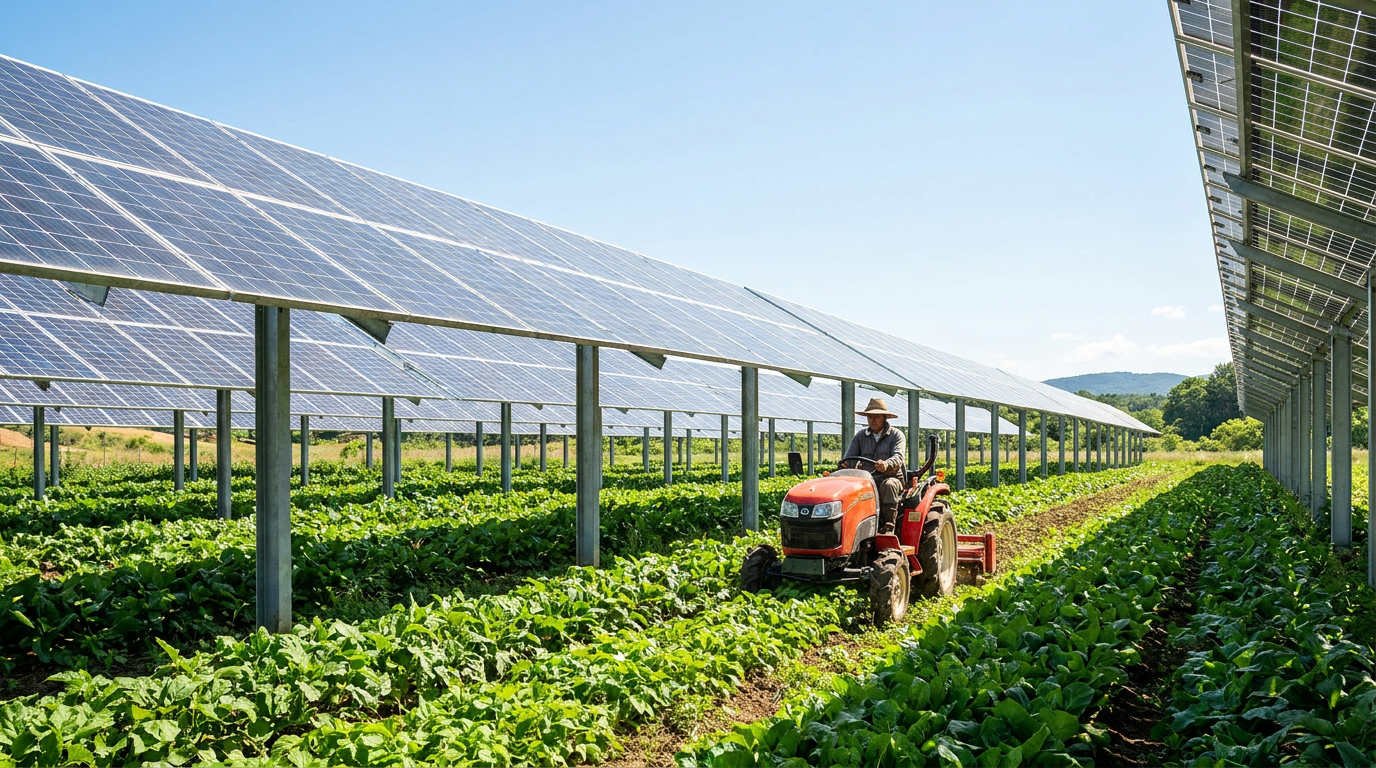
By elevating solar panels above active farmland, agrivoltaics is solving the land-use conflict between renewable energy and food production. Evidence shows the microclimate created by the panels can reduce water consumption and boost yields for shade-tolerant crops.
By Factlen Editorial Team
- Agronomists & Soil Scientists
- Focus on the biological realities, emphasizing that agrivoltaics is highly crop-specific and prioritizing soil health and moisture retention.
- Renewable Energy Developers
- Focus on unlocking vast tracts of land for the energy transition while managing the 10-20% structural cost premiums of elevated arrays.
- Agricultural Economists
- Focus on rural resilience, arguing that guaranteed electricity revenue protects small farms from bankruptcy during bad harvest years.
- Policy Makers & Regulators
- Focus on balancing national priorities, designing zoning laws that mandate genuine dual-use to prevent energy targets from cannibalizing food security.
What's not represented
- · Traditional farmers hesitant to sign multi-decade land leases with energy developers
- · Local communities concerned about the visual impact of highly elevated solar structures on rural landscapes
Why this matters
As the global transition to renewable energy accelerates, the demand for land threatens agricultural output. Agrivoltaics proves that communities do not have to choose between decarbonizing the grid and maintaining local food security, offering a financially viable path to achieve both simultaneously.
Key points
- Agrivoltaics solves the land-use conflict by co-locating solar panels and active farming on the same acreage.
- Dual-use systems can increase overall land-use efficiency by up to 73 percent compared to separate developments.
- The microclimate created by the panels reduces soil evaporation and protects crops from extreme heat and hail.
- Shade-tolerant crops like tomatoes and berries thrive, while light-demanding crops like wheat see yield reductions.
- Elevated structures cost 10-20% more to build, but provide farmers with a stable, weather-independent secondary income.
- Major policy shifts in the US, EU, and UK are rapidly removing zoning bottlenecks for dual-use projects.
The global transition to renewable energy faces a fundamental geometric problem: solar power requires massive amounts of physical space. As nations race to meet decarbonization targets, the demand for utility-scale solar installations has sparked intense land-use conflicts, pitting energy developers against agricultural communities concerned about the loss of arable soil.[5]
For years, the assumption was that land could either harvest the sun for food or harvest the sun for electricity, but not both. This zero-sum framing is now being dismantled by the rapid maturation of agrivoltaics—the deliberate co-location of agricultural production and solar energy generation on the exact same parcel of land.[1]
Moving far beyond early pilot stages, global agrivoltaic capacity has surged past 14 gigawatts, driven by a convergence of falling photovoltaic costs, rising agricultural climate stress, and new supportive policy frameworks. By elevating panels above crops or spacing them vertically between rows, agrivoltaics transforms a competition for acreage into a symbiotic system.[4][7]
Claim 1: Agrivoltaics dramatically increases overall land-use efficiency. The primary evidence for this claim rests on a metric known as the Land Equivalent Ratio (LER), which compares the output of dual-use land against separate parcels of pure farming and pure solar.[1]

Long-term data from the Fraunhofer Institute for Solar Energy Systems (ISE) demonstrates that agrivoltaic systems consistently achieve an LER of 1.35 to 1.73. In practical terms, this means a 100-hectare agrivoltaic farm can produce the same combined amount of food and electricity that would normally require 135 to 173 hectares of separated land.[1]
This efficiency gain is not merely theoretical. In densely populated regions like Japan, which pioneered the concept in 2004, and across Europe, the ability to stack energy and food production has become a critical mechanism for meeting renewable targets without compromising national food security.[4][5]
Claim 2: Solar shading reduces agricultural water consumption and protects against climate stress. As global temperatures rise, heat stress and drought are becoming existential threats to traditional farming. Agrivoltaics introduces a protective microclimate that directly mitigates these extremes.[4]
Evidence from the National Renewable Energy Laboratory (NREL) and the University of Arizona indicates that the partial shade cast by solar panels significantly lowers soil temperatures during peak daylight hours. This reduction in thermal stress directly translates to lower evapotranspiration rates, keeping moisture locked in the soil for longer periods.[2][5]
In arid environments, the water savings are profound. Controlled studies have shown that certain crops, such as peppers and tomatoes, experience up to 65 percent less water stress when grown under agrivoltaic arrays compared to open-field controls. Furthermore, the panels physically shield delicate crops from extreme weather events, including severe hail and torrential rain.[4][5]

Furthermore, the panels physically shield delicate crops from extreme weather events, including severe hail and torrential rain.
Claim 3: Crop yields improve under solar panels—with critical caveats. The evidence regarding agricultural output is robust but highly context-dependent, requiring transparent acknowledgment of biological constraints and plant physiology.[3]
Shade-tolerant plants, known as C3 crops—which include leafy greens, tomatoes, berries, olives, and certain orchard fruits—often thrive under partial shading. Because these plants reach photosynthesis saturation at lower light levels, the reduction in direct sunlight does not impede their growth, and the cooler microclimate can actually boost yields by up to 18 percent in specific trials.[4][7]
Conversely, the evidence shows that light-demanding C4 crops, such as corn and wheat, generally suffer yield penalties under solar arrays. Studies indicate that moderate to high shading can reduce the harvest of these staple grains by 16 to 42 percent. Consequently, agrivoltaics is not a universal agricultural solution, but rather a specialized tool best deployed with compatible crop profiles.[3][4]

Claim 4: Structural costs are higher, but dual-income streams offset the premium. Building an agrivoltaic farm is inherently more complex than a standard utility-scale solar installation, requiring specialized engineering to accommodate active farming beneath the arrays.[3]
To allow standard agricultural machinery—such as tractors and combine harvesters—to operate freely, panels must be mounted on elevated racking systems, often 6 to 15 feet above the ground. This requirement for heavier steel structures and deeper foundations increases initial capital expenditures by roughly 10 to 20 percent.[7]
However, financial modeling from energy analysts indicates that the dual-income stream fundamentally alters the return on investment. Farmers benefit from stable, long-term lease payments or direct electricity sales, which provide a financial buffer against the inherent volatility of crop yields and commodity markets.[6][7]
Claim 5: Policy frameworks are transitioning from experimental to institutional. The largest historical bottleneck for agrivoltaics has been regulatory ambiguity, specifically whether dual-use land should be zoned as agricultural or industrial, and how it qualifies for traditional farming subsidies.[3]

That barrier is rapidly dissolving. In the United States, federal resources now explicitly support solar-agriculture co-location, with NREL tracking hundreds of active sites. In Europe, the momentum is even stronger; the European Commission recently approved a €1.7 billion scheme in Italy specifically for agrivoltaic deployment, while France has established a comprehensive national framework.[2][4]
The United Kingdom has also adjusted its planning thresholds, making it significantly easier for mid-scale agrivoltaic projects to achieve consent without triggering protracted national infrastructure reviews, signaling a clear governmental push to normalize the technology.[7]
These policy shifts reflect a growing consensus among international bodies, including the International Renewable Energy Agency (IRENA), that integrating renewable energy into agriculture must create synergies rather than competition, ensuring that the clean energy transition does not inadvertently harm rural economies.[6]
As the technology matures—with innovations like semi-transparent panels and dynamic tracking systems that adjust their tilt based on the sun and the crops' immediate needs—agrivoltaics is poised to become a standard paradigm. It represents a rare, evidence-backed scenario where the demands of the energy transition and the preservation of global agriculture actively reinforce one another.[5][8]
How we got here
1982
German researchers Adolf Goetzberger and Armin Zastrow formally propose the concept of sharing land between solar panels and crops.
2004
Japan pioneers the first modern agrivoltaic pilot systems, coining the term 'solar sharing.'
2012
Global agrivoltaic capacity sits at a mere 5 megawatts, mostly confined to small experimental plots.
2021
Global installed capacity surpasses 14 gigawatts, driven heavily by large-scale deployments in China and Europe.
2024
France enacts a dedicated national legislative framework to standardize and accelerate agrivoltaic development.
2025
The UK raises planning thresholds for solar projects, easing the regulatory bottleneck for mid-scale dual-use farms.
Viewpoints in depth
Agronomists & Soil Scientists
Focus on the biological realities and limitations of crop shading.
Agricultural researchers emphasize that agrivoltaics is not a silver bullet for all farming, pointing to the stark differences in yield between shade-tolerant C3 crops and light-demanding C4 crops. They prioritize soil health, moisture retention, and the precise tuning of panel microclimates to protect against heat stress, warning against generic solar designs that ignore local agronomy.
Renewable Energy Developers
Focus on the geometric and economic realities of the energy transition.
For the energy sector, agrivoltaics is primarily viewed as a mechanism to unlock vast tracts of land that would otherwise be blocked by local zoning opposition and 'save our soil' campaigns. Their main concerns revolve around managing the 10 to 20 percent structural cost premiums of elevated arrays and ensuring streamlined grid interconnection for these hybrid sites.
Agricultural Economists
Focus on rural resilience and farm survival.
Economists argue that the most significant benefit of agrivoltaics is financial rather than biological. By providing a guaranteed, weather-independent revenue stream from electricity generation, dual-use systems protect small and mid-sized farms from bankruptcy during bad harvest years, effectively serving as a climate-resilient financial hedge.
Policy Makers & Regulators
Focus on balancing national priorities and preventing exploitation.
Regulators are tasked with ensuring that aggressive clean energy targets do not inadvertently cannibalize domestic food security. Their primary challenge is designing strict zoning laws and subsidies that mandate genuine dual-use—preventing developers from simply building standard solar farms and labeling them 'agrivoltaic' by planting minimal, unharvested ground cover.
What we don't know
- The long-term impact of altered microclimates on soil microbiome health over multi-decade solar lifespans.
- How rapidly semi-transparent photovoltaic materials will become cost-competitive with traditional opaque silicon panels.
- The exact degree to which climate change will force traditionally light-demanding crops to require artificial shading by 2050.
Key terms
- Agrivoltaics
- The simultaneous use of areas of land for both solar photovoltaic power generation and active agricultural production.
- Land Equivalent Ratio (LER)
- A metric used to measure the productivity of dual-use land compared to separating the land into pure farming and pure solar generation.
- Evapotranspiration
- The process by which water is transferred from the land to the atmosphere by evaporation from the soil and by transpiration from plants.
- C3 Crops
- A category of plants, including apples, grapes, and tomatoes, that reach photosynthesis saturation at lower light levels, making them highly suitable for partial shading.
- Bifacial Solar Panels
- Solar panels capable of capturing sunlight from both their front and back sides, often used in agrivoltaics to capture light reflected off the ground.
Frequently asked
Do solar panels block too much light for crops to grow?
It depends entirely on the crop. Shade-tolerant plants like lettuces, tomatoes, and certain berries thrive under the panels, while high-light crops like wheat and corn typically see reduced yields.
Can standard farm machinery still be used?
Yes. Agrivoltaic systems are specifically designed with elevated racking—often 6 to 15 feet high—or wide spacing to allow tractors and harvesters to operate normally beneath and between the arrays.
Is agrivoltaics more expensive to build than regular solar?
Yes. The specialized elevated racking systems and reinforced mounting structures required to accommodate farming equipment typically increase initial capital expenditures by 10 to 20 percent.
How does agrivoltaics save water?
The solar panels create a localized microclimate that provides partial shade, lowering soil temperatures and reducing water evaporation by up to 65 percent for certain crops in arid regions.
Sources
Source coverage
8 outlets
4 viewpoints surfaced








[1]Fraunhofer Institute for Solar Energy Systems (ISE)Renewable Energy Developers
Agrivoltaics: Opportunities for Agriculture and the Energy Transition
Read on Fraunhofer Institute for Solar Energy Systems (ISE) →[2]National Renewable Energy Laboratory (NREL)Agronomists & Soil Scientists
Agrivoltaics and Dual-Use Solar Research
Read on National Renewable Energy Laboratory (NREL) →[3]IEA-PVPSPolicy Makers & Regulators
Agrivoltaic Systems: Technical Performance and Operational Challenges
Read on IEA-PVPS →[4]MDPI EnergiesAgronomists & Soil Scientists
Agrivoltaics development progresses: From the perspective of photovoltaic impact on crops, soil ecology and climate
Read on MDPI Energies →[5]Lincoln Institute of Land PolicyAgricultural Economists
The Rise of Agrivoltaics: Dual-Use Solar and Agriculture
Read on Lincoln Institute of Land Policy →[6]IRENAAgricultural Economists
Solar-powered agri-food systems: Seven success stories
Read on IRENA →[7]Energy Solutions IntelligenceRenewable Energy Developers
Agrivoltaics 2026: Farming & Solar Dual Income
Read on Energy Solutions Intelligence →[8]Factlen Editorial TeamPolicy Makers & Regulators
Synthesis by Factlen editorial team
Read on Factlen Editorial Team →
Every angle. Every day.
Get energy stories with full source coverage and perspective breakdowns delivered to your inbox.