
The Rise of 'Green Collar' Jobs: How Vocational Training is Powering the Energy Transition
As wind turbine technicians and solar installers become the fastest-growing jobs in the U.S., trade schools and apprenticeship programs are rapidly expanding to bridge a critical skills gap.
By Factlen Editorial Team
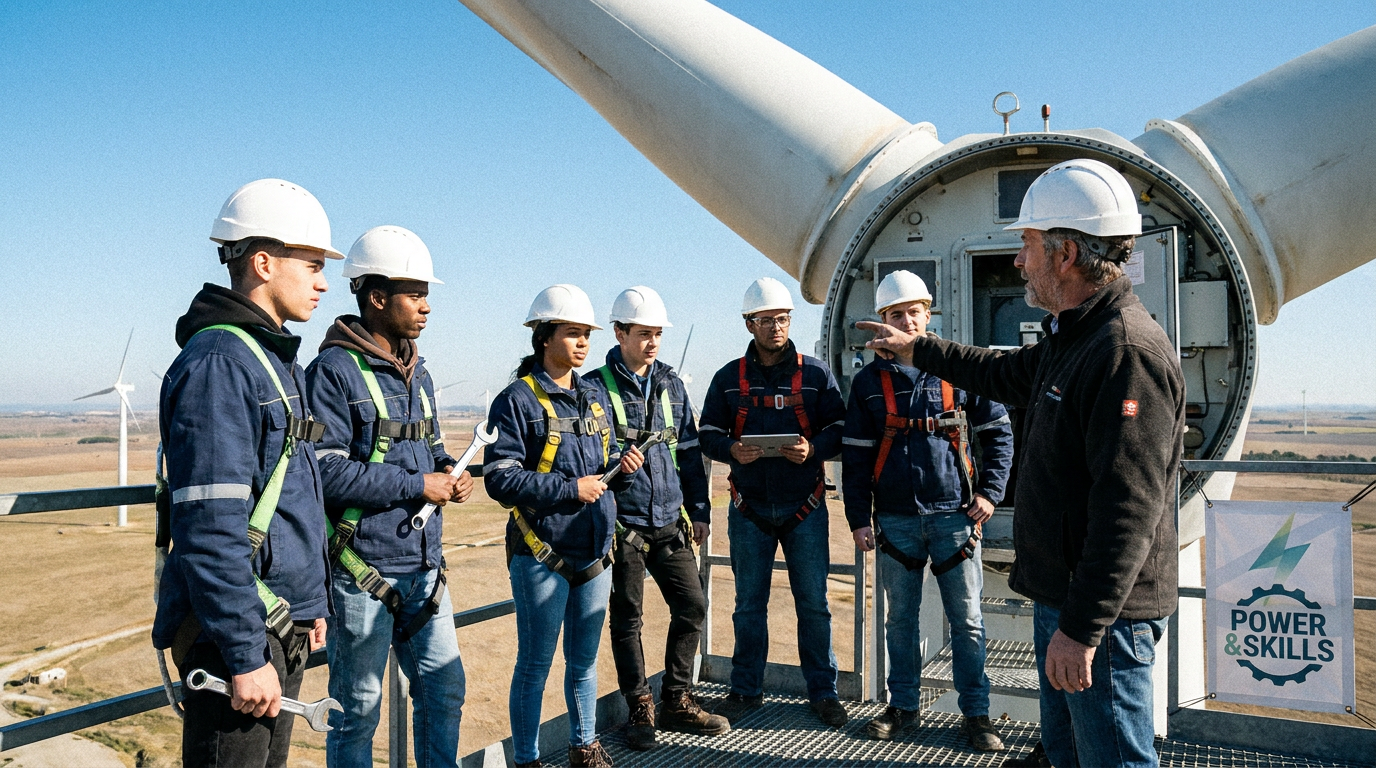
- Clean Energy Employers
- Focus on the acute skills gap and project deployment bottlenecks.
- Labor & Workforce Advocates
- Focus on job quality, safety standards, and equitable access to training.
- Vocational Educators
- Focus on adapting curricula to meet rapid technological changes in the energy sector.
What's not represented
- · Fossil fuel workers transitioning to the renewable sector
- · Rural municipalities hosting large-scale energy projects
Why this matters
The transition to renewable energy is creating hundreds of thousands of high-paying, secure jobs that do not require a four-year college degree, offering a lucrative new pathway for the middle class while addressing the climate crisis.
Key points
- Wind turbine technicians and solar installers are the two fastest-growing occupations in the United States.
- The clean energy industry is facing a severe skills gap, with projects occasionally stalling due to a lack of trained workers.
- Vocational schools and community colleges are launching specialized, short-term certificate programs to rapidly train the workforce.
- Registered apprenticeships allow workers to earn a wage while receiving hands-on training and industry-recognized credentials.
- Federal tax incentives for clean energy projects are increasingly tied to strict labor and apprenticeship requirements.
The energy transition is often visualized through sweeping landscapes of wind farms and gleaming rooftops of solar panels. But behind the hardware lies a more human transformation: the rapid rise of the "green collar" workforce. As nations race to meet ambitious climate targets and modernize aging electrical grids, the primary bottleneck is no longer just funding or technology—it is the availability of skilled hands to build, install, and maintain the infrastructure.[3][7]
This shift is fundamentally reshaping the landscape of vocational education and trade skills. For decades, the traditional trades—plumbing, electrical work, and carpentry—have been the bedrock of vocational training. Today, these foundational skills are being rapidly adapted and expanded to include specialized clean energy applications, creating a new tier of highly sought-after technical professionals.[5]
The numbers illustrate a striking economic reality. According to the U.S. Bureau of Labor Statistics, the two fastest-growing occupations in the country are wind turbine service technicians and solar photovoltaic installers. Employment for wind technicians is projected to surge by 50 percent between 2024 and 2034, a growth rate that vastly outpaces the national average for all other careers.[1]

What makes these roles particularly compelling is their accessibility. Unlike many high-growth sectors that require a four-year university degree and the associated student debt, green collar jobs are largely accessible through vocational training, community college certificates, and apprenticeships. The median annual salary for a wind turbine technician sits comfortably above $62,000, with experienced technicians earning well over $88,000.[1][5]
Despite the lucrative prospects, the industry faces a severe skills gap. In 2026, solar panels are frequently being manufactured and shipped faster than trained technicians can install them, and wind farms are being commissioned in regions where qualified maintenance engineers are scarce. Grid modernization projects, heavily subsidized by federal initiatives, occasionally stall simply for lack of skilled workers.[3][7]
To bridge this gap, community colleges and trade schools are overhauling their curricula. Institutions like Holyoke Community College in Massachusetts have launched dedicated "Clean Energy & Green Jobs Training" programs. These intensive, hands-on courses cover everything from weatherization and solar tech training to electric vehicle (EV) charger installation, often completed in just 4 to 16 weeks.[4]
Similarly, Santa Fe Community College recently utilized a $200,000 grant from the Environmental Protection Agency to operate environmental job training programs. These initiatives specifically target unemployed individuals, veterans, and underserved youth, providing them with 164 hours of instruction in hazardous waste management, environmental sampling, and emergency response—all at no cost to the student.[8]

Similarly, Santa Fe Community College recently utilized a $200,000 grant from the Environmental Protection Agency to operate environmental job training programs.
Beyond the classroom, the "earn while you learn" apprenticeship model is experiencing a major renaissance. The U.S. Department of Energy has heavily emphasized Registered Apprenticeship Programs (RAPs) as a proven pathway to develop a robust energy workforce. Apprentices earn a wage from day one, receiving a combination of on-the-job mentorship and classroom instruction that leads to an industry-valued credential.[2]
This model is particularly effective because it aligns the immediate labor needs of employers with the long-term career development of workers. The Apprenticeships in Clean Energy (ACE) Network, supported by the Department of Labor, provides free technical assistance to help employers design these programs. By standardizing training across the industry, workers gain transferable skills while companies benefit from lower turnover and increased safety.[6]
For large-scale energy developers, there is also a powerful financial incentive to embrace this educational model. Under the Inflation Reduction Act, clean energy projects can unlock significant tax incentives if they meet specific labor standards, which include employing a certain percentage of registered apprentices. This policy mechanism has effectively turned workforce development into a core business strategy for renewable energy firms.[6][7]

However, scaling these vocational programs is not without its challenges. One primary hurdle is geographic mismatch. The regions with the highest potential for utility-scale wind and solar farms—often rural or remote areas—do not always overlap with the population centers where vocational schools and potential trainees are concentrated.[3][7]
Additionally, the rapid pace of technological advancement in the clean energy sector means that curricula must be constantly updated. A technician trained on a 2020 solar inverter model may need upskilling to handle the bidirectional charging systems and smart-grid integrations becoming standard in 2026. This necessitates a model of lifelong learning rather than a one-and-done certification.[3]
To address this, industry leaders are pushing for standardized, nationally recognized certifications, such as the NABCEP Solar PV Certification and the GWO Basic Safety Training for wind technicians. These credentials ensure that a worker trained in California can seamlessly transition to a project in Texas or offshore in the Atlantic.[3]
The integration of adjacent technologies is also expanding the definition of a green collar worker. Electricians are increasingly required to understand battery storage systems and home energy management software, blurring the lines between traditional electrical work and IT networking. This convergence is prompting trade schools to introduce hybrid courses that blend physical wiring with digital literacy.[3][4]

As the global economy continues its pivot toward sustainability, the stigma historically associated with vocational education is rapidly fading. The narrative is shifting from trade schools being a "fallback" option to them being the premier launchpad for some of the most secure, high-paying, and impactful careers of the 21st century.[5][7]
Ultimately, the rise of green collar apprenticeships represents a rare alignment of economic opportunity and environmental necessity. By elevating vocational training and investing in the hands that will literally wire the future, the clean energy transition is proving to be as much about rebuilding the middle class as it is about reducing carbon emissions.[5][7]
How we got here
August 2022
The Inflation Reduction Act is signed into law, tying significant clean energy tax credits to strict apprenticeship and prevailing wage requirements.
2023
The Department of Labor launches the Apprenticeships in Clean Energy (ACE) Network to help employers develop registered training programs.
May 2024
The Bureau of Labor Statistics reports that wind turbine technicians and solar installers are officially the fastest-growing occupations in the U.S.
Early 2026
Global renewable energy employment surpasses 16.6 million jobs, highlighting an acute worldwide skills gap in installation and maintenance.
Viewpoints in depth
Vocational Educators
Focus on adapting curricula to meet rapid technological changes.
Community college administrators and trade school instructors emphasize the need for agile curricula. They argue that traditional semester-based learning is often too slow for the rapidly evolving clean energy sector. Instead, they advocate for short, intensive certificate programs and stackable credentials that allow workers to enter the field quickly and return for upskilling as technology advances, such as moving from basic solar installation to complex battery storage integration.
Clean Energy Employers
Focus on the acute skills gap and project deployment bottlenecks.
For renewable energy developers and installation firms, the primary concern is the sheer volume of labor required. They point out that supply chain issues have largely been resolved, making workforce availability the primary bottleneck for new wind and solar projects. Employers strongly advocate for expanded government subsidies for apprenticeship programs and streamlined certification processes to get "boots on the roof" faster, ensuring they can meet the demand spurred by federal tax incentives.
Labor & Workforce Advocates
Focus on job quality, safety standards, and equitable access.
Labor unions and workforce advocacy groups stress that a "green job" must also be a "good job." They champion Registered Apprenticeship Programs (RAPs) because these frameworks guarantee wage progressions, comprehensive safety training, and portable credentials. Advocates also focus heavily on ensuring that these lucrative career pathways are accessible to underserved communities, veterans, and workers transitioning out of the fossil fuel industry, preventing the new energy economy from replicating old inequalities.
What we don't know
- Whether vocational training infrastructure can scale fast enough to meet the escalating demands of the 2030 climate targets.
- How effectively workers from declining fossil fuel industries will be able to transition into these new green collar roles.
Key terms
- Green Collar Worker
- A professional employed in the environmental sectors of the economy, specifically in roles that involve renewable energy, energy efficiency, or sustainability.
- Registered Apprenticeship Program (RAP)
- A formalized, earn-while-you-learn workforce training model validated by the Department of Labor that combines on-the-job training with classroom instruction.
- Wind Turbine Service Technician (Windtech)
- A specialized tradesperson responsible for inspecting, diagnosing, maintaining, and repairing wind turbines.
- Photovoltaic (PV) Installer
- A technician who assembles, installs, and maintains solar panel systems on roofs or other structures.
Frequently asked
Do I need a college degree to get a green collar job?
No. The vast majority of high-growth roles, such as wind technicians and solar installers, require a high school diploma followed by vocational training, a community college certificate, or an apprenticeship.
How much do wind turbine technicians make?
According to the Bureau of Labor Statistics, the median annual salary for a wind turbine technician in 2024 was $62,580, with top earners making over $88,000.
Are these jobs only available in certain states?
While states with large wind and solar farms have high concentrations of these jobs, the push for residential solar, EV charging infrastructure, and grid modernization is creating demand nationwide.
What is the 'earn while you learn' model?
It refers to registered apprenticeships where workers are hired and paid a wage from their first day, receiving hands-on training and classroom instruction simultaneously.
Sources
Source coverage
8 outlets
3 viewpoints surfaced








[1]Bureau of Labor StatisticsLabor & Workforce Advocates
Wind Turbine Technicians : Occupational Outlook Handbook
Read on Bureau of Labor Statistics →[2]Department of EnergyLabor & Workforce Advocates
Apprenticeships & Workforce Development
Read on Department of Energy →[3]Green Fuel JournalClean Energy Employers
Renewable Energy Jobs in 2026: Global Market Growth, Skills Gap & Career Pathways
Read on Green Fuel Journal →[4]Holyoke Community CollegeVocational Educators
Clean Energy & Green Jobs Training
Read on Holyoke Community College →[5]Diversity EmploymentClean Energy Employers
Green-Collar Jobs: High-Growth Renewable Energy Jobs and What They Pay
Read on Diversity Employment →[6]ACE NetworkLabor & Workforce Advocates
Apprenticeships in Clean Energy Network
Read on ACE Network →[7]Factlen Editorial Team
Synthesis by Factlen editorial team
Read on Factlen Editorial Team →[8]Santa Fe Community CollegeVocational Educators
Training the Green Jobs Workforce
Read on Santa Fe Community College →
Every angle. Every day.
Get education stories with full source coverage and perspective breakdowns delivered to your inbox.