
US and Iran Sign 14-Point Ceasefire Agreement at Versailles: What the Deal Contains
President Trump and Iranian President Masoud Pezeshkian have signed a Memorandum of Understanding that halts military operations, reopens the Strait of Hormuz, and triggers a 60-day window for a final nuclear agreement.
By Factlen Editorial Team
- US Administration
- Prioritizes global economic stability and immediate de-escalation over maximalist military goals.
- Conservative Critics
- Argues the deal rewards aggression and fails to permanently dismantle nuclear threats.
- Israeli Leadership
- Views the agreement as a strategic failure that leaves regional adversaries intact and well-funded.
- Iranian Leadership
- Frames the ceasefire and economic relief as a historic victory against US pressure.
What's not represented
- · Lebanese civilians
- · European energy markets
Why this matters
This agreement pauses a major geopolitical conflict that threatened to trigger a global economic depression by choking off the world's oil supply. However, the sweeping concessions have sparked fierce domestic and international backlash, leaving the long-term stability of the Middle East highly uncertain.
Key points
- The US and Iran signed a 14-point Memorandum of Understanding at the Palace of Versailles.
- The agreement establishes a 60-day ceasefire and reopens the Strait of Hormuz to global shipping.
- The US committed to lifting its naval blockade within 30 days and backing a $300 billion reconstruction plan.
- Republican lawmakers heavily criticized the deal, calling it a massive foreign policy blunder.
- Israeli leadership distanced itself from the pact, viewing it as a strategic failure that leaves Hezbollah intact.
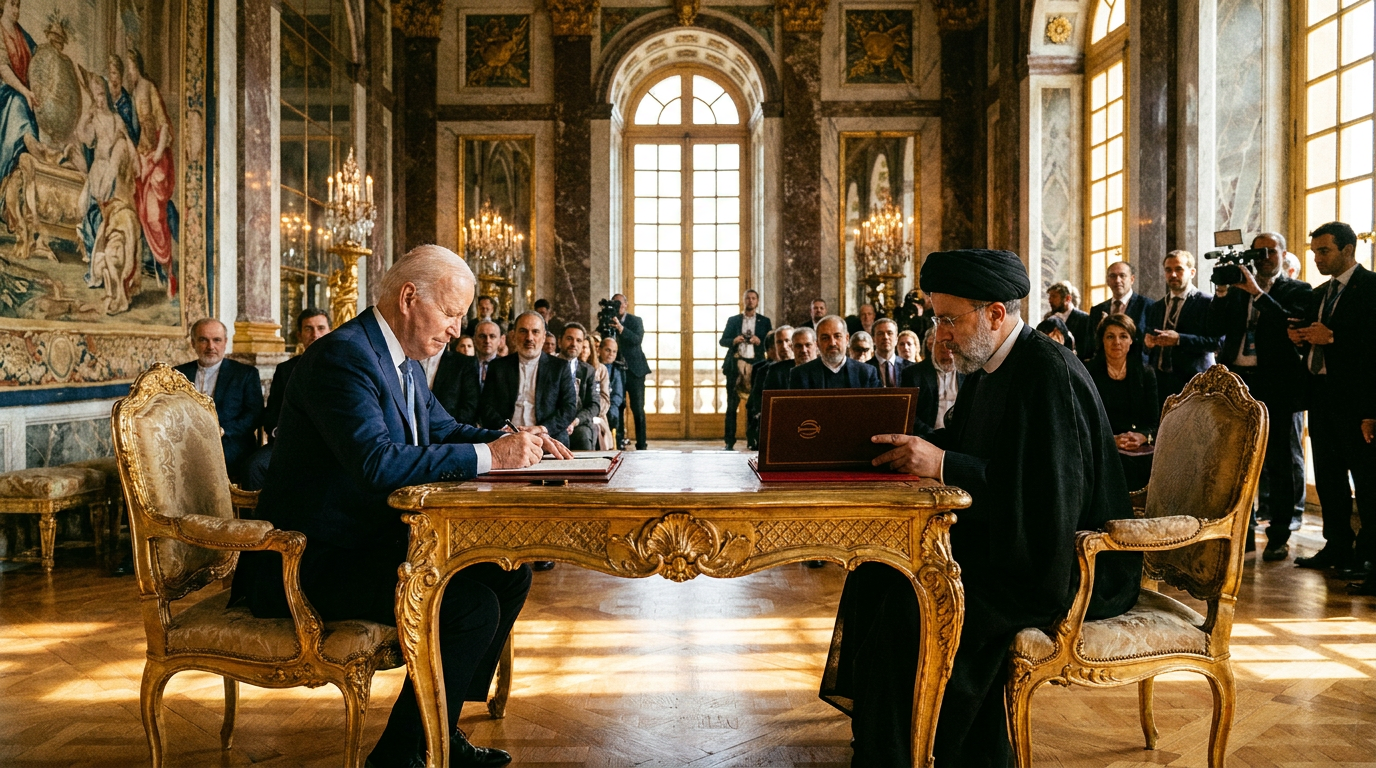
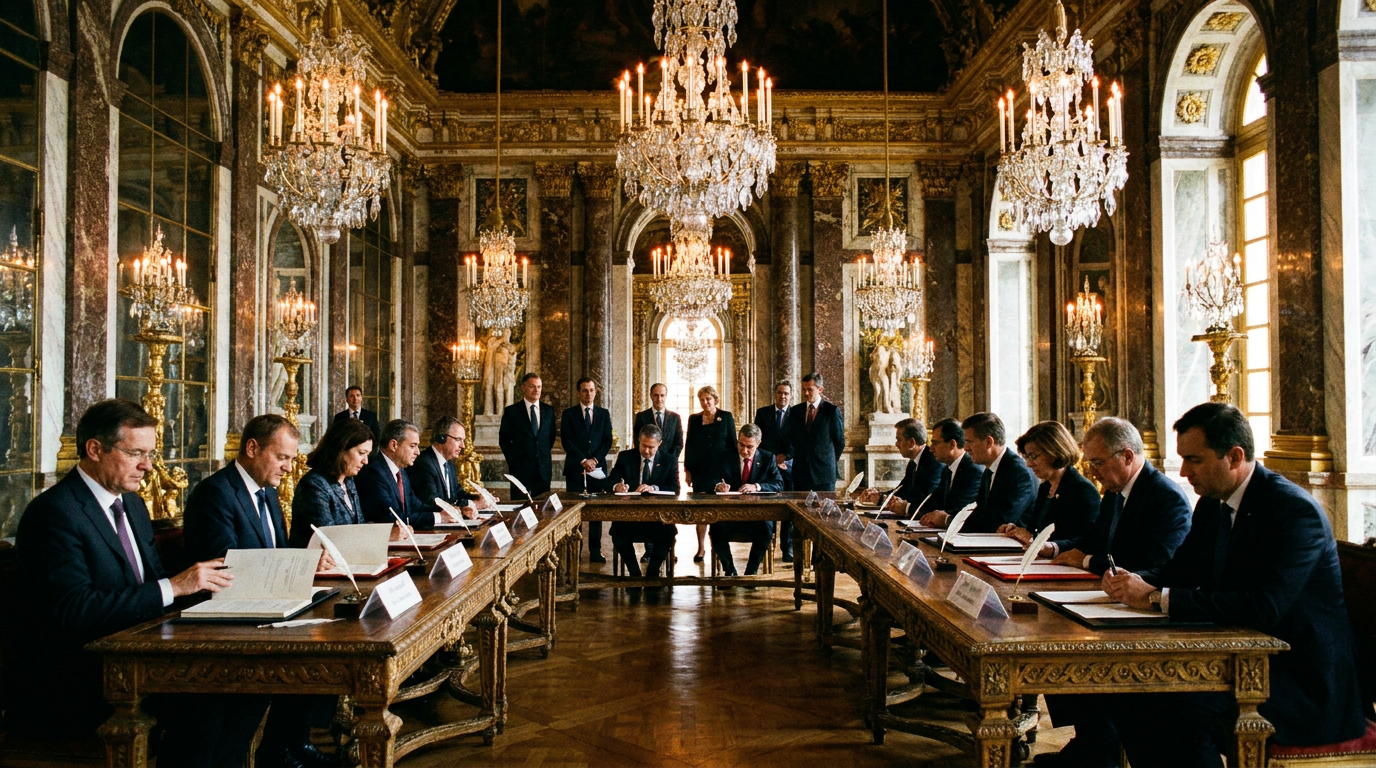
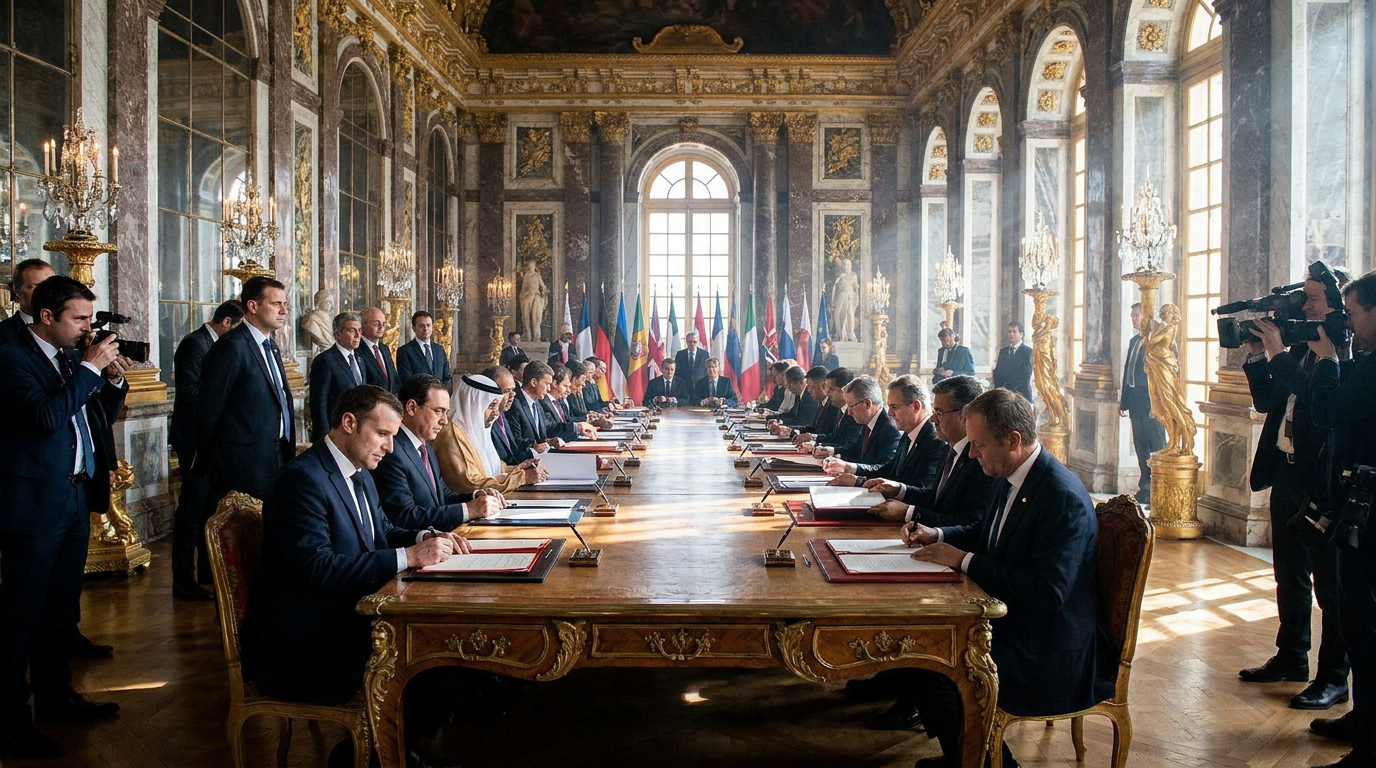
After weeks of devastating conflict and mounting global economic anxiety, the United States and Iran have signed a landmark 14-point Memorandum of Understanding (MoU) to halt hostilities. The agreement was formally signed by US President Donald Trump and Iranian President Masoud Pezeshkian during a dinner hosted by French President Emmanuel Macron at the Palace of Versailles, following the conclusion of the G7 summit. The "Islamabad Memorandum of Understanding" establishes an immediate and permanent end to military operations on all fronts, including the ongoing strikes in Lebanon. By bringing the leaders of the two adversarial nations together to physically sign the document, the administration hopes to signal a definitive pivot from armed conflict to diplomatic negotiation, though the sweeping concessions involved have already sparked fierce international and domestic debate.[1][2][6]
At the core of the agreement is a delicate exchange of economic relief for maritime security. In exchange for Iran immediately reopening the critical Strait of Hormuz—a vital maritime chokepoint through which a significant portion of the world's oil flows—the United States has agreed to lift its naval blockade and begin unwinding primary and secondary sanctions within 30 days. Furthermore, the US has committed to withdrawing its military forces from the immediate proximity of the Islamic Republic within that same 30-day window. Perhaps the most startling concession outlined in the draft text is a US commitment to coordinate a $300 billion reconstruction and economic development plan for Iran, working alongside regional partners to rebuild infrastructure damaged during the conflict.[1][6]

While the economic and maritime provisions are explicit, the agreement leaves the most contentious security issues largely unresolved. Iran has reaffirmed a broad pledge not to develop nuclear weapons, but the MoU defers the complex mechanics of dismantling its enriched uranium stockpile—a process known as down-blending—to future negotiations. The primary driver for this rapid, somewhat ambiguous diplomatic resolution was the immense pressure on the global economy. Iran's successful closure of the Strait of Hormuz threatened what the Trump administration explicitly warned could become a "worldwide depression." Analysts note that while the US entered the conflict with maximalist goals, including the total destruction of Iran's nuclear and ballistic missile programs, the asymmetrical warfare and the immediate economic fallout from restricted oil supplies forced a strategic pivot toward a negotiated settlement.[1][4][6]
Domestically, the agreement has triggered a political firestorm within the Republican party, with lawmakers who typically align with the Trump administration publicly revolting against the concessions. Outgoing Louisiana Senator Bill Cassidy labeled the MoU the "worst foreign policy blunder in decades," arguing that it fundamentally rewards Tehran for holding the global economy hostage. "Before the war, the strait was open, Iran was being crushed by sanctions, and 13 service members were still alive," Cassidy stated, adding that "Reagan is rolling over in his grave." Senator Ted Cruz echoed these sentiments, heavily criticizing the decision to allow Iran to potentially control tolls in the Strait of Hormuz in the future, and arguing that the administration is receiving exceptionally "bad advice" regarding theocratic regimes.[4]

In Jerusalem, the agreement was met with a mix of deep frustration and calculated political maneuvering. Israeli Prime Minister Benjamin Netanyahu, who was largely sidelined during the final stages of the US-led negotiations, publicly distanced himself from the pact. During a press conference, Netanyahu claimed that the joint US-Israeli military campaign had successfully removed the immediate threat of nuclear annihilation and caused enormous damage to Iranian infrastructure, but he pointedly noted that the MoU was solely the US president's decision. Behind the scenes, Israeli officials and opposition leaders were significantly less restrained, with many calling the deal a "strategic and political disaster" that throws a vital lifeline to Tehran while leaving the Iranian-backed militant group Hezbollah largely intact across Israel's northern border in Lebanon.[3]
In Jerusalem, the agreement was met with a mix of deep frustration and calculated political maneuvering.
Conversely, Iranian officials and their regional allies are framing the Versailles agreement as a historic diplomatic and military triumph. Iranian Parliament Speaker Mohammad Bagher Ghalibaf declared that the negotiations delivered far more tangible results than the war itself, calling the signed agreement a "record of US failure" that the Iranian people will judge favorably. The ceasefire's extension to Lebanon has also allowed Hezbollah leadership to proclaim a "great victory," as the MoU effectively halted Israeli airstrikes and included provisions guaranteeing Lebanon's territorial integrity. For Tehran, the promise of a $300 billion reconstruction fund and the lifting of crippling economic sanctions represents a massive return on their strategy of asymmetrical escalation and maritime disruption.[5][6]

It is crucial to understand that the Memorandum of Understanding is not a permanent treaty, but rather an interim framework designed to stop the immediate bleeding. The signing at Versailles triggers a strict 60-day window for diplomats from both nations to convene in Switzerland and hammer out a final, comprehensive agreement. This upcoming negotiation phase will be tasked with finalizing the implementation mechanisms for the reconstruction fund, defining the exact parameters of Iran's nuclear compliance, and establishing long-term security guarantees for the Persian Gulf. Vice President JD Vance has emphasized that the administration will judge the new Iranian leadership by their actual conduct during this period, rather than their rhetoric.[1][6]
The path to a final, lasting deal remains fraught with severe obstacles and deep uncertainties. The US administration must navigate intense domestic political outrage that could threaten legislative support for any financial commitments. Meanwhile, Israel has made it clear that it is not a signatory to the pact and reserves the right to act independently against any perceived existential nuclear threats. Furthermore, the logistical hurdles of assembling and administering a $300 billion reconstruction fund without inadvertently funding regional militant groups remain entirely undefined. For now, the Versailles signing has pulled the world back from the brink of a broader regional war and a catastrophic global energy crisis, but it leaves the fundamental power dynamics of the Middle East unresolved and highly volatile.[1][3][4]
How we got here
Pre-War
The US enters the conflict with maximalist goals to eliminate Iran's nuclear and ballistic missile programs.
Conflict Peak
Iran closes the Strait of Hormuz, triggering massive disruptions in global energy markets and fears of a worldwide depression.
June 17, 2026
The US and Iran digitally sign a draft 14-point Memorandum of Understanding to halt hostilities.
June 17, 2026 (Evening)
President Trump and President Pezeshkian formally sign the MoU at the Palace of Versailles.
Next 60 Days
Diplomats from both nations are scheduled to convene in Switzerland to negotiate a final, comprehensive treaty.
Viewpoints in depth
US Administration's Pragmatism
The administration argues the deal was necessary to prevent a global economic collapse.
Officials contend that the closure of the Strait of Hormuz posed an unacceptable risk of a "worldwide depression." By securing an immediate ceasefire and reopening the vital shipping lanes, the administration claims it has stabilized global energy markets while still extracting a pledge from Iran to halt its nuclear weapons development.
Republican Critics
Conservative lawmakers view the agreement as a dangerous appeasement that rewards Iranian aggression.
Critics like Senators Bill Cassidy and Ted Cruz argue that the US surrendered its leverage by lifting crippling sanctions and offering a $300 billion reconstruction package. They assert that the deal fails to permanently dismantle Iran's nuclear infrastructure and sets a dangerous precedent by showing that threatening global oil supplies yields massive financial and diplomatic concessions.
Israeli Leadership
Israel views the pact as a strategic disaster that leaves its primary adversaries intact.
While Prime Minister Netanyahu claims the military campaign successfully degraded Iran's capabilities, the broader Israeli establishment is deeply alarmed. They argue the agreement throws a financial lifeline to Tehran and fails to disarm Hezbollah in Lebanon, effectively pausing the conflict rather than resolving the fundamental security threats on Israel's borders.
Iranian Leadership
Tehran frames the agreement as a historic victory over US military and economic pressure.
Iranian officials, including Parliament Speaker Mohammad Bagher Ghalibaf, point to the lifting of the naval blockade and the promise of a $300 billion reconstruction fund as proof that their strategy of asymmetrical warfare succeeded. They view the deal as a formal acknowledgment of Iran's regional power and a definitive failure of Washington's maximalist military objectives.
What we don't know
- How the $300 billion reconstruction fund will be administered without inadvertently financing regional militant groups.
- The exact mechanisms and timeline for dismantling Iran's enriched uranium stockpile.
- Whether Israel will launch independent military action if it perceives the final agreement as insufficient.
Key terms
- Strait of Hormuz
- A vital maritime chokepoint between the Persian Gulf and the Gulf of Oman through which a significant portion of the world's oil supply flows.
- Memorandum of Understanding (MoU)
- A formal, non-binding agreement between two or more parties outlining the terms of an understanding, often serving as a framework for a future treaty.
- Down-blending
- The process of diluting highly enriched uranium with lower-enriched or natural uranium to make it unusable for nuclear weapons.
- Naval Blockade
- The use of naval forces to cut off a specific area, preventing maritime vessels from entering or leaving, often used as a tool of economic and military pressure.
Frequently asked
What is the 14-point Memorandum of Understanding?
It is an interim agreement signed by the US and Iran at Versailles that establishes a 60-day ceasefire, reopens the Strait of Hormuz, and lifts the US naval blockade.
Why did the US agree to a $300 billion reconstruction plan?
The US and regional partners agreed to the fund as a major concession to secure the immediate reopening of the Strait of Hormuz, which was threatening to cause a global economic depression.
Does this agreement permanently end Iran's nuclear program?
No. While Iran reaffirmed a pledge not to develop nuclear weapons, the specific mechanics of dismantling its enriched uranium stockpile were deferred to future negotiations.
How has Israel reacted to the ceasefire?
Israeli Prime Minister Benjamin Netanyahu distanced himself from the pact, while other Israeli officials have called it a "strategic disaster" that leaves Hezbollah and Iran's infrastructure intact.
Sources
Source coverage
6 outlets
4 viewpoints surfaced






[1]CBS NewsUS Administration
Live Updates: Trump formally signs U.S.-Iran deal as questions linger about nuclear program, missiles
Read on CBS News →[2]Fox NewsUS Administration
Trump personally signs Iran deal at Versailles in major diplomatic breakthrough
Read on Fox News →[3]AxiosIsraeli Leadership
Netanyahu fumes, allies rage over Trump's Iran deal
Read on Axios →[4]The GuardianConservative Critics
Trump's Iran deal is result of unrealistic ambitions for an untenable war
Read on The Guardian →[5]Al JazeeraIranian Leadership
Ghalibaf says talks delivered more results than war
Read on Al Jazeera →[6]CTV NewsIranian Leadership
Read the full 14-point agreement between the U.S. and Iran
Read on CTV News →
More in news politics
See all 10 stories →School Nutrition
The Evidence on Universal Free School Meals: What the Data Shows Three Years In
8 sources

Ranked Choice Voting
Fact-Checking Ranked Choice Voting: Does It Actually Fix Polarization and Turnout?
9 sources
US Foreign Policy
US and Iran Sign 14-Point Peace Memorandum, Triggering Market Rally and Political Backlash
7 sources
Iran Deal
U.S. and Iran Sign 14-Point Framework Agreement to End War
6 sources
Every angle. Every day.
Get news politics stories with full source coverage and perspective breakdowns delivered to your inbox.