
How Agentic Workflows Are Moving AI From Chatbots to Autonomous Task Executors
Enterprise AI is shifting from passive assistants to autonomous agents capable of planning, executing, and adapting to complex multi-step workflows.
By Factlen Editorial Team
- Enterprise Integrators
- Focused on leveraging AI agents to scale operations and drive measurable ROI.
- System Architects
- Focused on the technical orchestration, security, and governance of multi-agent systems.
- Workflow End-Users
- Focused on how autonomous AI changes daily job responsibilities and human-machine collaboration.
What's not represented
- · Labor unions concerned about job displacement
- · Small business owners lacking enterprise budgets
Why this matters
As AI systems transition from answering questions to executing complex business processes, workers will be freed from repetitive digital chores to focus on high-level strategy and creative problem-solving.
Key points
- Agentic workflows allow AI to autonomously plan and execute multi-step tasks without constant human prompting.
- Unlike rigid traditional automation, AI agents can adapt to unexpected variables and unstructured data.
- Multi-Agent Systems (MAS) divide complex work among specialized AI models to improve speed and reliability.
- Gartner projects 40% of enterprise applications will embed task-specific AI agents by the end of 2026.
- Strict governance and 'human-in-the-loop' protocols are becoming standard to ensure secure AI deployments.
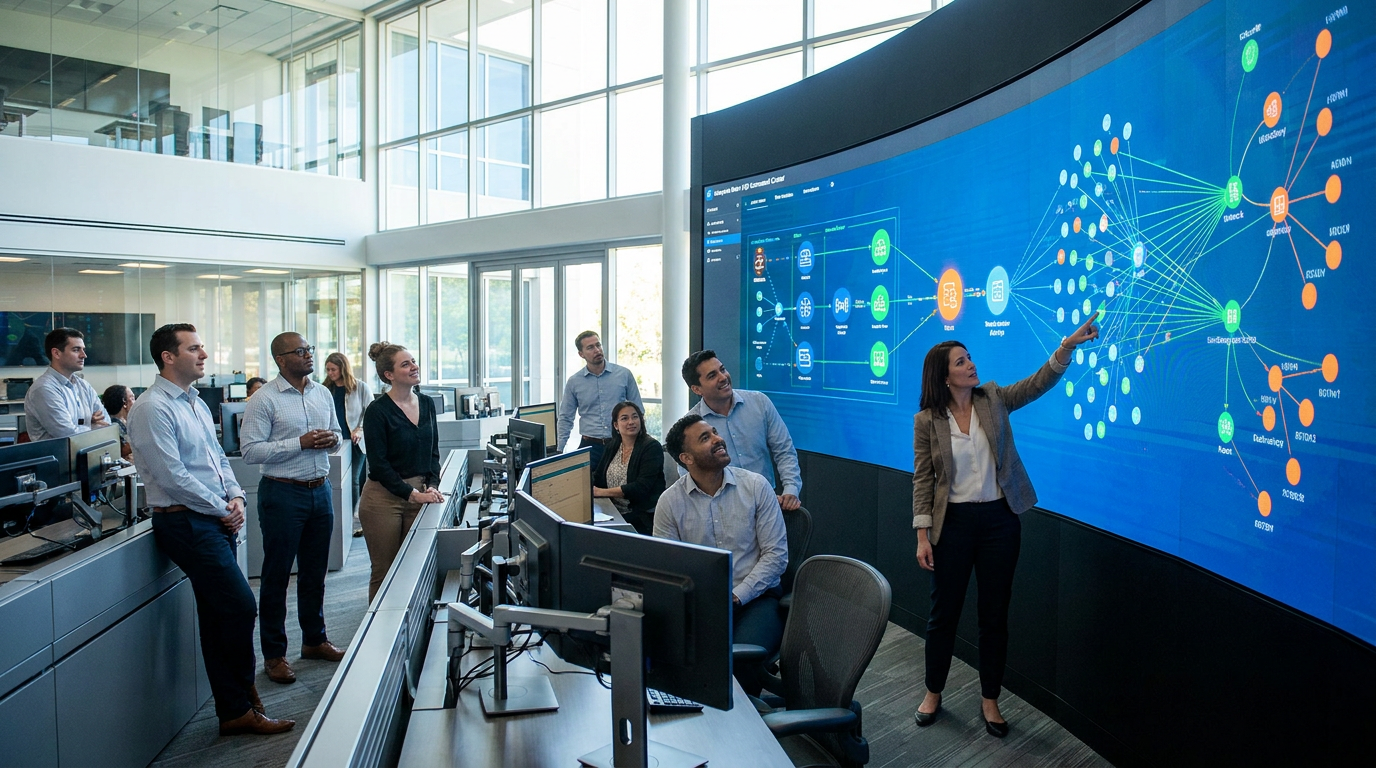
For the past three years, artificial intelligence has largely functioned as a highly capable but passive assistant, waiting patiently for a human prompt before generating text, writing code, or synthesizing research. But in 2026, the technological paradigm has definitively shifted from reactive chatbots to active, autonomous systems. This transition is being driven by the rapid maturation of "agentic workflows"—a fundamentally new architecture where AI models do not just answer isolated questions, but independently plan, execute, and adapt to complete complex, multi-step goals. Instead of relying on a human to guide it through every phase of a project, an agentic system takes a high-level objective and determines the optimal path to achieve it, marking a profound evolution in how knowledge work is conducted.[7]
The distinction between a traditional AI tool and an agentic workflow is fundamentally about autonomy and continuous reasoning. While a standard large language model requires continuous human steering to navigate a complex problem, an agentic system is given a broad mandate—such as researching fifty target accounts, cross-referencing them against internal compliance metrics, and populating a customer relationship management database. Once the objective is set, the AI agent breaks the goal down into logical sub-tasks, selects the appropriate software tools for each step, and executes the sequence without waiting for permission at every juncture. If it encounters an error, it attempts to troubleshoot the issue rather than simply halting the process.[3][4]
This shift represents a monumental leap in digital transformation, moving artificial intelligence from a novelty application to core enterprise infrastructure. According to a comprehensive 2026 report by McKinsey & Company, twenty-three percent of organizations are now actively scaling agentic AI systems in at least one business function, while an additional thirty-nine percent are in the active experimentation phase. The corporate focus has decisively moved away from evaluating how well an AI can write a polite email, pivoting instead to how reliably it can execute an end-to-end business process. For companies that successfully implement these systems, the result is a dramatic increase in operational velocity and a fundamental redesign of daily workflows.[1]
To fully grasp why agentic workflows are so disruptive, it is helpful to compare them to the previous generation of enterprise automation: Robotic Process Automation, or RPA. For years, RPA bots have handled repetitive, high-volume tasks like invoice processing, data entry, and basic system synchronization by following rigid, predefined rules. These systems are highly effective for perfectly predictable environments, but traditional automation is notoriously brittle. If an RPA bot encounters an unexpected variable—such as an unstructured email from a client, a missing file attachment, or a slightly altered website layout—the entire process breaks down. The bot lacks the cognitive ability to understand context, meaning any deviation from the hard-coded script results in a failure that requires immediate human intervention to resolve the exception.[3][5]

Agentic workflows solve this inherent brittleness through intelligent adaptability and contextual awareness. Instead of following a hard-coded, linear script, AI agents operate on an iterative cognitive loop: perceive, plan, act, and reflect. When an autonomous agent encounters an exception or an unexpected data format, it does not simply crash and wait for a software developer to fix it. It evaluates the new context, searches its available digital tools for alternative methods, and adjusts its execution plan in real time. This dynamic problem-solving mirrors how a human employee would behave when faced with a minor roadblock, allowing the automation to continue functioning smoothly even when the operating environment is messy, unstructured, or highly unpredictable.[4][5]
This adaptability is powered by the deep integration of advanced language models with external digital tools. In a true agentic workflow, the artificial intelligence is granted secure access to a company’s application programming interfaces (APIs), internal databases, and third-party software platforms. If an autonomous agent needs to verify a customer's payment history to resolve a support ticket, it can independently write a database query, execute it against the financial system, read the resulting data, and use that specific information to inform its next action. This ability to reach out into the digital world and manipulate software transforms the AI from a passive text generator into an active digital worker.[3]
As the technology matures throughout 2026, the underlying architecture of these systems is also evolving rapidly to handle enterprise-scale demands. Early attempts at autonomous AI often relied on a single, massive language model tasked with handling every single aspect of a complex workflow—from initial planning to data retrieval and final execution. This monolithic approach, sometimes referred to as a 'God Model' architecture, frequently led to high latency, severe logic failures, and a frustrating tendency for the AI to hallucinate or completely lose track of its original goal when the multi-step task became too convoluted or required highly specialized domain knowledge.[7]
As the technology matures throughout 2026, the underlying architecture of these systems is also evolving rapidly to handle enterprise-scale demands.
Today, the industry standard approach has shifted decisively toward the Multi-Agent System, or MAS. Instead of relying on one omnipotent model to do everything, complex workflows are intelligently divided among specialized, domain-specific agents that collaborate seamlessly to achieve the final outcome. In this framework, a 'Supervisor Agent' acts as the digital project manager. It analyzes the overarching user request, breaks it down into logical, manageable sub-tasks, and delegates those specific assignments to a team of specialized worker agents. Once the workers complete their individual components, the supervisor synthesizes their outputs into a cohesive final result, ensuring quality control and adherence to the original objective.[7]

For example, in a modern multi-agent setup, a 'Researcher Agent' might be tasked exclusively with querying internal company documents using Retrieval-Augmented Generation techniques, ensuring it only pulls from verified, proprietary data rather than relying on its general training. Simultaneously, a 'Tool Execution Agent'—highly trained in function calling—handles the actual API requests required to update a database, modify a spreadsheet, or send an outbound email. By dividing the labor among specialized models that excel at narrow tasks, these systems operate significantly faster, consume less computing power, and deliver much higher reliability than the single-model architectures of the past.[7]
The real-world applications of agentic workflows are already reshaping industries where operational complexity is the norm and the cost of errors is high. In the insurance sector, carriers are increasingly deploying autonomous agents to handle the intake of complex claims. An agentic system can read an unstructured email from a policyholder, recognize that a specific coverage type requires an additional police report, automatically reply to the customer to request the missing document, verify the document upon receipt, and route the completed file to a human adjuster. It accomplishes all of this dynamically, without a predefined sequence being explicitly coded by a developer in advance.[7]
Similar transformations are occurring in customer support and broad business operations. Major tech platforms are rolling out enterprise-scale deployments of autonomous AI agents that allow companies to automate lead qualification, personalized booking, and tier-one issue resolution at an unprecedented scale. These systems operate around the clock, handling multi-step conditional logic that would have previously required a massive human workforce to manage effectively. Because the agents can access real-time inventory databases and historical customer interactions, they provide highly personalized, context-aware service rather than the generic, pre-written responses that characterized the previous era of automated customer service chatbots.[7]
The financial momentum behind this shift toward autonomous operations is staggering, reflecting a broad consensus that agentic AI is the future of enterprise software. According to projections from Gartner, forty percent of enterprise applications will embed task-specific AI agents by the end of 2026, representing a massive jump from less than five percent in 2025. The global market for AI agents is projected to reach up to $12.1 billion this year alone. Looking further ahead, industry analysts expect that these autonomous systems will intermediate trillions of dollars in business-to-business spending by the end of the decade as they become deeply embedded in procurement, sales operations, and digital commerce.[2]

Despite the rapid adoption and clear operational benefits, the transition to autonomous operations is not without significant hurdles. The primary challenge facing organizations today is no longer the raw cognitive capability of the underlying AI models, but rather the sheer complexity of system integration. Most legacy enterprise software systems were designed explicitly for human operators navigating graphical user interfaces, not for autonomous digital agents that require continuous, real-time data access across multiple fragmented domains. Bridging this architectural gap requires substantial overhauls to internal data pipelines, often forcing companies to modernize their entire digital infrastructure before they can successfully deploy agentic workflows at scale.[7]
Furthermore, as these agents gain the ability to modify production databases, execute financial transactions, and send external communications on behalf of a company, governance and security have become paramount concerns for corporate leadership. The era of unchecked, experimental AI deployment is officially over. Enterprises are now mandating strict, zero-trust security frameworks, ensuring that autonomous agents operate within tightly defined digital guardrails and cannot access unauthorized sensitive data. For high-stakes decisions, organizations are implementing robust 'human-in-the-loop' protocols. In these setups, the AI completes the heavy lifting of data gathering, research, and workflow preparation, but explicitly requires a human manager to review and approve the final action before execution.[6][7]
Ultimately, the organizations succeeding in 2026 are those that view agentic workflows not merely as a cost-cutting mechanism, but as a powerful catalyst for redesigning how work fundamentally gets done across the enterprise. By delegating the execution of complex, multi-step digital processes to autonomous systems, human workers are freed from the burden of repetitive digital chores and endless software navigation. This profound shift allows employees to focus their time and energy on high-level strategy, creative problem-solving, empathetic customer interactions, and complex relationship-building—the deeply human areas of work where artificial intelligence remains entirely irreplaceable, paving the way for a more engaging and productive future of work.[1][7]
How we got here
2023
Generative AI chatbots become mainstream, requiring constant human prompting for every action.
2024
Early experimental AI agents demonstrate the ability to autonomously use external tools like web browsers and calculators.
2025
Enterprises begin pilot programs testing autonomous agents in isolated, low-risk environments.
Early 2026
Multi-agent systems become the standard architecture, allowing specialized AI models to collaborate reliably on complex tasks.
Mid 2026
Agentic workflows transition from experimental pilots to production-grade enterprise deployments across major industries.
Viewpoints in depth
Enterprise Integrators
Focused on leveraging AI agents to scale operations and drive measurable ROI.
For corporate leaders and enterprise integrators, the shift to agentic workflows is primarily about breaking through the limitations of traditional automation. They view the technology as a way to scale operations without linearly increasing headcount, particularly in high-volume areas like customer support and data processing. Their primary concerns revolve around proving return on investment, successfully integrating these new AI models with legacy software systems, and moving beyond the 'hype cycle' into production-grade reliability.
System Architects
Focused on the technical orchestration, security, and governance of multi-agent systems.
System architects and AI developers approach agentic workflows as a complex orchestration challenge. They advocate for the Multi-Agent System (MAS) approach, arguing that dividing tasks among specialized models is the only way to reduce hallucinations and latency. This camp is highly focused on establishing zero-trust security frameworks, ensuring that autonomous agents have strict digital guardrails, and building robust 'human-in-the-loop' approval processes to prevent AI from executing unauthorized actions in production environments.
Workflow End-Users
Focused on how autonomous AI changes daily job responsibilities and human-machine collaboration.
For the employees whose daily workflows are being augmented, the rise of agentic AI represents a fundamental shift in job responsibilities. Rather than executing repetitive tasks themselves, these workers are transitioning into roles as 'AI managers'—reviewing the work produced by agents, handling complex edge cases, and guiding the overall strategy. This perspective emphasizes the need for extensive upskilling and clear communication about how AI will empower, rather than replace, human creativity and relationship-building.
What we don't know
- How quickly legacy enterprise systems can be modernized to support real-time agentic data access.
- The long-term impact of autonomous agents on entry-level knowledge worker employment.
- Whether the high computing costs of running continuous multi-agent loops will limit adoption for smaller businesses.
Key terms
- Agentic Workflow
- An AI-driven process where autonomous models make decisions, take actions, and coordinate tasks with minimal human intervention.
- Robotic Process Automation (RPA)
- An older form of software automation that handles repetitive digital tasks by following strict, predefined rules.
- Multi-Agent System (MAS)
- An architecture where multiple specialized AI agents collaborate to complete a complex workflow, typically managed by a supervisor agent.
- Retrieval-Augmented Generation (RAG)
- A technique that allows an AI model to securely search and cite a company's internal documents rather than relying solely on its general training data.
- Human-in-the-loop
- A governance protocol requiring a human operator to review and approve an AI agent's proposed action before it is executed.
Frequently asked
What is the difference between an AI agent and a chatbot?
A chatbot requires continuous human prompting to answer single questions, while an AI agent takes a high-level goal and autonomously plans, executes, and adapts across multiple steps to achieve it.
How are agentic workflows different from traditional RPA?
Robotic Process Automation (RPA) follows rigid, hard-coded rules and breaks when it encounters unexpected data. Agentic workflows use AI to understand context, allowing them to adapt to exceptions and unstructured information in real time.
What is a Multi-Agent System (MAS)?
A Multi-Agent System divides a complex workflow among several specialized AI models—such as a supervisor agent delegating tasks to dedicated researcher and execution agents—rather than relying on one massive model to do everything.
Are humans still involved in agentic workflows?
Yes. While the AI handles the execution of routine tasks, organizations use 'human-in-the-loop' protocols to review and approve high-stakes decisions before the agent finalizes them.
Sources
Source coverage
7 outlets
3 viewpoints surfaced







[1]McKinsey & CompanyEnterprise Integrators
The state of AI in early 2026: Transitioning from pilots to scaled impact
Read on McKinsey & Company →[2]GartnerEnterprise Integrators
Predicts 2026: The New Era of Agentic Automation Begins
Read on Gartner →[3]IBMSystem Architects
What are agentic workflows?
Read on IBM →[4]AtlassianWorkflow End-Users
AI agentic workflows: The future of automation
Read on Atlassian →[5]AiseraSystem Architects
Agentic Workflows: The Next Leap in Enterprise Automation
Read on Aisera →[6]Blue PrismEnterprise Integrators
The Agentic Era Has Arrived. Is Your Enterprise Ready?
Read on Blue Prism →[7]Factlen Editorial TeamSystem Architects
Synthesis by Factlen editorial team
Read on Factlen Editorial Team →
More in ai
See all 5 stories →Agentic AI
Beyond the Chatbot: How Agentic AI Workflows Are Automating the Enterprise in 2026
6 sources

AI Safety
Cracking the Black Box: How Scientists Are Finally Mapping the 'Mind' of AI
7 sources
EU AI Act
EU AI Act Enters Enforcement: Transparency Rules Hold for August 2026 While High-Risk Deadlines Face Delay
8 sources

Every angle. Every day.
Get ai stories with full source coverage and perspective breakdowns delivered to your inbox.