
AI Detects Hidden Heart Disease Risk in Routine Bone Scans, Unlocking Early Prevention
A new AI algorithm can spot early warning signs of cardiovascular disease using standard bone density scans, allowing patients to discover their heart risk years before a potential heart attack.
By Factlen Editorial Team
- Medical Innovators
- Focuses on the technological leap of training AI to extract secondary data from existing medical imaging at unprecedented speeds.
- Preventative Care Advocates
- Emphasizes the life-saving potential of identifying silent cardiovascular risks years before a catastrophic event.
- Healthcare Administrators
- Highlights the economic and operational benefits of repurposing existing hospital infrastructure without adding costs.
What's not represented
- · Radiologists and Imaging Specialists
- · Medical Software Regulators
Why this matters
Heart disease is a leading global killer, often remaining silent until a catastrophic event. By repurposing routine osteoporosis scans to also screen for vascular calcification, millions of people could receive early warnings and make life-saving lifestyle changes without needing extra tests or radiation.
Key points
- An AI algorithm can now detect early signs of heart disease from routine bone density scans.
- The software looks for abdominal aortic calcification, which appears years before blockages reach the heart.
- AI analyzes the images in less than a second, compared to 5-15 minutes for human experts.
- The breakthrough allows for mass cardiovascular screening without extra radiation or patient costs.
- Early detection empowers patients to adopt preventative lifestyle changes before a heart attack occurs.
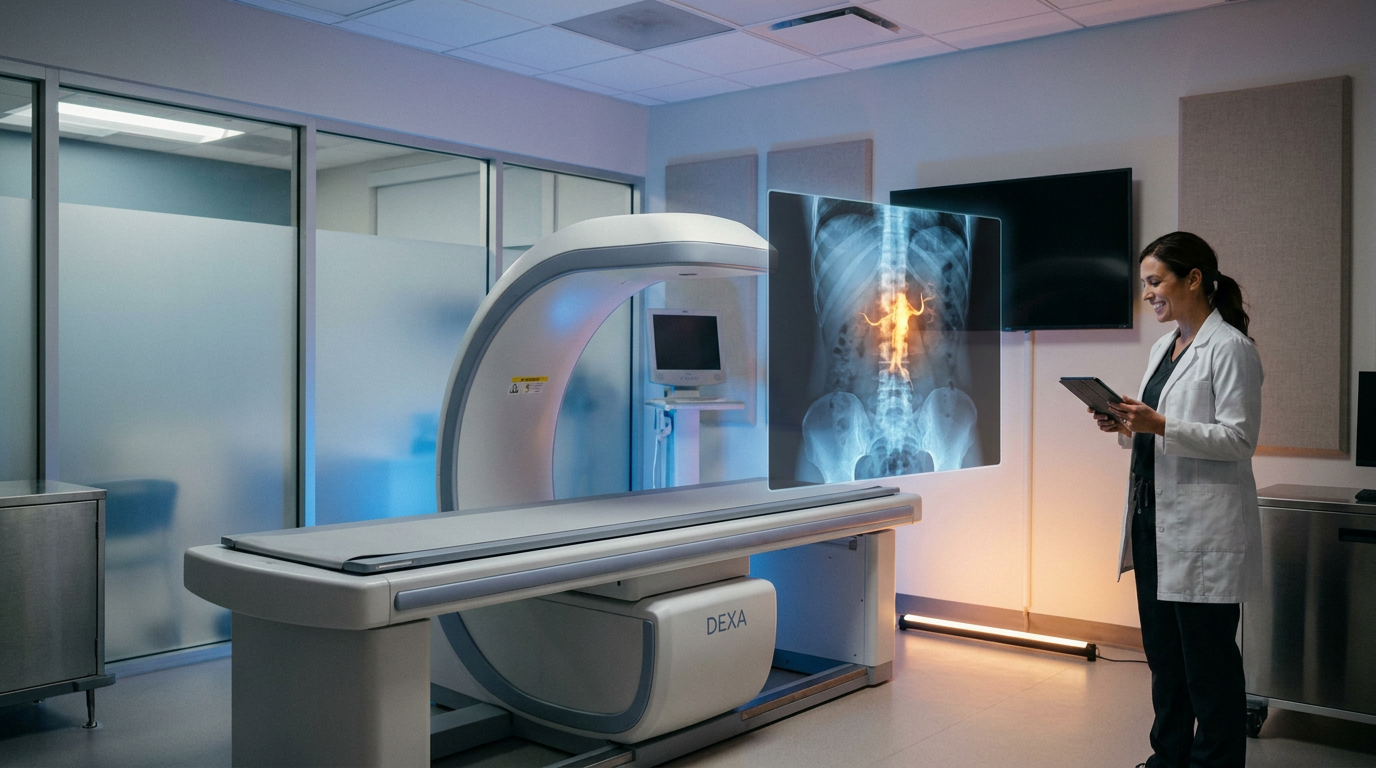
For decades, the dual-energy X-ray absorptiometry (DEXA) scan has been a single-purpose tool, quietly checking the bone density of older adults to diagnose osteoporosis.[1][5]
But hidden within those routine grayscale images of the lateral spine lies a secondary, life-saving piece of data: the health of the body's largest artery.[2][6]
Now, an international research team led by Australian scientists has developed an artificial intelligence algorithm capable of extracting that hidden data in seconds, effectively turning a standard bone scan into a powerful early warning system for cardiovascular disease.[1][3]
The breakthrough centers on a condition known as abdominal aortic calcification (AAC). As cardiovascular disease develops, calcium deposits begin to build up in the walls of the abdominal aorta.[2][5]

Crucially, this calcification in the abdomen often appears years before similar blockages develop in the coronary arteries near the heart.[2][7]
"Vascular calcification often starts in the abdominal aorta before blood vessels such as the heart," explains Professor Joshua Lewis of Edith Cowan University (ECU), the lead researcher on the project. "If you can detect it earlier, then you can make those changes... to prevent going on to having a heart attack or stroke."[3][4]
Historically, spotting AAC on a DEXA scan has been a frustratingly manual process. Highly trained specialists must visually inspect the images, a meticulous task that takes between five and fifteen minutes per scan.[5][6]
Because of the time and expense involved, this secondary analysis is rarely performed during routine clinical practice, leaving a wealth of preventative health data locked away and unread.[2][6]

The newly developed AI software eliminates this bottleneck entirely. Trained on tens of thousands of medical images, the algorithm can analyze a DEXA scan and quantify the extent of aortic calcification in a fraction of a second.[1][5]
The newly developed AI software eliminates this bottleneck entirely.
Operating at peak capacity, the software is capable of processing roughly 60,000 images in a single day, achieving an 80% agreement rate with expert human readers in its initial real-world testing phase.[5][6]
The implications for public health screening are massive. In Australia alone, approximately 700,000 people undergo a DEXA bone scan every year.[3][4]
By running those existing scans through the AI algorithm, hundreds of thousands of patients could simultaneously learn about their cardiovascular risk without requiring a separate doctor's appointment, an additional imaging procedure, or any extra radiation exposure.[1][7]
For patients, this invisible, frictionless screening can be life-altering. Pippa Luke, a patient who discovered she had advanced blood vessel disease through the scanning program, described the revelation as a crucial wake-up call.[3][4]

"Getting the results was definitely a catalyst for increasing my knowledge and awareness of heart health because otherwise it's very silent—you don't know you have anything," Luke noted.[3][4]
Armed with the early warning, she was able to proactively overhaul her lifestyle, adopting a Mediterranean diet and a targeted regimen of cardio and resistance exercises to halt the disease's progression before a catastrophic event occurred.[3][4]
Beyond heart attacks and strokes, the presence of AAC is a recognized predictor for a cascade of other late-life health complications, including an elevated risk of falls, severe fractures, and late-life dementia.[5][6]

Identifying high-risk individuals early allows healthcare providers to implement comprehensive, multi-disciplinary care plans that address both cardiovascular and cognitive health simultaneously.[1][6]
The project, supported by the Heart Foundation's Catalyst Partnership program and recently published in the Journal of the American College of Cardiology: Advances, is now moving aggressively toward real-world clinical integration.[2][7]
How we got here
2009
Professor Joshua Lewis begins exploring the use of DEXA bone density scans to detect heart disease at Sir Charles Gairdner Hospital.
2023
The international research team successfully develops the first version of the AI software, achieving 80% agreement with human experts.
2025
The Heart Foundation's Catalyst Partnership program awards funding to accelerate the project's transition into everyday clinical practice.
May 2026
Researchers publish breakthrough findings demonstrating the AI's ability to instantly detect cardiovascular risk from routine bone scans.
Viewpoints in depth
Medical Innovators
Focuses on the technological leap of training AI to extract secondary data from existing medical imaging.
For computer scientists and medical imaging researchers, the breakthrough lies in the algorithm's ability to perform complex pattern recognition at an unprecedented scale. By training the AI on tens of thousands of historical scans, researchers have created a tool that doesn't just match human accuracy, but shatters human speed limits. Processing 60,000 images a day transforms a boutique, time-intensive specialist review into a frictionless, automated background process that can be applied to every scan taken globally.
Preventative Care Advocates
Emphasizes the life-saving potential of identifying silent cardiovascular risks years before a catastrophic event.
Cardiologists and public health advocates view this technology as a game-changer for preventative medicine. Because abdominal calcification occurs long before blockages reach the heart, patients are granted a critical multi-year window to intervene. Advocates stress that empowering patients with this knowledge early allows them to adopt Mediterranean diets, increase cardiovascular exercise, and begin preventative medications, effectively stopping heart attacks before they ever happen.
Healthcare Administrators
Highlights the economic and operational benefits of repurposing existing hospital infrastructure.
From a health systems perspective, the AI algorithm represents the holy grail of medical innovation: improved patient outcomes with zero additional infrastructure costs. Because the software piggybacks on the millions of DEXA scans already being performed annually for osteoporosis, hospitals do not need to purchase new imaging machines, book additional patient appointments, or expose patients to further radiation. It maximizes the diagnostic yield of existing resources while eliminating the costly bottleneck of manual specialist reviews.
What we don't know
- The exact timeline for when this AI software will be universally integrated into all standard DEXA imaging machines worldwide.
- Whether the AI's accuracy rate will eventually surpass the 80% baseline achieved in its initial real-world testing phase as the algorithm continues to learn.
Key terms
- Abdominal Aortic Calcification (AAC)
- A buildup of calcium deposits in the walls of the body's largest artery, serving as a powerful early predictor of cardiovascular disease.
- DEXA Scan
- Dual-energy X-ray absorptiometry, a low-dose imaging test routinely used to measure bone density and diagnose osteoporosis.
- Subclinical Disease
- A medical condition that is actively developing in the body but has not yet produced any noticeable symptoms.
- Vascular Calcification
- The gradual hardening of blood vessels caused by the accumulation of calcium, cholesterol, and other substances, which can restrict blood flow.
Frequently asked
Do I need a separate scan to check for this heart risk?
No. The AI software analyzes the exact same DEXA bone density scan used to check for osteoporosis, requiring no extra appointments or radiation.
What is abdominal aortic calcification (AAC)?
AAC is a buildup of calcium in the walls of the body's largest artery. It is a strong early warning sign for future heart attacks, strokes, and late-life dementia.
What can patients do if the AI detects calcium buildup?
Early detection gives patients years to make preventative lifestyle changes, such as adopting a Mediterranean diet, increasing exercise, or starting medication to halt the disease's progression.
Is this AI screening available at my local clinic right now?
The software has successfully completed real-world testing and is currently moving toward broader clinical rollout, supported by organizations like the Heart Foundation.
Sources
Source coverage
7 outlets
3 viewpoints surfaced






[1]Edith Cowan UniversityMedical Innovators
Testing heart risk with the touch of a button
Read on Edith Cowan University →[2]Heart FoundationPreventative Care Advocates
Major Australian research breakthrough in heart disease detection
Read on Heart Foundation →[3]The West AustralianPreventative Care Advocates
A WA researcher and his global team have successfully shown that artificial intelligence can detect a marker of heart disease from bone scans
Read on The West Australian →[4]WA HealthPreventative Care Advocates
AI breakthrough in heart disease began at Charlies
Read on WA Health →[5]SciTechDailyMedical Innovators
Bone Density Scans Can Now Quickly Identify an Indicator of Cardiovascular Health Risk
Read on SciTechDaily →[6]Hospital & HealthcareHealthcare Administrators
AI predicts health conditions from bone scans
Read on Hospital & Healthcare →[7]Mirage NewsHealthcare Administrators
Major Australian research breakthrough in heart disease detection
Read on Mirage News →

More in ai
See all 7 stories →Medical AI
Generative AI Matches Human Experts in Complex Medical Data Analysis, Accelerating Research
7 sources

Local AI
How Small Language Models Are Putting Private, Offline AI Directly on Your Phone
7 sources

Open-Weight Models
The Rise of Local AI: How Indie Creators Are Reclaiming Their IP with Open-Weight Models
8 sources
Drug Discovery
UK Launches First-of-its-Kind 'AI Sandbox' to Accelerate Drug Discovery and Reduce Animal Testing
7 sources

Every angle. Every day.
Get ai stories with full source coverage and perspective breakdowns delivered to your inbox.