
Steam Deck OLED vs. ROG Ally X: The 2026 Premium Handheld Showdown
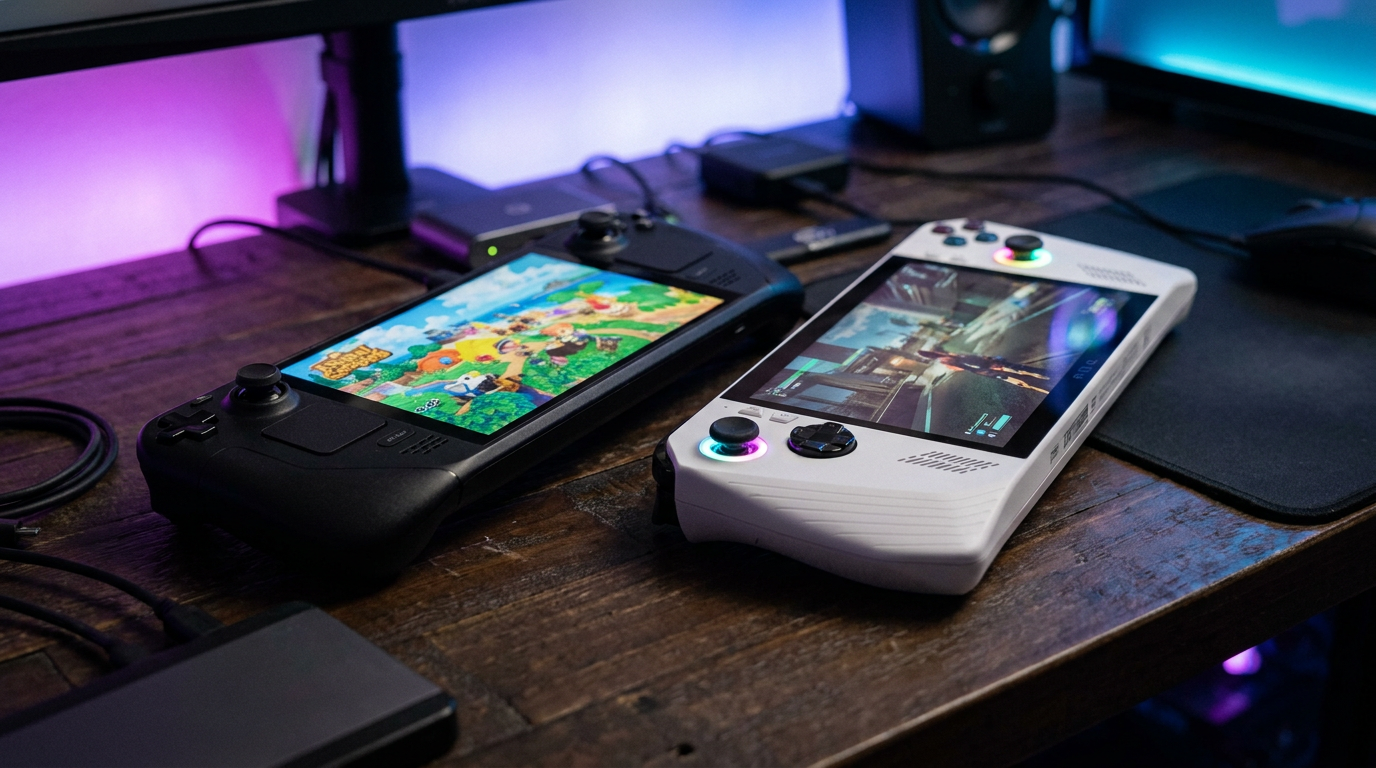
A comprehensive side-by-side analysis of the two leading handheld gaming PCs, comparing the Steam Deck OLED's seamless efficiency against the ROG Ally X's raw Windows power.
By Factlen Editorial Team
- Console-First Gamers
- Users who prioritize a seamless, frictionless interface and OLED contrast over raw graphical power.
- Power & Versatility Seekers
- Enthusiasts who want maximum frame rates and access to every PC gaming storefront natively.
- Hardware Modders & Tinkerers
- Power users who enjoy customizing their devices both physically and via open-source software.
What's not represented
- · Game Developers optimizing for fixed hardware
- · Linux Open-Source Contributors
Why this matters
For consumers looking to invest in portable gaming, choosing the right handheld dictates which game libraries they can access and how much technical troubleshooting they will endure. Understanding these hardware trade-offs ensures buyers do not waste hundreds of dollars on a device that clashes with their specific play style.
Key points
- The Steam Deck OLED excels in battery efficiency, OLED contrast, and a seamless console-like interface.
- The ASUS ROG Ally X offers superior raw performance, a 1080p 120Hz screen, and full Windows 11 compatibility.
- Valve's handheld is limited by its Linux operating system, which blocks certain anti-cheat multiplayer games.
- Asus's device features a massive 80Wh battery and 24GB of RAM to support demanding AAA titles.
- The choice ultimately comes down to prioritizing plug-and-play simplicity versus unlocked PC versatility.
The portable gaming landscape has matured dramatically by 2026, evolving from experimental prototypes into highly refined daily drivers that rival traditional home consoles. What was once a niche enthusiast market has blossomed into a mainstream category, offering players the unprecedented ability to carry their entire PC gaming libraries in their backpacks.[6]
The two undisputed heavyweights of this era are the Valve Steam Deck OLED and the ASUS ROG Ally X. Choosing between them is no longer a matter of determining which device is objectively better, but rather making a fundamental choice about gaming philosophy and user experience.[4][6]
The core of this side-by-side trade-off analysis comes down to a battle between refined efficiency and brute-force versatility. By evaluating the arguments for and against each device, backed by hardware evidence and real-world testing, prospective buyers can find the exact fit for their lifestyle.[6]
The case for the Steam Deck OLED is built entirely around friction-free efficiency and visual brilliance. Valve’s custom Linux-based SteamOS provides a console-like experience that simply works out of the box, allowing users to navigate their libraries effortlessly and suspend gameplay instantly without fighting background operating system processes.[5]

Conversely, the argument against the Steam Deck OLED centers on its strict performance ceiling and software walled garden. Because it utilizes a custom Linux operating system, games requiring aggressive kernel-level anti-cheat software—like major competitive multiplayer shooters—simply will not boot without extensive, often unsupported workarounds.[4][5]
The evidence supporting the Steam Deck’s efficiency is stark when looking at power draw. Thanks to its 50-watt-hour battery and a strict 15-watt thermal design power limit, the device excels at running indie games and older titles for anywhere from three to twelve hours on a single charge.[5]
Furthermore, the visual evidence is undeniable: the 7.4-inch HDR OLED display, running at a 1280x800 resolution with a 90Hz refresh rate, offers perfect black levels and vibrant contrast that a traditional LCD panel simply cannot match.[2][5]
On the other side of the spectrum, the case for the ASUS ROG Ally X is rooted in raw power and platform freedom. Equipped with the AMD Ryzen Z1 Extreme processor alongside a massive 24GB of LPDDR5X RAM, it operates as a full-fledged Windows 11 PC in a handheld form factor.[1][2]
On the other side of the spectrum, the case for the ASUS ROG Ally X is rooted in raw power and platform freedom.
The argument against the ROG Ally X focuses on the inherent clunkiness of Windows 11 on a seven-inch touchscreen and the compromises of its display technology. While Asus and Microsoft have introduced full-screen Xbox interfaces to mitigate the friction, navigating the desktop still requires occasional driver updates and troubleshooting.[1][3]
The evidence for the Ally X’s dominance in performance is easily quantified in modern AAA titles. Where the Steam Deck might struggle to maintain 30 frames per second in highly demanding games, the Ally X can comfortably push past 50 frames per second at a crisp 1080p resolution.[4]

To fuel this performance, Asus packed the Ally X with an unprecedented 80-watt-hour battery. While this massive capacity is necessary to feed the power-hungry processor, it also means the device can run heavier games longer than the Deck, provided the user actively manages the wattage settings.[2][4]
Ergonomics also present a distinct trade-off between the two premium devices. The Steam Deck is lighter at roughly 640 grams and features dual trackpads that make navigating desktop modes and complex strategy games incredibly intuitive.[5]
The Ally X, while slightly heavier, utilizes deep, Xbox-style controller grips that distribute its weight perfectly. This design choice makes it exceptionally comfortable for fast-paced, action-oriented gaming sessions, mimicking the feel of a traditional home console controller.[1][3]

Ultimately, the Steam Deck OLED fits well when a user prioritizes a seamless, console-like user interface, industry-leading OLED contrast, and exceptional battery life for indie or optimized titles. It does not fit when a player relies heavily on native Xbox Game Pass, competitive multiplayer shooters, or demands high frame rates in the newest releases.[5][6]
The ASUS ROG Ally X fits well when a gamer wants a single device that can play any PC storefront library natively, desires the highest possible frame rates, and values the flexibility of a full Windows operating system. It does not fit when a user wants a completely frictionless, plug-and-play experience without ever seeing a desktop login screen.[1][4][6]
How we got here
Feb 2022
Valve releases the original LCD Steam Deck, proving the viability of the modern handheld PC market.
Jun 2023
Asus enters the market with the ROG Ally, bringing Windows 11 and a 120Hz screen to the form factor.
Nov 2023
Valve launches the Steam Deck OLED, featuring a larger HDR screen, better battery, and refined thermals.
Jul 2024
Asus releases the ROG Ally X, doubling the battery capacity and increasing RAM to 24GB.
Viewpoints in depth
Console-First Gamers
Users who prioritize a seamless, frictionless interface over raw graphical power.
This camp argues that a handheld should feel like a dedicated gaming console, not a shrunken desktop computer. They point to SteamOS's ability to instantly suspend and resume gameplay, its unified controller profiles, and its lack of background bloatware as the gold standard. For these players, the visual leap of the HDR OLED screen and the efficiency of the 15W APU far outweigh the inability to play a handful of anti-cheat multiplayer titles.
Power & Versatility Seekers
Enthusiasts who want maximum frame rates and access to every PC gaming storefront.
This perspective values the freedom of the Windows operating system, arguing that a PC handheld should not be locked into a single ecosystem. They highlight the ROG Ally X's 24GB of RAM and Z-series processors as necessary tools for running modern AAA games at 1080p. While they acknowledge the occasional clunkiness of Windows on a small screen, they believe the trade-off is worth it to natively access Xbox Game Pass, Epic Games, and modding communities without complex workarounds.
Hardware Modders & Tinkerers
Power users who enjoy customizing their devices both physically and via software.
This niche but vocal community looks at both devices as blank canvases. They appreciate the Steam Deck's partnership with iFixit for easy parts replacement and its open Linux architecture for deep software tweaks. Conversely, they praise the Ally X for its dual USB-C ports, which allow for easy connection to external desktop GPUs, effectively turning the handheld into a full-fledged home gaming rig.
What we don't know
- How upcoming next-generation APUs will shift the balance of power and battery life in future handheld iterations.
- Whether Microsoft will eventually release a fully optimized, lightweight version of Windows specifically designed for handheld gaming PCs.
- How long Valve will continue to support the current Steam Deck hardware before announcing a true generational sequel.
Key terms
- APU (Accelerated Processing Unit)
- A single chip that combines both the central processor (CPU) and graphics processor (GPU), commonly used to save space in handhelds.
- TDP (Thermal Design Power)
- The maximum amount of heat a chip is allowed to generate, which directly dictates how much battery power it consumes during gameplay.
- OLED (Organic Light-Emitting Diode)
- A display technology where each pixel produces its own light, allowing for perfect black levels and infinite contrast.
- VRR (Variable Refresh Rate)
- A display feature that syncs the screen's refresh rate with the game's frame rate to eliminate screen tearing and visual stuttering.
Frequently asked
Can the Steam Deck play Xbox Game Pass games?
Not natively through a dedicated app. Users must stream Game Pass titles via a web browser or undertake the complex process of installing Windows on the device.
Does the ROG Ally X have an OLED screen?
No, it uses a 1080p IPS LCD panel. While it offers a smooth 120Hz refresh rate and Variable Refresh Rate (VRR), it lacks the perfect deep blacks of an OLED display.
Which device is better for competitive multiplayer games?
The ROG Ally X is better suited for competitive games because its Windows 11 operating system natively supports the aggressive anti-cheat software required by titles like Call of Duty.
How long does the battery last on these handhelds?
Both devices can last anywhere from 2 to 12 hours depending on the game's graphical demands, though the Ally X has a physically larger 80Wh battery to feed its more powerful processor.
Sources
Source coverage
6 outlets
3 viewpoints surfaced





[1]PCMagPower & Versatility Seekers
Asus ROG Xbox Ally X Review
Read on PCMag →[2]Pocket-lintConsole-First Gamers
ROG Ally X vs Steam Deck OLED: Which Premium Handheld Wins?
Read on Pocket-lint →[3]Pure XboxHardware Modders & Tinkerers
Six Months With The ROG Xbox Ally X
Read on Pure Xbox →[4]Chris Asante MediaPower & Versatility Seekers
Steam Deck OLED vs ROG Ally X 2025
Read on Chris Asante Media →The Truth About the Steam Deck OLED in 2026
Read on HonestCyborg →[6]Factlen Editorial TeamHardware Modders & Tinkerers
Synthesis by Factlen editorial team
Read on Factlen Editorial Team →



Every angle. Every day.
Get entertainment stories with full source coverage and perspective breakdowns delivered to your inbox.