
OLED vs. Mini-LED TVs in 2026: Which Premium Display Should You Buy?
As Tandem OLEDs get brighter and RGB Mini-LEDs achieve near-perfect contrast, the gap between the two leading TV technologies has never been narrower. Here is how to choose the right panel for your living room, gaming setup, or budget.
By Factlen Editorial Team
- Mini-LED Advocates
- Value sheer brightness, glare reduction, and zero burn-in risk for practical, everyday living room environments.
- OLED Purists
- Argue that pixel-level light control and infinite contrast are the only ways to experience true cinematic intent.
- Hybrid Power Users
- Weigh the trade-offs based on specific workflows, balancing gaming motion clarity against static-dashboard safety.
What's not represented
- · Budget-conscious consumers priced out of premium tiers
- · Professional Hollywood color graders
Why this matters
A premium TV is a multi-year investment that dictates how you experience movies, sports, and gaming. Choosing the wrong panel technology for your specific room lighting can result in washed-out daytime viewing or distracting light bleed during movie nights.
Key points
- The 2026 TV market is defined by OLEDs getting brighter and Mini-LEDs achieving better contrast.
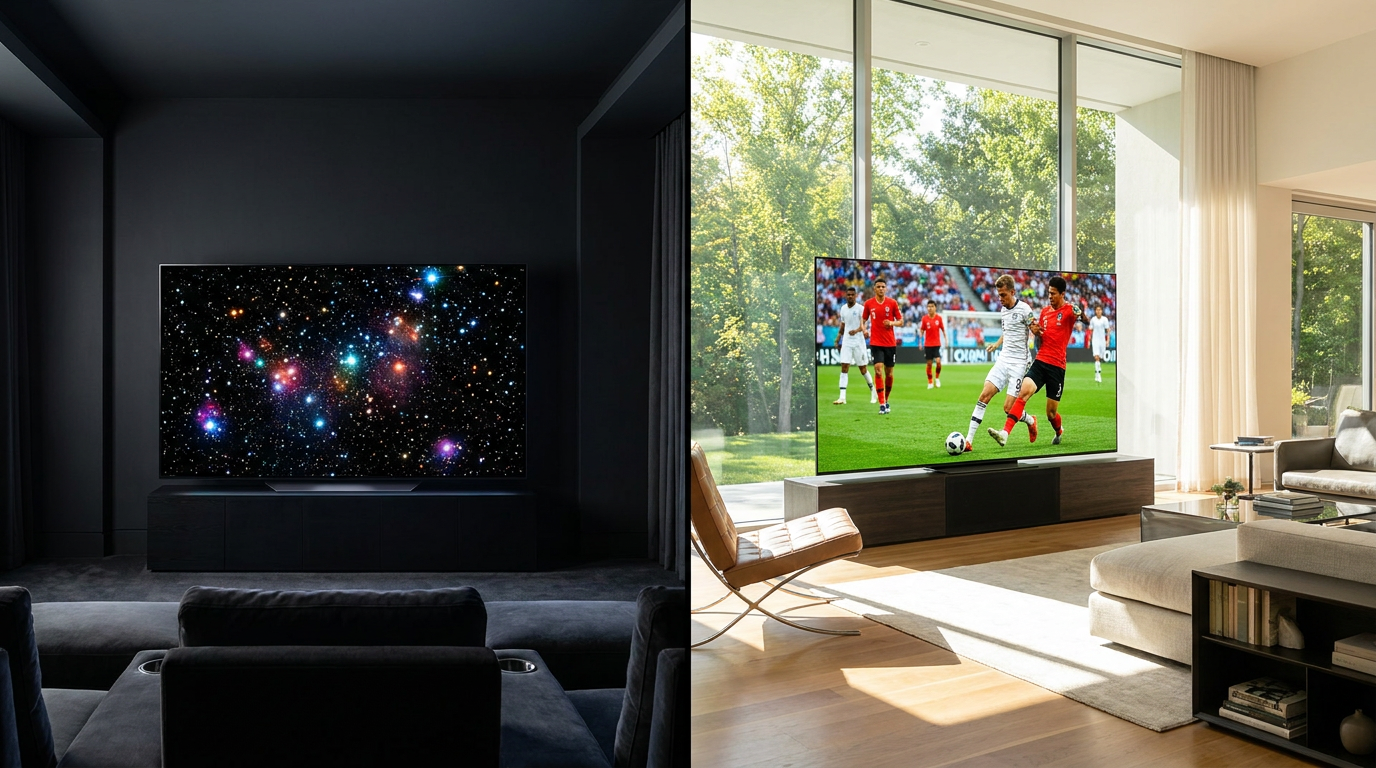
- OLEDs offer perfect black levels and infinite contrast, making them ideal for dark home theaters.
- Mini-LEDs can hit up to 5,000 nits of brightness, easily overpowering glare in sunlit living rooms.
- Tandem OLED technology stacks light-emitting layers to boost brightness and reduce burn-in risk.
- Mini-LED remains the most cost-effective way to buy massive 85-inch and 98-inch screens.
- OLED is the preferred choice for competitive gaming due to near-instantaneous pixel response times.
Buying a premium television in 2026 is defined by what industry analysts are calling the "Great Convergence." For years, the advice was simple: buy an OLED for dark rooms and a Mini-LED for bright rooms. But recent technological leaps have forced both panel types into each other's traditional strongholds, making the decision far more nuanced.[7]
The core difference comes down to how the screens generate light. OLED (Organic Light-Emitting Diode) panels are self-emissive, meaning every single pixel generates its own light and can turn off completely. Mini-LED TVs are essentially highly advanced LCDs that use thousands of microscopic LED backlights grouped into "dimming zones" behind the screen to control brightness and contrast.[2][6]
The argument for OLED centers on absolute precision. Because each pixel operates independently, OLEDs deliver "infinite" contrast and perfect, inky blacks. In 2026, the introduction of "Tandem OLED"—which stacks multiple RGB light-emitting layers—has given flagship models like the LG G5 a massive brightness jump, pushing peak highlights past 2,000 nits without sacrificing pixel-level control.[3][4][7]

The evidence for OLED's dominance is clearest in dedicated home theaters and high-end gaming setups. Reviewers consistently note that OLEDs exhibit zero "blooming" or "haloing"—the distracting glow around bright objects on dark backgrounds. Furthermore, OLEDs offer sub-millisecond response times, making them the undisputed champion for fast-paced, competitive gaming where motion clarity is paramount.[2][4]
However, the case against OLED remains tied to full-screen brightness and longevity. While peak highlights are now dazzling, OLEDs still aggressively dim the entire screen when displaying large, bright scenes (like a hockey rink or a snow-covered landscape) to protect the panel. Additionally, while mitigation software has improved drastically, the risk of permanent burn-in still exists for users who leave static news tickers or office dashboards on screen all day.[1][5]
However, the case against OLED remains tied to full-screen brightness and longevity.
The argument for Mini-LED is built on sheer, unadulterated power. By utilizing advanced backlighting, 2026 Mini-LED models can achieve blinding peak brightness levels of 3,000 to 5,000 nits. New "RGB Mini-LED" technology has even removed traditional color filters, resulting in purer color output that directly challenges OLED's vibrancy.[1][7]

The evidence for Mini-LED's superiority shines in bright, sunlit living rooms. These panels can effortlessly overpower window glare and maintain massive full-screen brightness without dimming. For daytime sports viewing or brightly lit open-concept homes, Mini-LED provides a punchy, vibrant image that OLED simply cannot sustain across the entire panel.[1][4]
The case against Mini-LED involves the physical limitations of backlighting. Even with flagship models boasting up to 40,000 local dimming zones, the TV is still illuminating clusters of pixels rather than individual ones. In pitch-black rooms, critical viewers may still notice slight blooming around subtitles or starfields, and the VA panels often used in these TVs can lose color accuracy when viewed from wide angles.[1][2]
Price and scaling also play a massive role in the trade-off. Mini-LED manufacturing is highly efficient at scale, making it the undisputed value king for massive 85-inch and 98-inch screens. Conversely, while OLED is competitively priced in the 55-inch to 65-inch range, stepping up to an 83-inch or larger OLED panel carries a steep, enthusiast-level premium.[1][7]

For productivity and PC use, the divide is equally stark. Power users often prefer Mini-LED monitors because they offer superior text rendering and complete immunity to burn-in, making them safe for static HUDs and spreadsheets. OLED, meanwhile, is favored by creative professionals who need perfect color grading and gamers who prioritize motion clarity over static-image safety.[5]
Ultimately, OLED fits well when you are building a dedicated dark-room home theater, playing competitive fast-paced games, or prioritizing absolute cinematic contrast and perfect viewing angles. It does not fit well when your living room has wall-to-wall windows, or if the TV will be used as a background monitor displaying static news channels for ten hours a day.[2][6]

Conversely, Mini-LED fits well when you are outfitting a bright, sunlit family room, hosting daytime sports watch parties, or seeking the largest possible screen size for your dollar. It does not fit well when absolute, pixel-perfect shadow detail in a pitch-black room is your top priority, or if you are highly sensitive to slight backlight blooming around dark scenes.[1][4]
How we got here
Early 2010s
OLED TVs enter the consumer market, establishing a new gold standard for perfect black levels but struggling with low brightness.
2019–2021
Mini-LED technology is introduced to consumer TVs, shrinking backlights to offer LCDs a massive leap in contrast and brightness.
2024
QD-OLED and MLA (Micro Lens Array) technologies push OLED brightness past the 1,000-nit barrier for the first time.
2026
The 'Great Convergence' arrives as Tandem OLEDs hit 2,000 nits and RGB Mini-LEDs reach 5,000 nits with tens of thousands of dimming zones.
Viewpoints in depth
Home Theater Enthusiasts
Prioritize absolute picture accuracy, perfect black levels, and cinematic intent above all else.
For dedicated cinephiles, the conversation begins and ends with OLED. This camp argues that the ability to turn individual pixels completely off creates an immersive depth that no backlight algorithm can replicate. They point out that in a light-controlled room, the massive 5,000-nit peak brightness of a Mini-LED is actually uncomfortable to view, making OLED's precise, pixel-level highlight control the superior choice for watching 4K HDR movies exactly as the director intended.
Bright-Room Viewers & Sports Fans
Value full-screen brightness, glare reduction, and vibrant colors for daytime viewing.
This perspective focuses on the reality of modern, open-concept living spaces. For users with large windows and ambient daylight, OLED's perfect blacks are washed out by reflections. This camp champions Mini-LED for its sheer horsepower, noting that its ability to sustain high brightness across the entire screen makes it the ultimate display for Sunday afternoon football games or brightly lit video games. They also value the peace of mind that comes with zero burn-in risk when leaving ESPN or news channels on for hours.
PC Gamers & Power Users
Weigh motion clarity against the risks of static UI elements and text rendering.
The gaming and productivity community is split based on specific use cases. Competitive gamers lean heavily toward OLED for its sub-millisecond response times, which eliminate motion blur during fast camera pans. However, power users who use their screens for coding, video editing, or displaying static dashboards favor Mini-LED. They argue that Mini-LED's traditional subpixel layout renders text more sharply, and its immunity to burn-in makes it the only safe choice for static user interfaces.
What we don't know
- Whether the new Tandem OLED structures will completely eliminate burn-in over a 5-to-10 year lifespan.
- If MicroLED (the true successor to both technologies) will become affordable for average consumers before the end of the decade.
Key terms
- Blooming (Haloing)
- A visual artifact where light bleeds from a bright object into the surrounding dark areas of the screen, common on backlit TVs but absent on OLEDs.
- Local Dimming Zones
- Specific clusters of LED backlights behind an LCD screen that can dim or brighten independently to improve contrast.
- Nits
- A unit of measurement for screen brightness. A higher number means the TV can display brighter highlights and combat room glare more effectively.
- Tandem OLED
- A display technology that stacks multiple organic light-emitting layers to increase overall brightness and panel durability.
Frequently asked
Does OLED still suffer from burn-in in 2026?
While the risk has been drastically reduced by better heat sinks and Tandem OLED technology, permanent image retention is still possible if static elements (like news tickers or game HUDs) are displayed for thousands of hours.
What is Tandem OLED?
Tandem OLED is a newer panel architecture that stacks multiple light-emitting layers. This allows the TV to achieve much higher brightness levels while reducing the strain on individual pixels, extending the panel's lifespan.
Why is Mini-LED better for large TVs?
Manufacturing massive OLED panels (83 inches and above) remains highly expensive with lower yield rates. Mini-LED scales much more cost-effectively, making 85-inch and 98-inch models significantly more affordable.
Which is better for PS5 or Xbox gaming?
Both are excellent, but OLED generally holds the edge for competitive gaming due to its near-instantaneous pixel response time, which eliminates motion blur in fast-paced titles.
Sources
Source coverage
7 outlets
3 viewpoints surfaced






[1]CNETMini-LED Advocates
OLED vs Mini-LED in 2026 — The Truth They Don't Tell You
Read on CNET →[2]RtingsOLED Purists
OLED vs Mini LED TV Comparison
Read on Rtings →[3]Data Wire SolutionsOLED Purists
Best TVs for 2026: 10 OLED and Mini-LED Picks by Room, Brightness, and Install Reality
Read on Data Wire Solutions →[4]EcoPicksGoMini-LED Advocates
LG G5 OLED vs LG QNED9M Mini LED Comparison (2026 Buyer's Guide)
Read on EcoPicksGo →[5]KTCPlayHybrid Power Users
OLED Versus Mini-LED for Office Dashboards
Read on KTCPlay →[6]A&B TVOLED Purists
The Basics: OLED Technology Explained
Read on A&B TV →[7]Alibaba Industry InsightsHybrid Power Users
OLED vs. Mini LED TV: 2026 Product and Market Trends
Read on Alibaba Industry Insights →

Every angle. Every day.
Get shopping stories with full source coverage and perspective breakdowns delivered to your inbox.