
The Solid-State Battery Breakthrough: How 2026 Became the Turning Point for 600-Mile EVs
After years of lab promises, solid-state batteries are finally hitting the road in 2026, promising to double EV range and cut charging times to under 20 minutes. But high manufacturing costs mean the technology will debut in premium models before reaching everyday car shoppers.
By Factlen Editorial Team
- Automakers & Developers
- View solid-state technology as the ultimate competitive advantage that will eliminate consumer range anxiety and unlock new vehicle designs.
- Industry Analysts
- Acknowledge the massive performance leaps but caution that manufacturing complexities and high costs will delay mass-market adoption for years.
- EV Consumers
- Weighing the immediate affordability of current lithium-ion models against the promised convenience and safety of waiting for solid-state technology.
What's not represented
- · Lithium-ion manufacturers defending current tech
- · Firefighters and first responders
Why this matters
For anyone holding off on buying an electric vehicle due to range anxiety or charging times, solid-state batteries represent the ultimate fix. Understanding this timeline helps buyers decide whether to purchase a current lithium-ion EV today or wait for the next generation of battery technology.
Key points
- Stellantis and Factorial Energy have begun real-world road testing of solid-state batteries in a Dodge Charger Daytona in North America.
- Chinese automaker Dongfeng announced it will begin mass production of solid-state batteries in the second half of 2026.
- The new cells promise to deliver over 600 miles of range and can charge from 15% to 90% in just 18 minutes.
- By replacing flammable liquid electrolytes with solid materials, the batteries virtually eliminate the risk of thermal runaway fires.
- High initial manufacturing costs mean the technology will debut in premium luxury vehicles before reaching the mass market.
For the better part of a decade, solid-state batteries have been the "fusion power" of the automotive industry—a miraculous technology that always seemed to be five years away. They promised to double the driving range of electric vehicles, slash charging times to the length of a gas station visit, and eliminate the fire risks associated with current lithium-ion packs. But moving the chemistry from controlled laboratory environments to the punishing reality of potholed highways proved immensely difficult.[7]
In June 2026, that timeline suddenly accelerated. The theoretical became tangible as major automakers in both North America and Asia announced they had crossed the threshold from lab testing to real-world integration. The race to commercialize the "holy grail" of EV batteries has officially moved to the streets.[1][3]
The most visible milestone arrived when Stellantis—the parent company of Jeep, Dodge, and Chrysler—announced it had successfully integrated solid-state battery cells into a Dodge Charger Daytona development vehicle. Partnering with Massachusetts-based battery developer Factorial Energy, Stellantis has begun road testing the technology across North America. It marks the first time a solid-state battery has been fully integrated into an operational test vehicle on the continent.[1][2][6]
The numbers behind the Stellantis-Factorial partnership highlight exactly why the industry is so desperate to make this technology work. Factorial's "FEST" (Factorial Electrolyte System Technology) cells achieved an energy density of 375 Watt-hours per kilogram (Wh/kg). In practical terms, that translates to a projected driving range of over 600 miles on a single charge. Furthermore, the cells demonstrated the ability to charge from 15% to 90% in just 18 minutes, effectively neutralizing the two biggest consumer objections to EV adoption: range anxiety and charging downtime.[1][2][6]

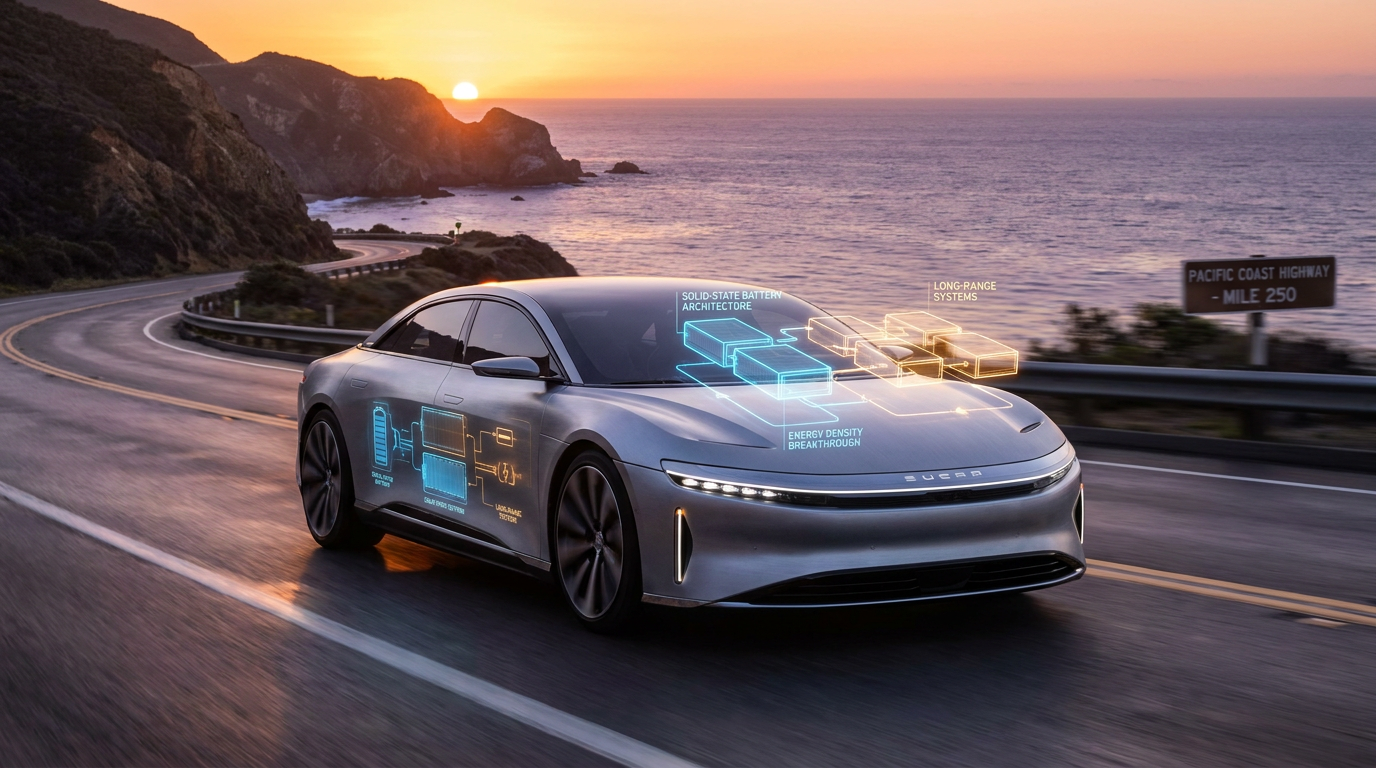
To understand why these leaps are possible, it helps to look inside the battery itself. Conventional lithium-ion batteries rely on a liquid or polymer gel electrolyte to shuttle ions back and forth between the anode and cathode as the battery charges and discharges. While effective, this liquid is relatively heavy, takes up physical space, and is highly flammable if the battery is punctured or overheats.[5][7]
A solid-state battery, as the name implies, replaces that liquid with a solid material—often an oxide-polymer composite, sulfide, or glass. Because the solid electrolyte is denser and more structurally stable, engineers can pack significantly more energy into the exact same physical footprint. The result is a battery pack that is roughly 30% lighter than a traditional lithium-ion equivalent, allowing automakers to increase range without adding thousands of pounds of dead weight to the vehicle chassis.[4][5][7]
The safety implications are equally profound. Without the flammable liquid electrolyte, the risk of "thermal runaway"—the chain-reaction fires that make EV battery blazes so notoriously difficult for firefighters to extinguish—is virtually eliminated. Chinese automaker Dongfeng Motor recently subjected its new solid-state cells to brutal physical testing to prove this point.[4][5]
Chinese automaker Dongfeng Motor recently subjected its new solid-state cells to brutal physical testing to prove this point.
According to regional government reports out of Hubei, Dongfeng compressed its solid-state battery cells by 50% using heavy machinery, and the cells remained fully operational. In thermal endurance trials, the components were exposed to direct heat of 170 degrees Celsius (338 degrees Fahrenheit) and showed absolutely no signs of smoke or fire. This inherent stability makes the batteries vastly safer in the event of a high-speed collision.[4][5]

Dongfeng is not just testing the technology; it is preparing to sell it. The automaker announced it will begin mass production and vehicle integration of its oxide-polymer solid-state batteries in the second half of 2026. Dongfeng claims its cells have achieved an energy density of 350 Wh/kg, targeting a driving range of 1,000 kilometers (620 miles).[3][4][5]
Crucially for drivers in colder climates, the solid electrolyte also solves the winter range-drop phenomenon that plagues current EVs. During extreme cold-weather testing in Mohe, China's northernmost city, Dongfeng's solid-state battery retained more than 74% of its electrical capacity at an ambient temperature of -30 degrees Celsius (-22 degrees Fahrenheit).[4][5]
Despite these massive breakthroughs, industry analysts caution that the average car shopper will not find a $25,000 solid-state EV at their local dealership anytime soon. The primary hurdle is no longer chemistry, but cost and manufacturing scale. Producing solid-state batteries requires entirely new automated assembly lines, and the solid electrolytes are notoriously difficult to manufacture without microscopic defects.[7]
Market analysts estimate that early solid-state batteries will cost between $400 and $800 per kilowatt-hour (kWh) to produce in 2026. By comparison, the mature lithium-ion battery industry had already driven costs down to roughly $132 per kWh by 2022. That massive price premium means solid-state technology will initially be reserved for luxury flagships, high-performance sports cars, and heavy-duty trucks where buyers are willing to pay a premium for extreme range and low weight.[7]

Getting the cells to communicate with the rest of the car also requires bespoke engineering. Stellantis noted that integrating Factorial's cells into the Dodge Charger Daytona wasn't as simple as swapping out batteries in a television remote. The engineering team had to design a patented mechanical architecture and adapt the vehicle's control systems to manage the unique discharge rates of the solid-state modules.[2][6]
The broader automotive industry is watching these 2026 rollouts closely, with a wave of fast followers preparing their own launches. Chinese automakers Chery and BYD are targeting 2027 for their solid-state debuts, while Nissan has publicly committed to mass-producing its proprietary solid-state batteries by the end of the 2028 financial year.[3]
For consumers currently shopping for an electric vehicle, the solid-state timeline presents a classic technology dilemma. Current lithium-ion EVs are more affordable and capable than ever, benefiting from a decade of manufacturing optimization. But for buyers whose lifestyles demand frequent 500-mile road trips or who lack home charging access, the promise of an 18-minute charge and a 600-mile range might finally be worth the wait.[1][7]
How we got here
2021
Stellantis and Factorial Energy officially launch their partnership to develop automotive-grade solid-state batteries.
2025
Factorial validates its 77-amp-hour FEST cells, proving an energy density of 375 Wh/kg in laboratory settings.
Early 2026
Dongfeng Motor successfully completes extreme cold-weather testing of its solid-state prototype in Mohe, China.
June 2026
Stellantis begins real-world road testing of solid-state batteries in a Dodge Charger Daytona development vehicle.
Late 2026
Dongfeng Motor's target date to begin mass production and vehicle integration of its oxide-polymer solid-state batteries.
Viewpoints in depth
Automakers & Developers
View solid-state technology as the ultimate competitive advantage that will eliminate consumer range anxiety and unlock new vehicle designs.
For legacy automakers and battery startups, solid-state chemistry is the key to unlocking the next massive wave of EV adoption. Executives argue that the current lithium-ion paradigm has reached its physical limits regarding energy density and charging speed. By transitioning to solid electrolytes, manufacturers like Stellantis and Dongfeng believe they can finally offer consumers an EV experience that mirrors the convenience of a gas-powered car—specifically, 600+ miles of range and sub-20-minute "fill-ups." Furthermore, the 30% reduction in battery weight allows engineers to design lighter, more agile vehicles that don't require massive suspension reinforcements just to carry their own power source.
Industry Analysts
Acknowledge the massive performance leaps but caution that manufacturing complexities and high costs will delay mass-market adoption for years.
While market watchers acknowledge the technical triumphs of 2026, they remain highly skeptical of the immediate commercial impact. Analysts point out that building a solid-state battery in a lab is vastly different from manufacturing millions of them flawlessly on an automated assembly line. The solid electrolytes are brittle, and ensuring perfect contact between the solid layers without microscopic gaps remains a profound engineering challenge. Because of these manufacturing hurdles, analysts project early solid-state cells will cost between $400 and $800 per kWh—making them financially viable only for six-figure luxury vehicles and high-end sports cars in the near term.
EV Consumers
Weighing the immediate affordability of current lithium-ion models against the promised convenience and safety of waiting for solid-state technology.
For the car-buying public, the sudden acceleration of solid-state timelines creates a purchasing dilemma. Many consumers who have been on the fence about EV adoption view the 600-mile range and fire-safe chemistry of solid-state batteries as the baseline requirements for making the switch. However, as the reality of the "luxury-first" rollout strategy becomes clear, budget-conscious shoppers are realizing they may have to wait until the 2030s for a $30,000 solid-state commuter car. This leaves buyers weighing whether to take advantage of the currently plummeting prices of mature lithium-ion EVs or to lease in the short term while waiting for the new technology to scale.
What we don't know
- Exactly how much of a price premium automakers will charge for the first generation of solid-state EVs.
- How quickly manufacturing yields can be improved to bring the cost of solid-state cells down to parity with lithium-ion.
- Whether the solid-state cells will suffer from unforeseen degradation issues after years of real-world fast charging.
Key terms
- Solid-State Battery
- A type of battery that uses solid electrodes and a solid electrolyte, rather than the liquid or polymer gel electrolytes found in conventional lithium-ion batteries.
- Electrolyte
- The medium inside a battery that allows ions to flow between the cathode and anode, enabling the battery to charge and discharge.
- Energy Density (Wh/kg)
- A measurement of how much energy a battery contains in proportion to its weight. Higher energy density means a vehicle can drive further without the battery getting heavier.
- Thermal Runaway
- A dangerous chain reaction within a damaged battery cell where rising temperatures cause the cell to catch fire, which then ignites neighboring cells.
- Oxide-Polymer Composite
- A specific type of solid material used by some manufacturers to replace the liquid electrolyte, chosen for its stability and compatibility with existing manufacturing supply chains.
Frequently asked
What makes a solid-state battery different?
Conventional EV batteries use a liquid or gel electrolyte to move energy inside the cell. Solid-state batteries replace that liquid with a solid material, which allows them to store more energy in the same space and eliminates the risk of flammable liquid fires.
Will solid-state batteries make EVs cheaper?
Not initially. Because the manufacturing process is entirely new, early solid-state batteries are estimated to cost between $400 and $800 per kWh to produce—several times more expensive than current lithium-ion batteries. Prices will drop as production scales up over the next decade.
When can I buy a car with a solid-state battery?
Automakers like Dongfeng are beginning mass production in late 2026, while Stellantis is currently road-testing the technology. However, due to high costs, the first solid-state batteries will likely only be available in premium luxury vehicles and high-performance models before trickling down to everyday cars by the end of the decade.
Do solid-state batteries work in the winter?
Yes, and they perform significantly better than current batteries. Recent tests by Dongfeng showed their solid-state cells retained over 74% of their capacity even at -30 degrees Celsius (-22 degrees Fahrenheit).
Sources
Source coverage
7 outlets
3 viewpoints surfaced






[1]ElectrekAutomakers & Developers
Factorial, Stellantis test solid-state EV batteries in real life
Read on Electrek →[2]PR NewswireAutomakers & Developers
Stellantis and Factorial Integrate Advanced Solid-State Battery into Stellantis Development Vehicle and Launch Road Testing
Read on PR Newswire →[3]CarsGuideEV Consumers
Huge update on groundbreaking EV tech: Timeline for solid-state batteries
Read on CarsGuide →[4]CarNewsChinaAutomakers & Developers
Dongfeng Motor's solid-state batteries are scheduled for mass production and vehicle integration in the second half of 2026
Read on CarNewsChina →[5]ArenaEVAutomakers & Developers
Dongfeng targets late 2026 for mass production of long-range solid-state batteries
Read on ArenaEV →[6]DesignNewsAutomakers & Developers
Stellantis Road Tests Factorial's Solid-State Batteries in Dodge Charger Daytona
Read on DesignNews →[7]Chasing CarsIndustry Analysts
Solid state batteries: what are they and when are they coming?
Read on Chasing Cars →


Every angle. Every day.
Get shopping stories with full source coverage and perspective breakdowns delivered to your inbox.