
How the 'Library of Things' Movement is Replacing Ownership with Access
Community-driven sharing hubs are allowing residents to borrow tools, camping gear, and appliances instead of buying them, saving money and reducing environmental waste.
By Factlen Editorial Team
- Circular Economy Advocates
- Prioritize the environmental benefits of sharing, focusing on waste reduction and lowering manufacturing emissions.
- Community & Equity Organizers
- Focus on how shared resources reduce financial strain and build neighborhood resilience and social trust.
- Public Library Administrators
- View the lending of physical objects as the natural evolution of civic library services to remain relevant and useful.
What's not represented
- · Retailers and manufacturers of consumer goods
- · Commercial equipment rental companies
Why this matters
By shifting from individual ownership to community access, households can save hundreds of dollars a year on rarely used items while drastically cutting down on the manufacturing emissions and landfill waste associated with modern consumerism.
Key points
- The Library of Things movement allows communities to borrow physical items like tools and appliances instead of purchasing them.
- There are currently around 2,000 formal sharing libraries operating globally.
- The model saves users significant money, with the average borrow saving roughly $180 compared to buying new.
- Sharing resources drastically reduces carbon emissions by preventing the manufacture and disposal of single-use goods.
- Traditional public libraries are increasingly integrating non-book items into their catalogs via 24/7 smart lockers.
The modern household is a graveyard of underutilized equipment. The average power drill, for instance, is used for an estimated 13 to 15 minutes over its entire lifespan. Yet, millions of households purchase their own, storing them in garages, basements, and closets where they gather dust and slowly degrade. This hyper-individualized model of consumption requires every family to independently acquire, maintain, and eventually dispose of identical sets of tools and appliances. The result is a profound drain on both personal finances and global resources, driven by the assumption that access requires ownership.[1][2][6]
This phenomenon extends far beyond power tools and hardware. Research suggests that up to 80% of household items are used less than once a month, from carpet cleaners and sewing machines to camping tents and specialized baking equipment. In response to this vast inefficiency, a rapidly expanding movement known as the "Library of Things" (LoT) is reimagining how communities access physical goods. By building shared resource infrastructure, these initiatives allow neighborhoods to collectively steward items that are only needed occasionally. Instead of a hundred homes owning a hundred rarely used pressure washers, a community can share a handful of high-quality units, turning underused consumer goods into accessible civic assets.[1][2][6]
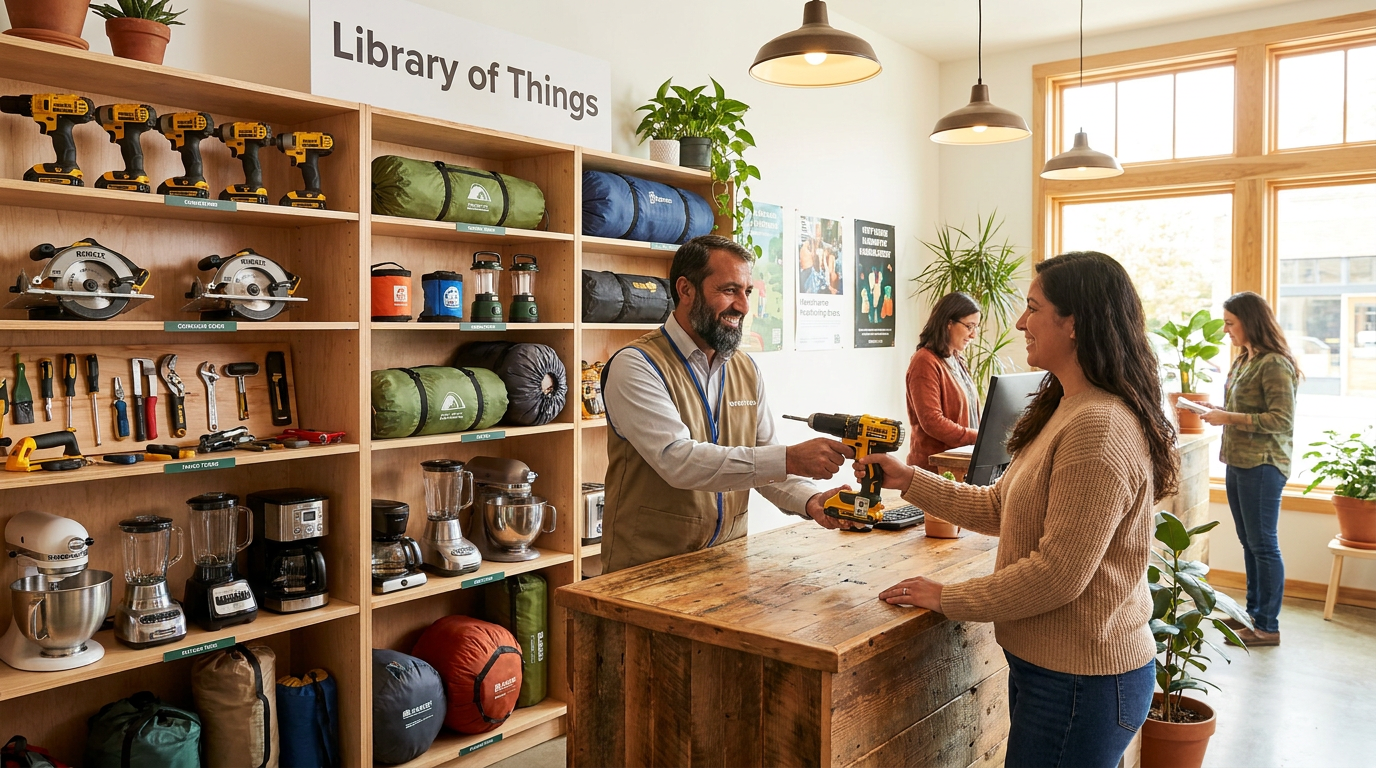
A Library of Things operates on the exact same fundamental principle as a traditional book library, but its inventory pushes the boundaries of what can be borrowed. Instead of checking out a novel, a resident might check out a laser level for a weekend renovation, a PA system for a block party, or a dehydrator for a seasonal harvest. The primary goal is to provide affordable, on-demand access to the tools necessary for daily life, hobbies, and home maintenance without the financial burden of purchasing them outright.[1][4]

While the concept of communal sharing is ancient, the formalized LoT model is currently experiencing a global surge in popularity and institutional support. According to recent industry reports, there are now roughly 2,000 formal Libraries of Things operating worldwide, alongside countless informal neighborhood sharing networks. These operations range widely in scale and scope. Some are small, volunteer-run collections housed in donated garage spaces or shipping containers, while others are sophisticated, well-funded operations seamlessly integrated into municipal public library systems with dedicated staff and extensive digital catalogs.[1][6]
The operational mechanism of a modern Library of Things is designed for low-friction access. Members typically pay a small annual subscription fee or utilize a pay-as-you-go model to access the inventory, with many hubs offering no-questions-asked concession rates to ensure equitable access for low-income residents. Items are cataloged online, allowing users to browse availability, reserve equipment digitally, and pick it up at a central community hub. Some advanced systems are even deploying automated smart lockers to facilitate contactless, round-the-clock borrowing and returns.[3][5][7]
The primary driver for many users adopting this model is purely financial. In an era defined by persistent inflation and cost-of-living pressures, affordable access to equipment prevents households from taking on debt for infrequent, yet necessary, tasks. According to detailed impact data from Library of Things UK, the average borrow saves a user approximately £143 (around $180) compared to purchasing the identical item new. For a family undertaking a modest home repair or hosting a single event, these savings can represent a significant portion of their monthly budget.[1][5][6][7]
The primary driver for many users adopting this model is purely financial.
Beyond individual household savings, the environmental claims of the sharing movement are substantial. The LoT model serves as a highly practical, localized application of the "circular economy"—an economic framework focused on maximizing the utility of existing resources and minimizing the extraction of new raw materials. By sharing a single heavy-duty item among dozens of households, communities directly prevent the manufacturing, international shipping, packaging, and eventual landfill disposal of redundant machines. Environmental advocates argue that true sustainability cannot be achieved simply by manufacturing "greener" products, but requires a fundamental reduction in overall consumption through shared access.[4][5][6][7]

The carbon accounting behind these sharing hubs reveals a massive reduction in localized emissions. Library of Things UK calculates that, on average, 50% of their borrows directly prevent a retail purchase. Because the average carbon footprint to manufacture an item in their catalog is 28 kilograms of CO2 equivalent, each borrow prevents an estimated 14 kilograms of manufacturing emissions. When multiplied across thousands of transactions annually, the climate impact of a single neighborhood sharing hub rivals that of major municipal green initiatives.[5][6]
Real-world pilot programs are consistently validating these environmental and financial metrics. A recent two-year pilot program at the Charlton Kings Library in Gloucestershire, UK, reported that 482 borrowed items saved local residents over £53,000 and avoided nearly 17 tonnes of carbon emissions in a single year. Similarly, the Share Shed—a pioneering mobile Library of Things that travels between rural towns in South Devon—reports saving its users up to £420,000 in foregone purchases and preventing 275 tons of CO2 since its inception. These localized successes are providing the empirical data needed to attract broader municipal and philanthropic funding.[2][6][8]
However, organizers and volunteers emphasize that the benefits of the model extend far beyond carbon metrics and cash savings. Libraries of Things serve as vital social infrastructure, fostering community cohesion, skill-sharing, and a sense of collective accomplishment. When residents visit a sharing hub, they frequently interact with knowledgeable volunteers, exchange advice on DIY projects, and build neighborhood trust. For many users, joining a sharing library significantly reduces feelings of isolation and provides a tangible connection to their local community.[2][7]
The success of independent sharing hubs is now prompting traditional public libraries to rapidly evolve their own service models. A 2025 survey of library professionals conducted by D-Tech International found that patrons increasingly expect their local libraries to offer non-traditional items alongside physical books and digital media. To accommodate this shifting demand, 60% of surveyed librarians identified multiple locker sizes as a critical feature for new smart-locker installations, specifically to enable the secure, 24/7 lending of bulky tools and kitchen appliances.[3]

Despite the widespread optimism and proven impact, the sharing model faces structural uncertainties as it attempts to scale. The vast majority of independent LoTs still operate on shoestring annual budgets of less than $10,000 and rely almost entirely on the dedication of volunteer labor to manage inventory and repair broken items. Maintaining complex mechanical equipment, managing liability insurance, and securing affordable, accessible commercial space remain persistent hurdles that prevent many pilot programs from expanding into permanent civic institutions. Without reliable, recurring funding, many of these community hubs risk burning out their core volunteer base.[1][6]
To overcome these operational barriers, experts recommend embedding sharing libraries within existing community organizations to share overhead costs and leverage established foot traffic. Successful hubs are increasingly partnering with local repair cafes, traditional public libraries, affordable housing developments, and community centers. By integrating into existing spaces, a Library of Things can drastically reduce its administrative burden, avoid expensive commercial rent, and focus entirely on expanding its inventory. This embedded approach also ensures that the library reaches a broader demographic, rather than just appealing to niche environmental advocates.[1][6][7]
Ultimately, advocates envision a future where "shared resource infrastructure" is viewed as a fundamental civic utility, as ubiquitous and essential as public parks, transit systems, or municipal water. They argue that a resilient neighborhood is one where residents can easily access the tools they need to improve their homes, grow their own food, and recover from emergencies without facing financial ruin. By shifting the cultural default from isolated individual ownership to collaborative, community-based access, the Library of Things movement offers a highly tangible blueprint for a more sustainable, affordable, and deeply connected society.[1][6]
How we got here
1943
The first known tool library opens in Grosse Pointe Farms, Michigan, to offer training to young people.
1979
The longest-running modern tool library is established as part of the Berkeley Public Library system in California.
2010s
The modern 'Library of Things' movement gains global traction, expanding beyond tools to include kitchenware, electronics, and camping gear.
2024
Shareable reports that roughly 2,000 formal Libraries of Things are operating worldwide.
2025
Surveys reveal that a majority of public librarians are prioritizing smart lockers to facilitate 24/7 access to non-traditional items.
Viewpoints in depth
Circular Economy Advocates
Focus on reducing consumption, maximizing resource utility, and preventing the carbon emissions associated with manufacturing redundant goods.
This camp argues that true sustainability cannot be achieved simply by manufacturing 'greener' products, but requires a fundamental reduction in overall consumption. By sharing heavy-duty items, communities directly prevent the manufacturing, international shipping, packaging, and eventual landfill disposal of redundant machines, making shared access a critical climate intervention.
Community & Equity Organizers
Emphasize the social benefits of the model, arguing that shared infrastructure bridges economic inequality.
For these organizers, the primary value of a sharing library is social resilience. They point out that low-income households are disproportionately burdened by the need to purchase expensive, single-use items for home maintenance. By providing affordable access, these hubs prevent debt, foster neighborhood trust, and give residents the agency to improve their living conditions.
Public Library Administrators
View the lending of physical objects as the natural evolution of civic library services to remain relevant.
Library professionals see the integration of non-book items as a necessary adaptation to modern community needs. As digital media replaces physical books, administrators are utilizing smart lockers and expanded catalogs to transform libraries into comprehensive community support centers, ensuring they remain vital, highly utilized civic spaces.
What we don't know
- How independent, volunteer-run libraries will secure long-term funding to cover commercial rent and equipment maintenance.
- Whether the model can scale effectively in rural areas with lower population density and fewer centralized community hubs.
Key terms
- Library of Things (LoT)
- A community-based lending system where people can borrow physical resources like tools, appliances, and recreational gear instead of buying them.
- Circular Economy
- An economic model focused on minimizing waste and making the most of resources by sharing, reusing, repairing, and recycling existing materials.
- Shared Resource Infrastructure
- Physical and digital systems—such as lending kiosks or community hubs—that allow neighborhoods to collectively access and steward goods.
Frequently asked
What kinds of items can I borrow from a Library of Things?
Inventories vary, but common items include power tools, gardening equipment, camping gear, sewing machines, and specialized kitchen appliances.
How much does it cost to use?
Most libraries operate on a small annual membership fee or a low-cost pay-as-you-go model, while some are entirely free or offer concession rates.
Who maintains the broken tools?
Maintenance is typically handled by community volunteers, often in partnership with local 'repair cafes' where skilled individuals fix and service the inventory.
Sources
Source coverage
8 outlets
3 viewpoints surfaced







[1]ShareableCommunity & Equity Organizers
State of Libraries of Things 2024 Report
Read on Shareable →[2]Share ShedCommunity & Equity Organizers
The Share Shed Guide
Read on Share Shed →[3]D-Tech InternationalPublic Library Administrators
The Future of Libraries Survey 2025
Read on D-Tech International →[4]Active SustainabilityCircular Economy Advocates
The Library of Things where you can borrow anything you need
Read on Active Sustainability →[5]Library of Things UKCircular Economy Advocates
Impact Report Methodology
Read on Library of Things UK →[6]Factlen Editorial Team
Synthesis by Factlen editorial team
Read on Factlen Editorial Team →[7]MediumCommunity & Equity Organizers
We want the Amazon rainforest to outlast Amazon.com
Read on Medium →[8]Charlton Kings Parish CouncilPublic Library Administrators
Library of Things Impact Report 2025
Read on Charlton Kings Parish Council →
Every angle. Every day.
Get community stories with full source coverage and perspective breakdowns delivered to your inbox.