
Induction vs. Gas Cooktops: The Complete 2026 Trade-Off Analysis
As induction technology matures and health concerns around gas stoves mount, homeowners face a complex choice between electromagnetic efficiency and traditional flame control.
By Factlen Editorial Team
- Electrification Advocates
- Public health and climate experts pushing for a rapid transition away from residential gas.
- Culinary Traditionalists
- Chefs and home cooks who prioritize the tactile control and versatility of open-flame cooking.
- Pragmatic Homeowners
- Consumers focused on the total cost of ownership, installation hurdles, and daily reliability.
What's not represented
- · Renters who cannot modify their home's infrastructure
- · Professional restaurant owners managing commercial kitchen retrofits
Why this matters
The stove you choose dictates not only your daily cooking experience but also your home's indoor air quality, long-term energy bills, and potential need for expensive electrical upgrades.
Key points
- Induction cooktops transfer 85 to 90 percent of their energy directly to the pan, making them significantly more efficient than gas.
- Switching to induction often requires a dedicated 240-volt electrical circuit, which can trigger costly panel upgrades in older homes.
- Recent health studies link the indoor combustion of natural gas to elevated levels of benzene and an increased risk of childhood asthma.
- Gas ranges remain the preferred choice for techniques requiring visual flame control, wok cooking, and resilience during power outages.
The American kitchen is undergoing its most significant technological shift in decades, driven by a fierce debate over how we heat our food. For generations, the blue flame of a gas stove was the undisputed symbol of a serious cook, while electric coils were relegated to budget apartments. But in 2026, the landscape has fundamentally changed. Advanced induction technology has moved from a premium European niche to the mainstream market, actively challenging the long-held dominance of gas ranges. This transition is not merely about aesthetic preferences; it is a complex collision of culinary tradition, emerging public health research, and fundamental home infrastructure.[1]
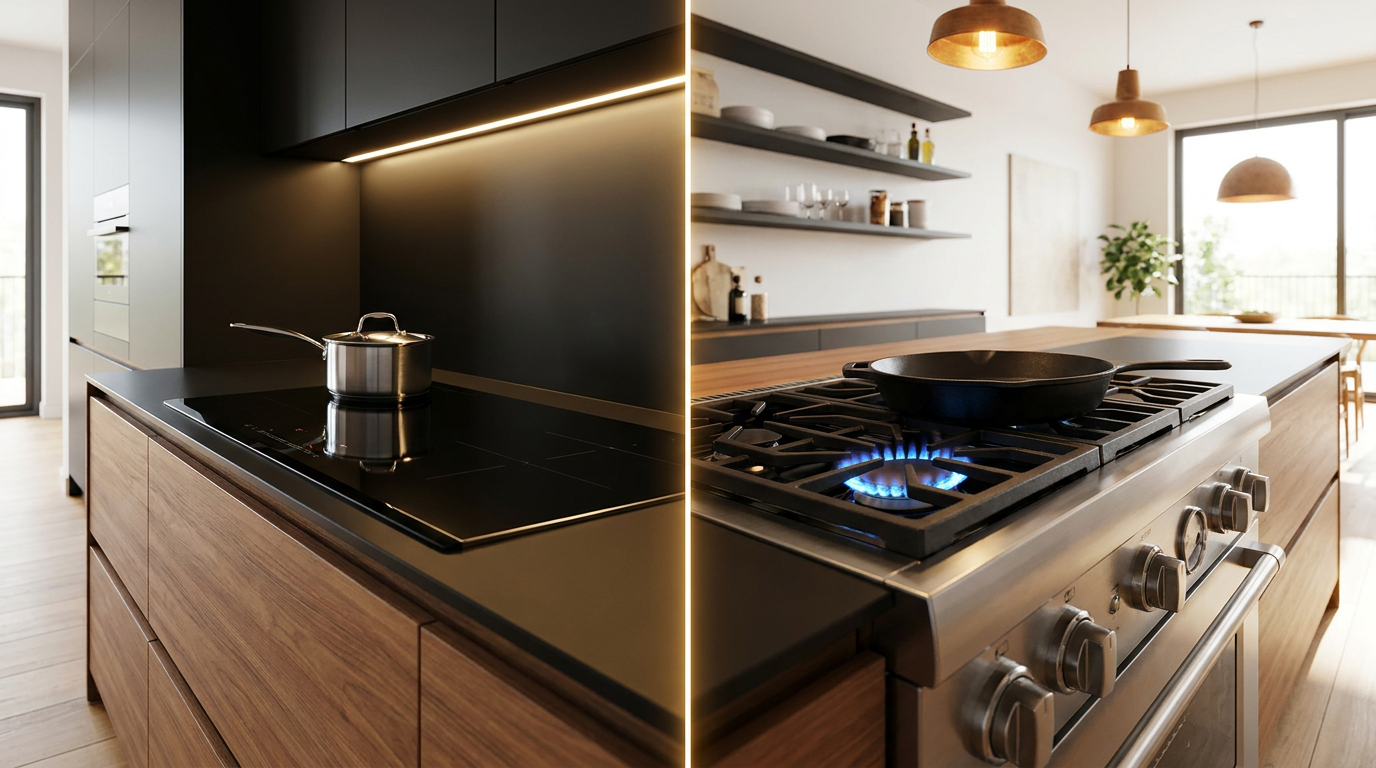
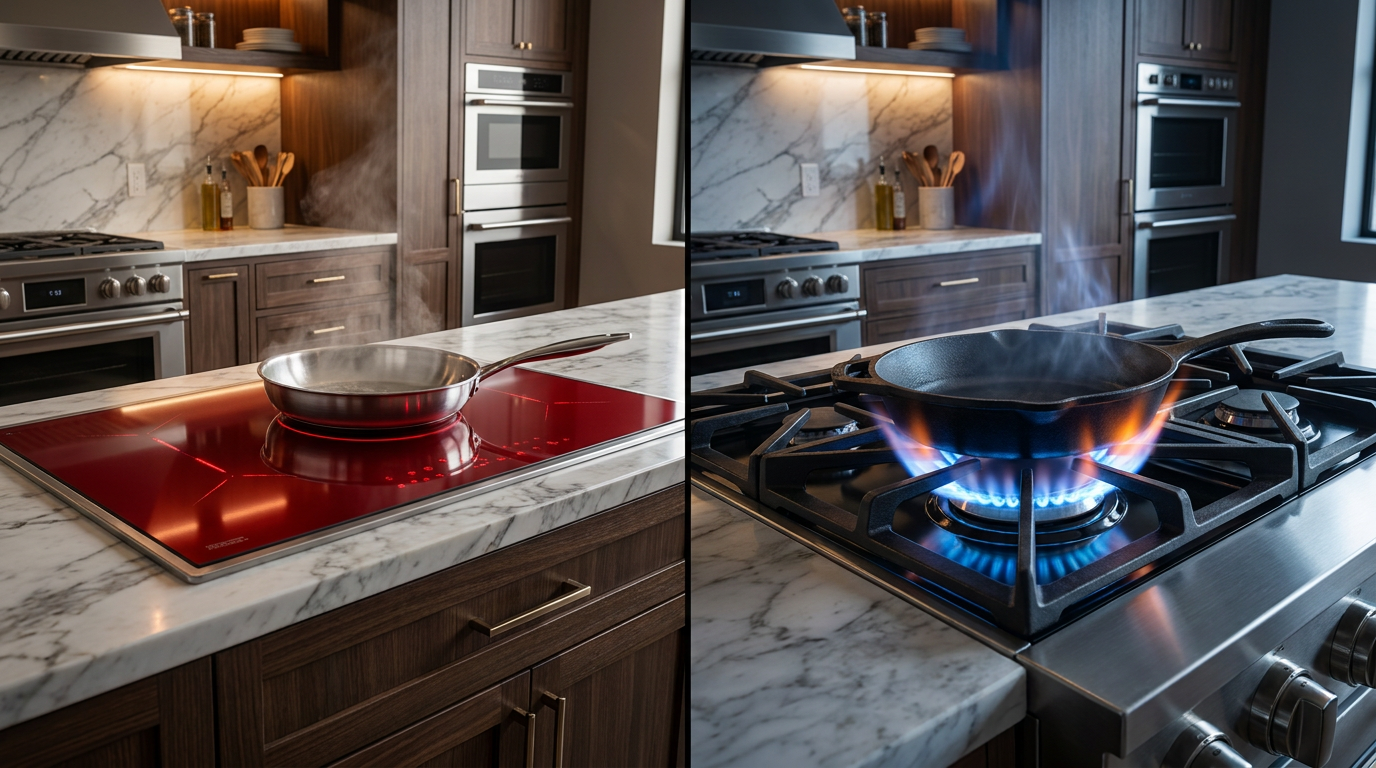
To understand the trade-offs, one must first understand the physics. Gas cooktops rely on combustion, burning natural gas or propane to create an open flame that heats the bottom of a pan, which in turn heats the food. Induction, by contrast, does not generate heat on the surface of the appliance at all. Instead, copper coils beneath a glass surface create a rapidly alternating magnetic field. When a compatible, magnetic pan is placed on the zone, this field induces an electrical current directly within the metal of the cookware. The pan itself becomes the heating element, leaving the surrounding glass relatively cool.[1][6]
The argument for induction begins with raw thermodynamic efficiency. Because gas relies on an open flame, a massive amount of thermal energy escapes around the sides of the cookware and dissipates into the kitchen air. Data from energy analysts indicates that gas cooktops operate at roughly thirty-two to forty percent efficiency. Induction, because it generates heat directly inside the metal vessel, achieves an efficiency rate of eighty-five to ninety percent. This means that nearly all the energy you pay for is actually cooking your meal, rather than forcing your air conditioning to work harder to cool the room.[2]

The evidence for this efficiency is most visible in cooking speed. In standardized testing, induction cooktops consistently bring water to a rolling boil twenty to forty percent faster than high-output gas burners. A high-end induction zone utilizing a power-boost function can deliver up to 3,700 watts of energy, boiling a large pot of pasta water in under three minutes. For busy households, this translates to hours of saved time over the course of a year. Furthermore, the digital controls allow for pinpoint precision, enabling cooks to hold a delicate sauce at a steady simmer without the risk of breaking.[3]
However, the argument against induction centers heavily on the friction of installation and upfront costs. Switching from gas to induction is rarely a simple plug-and-play operation. Induction ranges require a dedicated 240-volt, 40- or 50-amp electrical circuit to operate safely. For newer homes, this might only require running a new wire from the breaker box to the kitchen. But for the roughly twenty percent of older homes equipped with electrical panels smaller than 100 amps, the required infrastructure upgrade is substantial and highly disruptive to the renovation timeline.[4]
The evidence on these hidden costs can be daunting for pragmatic homeowners. While the cooktops themselves have reached price parity with mid-to-high-end gas models, the required electrical panel upgrades frequently exceed one thousand dollars. Additionally, homeowners must factor in the cost of hiring a plumber to safely cap the existing gas line. Finally, there is the cookware tax: induction only works with magnetic materials like cast iron, carbon steel, and magnetic stainless steel. If your kitchen is stocked with aluminum, copper, or glass cookware, you will need to purchase an entirely new set of pots and pans before cooking your first meal.[4]
For gas ranges, the argument for their continued use relies on versatility, tactile feedback, and culinary tradition. Gas provides an immediate, visual indicator of heat levels; a cook can look at the flame and instantly know how the pan will react. Furthermore, gas is entirely agnostic to cookware materials, welcoming everything from a cheap aluminum skillet to a traditional clay pot. It also excels at specific techniques that induction struggles to replicate, such as charring peppers directly on the heavy cast-iron grates or tossing food in a round-bottomed wok, which requires the heat to wrap around the sides of the vessel.[1][6]

For gas ranges, the argument for their continued use relies on versatility, tactile feedback, and culinary tradition.
The evidence supporting gas performance is found in its consistency across edge cases. When a cook lifts a pan off a gas flame to toss ingredients, the heat source remains active and ready. When an induction cooktop senses the pan has been removed, it often shuts off the magnetic field, requiring the element to re-engage when the pan is set back down. Additionally, many induction models utilize power-sharing technology, meaning that if you run two burners on the same side of the stove at maximum power, the appliance will automatically throttle one down. Gas burners operate independently, allowing a cook to run multiple high-BTU flames simultaneously. Gas also provides resilience, allowing households to cook meals during electrical grid outages.[6]
The most potent argument against gas, however, has emerged from recent public health and environmental research. Burning natural gas indoors produces combustion byproducts, most notably nitrogen dioxide and carbon monoxide. As homes have become better insulated and more airtight for energy efficiency, these pollutants are increasingly trapped inside the kitchen, creating micro-environments with poor air quality. This invisible exhaust has shifted the conversation from a purely culinary debate to a pressing matter of residential health and safety. Families are now weighing the joy of an open flame against the respiratory implications of indoor emissions.[5][8]
The evidence regarding these health impacts has catalyzed the electrification movement. A landmark study by Stanford University researchers found that a single gas burner operating on high can raise indoor concentrations of benzene—a known carcinogen—to levels exceeding those found in secondhand smoke. Furthermore, comprehensive meta-analyses have linked the presence of gas stoves in homes to a forty-two percent increased risk of childhood asthma. While high-quality, externally vented range hoods can mitigate these risks, industry data shows that the vast majority of residential range hoods merely recirculate air or lack the capture efficiency required to exhaust the pollutants safely outdoors.[5][8]

Beyond the kitchen walls, the environmental impact of residential gas lines has prompted significant policy shifts. Municipalities and state agencies are increasingly offering substantial rebates to homeowners who cap their gas lines and switch to electric appliances, aiming to reduce reliance on fossil fuels. In some regions, new construction is legally required to be all-electric. This shifting regulatory landscape means that investing in a high-end gas range today carries a slight risk of obsolescence, or at least increased operating costs, as the broader energy grid transitions toward renewable electricity.[7]
On a day-to-day basis, the trade-offs extend to cleaning and maintenance. Gas cooktops, with their heavy cast-iron grates, burner caps, and intricate crevices, are notoriously tedious to clean. Spills often bake onto the hot surfaces around the flame, requiring abrasive scrubbing and specialized cleaners. Induction cooktops offer a completely flat, continuous glass surface. Because the glass itself does not generate heat, spills do not instantly carbonize. A simple wipe with a damp cloth is usually sufficient to restore the surface to a pristine shine, a practical benefit that consistently ranks high in user satisfaction surveys.[3][6]
Safety considerations also heavily favor the newer technology. The absence of an open flame entirely eliminates the risk of igniting loose clothing, paper towels, or dishcloths. Because induction requires a magnetic connection to activate, a burner accidentally left on will not generate heat unless a compatible pan is present. The surface cools rapidly once the pan is removed, drastically reducing the risk of accidental burns—a crucial factor for households with young children, elderly residents, or pets that might jump onto the counters.[5][6]
For homeowners torn between the two technologies, a hybrid approach is emerging in luxury kitchen design. Some manufacturers now offer modular cooktops, allowing buyers to install a primary induction surface for everyday boiling, simmering, and sautéing, paired with a single, dedicated gas burner or wok ring for specialized high-heat techniques. This compromise delivers the speed, safety, and easy cleanup of induction while preserving the tactile joy of open-flame cooking when a specific recipe demands it, offering the best of both worlds.[1]

Ultimately, an induction cooktop fits well when a household prioritizes speed, energy efficiency, and indoor air quality. It is the superior choice for those who want effortless cleanup, have young children, and are willing to invest in the necessary electrical upgrades. It is particularly compelling for homeowners already planning a major kitchen renovation where running a new 240-volt line can be easily absorbed into the broader project budget without causing unexpected delays or disproportionate financial strain. For these buyers, the long-term benefits easily outweigh the initial friction.[1][2][7]
Conversely, a gas range remains the better fit when a home lacks the electrical capacity for a high-amp circuit and the cost of a panel upgrade is prohibitive. It is the logical choice for culinary traditionalists who rely heavily on wok cooking, charring, and visual flame control, or for those who live in areas with frequent power outages and require an off-grid cooking solution. The decision rests not on which technology is objectively perfect, but on which set of compromises best aligns with your daily life, budget, and cooking style.[1][4]
How we got here
1970s
Early induction cooktops are introduced by Westinghouse, but fail to gain market traction due to high costs and low reliability.
2010s
Induction technology matures and gains widespread adoption in European and Asian markets due to high energy costs.
2023
Stanford University publishes a landmark study linking gas stove emissions to elevated indoor benzene levels, sparking national debate.
2025
Multiple US municipalities begin offering substantial rebates for homeowners transitioning from gas to induction to meet climate goals.
2026
Induction cooktops reach price parity with mid-tier gas ranges, accelerating adoption in the American residential market.
Viewpoints in depth
Electrification Advocates
Public health and climate experts pushing for a rapid transition away from residential gas.
This camp argues that the kitchen stove is a critical front in both the fight against climate change and the effort to improve indoor air quality. Citing studies from Stanford and the EPA, they point out that gas stoves leak methane even when turned off and produce harmful levels of nitrogen dioxide during use. For these advocates, the superior energy efficiency of induction is a secondary benefit to the primary goal of removing fossil fuel combustion from the center of the family home.
Culinary Traditionalists
Chefs and home cooks who prioritize the tactile control and versatility of open-flame cooking.
Traditionalists acknowledge the speed of induction but argue that cooking is about more than boiling water quickly. They value the visual feedback of a flame, which instantly communicates the heat level without requiring a glance at a digital display. This camp also emphasizes the limitations of induction for specific techniques, such as wok cooking, charring vegetables directly on the heat source, and using non-magnetic cookware like traditional copper or clay pots.
Pragmatic Homeowners
Consumers focused on the total cost of ownership, installation hurdles, and daily reliability.
For this group, the debate often comes down to infrastructure and economics rather than culinary philosophy or environmental ideals. They point out that while induction is cheaper to operate, the upfront costs of upgrading an older home's electrical panel to support a 50-amp circuit can easily wipe out a decade of energy savings. They also value the resilience of gas during winter storms or grid failures, noting that a gas stove can still prepare a hot meal when the power goes out.
What we don't know
- Whether the electrical grid in older neighborhoods can support mass simultaneous adoption of high-amp induction ranges.
- How quickly the secondary market for used gas ranges will depreciate as electrification mandates expand.
Key terms
- Electromagnetic Induction
- The process by which a magnetic field generates an electrical current inside a magnetic material, creating heat directly within the cookware.
- Thermal Efficiency
- The percentage of energy consumed by an appliance that is actually transferred into the food, rather than lost to the surrounding air.
- Power-Sharing
- A feature on many induction cooktops where the appliance automatically reduces power to one burner if multiple burners on the same circuit are used at high settings simultaneously.
- Capture Efficiency
- A metric describing how effectively a range hood captures and exhausts smoke, steam, and pollutants from the cooking surface.
Frequently asked
Do I need to buy all new pots and pans for an induction stove?
Only if your current cookware is not magnetic. Cast iron, carbon steel, and magnetic stainless steel work perfectly, while aluminum, copper, and glass will not work.
Can an induction cooktop interfere with a pacemaker?
Because induction uses electromagnetic fields, manufacturers and doctors generally recommend keeping pacemakers at least two feet away from the active cooking surface, though risks are considered low.
Is it more expensive to cook with gas or electricity?
It depends on local utility rates, but because induction is up to 90% efficient compared to gas's 40%, induction often costs less month-to-month, even in areas where natural gas is cheap.
Do I still need a range hood with an induction cooktop?
Yes. While induction does not produce combustion gases like carbon monoxide, cooking food still releases grease, smoke, and odors that need to be vented outdoors.
Sources
Source coverage
8 outlets
3 viewpoints surfaced








[1]Factlen Editorial TeamCulinary Traditionalists
Synthesis by Factlen editorial team
Read on Factlen Editorial Team →[2]Energy SolutionsElectrification Advocates
Induction vs Gas Cooktops: The Definitive Health, Efficiency & Economic Analysis
Read on Energy Solutions →[3]CHOICEPragmatic Homeowners
Gas vs induction: Which cooks better?
Read on CHOICE →[4]The KitchnPragmatic Homeowners
What It Really Costs to Switch from a Gas to an Induction Stove
Read on The Kitchn →[5]Silicon Valley Clean EnergyElectrification Advocates
Are Induction Cooktops Better Than Traditional Gas Stoves?
Read on Silicon Valley Clean Energy →[6]Yale AppliancePragmatic Homeowners
Induction vs Gas 2026: Pros & Cons
Read on Yale Appliance →[7]BayRENElectrification Advocates
BayREN Adds Induction Cooking as an EASE Home Upgrade
Read on BayREN →[8]CLASPElectrification Advocates
The Health and Climate Benefits of Transitioning to Electric Cooking
Read on CLASP →

Every angle. Every day.
Get shopping stories with full source coverage and perspective breakdowns delivered to your inbox.