
The Evidence on Accessory Dwelling Units: ROI, Property Value, and Multi-Generational Living
As zoning laws relax nationwide, data shows Accessory Dwelling Units (ADUs) are delivering significant financial returns for homeowners while providing a proven solution for aging in place.
By Factlen Editorial Team
- Housing Market Analysts
- Focuses on the macroeconomic impact of ADUs on the national housing shortage.
- Homeowners & Builders
- Focuses on the financial ROI, property rights, and wealth-building potential.
- Aging-in-Place Advocates
- Focuses on the social benefits of multi-generational living and accessible design.
What's not represented
- · Neighborhood Associations concerned about density
- · Renters living in unpermitted shadow housing
Why this matters
For homeowners, an ADU represents one of the few accessible ways to generate passive income and build substantial property equity. For families, it offers a practical, dignified way to keep aging parents close without sacrificing privacy.
Key points
- A Freddie Mac analysis identified 1.4 million properties with ADUs nationwide, showing deep organic demand.
- California ADU permits grew 54.3% from 2021 to 2025, driven by aggressive state-level zoning reforms.
- Adding an ADU can increase a property's appraised value by 20% to 30% in high-demand markets.
- Over 75% of adults over 50 wish to age in place, making ADUs a critical tool for multi-generational living.
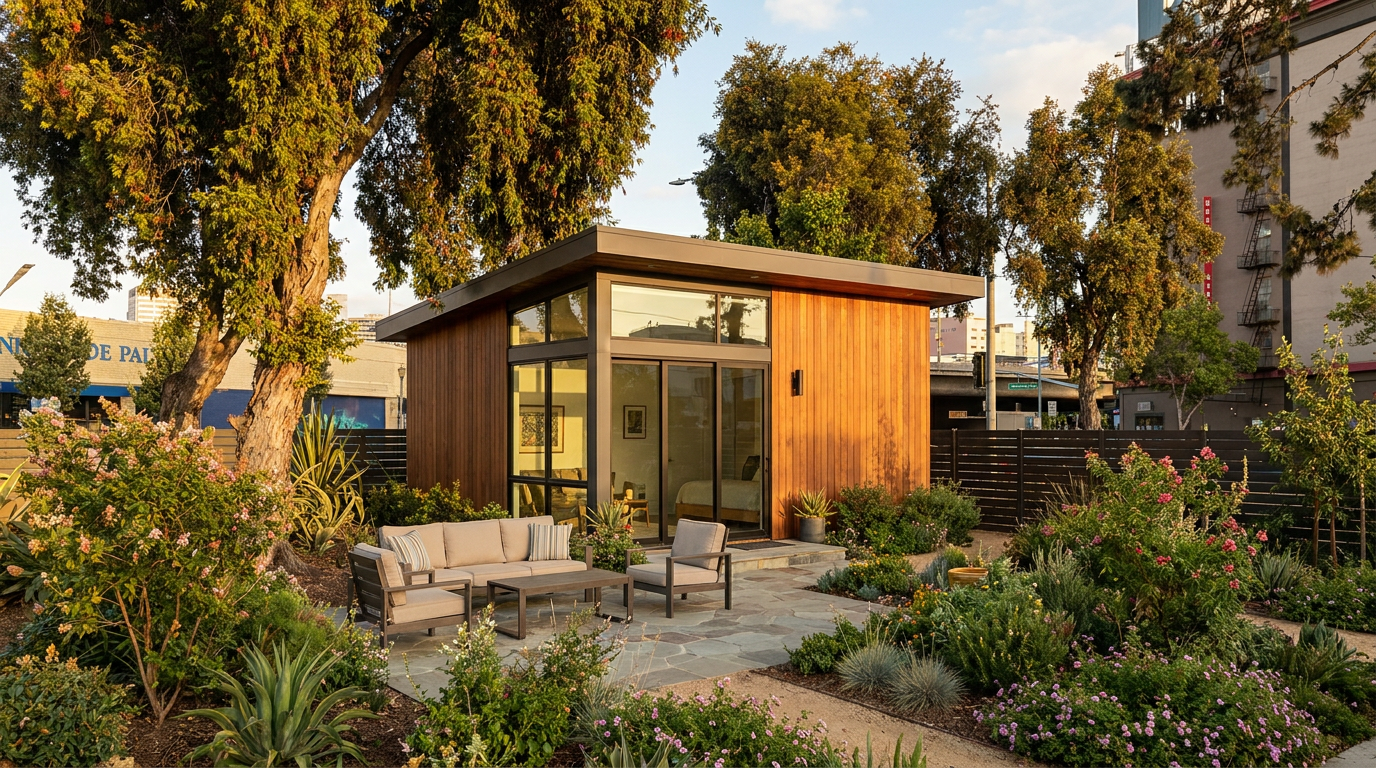
The American backyard is undergoing a quiet but profound transformation. Across the country, homeowners are converting garages, finishing basements, and dropping modular cottages onto their lawns. These structures, formally known as Accessory Dwelling Units (ADUs), are rapidly moving from a niche architectural trend to a mainstream housing solution. Driven by a rare alignment of interests—homeowners seeking passive income, families needing multi-generational living spaces, and municipalities desperate to increase housing supply—the ADU market has matured into a multi-billion-dollar industry. As zoning laws relax and financing becomes more accessible, ADUs offer a highly practical, evidence-backed pathway for middle-class wealth building.[7]
The scale of the ADU market is significantly larger than previously understood by urban planners. A landmark text-mining analysis conducted by Freddie Mac identified approximately 1.4 million single-family properties with ADUs across the United States. By analyzing over 600 million Multiple Listing Service (MLS) transactions dating back to the late 1990s, researchers found that the growth trajectory of these secondary units predates the most recent wave of progressive zoning reforms. The data reveals a deep, underlying consumer preference for properties that offer flexible living arrangements, whether for rental income or extended family.[1][3]
The data shows a sustained, organic demand for flexible housing that has only accelerated over the past decade. Between 2009 and 2019, the number of first-time ADU listings grew at an average annual rate of 8.6%. Furthermore, by 2019, homes with ADUs represented 4.2% of all homes sold on the MLS, a substantial increase from just 1.1% in the year 2000. This steady climb indicates that homebuyers actively seek out and place a premium on properties equipped with secondary units, viewing them as a vital hedge against rising housing costs.[1][3]
While organic demand has always existed, state-level policy preemption is the primary catalyst for the current construction boom. Historically, regulatory barriers—such as strict parking minimums, large setback requirements, and mandatory owner-occupancy rules—suppressed new construction. California changed the paradigm by passing a series of aggressive state laws starting in 2017 that preempted local zoning restrictions and stripped municipalities of their ability to block compliant ADU projects. This legislative framework effectively legalized backyard homes across the entire state, transforming the regulatory landscape and providing a blueprint for other housing-constrained regions to follow.[4][7]

The results in California offer the clearest evidence of how policy reform unlocks housing supply. According to building permit data analyzed by Shovels.ai, California ADU permits grew 54.3% from 2021 to 2025, reaching over 24,000 permitted addresses in 2025 alone. Even as broader residential construction in the state contracted sharply due to high interest rates and elevated material costs, ADU construction remained a resilient bright spot, re-accelerating to 8.6% growth in 2025. This divergence highlights the unique economic resilience of micro-development compared to traditional large-scale homebuilding.[4][7]
Other states are now adopting the California playbook with even more aggressive frameworks. Washington State recently implemented HB 1337, which took effect statewide in mid-2025, allowing two ADUs per lot, removing owner-occupancy mandates, and capping local impact fees. As more states move to override restrictive local zoning, housing analysts project that ADUs could eventually close up to one-third of the nation's estimated 3.7 million unit housing deficit. The policy shift represents a fundamental rethinking of the single-family neighborhood.[7]
Beyond macroeconomic housing supply, ADUs deliver a measurable, dual-engine return on investment for individual homeowners. The financial calculus of building an ADU rests on two pillars: immediate rental income and long-term property appreciation. Industry data indicates that adding an ADU can increase a property's appraised value by 20% to 30% in high-demand markets. Because the land is already owned, the cost basis for adding a unit is significantly lower than purchasing a new standalone investment property. This unique cost structure allows homeowners to generate outsized returns on their construction capital, effectively transforming their backyards into high-yield real estate assets.[5][6]
In coastal cities and major urban centers, the value premium is particularly stark. A $200,000 investment in a detached backyard unit can frequently add $250,000 or more to the home's resale value upon completion. Furthermore, properties with ADUs tend to appreciate at a faster annual rate—roughly 9% compared to 7% for traditional single-family homes—accelerating equity growth for the homeowner. This accelerated appreciation provides a powerful financial cushion, enabling homeowners to build generational wealth without needing to relocate.[5][6]

In coastal cities and major urban centers, the value premium is particularly stark.
The cash flow potential is equally compelling for those who choose to rent their units. In markets like Los Angeles, Seattle, or the San Francisco Bay Area, a detached ADU can generate $2,000 to $4,000 per month in rental income. This revenue stream often exceeds the monthly payment on the construction loan or home equity line of credit used to finance the build. As a result, the unit can effectively pay for itself within 8 to 10 years, transitioning into a permanent source of passive income and a reliable hedge against inflation.[5][6]
While the financial ROI is strong, a significant portion of the ADU boom is driven by family needs rather than pure investment motives. Demographic shifts, particularly the rapid aging of the Baby Boomer generation, are driving non-financial adoption. AARP has become one of the most vocal advocates for ADU expansion, integrating ADU-friendly policies into its national Livability Index and lobbying state legislatures to remove barriers to construction. For these advocates, the backyard cottage is a vital tool for preserving family cohesion.[2]
According to AARP's survey data, more than 75% of adults over the age of 50 wish to remain in their communities as they age. However, many are priced out of their neighborhoods or live in multi-story homes that become physically difficult to navigate. ADUs offer a practical solution for multi-generational living, allowing aging parents to downsize into a custom-built, accessible backyard cottage while their adult children take over the primary residence. This arrangement provides proximity for caregiving while maintaining essential privacy for both generations.[2]
The survey revealed that one in four homeowners aged 50 and older have seriously considered building an ADU on their property. Among those interested, the primary motivation is not rental income, but rather ensuring that a loved one who needs care has a safe, proximate place to live. By designing units with zero-step entries, wider doorways, and accessible bathrooms, families can preemptively adapt to mobility challenges, avoiding the high costs and emotional toll of institutional assisted living facilities.[2][7]

Despite the clear demand and proven ROI, financing remains the most significant bottleneck to widespread ADU adoption. The upfront cost of construction presents a high barrier to entry, typically ranging from $100,000 for a simple garage conversion to well over $300,000 for a new, detached unit with premium finishes. Because these projects require substantial capital before any rental income can be generated, lower- and middle-income homeowners often find themselves locked out of the market. This capital constraint threatens to concentrate the wealth-building benefits of ADUs among affluent homeowners who already possess significant liquid assets or deep home equity.[5][6][7]
Traditional mortgage lenders have historically struggled to underwrite ADUs because the projects do not fit neatly into standard loan products. They are not quite home improvement projects, not quite new construction, and not quite commercial investment properties. Consequently, homeowners often have to rely on cash savings, cash-out refinances, or HELOCs, which are highly sensitive to prevailing interest rates and require substantial existing equity. This lack of standardized financing has artificially capped the growth rate of the industry.[6][7]
However, the evidence suggests the financial industry is finally catching up to the policy landscape. More lenders are introducing specialized ADU construction loans, and appraisers are increasingly willing to use income-based valuation approaches that factor in projected rental revenue when assessing the property. Freddie Mac has explicitly signaled to lenders that they should consider offering dedicated financing options to support this growing market segment, which could soon unlock a massive wave of new construction.[1][6]
As the market matures, urban planners are closely monitoring the long-term impacts of increased density. While the permitted ADU market is well-documented, the true scale of secondary units remains obscured by a vast "shadow market" of unpermitted conversions. Freddie Mac notes that in some high-foreclosure neighborhoods in Los Angeles, up to 80% of single-family homes likely harbor illegal ADUs. Bringing these units up to code remains a complex challenge for local governments.[1][3][7]

As cities implement amnesty programs to legalize these shadow units, questions remain about municipal infrastructure. The long-term impact on street parking, water usage, and school enrollment is a subject of ongoing study. However, the current consensus among urban planners is that the incremental, distributed density provided by ADUs places far less strain on municipal resources than traditional greenfield suburban development, as it leverages existing roads, utility lines, and transit networks. By infilling established neighborhoods, cities can accommodate population growth without the massive public expenditures required to expand the urban footprint.[3][7]
Ultimately, the evidence surrounding Accessory Dwelling Units points to a rare policy triumph in the notoriously difficult housing sector. By empowering individual homeowners to become micro-developers, ADUs are simultaneously creating wealth, keeping families together, and quietly chipping away at the nation's housing shortage. As financing models standardize and more states adopt permissive zoning frameworks, the backyard cottage is poised to become a permanent, essential fixture of the American residential landscape.[2][7]
How we got here
2017
California passes SB 1069, kicking off the modern wave of state-level ADU preemption laws.
2020
Freddie Mac publishes a landmark study identifying 1.4 million properties with ADUs nationwide.
2023
Washington State signs HB 1337, creating one of the most permissive ADU frameworks in the country.
2025
California ADU permits reach over 24,000 annually, representing a 54% increase since 2021 despite high interest rates.
2026
New state laws take effect permanently removing owner-occupancy requirements for standard ADUs in key markets.
Viewpoints in depth
Housing Market Analysts
Focuses on the macroeconomic impact of ADUs on the national housing shortage.
Analysts view ADUs as a critical, market-driven tool to infill existing neighborhoods without the need for massive public subsidies. By analyzing permit data and MLS listings, they argue that relaxing zoning laws unleashes pent-up organic demand, allowing private homeowners to effectively act as micro-developers and close a meaningful portion of the housing deficit.
Homeowners & Builders
Focuses on the financial ROI, property rights, and wealth-building potential.
For property owners and the construction industry, ADUs represent a powerful wealth-building vehicle. They emphasize the dual financial benefits of immediate rental cash flow and long-term property appreciation. This camp advocates for streamlined permitting, reduced impact fees, and better financing products to lower the barrier to entry for middle-class families.
Aging-in-Place Advocates
Focuses on the social benefits of multi-generational living and accessible design.
Organizations like AARP champion ADUs as a humane solution to the senior housing crisis. They argue that backyard cottages allow older adults to downsize safely while remaining in their communities and close to family caregivers. For this group, the primary value of an ADU is not rental income, but rather preserving independence, dignity, and family cohesion.
What we don't know
- The exact number of unpermitted 'shadow' ADUs currently housing renters across the country.
- How the widespread addition of ADUs will impact municipal infrastructure like water systems and parking over the next decade.
- Whether traditional mortgage lenders will standardize ADU construction loans to make financing accessible to lower-income homeowners.
Key terms
- Accessory Dwelling Unit (ADU)
- A secondary, self-contained housing unit located on the same lot as a primary single-family home.
- Owner-Occupancy Requirement
- A zoning rule, increasingly being banned by states, that forces the property owner to live in either the main house or the ADU.
- Setback Rules
- Local regulations dictating how far a structure must be built from the property line, which are often relaxed for ADUs.
- Shadow Housing
- Unpermitted or illegal secondary units that are not officially recorded in municipal tax or zoning databases.
Frequently asked
How much does it cost to build an ADU?
Costs vary widely, ranging from $100,000 for a simple garage conversion to over $300,000 for a new, detached backyard cottage.
Does an ADU increase my property taxes?
Yes, building an ADU typically triggers a reassessment of the newly added value, which will increase your property tax bill, though usually not the tax basis of the primary home.
Can I build an ADU if I have an HOA?
It depends on your state. In places like California and Washington, state laws largely override HOA bans on ADUs, but HOAs may still impose reasonable design guidelines.
Do I have to rent out my ADU?
No. Many homeowners build ADUs to house aging parents, adult children, or to use as a home office or creative studio.
Sources
Source coverage
7 outlets
3 viewpoints surfaced






[1]Freddie MacHousing Market Analysts
Granny Flats, Garage Apartments, In-Law Suites: Identifying Accessory Dwelling Units
Read on Freddie Mac →[2]AARPAging-in-Place Advocates
Accessory Dwelling Units Allow Homeowners to Choose Where They Age
Read on AARP →[3]HousingWireHousing Market Analysts
1.4 million homes have accessory dwelling units, Freddie Mac says
Read on HousingWire →[4]Shovels.aiHousing Market Analysts
California Housing Market Outlook: Supply Signals from Building Permit Data
Read on Shovels.ai →[5]APEX HomesHomeowners & Builders
How Much Value Does an ADU Add to a Home in California?
Read on APEX Homes →[6]ModFiiHomeowners & Builders
ADU Financing: How to Finance an Accessory Dwelling Unit (2026 Guide)
Read on ModFii →[7]Factlen Editorial TeamAging-in-Place Advocates
Synthesis by Factlen editorial team
Read on Factlen Editorial Team →
Every angle. Every day.
Get real estate stories with full source coverage and perspective breakdowns delivered to your inbox.