
The Science of Lengthened Partials: Why the 'Stretch' is Redefining Muscle Growth
New sports science reveals that training muscles in their most stretched position—using 'lengthened partials'—can stimulate more hypertrophy than a traditional full range of motion.
By Aylin Aksoy

In short
- Lengthened partials involve performing only the bottom half of a repetition where the muscle is fully stretched.
- Research shows the stretched position provides the vast majority of the hypertrophy stimulus in a given exercise.
- Shortened partials (the 'squeeze' at the top) build significantly less muscle than lengthened partials.
For decades, the golden rule of the gym was absolute: always use a full range of motion. Anyone caught performing half-reps was swiftly accused of 'ego lifting'—sacrificing form just to move heavier weights. But a quiet revolution in sports science is turning that old-school dogma on its head, revealing that the most potent trigger for muscle growth might actually hide in the bottom half of the lift.[6]
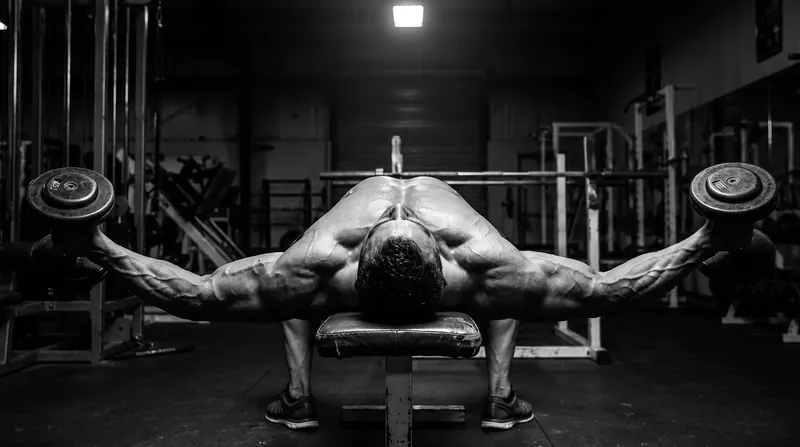
Enter the 'lengthened partial,' a training technique that has taken the evidence-based bodybuilding community by storm. A lengthened partial involves performing only the portion of a repetition where the target muscle is fully stretched, intentionally cutting out the top half of the movement. Think of the deep bottom half of a squat, or the lowest portion of a dumbbell chest fly.[1]
The biological engine driving this trend is a concept known as stretch-mediated hypertrophy. When a muscle is placed under load in its most lengthened position, it experiences extreme mechanical tension. This tension acts as a powerful signaling mechanism, telling the body to synthesize new muscle proteins and, in some cases, potentially add new sarcomeres—the basic contractile units of muscle tissue.[3][5]
For years, researchers assumed that a full range of motion was the undisputed champion of muscle growth. However, when sports scientists began isolating different parts of the lift, the data revealed a massive disparity. Studies comparing 'shortened partials'—the top half of a movement, like the squeeze at the top of a bicep curl—against lengthened partials found that the stretched position was doing almost all the heavy lifting for hypertrophy.
In fact, a growing body of literature suggests that lengthened partials can build as much, and frequently more, muscle mass than a traditional full range of motion. By restricting the movement to the bottom 50 to 75 percent of the exercise arc, lifters force the muscle to spend the entirety of the set in its most mechanically disadvantageous—and therefore most stimulating—position.[1][5]
The results have prompted a reevaluation of how we program hypertrophy training. Dr. Milo Wolf, a leading researcher in range-of-motion science, has noted that lifters might unlock roughly 5 percent more overall muscle growth simply by prioritizing the stretched portion of their exercises. While 5 percent may sound modest to a beginner, it represents a massive advantage for advanced natural bodybuilders fighting for every ounce of tissue.[5][6]
However, the science of stretch-mediated hypertrophy is not universally uniform across the human body. Recent comprehensive testing, including high-budget MRI experiments, has demonstrated that not all muscles respond to the stretch stimulus equally. The degree of stretch a muscle can safely endure depends heavily on its anatomical structure.[2]
Bi-articulate muscles—those that cross two joints, such as the hamstrings, calves, and the long head of the triceps—appear to be the most responsive to stretch-mediated hypertrophy. Because these muscles can be stretched to extreme lengths, they experience a profound growth stimulus when loaded in that elongated state. Conversely, muscles like the chest or lateral deltoids may not require as extreme a stretch to maximize their growth potential.[2]
Despite the enthusiasm, some exercise scientists urge caution regarding the exact mechanisms at play. Skeptics point out that while the growth is undeniable, it may not be the 'stretch' itself causing the hypertrophy. Instead, the bottom of a lift is simply where the weight exerts the highest torque on the joint, meaning the muscle is working its hardest to overcome the resistance.[4]
Furthermore, the academic debate continues over whether stretch-mediated hypertrophy causes muscles to thicken by adding sarcomeres in parallel, or lengthen by adding sarcomeres in series. While animal models from the 1970s showed massive muscle growth from passive stretching alone, human studies are still working to map the exact cellular adaptations.[3][4]
Regardless of the precise cellular mechanism, the practical application for everyday lifters is highly effective. You do not need to abandon full range of motion to reap the benefits of the stretch. Full range of motion remains excellent for building well-rounded functional strength, maintaining joint mobility, and ensuring the muscle is trained through its entire contractile range.[1][6]
Instead, many top coaches now advocate for a 'hybrid approach.' In this model, a lifter performs a standard set using a full range of motion until they reach muscular failure—the point where they can no longer complete the top half of the rep. Rather than racking the weight, the lifter stays in the bottom position and grinds out three to five lengthened partials to fully exhaust the muscle.[1]
This hybrid method allows lifters to push safely past traditional failure. Because muscles are naturally stronger in their eccentric lowering phase and their stretched phase, a lifter who cannot complete a full bicep curl can still control the weight through the bottom half of the arc. This efficiently maximizes the time under tension without requiring additional heavy sets.[5][6]
Interestingly, many lifters report that lengthened partials are actually kinder to their joints. By avoiding the hard lockouts at the top of a movement—such as fully extending the knees on a leg press or locking the elbows on a bench press—the lifter keeps constant tension on the muscle belly rather than transferring the load to the connective tissues and skeletal structure.
The rise of lengthened partials represents a broader shift in fitness culture: moving away from rigid, dogmatic rules and toward a more nuanced, evidence-based understanding of human physiology. By embracing the stretch, lifters are discovering that sometimes, doing half the work at the right time yields entirely better results.[6]
Key terms
- Stretch-Mediated Hypertrophy
- The biological process where placing a muscle under load in a stretched position triggers enhanced muscle growth.
- Lengthened Partial
- A half-repetition performed exclusively in the portion of the lift where the muscle is most elongated.
- Shortened Partial
- A half-repetition performed at the top of a lift, where the muscle is fully contracted or squeezed.
- Mechanical Tension
- The physical stress placed on muscle fibers when they resist a heavy load, considered the primary driver of muscle growth.
- Bi-articulate Muscle
- A muscle that crosses two separate joints, allowing it to be stretched to a greater degree than standard muscles.
Frequently asked
What exactly is a lengthened partial?
A lengthened partial is a repetition performed only in the bottom half of an exercise's range of motion, where the target muscle is fully stretched.
Do lengthened partials replace full range of motion?
No. Most experts recommend using a full range of motion for the majority of your training, and adding lengthened partials at the end of a set to push past failure.
Which muscles benefit most from this technique?
Bi-articulate muscles that cross two joints—such as the hamstrings, calves, and the long head of the triceps—show the greatest response to stretch-mediated hypertrophy.
Are lengthened partials safe for my joints?
For many lifters, they are actually safer. By avoiding the lockout at the top of a movement, you keep the tension on the muscle belly rather than the connective tissue.
Viewpoints in depth
Evidence-Based Coaches
Advocate for maximizing time spent in the stretched position to optimize muscle growth.
This camp, led by sports scientists and modern hypertrophy coaches, argues that mechanical tension in the stretched position is the undisputed king of muscle growth. They point to numerous recent studies showing that lengthened partials consistently outperform shortened partials, and often beat full range of motion. For these coaches, intentionally cutting out the top half of a rep is not 'ego lifting'—it is a calculated optimization of training volume and fatigue management.
Strength Purists
Emphasize full range of motion for overall athletic development and functional strength.
Traditional strength coaches and purists maintain that while lengthened partials may build muscle, full range of motion is non-negotiable for building functional, real-world strength. They argue that training a muscle through its entire contractile range is essential for joint health, mobility, and athletic performance. This group generally views lengthened partials as a useful supplementary finisher, but warns against abandoning full-ROM compound lifts.
Mechanism Skeptics
Demand more precise human data to prove the growth is caused by stretch rather than simple mechanical torque.
A subset of exercise scientists agree that the bottom of the lift builds more muscle, but they dispute the 'stretch-mediated' label. They argue that the bottom of a squat or curl is simply where the exercise is mechanically hardest—meaning the muscle is producing the most force to overcome torque. They suggest that until human studies can definitively prove sarcomerogenesis (the addition of new muscle units in series), the fitness industry should be careful about attributing the magic purely to the 'stretch' rather than basic heavy loading.
- Evidence-Based Coaches
- Advocate for maximizing time spent in the stretched position to optimize muscle growth.
- Strength Purists
- Emphasize full range of motion for overall athletic development and functional strength.
- Mechanism Skeptics
- Demand more precise human data to prove the growth is caused by stretch rather than simple mechanical torque.
Perspectives this story doesn't cover
- Physical Therapists
- Olympic Weightlifters
Sources
Source coverage
6 outlets
3 viewpoints surfaced






- [1]Men's HealthStrength Purists
Are partial reps the smartest new technique to build muscle?
Read on Men's Health → - [2]Built With ScienceEvidence-Based Coaches
We Spent $40K to Test Stretch-Mediated Hypertrophy
Read on Built With Science → - [3]National Institutes of HealthMechanism Skeptics
Stretch-Mediated Hypertrophy: Results from Human Studies
Read on National Institutes of Health → - [4]Menno HenselmansMechanism Skeptics
The Stretch-Mediated Hypertrophy Revolution: Fact or Fiction?
Read on Menno Henselmans → - [5]Hevy CoachEvidence-Based Coaches
Lengthened Partials: Definition, Uses, Benefits, and Tips
Read on Hevy Coach → - [6]Factlen Editorial Team
Synthesis by Factlen editorial team
Read on Factlen Editorial Team →

More in Fitness
See all →Hypertrophy Science
The Science of Natural Hypertrophy: How Evidence-Based Bodybuilding is Reshaping Fitness
5 sources

Hypertrophy Science
The New Science of Hypertrophy: Why 'Lengthened Partials' Are Changing How Bodybuilders Train
5 sources

Hypertrophy Science
The Science of Stretch-Mediated Hypertrophy: Why Training at Long Muscle Lengths Drives More Growth
3 sources
Supplement Safety
FDA Warns Bodybuilding Supplements Illegally Contain Steroids, Posing Risk of Severe Liver Injury
7 sources

Comments
Every angle. Every day.
Get Fitness stories with full source coverage and perspective breakdowns, free every day.