
US and Iran Sign 14-Point Agreement to End War and Reopen Strait of Hormuz
President Donald Trump and Iranian President Masoud Pezeshkian have signed a 14-point Memorandum of Understanding in France, officially ending the two-month conflict. The deal secures a commitment from Iran to never acquire a nuclear weapon in exchange for a $300 billion redevelopment package and the immediate reopening of global shipping lanes.
By Factlen Editorial Team
- US Administration
- Views the deal as a historic victory that neutralizes the nuclear threat without a prolonged ground war.
- Iranian Leadership
- Frames the agreement and financial package as a vindication of their economic resistance strategy.
- Global Market Observers
- Focuses on the immediate relief to global energy supply chains and the pragmatic compromises made by both sides.
What's not represented
- · Israeli government officials
- · Middle Eastern oil-producing neighbors
Why this matters
The immediate reopening of the Strait of Hormuz will relieve a severe bottleneck in global energy supplies, likely driving down gas prices worldwide. Furthermore, the agreement averts a broader regional war in the Middle East while establishing a massive new economic framework for Iran.
Key points
- The US and Iran signed a 14-point agreement in France to end their two-month conflict.
- Iran committed to never acquiring a nuclear weapon.
- A $300 billion international redevelopment package will be directed to the Iranian economy.
- The Strait of Hormuz will immediately reopen to commercial shipping.
- The deal averts a broader regional war and stabilizes global energy markets.
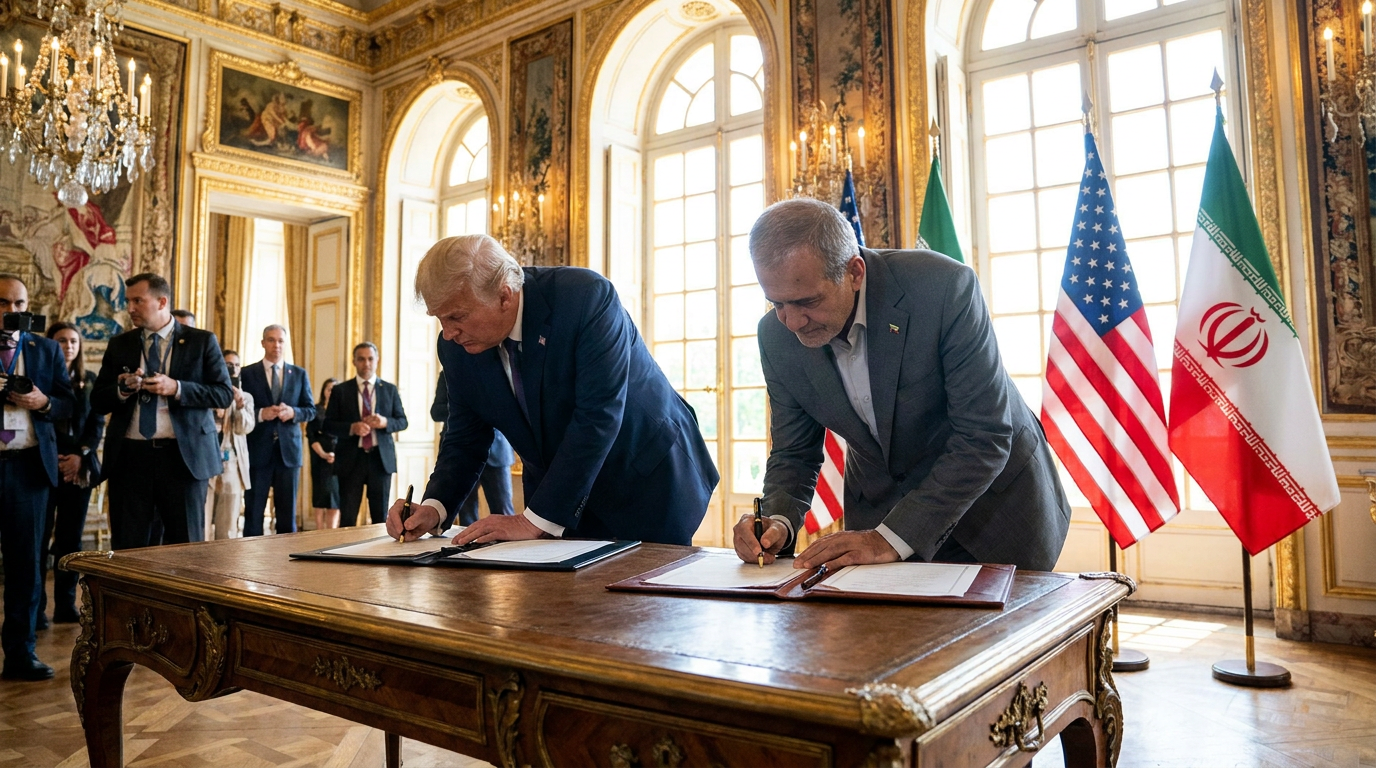
US President Donald Trump and Iranian President Masoud Pezeshkian signed a 14-point Memorandum of Understanding on Wednesday evening, formally ending a two-month military and economic conflict. The signing took place following a G7 dinner at the Palace of Versailles in France, marking a sudden diplomatic resolution to a crisis that had paralyzed global energy markets and threatened to engulf the broader Middle East.[1][2]
The agreement centers on three primary pillars: an immediate cessation of all hostilities, a binding commitment that Iran will never develop or acquire a nuclear weapon, and a massive $300 billion international redevelopment package directed toward the Iranian economy. Crucially for the global economy, the pact mandates the immediate reopening of the Strait of Hormuz to commercial shipping, ending a blockade that had severely disrupted international trade.[1][6]

For the past two months, the closure of the Strait of Hormuz—a vital maritime chokepoint through which roughly a fifth of the world's oil consumption passes—has wreaked havoc on global markets. The resulting economic chaos served as a primary catalyst for the accelerated negotiations, as both nations faced mounting domestic and international pressure to restore trade flows and stabilize energy prices.[4][6]
In Washington, the agreement is being framed through competing lenses. The Trump administration has touted the deal as a historic victory that secures a permanent end to Iran's nuclear ambitions without requiring a prolonged ground war. During a press conference, President Trump emphasized that the agreement stabilizes the Middle East while warning that military action remains an option if nuclear talks fail to materialize into verifiable action.[3][5]

In Washington, the agreement is being framed through competing lenses.
However, some political analysts and critics note that the final terms fall short of the administration's initial demands for an unconditional Iranian surrender. The inclusion of a $300 billion redevelopment package represents a significant concession, acknowledging the severe economic toll the conflict took on Iran while also rewarding Tehran's strategy of weaponizing global economic stability to force diplomatic engagement.[3][4]
In Tehran, the narrative focuses on resilience and diplomatic pragmatism. Iranian Parliament Speaker Mohammad Baqer Ghalibaf publicly stated that the negotiations delivered more results than war, signaling a unified stance among Iran's political elite to accept the financial lifeline. While Iran suffered substantial military and infrastructure losses during the two-month exchange, the leadership is framing the $300 billion package as a victory for national endurance.[2][4]
The venue of the signing—the Palace of Versailles, immediately following a G7 summit—underscores the heavy involvement of European allies in brokering the ceasefire. European nations, heavily exposed to the energy shock caused by the Strait of Hormuz closure, played a critical back-channel role in bridging the gap between Washington's maximalist demands and Tehran's economic desperation.[1][5]

Implementation of the 14-point memo will begin immediately, with international monitors expected to deploy to the Strait of Hormuz to oversee the resumption of commercial shipping. The coming weeks will test the durability of the ceasefire, as diplomats work to translate the broad strokes of the Versailles agreement into a binding, verifiable nuclear framework and establish the mechanisms for disbursing the redevelopment funds.[1][3]
How we got here
April 2026
Direct military and economic conflict begins, leading to the closure of the Strait of Hormuz.
May 2026
Global energy markets experience severe shocks as international oil shipments halt.
Mid-June 2026
Back-channel diplomatic talks accelerate ahead of the G7 summit in France.
June 17, 2026
A 14-point Memorandum of Understanding is signed at the Palace of Versailles.
Viewpoints in depth
US Administration
Views the deal as a historic victory that neutralizes the nuclear threat without a prolonged ground war.
The Trump administration is framing the Versailles agreement as a masterclass in coercive diplomacy. By securing a permanent pledge against Iranian nuclear proliferation, the administration argues it achieved its primary strategic objective without committing the United States to a costly, multi-year ground invasion. Officials emphasize that the threat of overwhelming military force remains on the table to ensure compliance.
Iranian Leadership
Frames the agreement and financial package as a vindication of their economic resistance strategy.
For Tehran, the $300 billion redevelopment package is being heralded as a massive diplomatic victory that justifies the severe losses endured over the past two months. Iranian officials argue that by demonstrating their ability to shut down the Strait of Hormuz and inflict pain on the global economy, they forced the international community to the negotiating table and secured a historic financial lifeline to rebuild their nation.
Foreign Policy Skeptics
Warns that the massive financial package rewards economic disruption and questions the enforceability of the nuclear pledges.
Critics of the agreement, including several prominent defense analysts, argue that the deal sets a dangerous precedent. By providing a $300 billion package after Iran weaponized global shipping lanes, skeptics warn that the international community is effectively rewarding economic hostage-taking. Furthermore, they question whether the broad strokes of the Memorandum of Understanding can be translated into a rigorous, foolproof inspection regime to guarantee Iran's nuclear compliance.
What we don't know
- The exact mechanisms and international contributors for the $300 billion redevelopment package.
- How the nuclear non-proliferation pledge will be monitored and enforced on the ground.
- Whether hardline factions within either country will attempt to undermine the implementation of the agreement.
Key terms
- Strait of Hormuz
- A narrow waterway between the Persian Gulf and the Gulf of Oman that is a crucial chokepoint for global oil shipments.
- Memorandum of Understanding (MoU)
- A formal agreement between two or more parties that outlines shared goals and terms, often serving as a precursor to a legally binding treaty.
Frequently asked
Does this mean the war is completely over?
The agreement mandates an immediate end to fighting, though a formal, binding treaty is still required to finalize the long-term peace.
Who is paying the $300 billion redevelopment package?
The exact funding mechanisms have not been fully detailed, but it is expected to be an internationally backed financial package involving multiple nations.
Will gas prices go down?
With the reopening of the Strait of Hormuz, global oil supplies will normalize, which analysts expect will lower gas prices significantly.
Sources
Source coverage
6 outlets
3 viewpoints surfaced






[1]BBCGlobal Market Observers
What's in the US-Iran agreement that's now in effect
Read on BBC →[2]Al JazeeraIranian Leadership
US and Iran sign Memorandum of Understanding to end war
Read on Al Jazeera →[3]AxiosUS Administration
Trump settles for Iran deal that falls short of his promises
Read on Axios →[4]NYTGlobal Market Observers
Before Making a Deal, Trump Demanded Iran’s Surrender. He Got a Surprise.
Read on NYT →[5]Fox NewsUS Administration
Trump secures historic peace agreement with Iran at G7 summit
Read on Fox News →[6]ReutersGlobal Market Observers
Oil prices plunge as US, Iran sign pact to reopen Strait of Hormuz
Read on Reuters →
Every angle. Every day.
Get news politics stories with full source coverage and perspective breakdowns delivered to your inbox.