
How Closed-Loop Restaurants Are Redefining Zero-Waste Dining
As food costs soar, a new wave of restaurants is adopting circular systems that turn kitchen scraps into compost, energy, and new ingredients. But the sudden retirement of the Michelin Green Star has left the industry debating how to verify true sustainability.
By Factlen Editorial Team
- Zero-Waste Pioneers
- Chefs and restaurateurs who view waste elimination as a moral and culinary imperative.
- Food Tech Innovators
- Software developers and investors focused on operational efficiency and AI forecasting.
- Gastronomic Auditors
- Guidebook publishers and industry analysts evaluating the validity of sustainability claims.
What's not represented
- · Small-scale farmers who receive the composted waste
- · Waste management municipalities losing commercial revenue
Why this matters
The commercial food service sector generates millions of tons of waste annually, driving up greenhouse gas emissions and operating costs. By proving that high-end gastronomy can operate without sending anything to landfills, closed-loop restaurants offer a scalable blueprint for the broader food system.
Key points
- Closed-loop restaurants turn kitchen scraps into compost, energy, and new ingredients to eliminate landfill waste.
- Chefs are using fermentation to transform vegetable trimmings into complex condiments.
- AI forecasting tools are helping kitchens predict demand and reduce overproduction by up to 30 percent.
- On-site composting machines can process organic waste into fertilizer in under 24 hours.
- Michelin abruptly retired its Green Star sustainability award in May 2026, opting for an editorial platform instead.
The traditional restaurant operates on a linear "take-make-dispose" model. Ingredients arrive in packaging, meals are prepped, and the inevitable scraps—peels, bones, half-eaten plates—are tossed into dumpsters destined for landfills. Globally, this system contributes to the roughly one billion tons of food wasted every year.[6]
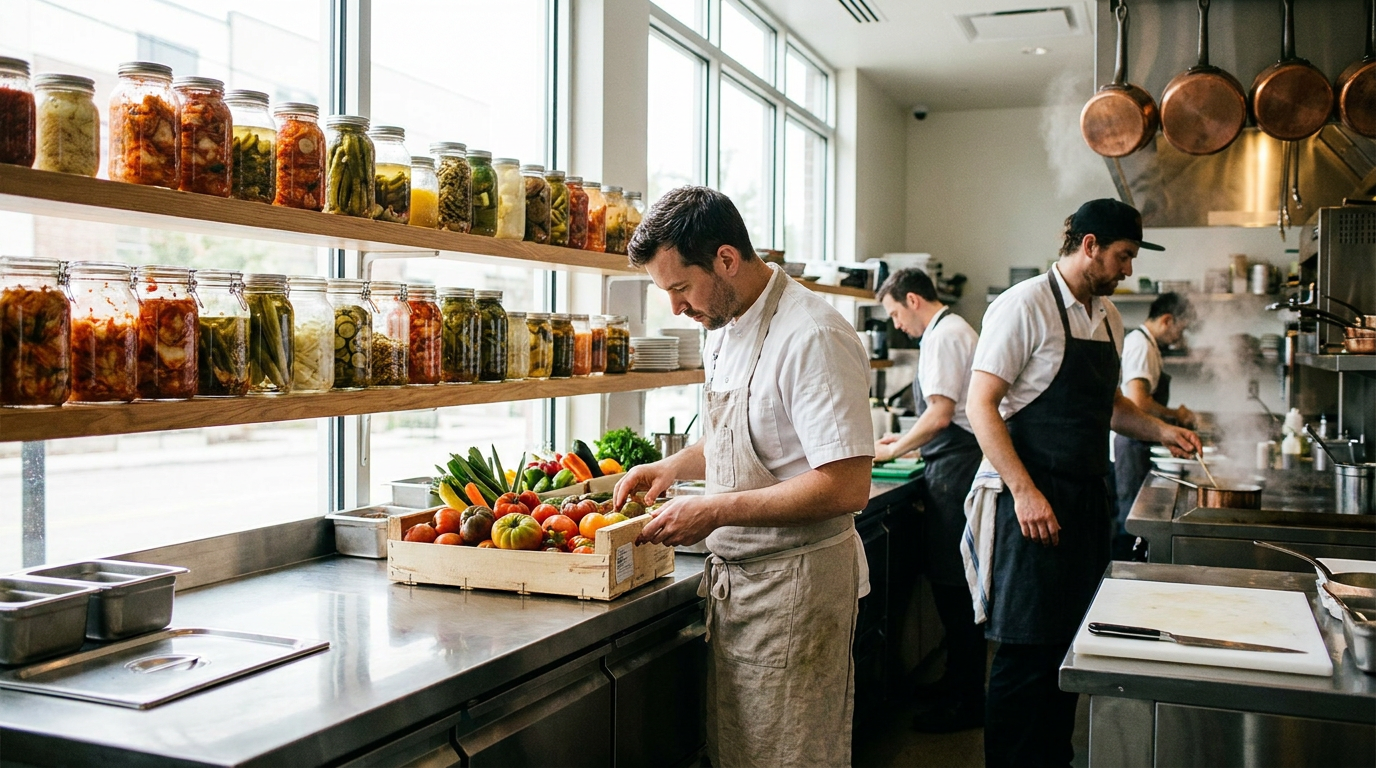
But a growing cohort of chefs and restaurateurs is abandoning the linear model in favor of a "closed-loop" ecosystem. In a closed-loop restaurant, uneaten food is no longer treated as a sunk cost or garbage. Instead, it is a managed input that is redirected into compost, animal feed, or new culinary ingredients.[3][6]
The pioneer of this movement is Silo, a London restaurant that famously operates without a single trash bin. By sourcing ingredients directly from farmers in reusable vessels and upcycling every scrap, Silo proved that a zero-waste commercial kitchen was not only possible, but capable of producing world-class cuisine.[1]
In 2026, the concept has expanded globally, moving from a niche experiment to a refined operational standard. At Baldío in Mexico City, nearly all ingredients are sourced from ancient floating farms called chinampas. The kitchen relies heavily on an in-house fermentation program, transforming vegetable trimmings and excess produce into complex condiments that form the backbone of their ever-changing menu.[1]

The physical technology enabling these closed-loop systems has also matured. Modern zero-waste kitchens are increasingly equipped with fully automatic, in-vessel composting machines. These compact units can process organic waste into nutrient-rich fertilizer in under 24 hours, completely eliminating odors and the need for municipal waste hauling.[3]
That compost is then returned to the very farmers who supply the restaurant, physically closing the agricultural loop. This farm-to-table-to-farm approach regenerates soil health while allowing restaurants to cut their waste disposal costs by up to 60 percent.[3][6]
However, the most effective way to handle food waste is to prevent it from entering the kitchen in the first place. This is where artificial intelligence has become a critical tool for sustainable dining.[4][5]
However, the most effective way to handle food waste is to prevent it from entering the kitchen in the first place.
Platforms like ClearCOGS and Winnow Vision use machine learning to analyze a restaurant's historical sales data, local weather forecasts, and seasonal trends to generate highly precise demand predictions.[4][5]
By telling a kitchen exactly how much of a specific ingredient to prep on a given Tuesday, these AI systems eliminate the overproduction that plagues chain restaurants and fine-dining establishments alike. Early studies show that AI-driven forecasting can reduce a commercial kitchen's food waste by 30 percent within just a few months.[4][5]

The financial incentives are impossible to ignore. Food costs typically represent 30 to 50 percent of a restaurant's total expenditures. When operators manage their organic waste with the same rigorous data analysis applied to labor and rent, they unlock significant margin improvements.[3][4]
Despite these operational leaps, the zero-waste movement faced a sudden public relations hurdle in May 2026. The Michelin Guide abruptly announced the retirement of its "Green Star" award, a distinction introduced in 2020 to recognize restaurants demonstrating outstanding environmental stewardship.[2]
At its peak, over 290 restaurants globally held a Green Star. Michelin inspectors evaluated venues on their sourcing, waste systems, and resource management. But critics argued that culinary inspectors were ill-equipped to audit hard ecological data, leading to concerns that the award occasionally rewarded polished sustainability narratives over actual impact.[2]

Michelin replaced the Green Star with "Mindful Voices," a purely editorial platform that highlights eco-friendly pioneers without bestowing an official accolade. The decision left many sustainable chefs feeling let down, as the Green Star had become a vital marketing tool to attract premium, eco-conscious diners.[2]
Without a globally recognized third-party certification, the burden of proof now falls heavily on the restaurants themselves. Industry analysts expect a rise in self-published sustainability reports and partnerships with dedicated environmental auditors to fill the void left by Michelin.[2][7]
Ultimately, the transition to closed-loop dining is accelerating regardless of accolades. As municipal regulations around organic waste tighten and climate-conscious consumers demand greater transparency, zero-waste practices are shifting from a celebrated luxury to a baseline expectation for the hospitality industry.[6][7]
How we got here
2014
Silo opens in the UK, widely recognized as the world's first zero-waste restaurant.
2020
The Michelin Guide introduces the Green Star to reward restaurants with outstanding sustainability practices.
2024
AI-driven demand forecasting tools begin seeing widespread adoption in commercial kitchens to reduce over-ordering.
May 2026
Michelin abruptly retires the Green Star award, replacing it with an editorial platform and sparking industry debate.
Viewpoints in depth
Zero-Waste Pioneers
Chefs and restaurateurs who view waste elimination as a moral and culinary imperative.
This camp argues that the traditional linear food system is fundamentally broken. By utilizing techniques like fermentation, whole-animal butchery, and on-site composting, they believe restaurants can operate in perfect harmony with their local ecosystems. For these pioneers, zero-waste is not a marketing gimmick but a strict daily discipline that forces greater culinary creativity and respect for the ingredients.
Food Tech Innovators
Software developers and investors focused on operational efficiency and AI forecasting.
Tech-focused stakeholders view food waste primarily as a data and forecasting problem. They argue that while composting is good, preventing overproduction through AI and machine learning is better. By giving kitchens precise predictive analytics, they aim to solve the economic inefficiencies that lead to waste before the food is even ordered, protecting both the planet and the restaurant's profit margins.
Gastronomic Auditors
Guidebook publishers and industry analysts evaluating the validity of sustainability claims.
This group grapples with the difficulty of verifying 'green' claims in the hospitality sector. They note that culinary inspectors are trained to judge flavor and service, not to audit supply chain carbon footprints. The shift away from formal awards like the Michelin Green Star reflects their belief that sustainability is too complex and localized to be graded on a standardized global rubric without rigorous, scientific auditing.
What we don't know
- How diners will verify a restaurant's sustainability claims now that the Michelin Green Star has been retired.
- Whether the high upfront costs of AI forecasting software and in-vessel composters will prevent smaller, independent restaurants from adopting closed-loop systems.
Key terms
- Closed-loop system
- An operational model where all waste is repurposed or recycled back into the supply chain, eliminating the need for landfills.
- Fermentation
- A culinary technique used in zero-waste kitchens to preserve vegetable scraps and off-cuts by converting them into flavorful condiments.
- In-vessel composting
- An enclosed, automated machine that rapidly breaks down organic restaurant waste into fertilizer, often in under 24 hours.
- Predictive analytics
- The use of AI and historical data to forecast exactly how much food a restaurant will sell, preventing overproduction.
Frequently asked
What is a closed-loop restaurant?
It is a dining establishment that aims to send zero waste to landfills. Instead, food scraps are fermented into new ingredients, composted into fertilizer, or repurposed, creating a circular ecosystem.
How does AI help reduce food waste?
AI analyzes historical sales, weather, and local events to predict exactly what customers will order. This allows kitchens to prep only what is needed, reducing overproduction by up to 30 percent.
Why did Michelin get rid of the Green Star?
In May 2026, Michelin retired the Green Star amid concerns that culinary inspectors could not properly audit hard ecological data. It was replaced with an editorial platform called Mindful Voices.
Sources
Source coverage
7 outlets
3 viewpoints surfaced







[1]ForbesZero-Waste Pioneers
Zero-Waste Dining Takes Center Stage
Read on Forbes →[2]JalopnikGastronomic Auditors
Sustainable Restaurants Left in Limbo as Michelin Retires Green Star Award
Read on Jalopnik →[3]Modern Restaurant ManagementZero-Waste Pioneers
Rethinking What “Waste” Means
Read on Modern Restaurant Management →[4]Closed Loop PartnersFood Tech Innovators
Investing in AI to Mitigate Food Waste
Read on Closed Loop Partners →[5]MDPIFood Tech Innovators
AI-Based Technologies for Food Waste Reduction in Restaurant Management
Read on MDPI →[6]EHL InsightsGastronomic Auditors
Strategies to Reduce Food Waste in Restaurants Using the Circular Economy
Read on EHL Insights →[7]Factlen Editorial TeamGastronomic Auditors
Synthesis by Factlen editorial team
Read on Factlen Editorial Team →

Every angle. Every day.
Get lifestyle stories with full source coverage and perspective breakdowns delivered to your inbox.