
The US-Iran Peace Framework: What the Versailles Memorandum Actually Does
President Trump and Iranian President Pezeshkian have signed a 14-point memorandum to halt the 110-day war, reopening the Strait of Hormuz in exchange for a 60-day window to negotiate sanctions relief and nuclear curbs.
By Factlen Editorial Team
- US Administration
- Frames the deal as a definitive victory that halts a costly war and prevents a nuclear-armed Iran.
- Israeli Leadership
- Feels sidelined by a framework that leaves its primary regional adversary intact and vows to maintain military independence.
- Iranian Leadership
- Portrays the memorandum as a successful resistance that forced Washington to grant massive economic concessions.
- Republican Critics
- Views the agreement as a dangerous capitulation that surrenders leverage just as sanctions were crushing Tehran.
What's not represented
- · Lebanese civilians caught in the crossfire
- · European energy importers
- · Commercial maritime shipping companies
Why this matters
This framework pauses a 110-day conflict that choked global energy supplies and drove up inflation. If the 60-day negotiation window succeeds, it could permanently reopen the Strait of Hormuz and reshape Middle Eastern geopolitics; if it fails, the U.S. has threatened to resume direct military strikes.
Key points
- The U.S. and Iran signed a 14-point memorandum of understanding to halt military operations.
- The agreement establishes a 60-day window to negotiate a final deal on nuclear curbs and sanctions relief.
- Iran agreed to down-blend its enriched uranium and reopen the Strait of Hormuz.
- The U.S. pledged to lift its naval blockade and develop a plan for a $300 billion reconstruction fund.
- Israel was not a party to the deal and asserts its right to continue independent military action.
- Hawkish U.S. lawmakers heavily criticized the framework as a massive concession to Tehran.
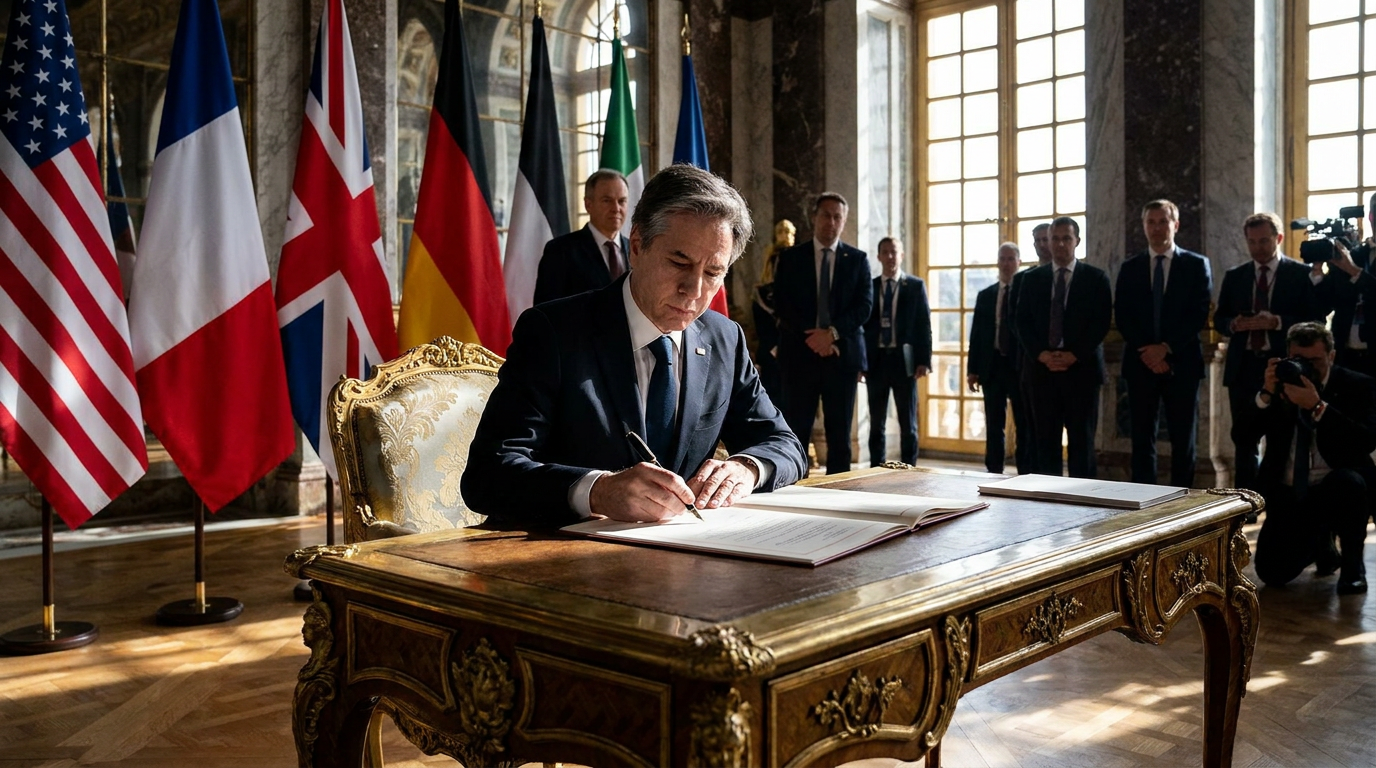
After 110 days of a conflict that choked global energy supplies and threatened to engulf the Middle East, the United States and Iran have agreed to a sudden halt. On Wednesday evening, following the G7 summit, U.S. President Donald Trump signed a 14-point memorandum of understanding (MoU) at the Palace of Versailles in France. The agreement, signed electronically by Iranian President Masoud Pezeshkian, mandates an immediate and permanent termination of military operations on all fronts, including the heavily contested border between Israel and Lebanon.[1][3][5]
The Versailles framework is not a finalized peace treaty, but rather a two-month sprint toward one. It establishes a 60-day window for Washington and Tehran to negotiate a definitive agreement regarding Iran's nuclear program and the lifting of crippling economic sanctions. In the interim, the immediate global crisis—the effective closure of the Strait of Hormuz since late February—is slated to end, allowing the resumption of critical maritime trade.[1][3]
The economic relief was instantaneous. Global markets, which had been battered by the threat of a worldwide depression, rallied on the news. Brent crude oil futures dropped by more than 1 percent to $78.66 a barrel as traders priced in the return of unimpeded shipping through the vital chokepoint. In exchange for Iran guaranteeing free transit through the strait, the United States has pledged to lift its naval blockade against Iranian ports within 30 days.[3]

The core of the nuclear compromise rests on a mechanism known as down-blending. According to the text released by the U.S., Iran has agreed to dilute its stockpile of highly enriched uranium, rendering it unusable for a weapon, and has pledged not to procure or develop nuclear arms. The Trump administration has framed this concession as a major win that erects a definitive wall between Tehran and a nuclear bomb.[2][3]
However, the framework includes significant financial inducements that have sparked immediate domestic backlash. The U.S. committed to developing a mutually agreed plan to provide $300 billion in funds for the reconstruction and development of Iran. This staggering figure, combined with the upfront sanctions relief, has infuriated hawkish members of the president's own party.[2][3]
Senator Bill Cassidy of Louisiana led the conservative revolt, labeling the MoU the worst foreign policy blunder in decades. Cassidy argued that the war had already crushed Iran via sanctions and that the new deal surrenders that leverage while allowing Tehran to build brand-new infrastructure. Before the war, the strait was open, Iran was being crushed by sanctions, and 13 service members were still alive, Cassidy stated. Now, 13 Americans are dead, families have paid billions at the pump, sanctions will be lifted, and the bombing has stopped.[2]

Senator Bill Cassidy of Louisiana led the conservative revolt, labeling the MoU the worst foreign policy blunder in decades.
Critics have also drawn unfavorable comparisons to the 2015 Joint Comprehensive Plan of Action (JCPOA), the Obama-era nuclear deal that Trump famously withdrew from during his first term. Detractors argue the new framework achieves fewer verifiable curbs on Iran's nuclear ambitions while offering substantially more economic relief, effectively rewarding Tehran for weaponizing the global oil supply.[2][5]
The diplomatic fallout extends far beyond Washington. In Israel, the agreement has triggered a profound rift between the Trump administration and Prime Minister Benjamin Netanyahu. Israel was entirely sidelined during the negotiating process, with Netanyahu publicly acknowledging that he had not even seen the details of the framework before it was announced.[4][6][7]
Netanyahu, who has long insisted that preventing a nuclear Iran is his life's mission, pointedly distanced his government from the Versailles document. In a press conference, he emphasized that Israel is not a signatory and will not be bound by its terms. This agreement was made by the United States, Netanyahu said, asserting that Israel retains absolute freedom of action to defend itself against both Iran and its proxy, Hezbollah, in Lebanon.[4]

The friction between the two allies spilled into public view during the G7 press conference. In a remarkable departure from traditional U.S. diplomatic rhetoric, Trump harangued the Israeli leader, claiming that without him there would be no Israel and suggesting Netanyahu needed to be more responsible regarding military operations in Lebanon. Trump also claimed that Israel's recent actions had threatened to jeopardize the delicate negotiations with Tehran.[6]
Conversely, the mood in Tehran and among its allied factions has been triumphant. Iranian state media broadcast images of President Pezeshkian holding the signed document, while the country's chief negotiator, Mohammad Bagher Ghalibaf, characterized the agreement as a record of U.S. failure. Hezbollah's leadership similarly proclaimed the ceasefire a great victory for the so-called Axis of Resistance.[1]
Despite the signatures, the durability of the Versailles framework remains highly uncertain. The 60-day negotiation period is fraught with potential pitfalls, from the complex logistics of verifying uranium down-blending to the domestic political pressures facing both leaders. The U.S. has not yet detailed exactly how the $300 billion reconstruction fund will be financed or administered, a point likely to face fierce opposition in Congress.[2][3][5]

Furthermore, the enforcement mechanism relies heavily on the threat of renewed violence. Trump was blunt about the consequences of Iranian non-compliance, telling reporters that the 60-day timeline was not a hard deadline, but that his patience was conditional. If they don't behave, we'll go right back to dropping bombs right smack in the middle of their head, the president warned.[5]
For now, the global economy breathes a sigh of relief as oil tankers prepare to navigate the Strait of Hormuz without the immediate threat of military strikes. But as the 60-day clock begins ticking, the fundamental contradictions of the conflict—Israel's security imperatives, Iran's regional ambitions, and America's desire to exit a costly war—remain unresolved, merely paused by a signature in a French palace.[1][3][4][6]
How we got here
Late Feb 2026
A U.S. and Israeli military offensive begins, leading to the effective closure of the Strait of Hormuz.
June 15, 2026
Israel escalates strikes in Lebanon, prompting U.S. frustration over the jeopardized peace talks.
June 17, 2026
The U.S. and Iran officially sign the 14-point memorandum of understanding, halting military operations.
Mid-August 2026
The 60-day deadline to finalize a definitive nuclear and sanctions-relief agreement expires.
Viewpoints in depth
The Trump Administration's View
The White House frames the deal as a definitive victory that prevents a nuclear-armed Iran.
U.S. officials argue that the immediate ceasefire and Iran's commitment to down-blend its uranium stockpile achieve the primary goals of the war without further American casualties. They maintain that the 60-day window provides leverage, backed by the explicit threat of resumed bombing if Tehran fails to comply with the framework's terms.
The Israeli Government's View
Israel feels sidelined by a deal that leaves its primary regional adversary intact.
Israeli leadership emphasizes that they are not a party to the Versailles memorandum and will not be bound by its restrictions. Officials argue the framework fails to dismantle Iran's nuclear infrastructure permanently and rewards aggression with sanctions relief, insisting Israel retains the right to strike Iranian or Hezbollah targets to ensure its own survival.
Congressional Republican Critics
Hawkish U.S. lawmakers view the agreement as a dangerous capitulation.
Critics within the president's own party argue that the U.S. surrendered its maximum-pressure leverage just as sanctions were crushing the Iranian economy. They point to the proposed $300 billion reconstruction fund and the lifting of the naval blockade as massive concessions that will allow Tehran to rebuild its military capabilities and infrastructure.
The Iranian Leadership's View
Tehran portrays the memorandum as a successful resistance against American and Israeli military pressure.
Iranian officials and allied proxy groups like Hezbollah have declared the ceasefire a strategic victory. They highlight the immediate economic relief, the unblocking of their ports, and the massive proposed reconstruction funds as evidence that their strategy of threatening the Strait of Hormuz successfully forced Washington to the negotiating table.
What we don't know
- How the proposed $300 billion reconstruction fund will be financed or administered.
- Whether Israel will launch independent military strikes during the 60-day negotiation window.
- The exact verification mechanisms that will be used to ensure Iran is down-blending its uranium.
Key terms
- Memorandum of Understanding (MoU)
- A formal agreement between two or more parties that outlines the terms and details of a mutual understanding, often serving as a framework for a future, legally binding treaty.
- Down-blending
- The process of mixing highly enriched uranium with lower-grade material to reduce its concentration, rendering it unusable for nuclear weapons.
- Strait of Hormuz
- A narrow, strategically vital waterway between the Persian Gulf and the Gulf of Oman through which a significant portion of the world's oil supply passes.
- Joint Comprehensive Plan of Action (JCPOA)
- The 2015 nuclear agreement between Iran and world powers, which the U.S. withdrew from in 2018, that limited Iran's nuclear program in exchange for sanctions relief.
Frequently asked
Is the war between the U.S. and Iran permanently over?
The current agreement is a ceasefire and a framework, not a final peace treaty. Both sides have 60 days to negotiate a definitive deal, and the U.S. has threatened to resume military strikes if talks fail.
What happens to Iran's nuclear weapons program?
Under the memorandum, Iran has pledged not to procure or develop nuclear weapons and agreed to dilute its existing stockpile of highly enriched uranium.
How does this deal affect global gas prices?
The agreement reopens the Strait of Hormuz, allowing oil tankers to resume normal transit. Global oil prices immediately dropped by over 1 percent following the announcement.
Did Israel agree to this ceasefire?
No. Israel was not a signatory to the U.S.-Iran agreement, and Prime Minister Benjamin Netanyahu stated that Israel will not be bound by its terms and retains the right to defend itself.
Sources
Source coverage
7 outlets
4 viewpoints surfaced







[1]The GuardianUS Administration
Trump signs agreement with Iran at Versailles
Read on The Guardian →[2]Al JazeeraRepublican Critics
Louisiana Senator Bill Cassidy blasts US-Iran MoU as 'worst foreign policy blunder in decades'
Read on Al Jazeera →[3]The HinduIranian Leadership
Text of U.S.-Iran memorandum of understanding released by U.S.
Read on The Hindu →[4]Times of IsraelIsraeli Leadership
Netanyahu avoids criticizing US-Iran deal, claims war's main goals have been achieved
Read on Times of Israel →[5]CBS NewsUS Administration
U.S., Iran remotely sign memorandum of understanding, White House official says
Read on CBS News →[6]Washington PostIsraeli Leadership
Trump goes after Netanyahu as he pursues deal with Iran, putting their friendship to the test
Read on Washington Post →[7]AxiosIsraeli Leadership
Netanyahu fumes, allies rage over Trump's Iran deal
Read on Axios →

Every angle. Every day.
Get news politics stories with full source coverage and perspective breakdowns delivered to your inbox.