
Meta Quest 3 vs. Apple Vision Pro: The 2026 Spatial Computing Buyer's Guide
A comprehensive side-by-side analysis of the $499 Meta Quest 3 and the $3,499 Apple Vision Pro, comparing their displays, ecosystems, and ideal use cases.
By Factlen Editorial Team
- VR Gaming Enthusiasts
- Prioritize tactile controllers, game libraries, and untethered movement.
- Spatial Computing Professionals
- Prioritize text clarity, ecosystem integration, and seamless UI.
- Enterprise Fleet Managers
- Prioritize cost-efficiency, scalability, and robust device management.
What's not represented
- · Educators deploying headsets in K-12 classrooms on tight public budgets.
- · Independent VR developers struggling to optimize software for two radically different input paradigms.
Why this matters
Choosing the right mixed reality headset dictates whether you are buying into a dedicated gaming console or a high-end spatial computer. With a $3,000 price gap between the market leaders, understanding the trade-offs in display fidelity, input methods, and software ecosystems is essential to avoid a costly mismatch for your specific needs.
Key points
- The Meta Quest 3 is a $499 standalone VR headset optimized for interactive gaming and untethered movement.
- The Apple Vision Pro is a $3,499 spatial computer designed for high-end productivity, media consumption, and seamless Apple ecosystem integration.
- Apple's Micro-OLED displays offer 23 million pixels for unparalleled text clarity, while Meta utilizes 9-million-pixel LCD pancake lenses.
- The Quest 3 relies on tactile Touch Plus controllers for precise input, whereas the Vision Pro uses controller-free eye and hand tracking.
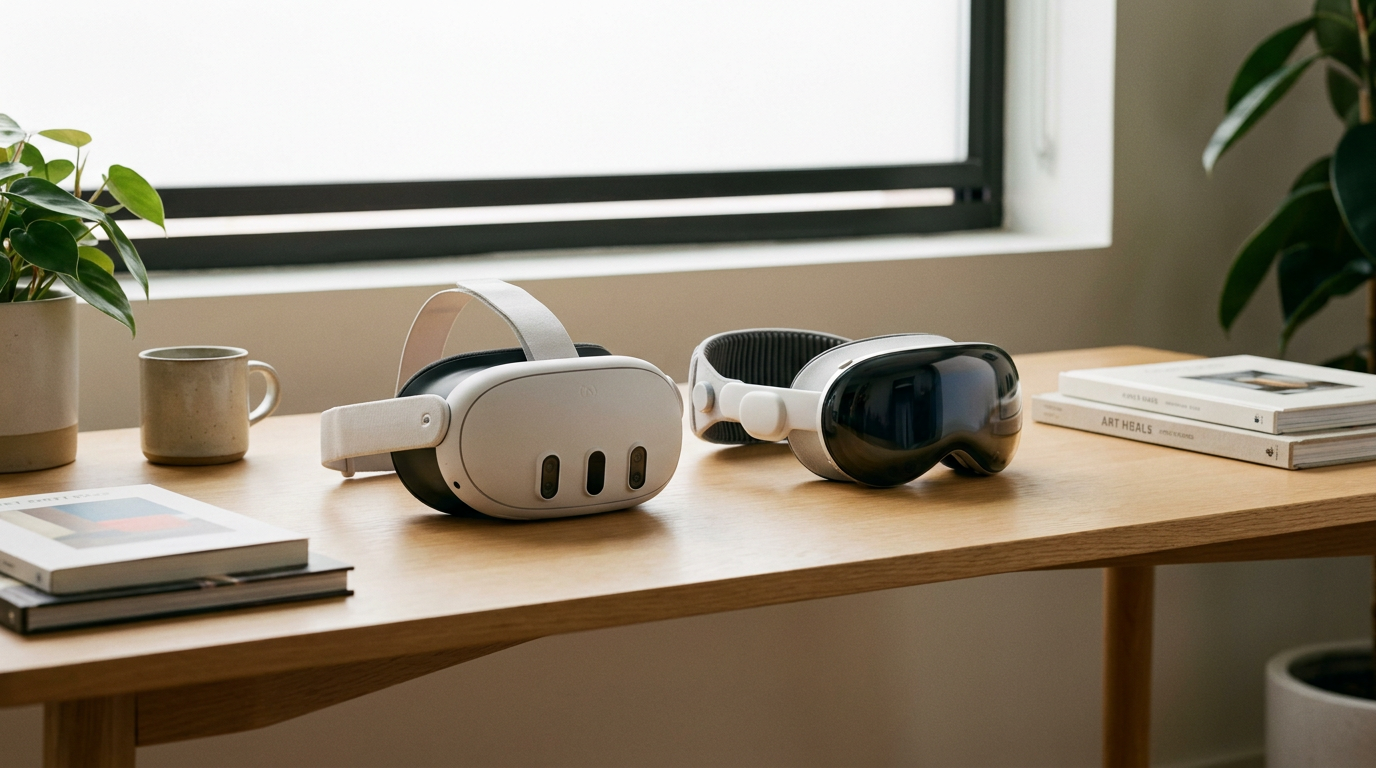
The extended reality market has settled into a fascinating duopoly. On one side sits the Meta Quest 3, a $499 device that dominates the consumer virtual reality space. On the other side is the Apple Vision Pro, a $3,499 technological marvel that Apple insists is not a VR headset, but a "spatial computer." Both devices overlay digital content onto the real world, but they sit at opposite ends of the market.[1][3]
The price gap between these two devices is the defining characteristic of the market. You can purchase seven Meta Quest 3 headsets for the price of a single Apple Vision Pro. This is not merely a brand premium; it reflects two fundamentally different philosophies regarding what face-worn computers should do, who they are for, and what hardware is required to achieve those goals.[2][7]
When evaluating the Apple Vision Pro, the argument for the device centers on its unparalleled visual fidelity and seamless integration into the Apple ecosystem. The evidence lies in its dual Micro-OLED displays, which pack 23 million pixels—roughly 3660 by 3200 pixels per eye. This resolution surpasses standard 4K, eliminating the "screen door effect" and making small text perfectly legible. Against the Vision Pro, however, is its restrictive cost, heavy 650-gram weight, and reliance on a tethered external battery pack that limits physical mobility.[4][6][8]
Conversely, the argument for the Meta Quest 3 is its unmatched value, vast content library, and untethered freedom. The evidence is its $499 starting price, an internal battery that provides two to three hours of truly wireless use, and a lightweight 515-gram all-in-one design. Against the Quest 3 is its lower-tier visual hardware; it utilizes LCD pancake lenses with roughly 9 million pixels (2064 by 2208 per eye). While excellent for the price, it cannot match Apple's crispness for high-end productivity tasks.[2][4][6]

The philosophical divide extends to how users interact with the digital world. The Vision Pro relies entirely on eye and hand tracking. Cameras monitor where you look, and a subtle pinch of your fingers acts as a mouse click. This controller-free approach feels magical and intuitive for navigating menus, browsing the web, and resizing spatial windows. However, it lacks the tactile feedback required for fast-paced, precision-based applications.[7][8]
The Quest 3 takes the opposite approach, shipping with two Touch Plus controllers. These controllers provide haptic feedback, physical buttons, and precise spatial tracking. For gaming, fitness applications, and complex 3D modeling, physical controllers remain vastly superior to hand tracking. While the Quest 3 does support hand tracking, it is not the primary input method, reflecting Meta's focus on interactive, physical experiences.[1][7]
Passthrough technology—the ability to see the real world through the headset's cameras—is a critical battleground. The Vision Pro's passthrough is currently the industry standard, utilizing its high-resolution cameras to render the physical room with minimal warping and accurate depth. It seamlessly blends digital objects into your physical space, complete with accurate shadows and occlusion.[5][6]
Passthrough technology—the ability to see the real world through the headset's cameras—is a critical battleground.
The Quest 3 also features full-color passthrough, a massive upgrade from its predecessor's grainy black-and-white cameras. However, the Quest's passthrough exhibits noticeable warping around moving objects and struggles in low-light conditions. It is highly functional for avoiding furniture or grabbing a drink, but it does not create the illusion of looking through clear glass that Apple strives for.[4][8]

Software ecosystems dictate what these devices can actually do. Meta has spent years cultivating a dedicated VR gaming ecosystem. The Quest platform boasts thousands of native titles, ranging from immersive shooters to fitness apps, and supports wireless PC VR streaming via Air Link. If interactive entertainment is the goal, the Quest 3 wins by default.[1][7]
Apple's visionOS, by contrast, is built for spatial media and productivity. It natively runs hundreds of thousands of iPad apps, integrates flawlessly with MacBooks to create massive virtual displays, and supports high-bitrate spatial video. However, its dedicated gaming library is sparse, and the lack of controllers means it will likely never support traditional VR gaming ports.[4][5][8]
Comfort and ergonomics present another stark contrast. The Quest 3 utilizes a plastic body and a fabric strap, keeping the weight relatively low and balanced. It is designed for movement, allowing users to play active games without the headset shifting excessively. It also accommodates standard prescription glasses directly inside the facial interface.[2][3][6]
The Vision Pro's premium build materials—aluminum and laminated glass—make it undeniably beautiful but noticeably front-heavy. Users often report fatigue during long sessions, despite the soft knit headband. Furthermore, the Vision Pro cannot accommodate glasses; users must purchase custom magnetic Zeiss optical inserts, adding to the total cost.[2][8]

In the enterprise sector, the trade-offs become a matter of scale versus capability. The argument for deploying the Vision Pro in business is its ability to handle high-end design, architectural visualization, and executive-level virtual collaboration. The evidence is its seamless integration with enterprise Apple device management and its unparalleled visual clarity. Against it is the $3,499 unit cost, which makes fleet deployment prohibitively expensive for most departments.[5]
The argument for the Quest 3 in enterprise is its scalability. The evidence shows that companies can deploy fleets of Quest 3s for warehouse training, safety simulations, and virtual onboarding at a fraction of the cost. Against the Quest 3 in the boardroom is its less professional aesthetic and Meta's historically consumer-focused software ecosystem, though Meta has made strides with its Quest for Business platform.[5]
Audio capabilities also diverge. The Quest 3 features significantly improved built-in speakers over previous generations, delivering loud, clear spatial audio without covering the ears. It also lacks a 3.5mm headphone jack, relying on USB-C or Bluetooth. The Vision Pro integrates dual-driver audio pods into the headband, delivering what reviewers consistently describe as the best spatial audio experience on any consumer device, perfectly anchoring sound to virtual objects in the room.[2][4]

Ultimately, the decision comes down to matching the hardware to the specific use case. The Meta Quest 3 fits well when the user prioritizes interactive gaming, physical fitness applications, untethered movement, and maximizing value. It is the definitive choice for anyone looking to experience the breadth of modern virtual reality without a massive financial commitment. It does not fit when the primary goal is reading fine text for eight hours a day or replacing a high-end multi-monitor workstation.[1][7][8]
The Apple Vision Pro fits well when the user is deeply entrenched in the Apple ecosystem, demands the absolute highest visual fidelity available, and intends to use the device primarily for spatial computing, media consumption, and stationary productivity. It does not fit when the user wants to play fast-paced VR games, requires a highly active physical experience, or is constrained by a standard consumer electronics budget.[1][7][8]
How we got here
June 2023
Meta officially announces the Quest 3, and Apple unveils the Vision Pro just days later.
October 2023
The Meta Quest 3 launches globally at a starting price of $499.
February 2024
The Apple Vision Pro officially releases in the United States for $3,499.
Mid-2024
Apple expands Vision Pro availability to international markets while Meta continues to update visionOS competitors.
Early 2026
Both platforms mature with expanded app ecosystems, solidifying their distinct roles in gaming and enterprise.
Viewpoints in depth
VR Gaming Enthusiasts
Users focused on immersive interactive entertainment and expansive game libraries.
For the gaming community, the priority is tactile feedback, low latency, and a deep library of native titles. This camp heavily favors the Meta Quest 3, citing its included Touch Plus controllers as essential for precise aiming and physical movement in virtual spaces. They argue that Apple's controller-free, eye-and-hand tracking approach—while magical for UI navigation—fails to provide the haptic feedback required for fast-paced gaming. Furthermore, Meta's years of cultivating a dedicated VR gaming ecosystem means the Quest platform has thousands of titles ready to play, whereas visionOS relies mostly on flat iPad ports and a handful of spatial experiences.
Spatial Computing Professionals
Power users and creatives who view headsets as the next evolution of the multi-monitor workstation.
Productivity-focused users view the headset not as a toy, but as a high-end spatial computer. This camp champions the Apple Vision Pro, pointing to its M2 and R1 silicon and 23-million-pixel Micro-OLED displays as non-negotiable requirements for reading crisp text and manipulating high-resolution 3D models. They argue that the $3,499 price tag is justified when the device replaces a multi-monitor Mac setup and a home theater system simultaneously. For these users, the Quest 3's lower-resolution LCD screens and slight passthrough warping cause eye strain during long work sessions, making it unsuitable for professional enterprise use.
Enterprise Fleet Managers
Corporate IT buyers deploying headsets at scale for employee training and collaboration.
Organizations looking to deploy mixed reality across hundreds of employees prioritize total cost of ownership, durability, and device management. This camp leans toward the Meta Quest 3 (and its cheaper 3S variant) because a company can outfit seven employees for the price of a single Vision Pro. They value the Quest's all-in-one design with no dangling battery cables, which reduces tripping hazards during physical training simulations. While they acknowledge Apple's superior visual fidelity, they argue that 4K LCD screens are more than sufficient for warehouse simulations, safety training, and virtual onboarding.
What we don't know
- Whether Apple will release a more affordable, non-Pro version of the Vision headset to compete directly with Meta's pricing.
- How quickly developers will build native, controller-free spatial applications for visionOS compared to traditional VR games.
- If Meta will eventually pivot toward eye-tracking as a primary input method in future mainstream consumer headsets.
Key terms
- Passthrough
- A feature that uses exterior cameras to display the real world inside the headset, allowing users to see their surroundings while wearing the device.
- Micro-OLED
- An advanced display technology used in the Vision Pro that packs millions of pixels into a tiny screen, offering higher contrast and deeper blacks than standard LCDs.
- Pancake Lenses
- A type of optical lens used in modern headsets that folds light multiple times, allowing the headset to be significantly thinner and lighter than older models.
- Spatial Computing
- Apple's preferred term for mixed reality, emphasizing the use of the physical environment as a canvas for digital applications and productivity tools.
- Field of View (FOV)
- The extent of the observable world that is seen at any given moment through the headset, measured in degrees.
Frequently asked
Can I play standard VR games on the Apple Vision Pro?
While the Vision Pro supports some spatial games and flat iPad games, it lacks dedicated VR controllers and does not natively support the vast library of SteamVR or Meta Quest games. It is primarily designed for spatial media and productivity.
Do I need a PC to use either headset?
No, both the Meta Quest 3 and Apple Vision Pro are standalone devices with their own onboard processors. However, the Quest 3 can connect to a PC for high-end gaming, and the Vision Pro can mirror a Mac display.
Which headset is better for watching movies?
The Apple Vision Pro offers a vastly superior movie-watching experience due to its Micro-OLED displays, which provide true blacks and higher resolution, alongside excellent spatial audio.
Can I wear glasses with these headsets?
The Meta Quest 3 accommodates most standard prescription glasses directly inside the headset. The Apple Vision Pro does not fit glasses; users must purchase custom Zeiss optical inserts that attach magnetically to the lenses.
Sources
Source coverage
8 outlets
3 viewpoints surfaced






[1]Reality AtlasVR Gaming Enthusiasts
Meta Quest 3 and Apple Vision Pro compared — gaming vs spatial computing
Read on Reality Atlas →[2]Laptop MagSpatial Computing Professionals
Meta Quest 3 vs Apple Vision Pro: Specs
Read on Laptop Mag →[3]VR CompareEnterprise Fleet Managers
Meta Quest 3 vs Apple Vision Pro (Comparison)
Read on VR Compare →[4]Pocket-lintSpatial Computing Professionals
Meta Quest 3 vs Apple Vision Pro
Read on Pocket-lint →[5]AutoVRseEnterprise Fleet Managers
Meta Quest 3 vs. Apple Vision Pro for Enterprise
Read on AutoVRse →[6]VR WaveEnterprise Fleet Managers
Meta Quest 3 vs Apple Vision Pro
Read on VR Wave →[7]VR.orgVR Gaming Enthusiasts
Meta Quest 3 vs Apple Vision Pro compared
Read on VR.org →[8]Mark Ellis ReviewsSpatial Computing Professionals
Apple Vision Pro vs Meta Quest 3: Which one should you buy?
Read on Mark Ellis Reviews →
Every angle. Every day.
Get meta stories with full source coverage and perspective breakdowns delivered to your inbox.