
Fed Holds Rates Steady as Warsh's Debut Signals Hawkish Shift on Inflation
In his first meeting as Federal Reserve Chairman, Kevin Warsh held interest rates steady but shocked markets by signaling potential rate hikes before the end of 2026.
By Factlen Editorial Team
- Hawkish Policymakers
- Prioritize taming the 4.2% inflation spike and preventing energy costs from broadening into the core economy, even if it requires rate hikes.
- Market Participants
- Adjusting portfolios for a 'higher for longer' reality, selling off equities and buying U.S. dollars as bond yields rise.
- Global Central Banks
- Caught in the crossfire of a surging U.S. dollar, facing intense pressure to intervene in currency markets to protect domestic exchange rates.
What's not represented
- · Borrowers and Homebuyers
- · Emerging Market Economies
Why this matters
The Federal Reserve's pivot away from rate cuts means borrowing costs for mortgages, auto loans, and credit cards will remain elevated for the foreseeable future. The resulting surge in the U.S. dollar is also exporting inflation globally, putting immense pressure on foreign currencies like the Japanese Yen.
Key points
- The Federal Reserve held interest rates steady at 3.5% to 3.75% in Kevin Warsh's first meeting as chairman.
- Nine of 19 Fed officials now project at least one interest rate hike before the end of 2026.
- The hawkish pivot is driven by a resurgence in inflation, which hit 4.2% in May due to an energy shock.
- Warsh gutted the traditional policy statement, removing forward guidance and the central bank's previous easing bias.
- The prospect of higher U.S. rates sent the dollar surging, pushing the Japanese yen past 160 and into intervention territory.
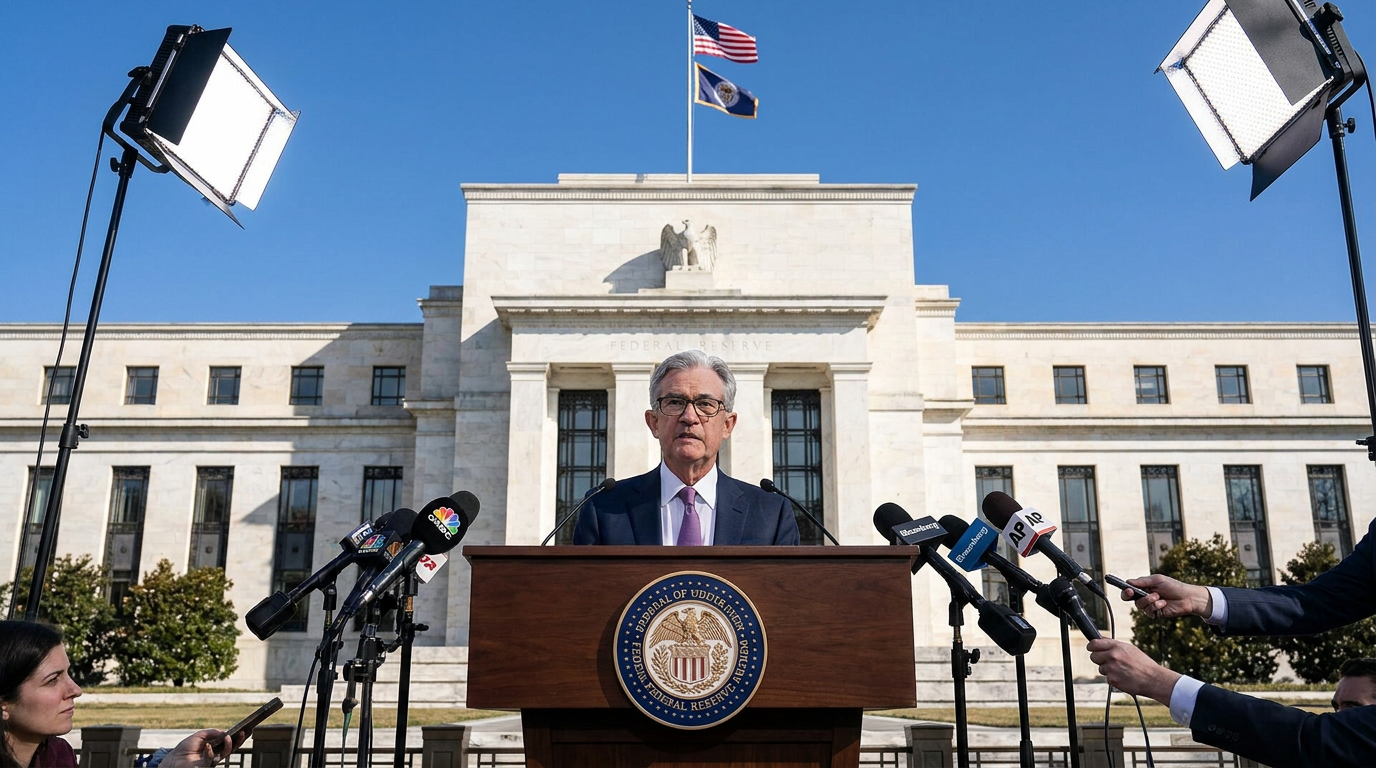
The Federal Reserve has officially entered the Kevin Warsh era, and the new chairman’s debut delivered a hawkish shock to global financial markets. Concluding his first Federal Open Market Committee (FOMC) meeting on Wednesday, Warsh and the central bank voted unanimously to hold the benchmark federal funds rate steady at a target range of 3.5% to 3.75%. While the headline rate decision was entirely expected by economists and traders, the surprise came from the central bank’s updated economic projections. In a sharp reversal from just three months ago, nine of the 19 Fed officials now project at least one interest rate hike before the end of 2026.[4][5][7]
This hawkish shift marks a dramatic U-turn for an institution that had previously penciled in rate cuts for this year. The pivot is being driven by a sudden resurgence in consumer prices, with headline inflation spiking to 4.2% in May—the highest level the United States has seen since April 2023. The primary culprit for this inflationary flare-up is the recent energy shock triggered by the U.S.-Iran conflict. Although an interim ceasefire agreement has recently sent oil prices tumbling to a three-month low, the preceding months of elevated energy costs have already begun to bleed into the broader economy, raising the cost of freight, manufacturing, and travel.[4][5][8]
During his inaugural press conference, Warsh addressed this dynamic directly, establishing a distinctly different tone from his predecessor, Jerome Powell. Warsh acknowledged that the Federal Reserve’s monetary policy cannot control the price of a barrel of oil or a dozen eggs. However, he emphasized that the central bank’s mandate is to ensure those isolated price spikes do not broaden into systemic inflation. "It’s to make sure that those changes in oil or beef or eggs or milk don't broaden in the economy, don't have second and third effects," Warsh told reporters, pledging to deliver on price stability.[4][5]

Reflecting this deep concern over second-order effects, the FOMC significantly upgraded its year-end inflation forecast. The committee now expects the Personal Consumption Expenditures (PCE) index—the Fed’s preferred inflation gauge—to end 2026 at an annualized 3.6%. This is a steep increase from the 2.7% it projected back in March. Even excluding volatile food and energy prices, core inflation is expected to remain uncomfortably high, prompting former Fed officials and current analysts to warn that the central bank may be forced to act aggressively by the fall if the data does not cool.[1][4][7]
Beyond the hawkish policy tilt, Wednesday’s meeting showcased Warsh’s intent to radically overhaul how the Federal Reserve communicates with the public and financial markets. The traditional FOMC policy statement was gutted, stripped of its usual forward guidance and the so-called "easing bias" that had previously hinted at future rate cuts. Warsh described the new, significantly shorter statement as a return to "just the facts," dispensing with older language that he believes boxes the central bank into predetermined paths and creates unnecessary market volatility when economic conditions change.[2][4][9]
The traditional FOMC policy statement was gutted, stripped of its usual forward guidance and the so-called "easing bias" that had previously hinted at future rate cuts.
To institutionalize these changes, Warsh announced the creation of five new task forces designed to review the Fed’s broader conduct of monetary policy. These groups will assess the central bank's public communications, its handling of inflation data, the management of its balance sheet, and the future of the "dot plot"—the closely watched matrix of individual policymakers' rate projections. Warsh confirmed he was the sole board member who did not contribute a projection to Wednesday's dot plot, signaling his deep skepticism of the tool's utility.[2][5]

Financial markets, which had spent the early part of the week rallying on hopes of a lasting Middle East peace agreement, reacted violently to the prospect of higher borrowing costs. The Dow Jones Industrial Average plunged 500 points immediately following the release of the new projections, while the broader S&P 500 and the tech-heavy Nasdaq Composite both shed roughly 1 percent in afternoon trading. The bond market rapidly repriced the U.S. rates outlook, sending Treasury yields surging as institutional traders abandoned their bets on a near-term easing cycle.[4][5][8]
This surge in bond yields immediately supercharged the U.S. dollar, which climbed to a two-month high against a basket of global currencies. Because capital flows toward higher returns, the prospect of sustained, elevated interest rates in the United States acts as a magnet for global investment. While a strong dollar helps insulate American consumers from the rising cost of imported goods, it effectively exports inflation to the rest of the world by making dollar-denominated commodities like oil more expensive for foreign buyers.[9][10]
The most severe collateral damage from the Fed’s hawkish shift is currently unfolding in Japan, where policymakers are struggling to defend their currency. Following the FOMC announcement, the Japanese yen weakened past 160 per dollar, plunging back into what currency traders widely consider to be "intervention territory." The Bank of Japan recently raised its own interest rates to a 31-year high of 1.00% in a landmark attempt to normalize monetary policy and protect its domestic economy from the war-induced energy shock.[3][9][10]
However, the sheer size of the interest rate differential between the U.S. and Japan means the yen remains highly vulnerable. With U.S. rates sitting securely above 3.5% and Japanese rates at just 1.00%, the math heavily favors the dollar. This dynamic places immense pressure on the Japanese Ministry of Finance to intervene directly in currency markets to artificially prop up the yen—a costly maneuver that analysts warn is often just a temporary containment exercise if U.S. rates remain elevated.[3][9][10]

Domestically, Warsh’s hawkish debut puts him on a collision course with the White House. President Donald Trump, who appointed Warsh to succeed Powell, has publicly and repeatedly demanded lower borrowing costs to spur economic growth. While Warsh declined to comment on his relationship with the administration during the press conference, his willingness to entertain rate hikes in an election year underscores his commitment to central bank independence and his reputation as a monetary hawk.[4][5][8]
The coming months will serve as a critical test for the global economy. Policymakers and investors alike are waiting to see whether the interim peace deal in the Middle East can cool energy prices fast enough to drag headline inflation back down. If the energy shock subsides and productivity gains from the ongoing artificial intelligence boom materialize, the Fed may yet avoid a December rate hike. For now, however, Kevin Warsh has successfully convinced global markets that the Federal Reserve is willing to inflict economic pain to restore price stability.[1][4][8]
How we got here
December 2025
The Federal Reserve issues its last interest rate cut, bringing the federal funds rate to 3.5%–3.75%.
March 2026
Fed officials release projections indicating they expect at least one rate cut by the end of the year.
May 2026
U.S. inflation spikes to a three-year high of 4.2%, driven by an energy shock from the Middle East.
June 17, 2026
Kevin Warsh holds his first FOMC meeting as Chair, holding rates steady but signaling a potential hike.
Viewpoints in depth
The Hawkish Consensus
Federal Reserve officials and inflation hawks argue that the energy shock cannot be ignored.
Policymakers emphasize that while the central bank cannot control the geopolitical events driving up oil prices, it must prevent those costs from permanently embedding themselves in the broader economy. By signaling a willingness to hike rates, hawks aim to anchor inflation expectations and prevent a 1970s-style wage-price spiral, even if it means sacrificing near-term economic growth.
The Market Reality
Investors and traders are rapidly repricing the cost of capital.
Wall Street had spent months positioning for a gradual easing cycle, making the Fed's hawkish U-turn a severe shock to portfolios. The realization that the 'easing bias' is dead has triggered a sell-off in equities and a surge in Treasury yields, as institutional investors adjust to a 'higher for longer' reality that fundamentally alters corporate valuations and borrowing costs.
The Global Contagion
Foreign central banks are bearing the brunt of the Fed's domestic policy.
A hawkish Federal Reserve acts as a vacuum for global capital, supercharging the U.S. dollar at the expense of foreign currencies. For countries like Japan, this dynamic imports inflation by making dollar-denominated commodities vastly more expensive. Foreign central banks are now caught in a dilemma: either hike their own rates to defend their currencies and risk recession, or burn through foreign reserves in costly market interventions.
What we don't know
- Whether the interim U.S.-Iran peace deal will hold long enough to meaningfully drag down global energy prices.
- How the five newly announced task forces will ultimately change the Fed's communication strategy and the future of the dot plot.
- If the Bank of Japan will actually intervene in currency markets to defend the yen at the 160 level.
Key terms
- Federal funds rate
- The target interest rate set by the Fed at which commercial banks borrow and lend their excess reserves to each other overnight.
- Easing bias
- Language in a central bank's policy statement indicating that its next move is more likely to be an interest rate cut rather than a hike.
- Dot plot
- A visual representation of the interest rate projections of the 19 members of the Federal Open Market Committee.
- Currency intervention
- When a country's central bank or finance ministry buys or sells its own currency in the foreign exchange market to influence its value.
Frequently asked
Did the Federal Reserve raise interest rates today?
No, the Fed held the benchmark federal funds rate steady at a range of 3.5% to 3.75%. However, officials signaled that a rate hike could happen later in 2026.
Why is inflation rising again?
Inflation spiked to 4.2% in May primarily due to an energy shock caused by the U.S.-Iran conflict, which drove up the cost of oil and gas.
What is the 'dot plot'?
The dot plot is a chart published by the Federal Reserve showing where each individual policymaker expects interest rates to be in the future.
Why is the Japanese Yen losing value?
The Yen is weakening because U.S. interest rates are significantly higher than Japan's rates, making the U.S. dollar a more attractive and higher-yielding investment.
Sources
Source coverage
10 outlets
3 viewpoints surfaced









[1]BloombergMarket Participants
Kaplan: Fed Should Act by Fall If Inflation Persists
Read on Bloomberg →[2]NYTMarket Participants
Warsh Makes His Case With Jargon, and a Penchant for Detail
Read on NYT →Asia Strategists Eye Yen Intervention, Tech Stocks Post-Warsh
Read on Bloomberg →[4]CBS NewsHawkish Policymakers
Federal Reserve Chairman Kevin Warsh will hold his first press conference
Read on CBS News →[5]The GuardianHawkish Policymakers
Open markets committee says 'economic activity is expanding at a solid pace' in first meeting under new chair Kevin Warsh
Read on The Guardian →[6]KiplingerMarket Participants
The June Fed meeting was Kevin Warsh's first as chair
Read on Kiplinger →[7]BNN BloombergHawkish Policymakers
U.S. Federal Reserve holds interest rates steady
Read on BNN Bloomberg →[8]ForbesMarket Participants
Kevin Warsh's first meeting as Federal Reserve chair
Read on Forbes →[9]Forex.comGlobal Central Banks
The bigger story may be the yen
Read on Forex.com →[10]INGGlobal Central Banks
ING's expectations for the Federal Reserve's central projections
Read on ING →

More in business
See all 5 stories →Biotech Funding
Heart Health Biotech Kardigan Raises $400 Million in Upsized IPO as Sector Rebounds
6 sources
Global Energy
US-Iran Interim Deal Takes Effect, Reopening Strait of Hormuz and Driving Down Global Oil Prices
7 sources

Cardiovascular Tech
Heart Health Biotech Kardigan Raises $400 Million in Upsized IPO
7 sources

Every angle. Every day.
Get business stories with full source coverage and perspective breakdowns delivered to your inbox.