
How Flag Football Will Work at the 2028 LA Olympics: Rules, Format, and Strategy
Flag football makes its Olympic debut in Los Angeles in 2028. Here is a complete breakdown of the 5-on-5 format, the 'no-run zones,' and why the non-contact sport is poised for a global breakout.
By Factlen Editorial Team
- Traditional Flag Specialists
- Argue that the unique 5-on-5 mechanics and lateral agility requirements give dedicated flag players an edge over traditional tackle athletes.
- NFL Talent Advocates
- Believe that the overwhelming physical advantages of elite NFL superstars will easily translate to dominance in the Olympic format.
- Global Growth Proponents
- Focus on the sport's low barrier to entry, viewing the Olympics as a catalyst to make American football a truly accessible worldwide game.
What's not represented
- · Amateur flag football leagues currently operating without NFL funding
- · Defensive specialists adapting to the non-contact rules
Why this matters
Flag football's Olympic debut represents a massive shift in how American football is played and exported globally. By removing the physical and financial barriers of the tackle game, the 5-on-5 format is poised to introduce a safer, highly accessible version of the sport to millions of new athletes worldwide.
Key points
- Flag football will make its Olympic debut at the 2028 Los Angeles Games.
- The sport will be played in a 5-on-5 format on a condensed 70-yard field.
- There is no kicking; drives start at the 5-yard line with four downs to reach midfield.
- Quarterbacks have a strict seven-second clock to release a forward pass.
- The event will be hosted at BMO Stadium, fitting LA28's 'no-build' sustainability mandate.
- Both men's and women's tournaments will run concurrently to promote global gender equity.
When the Olympic flame arrives in Los Angeles in 2028, the Games will look fundamentally different than previous iterations. Operating under a strict "radical reuse" and "no-build" mandate, organizers are relying entirely on existing infrastructure to host the world's largest sporting event. But the innovation extends beyond the venues. The Los Angeles Organizing Committee successfully lobbied the International Olympic Committee to introduce sports that reflect American athletic culture while offering a low barrier to global entry. Chief among these additions is flag football, a non-contact, high-octane variant of American football that is poised to become the breakout spectacle of the 2028 Summer Games.[1][2][4][6][8]
The inclusion of flag football—alongside T20 cricket, six-a-side lacrosse, baseball, and squash—marks a deliberate pivot by the IOC toward faster, more youth-oriented formats. While traditional tackle football requires expensive protective equipment, specialized stadiums, and a massive roster, flag football strips the gridiron game down to its most kinetic elements. It is a sport defined by speed, lateral agility, and precision passing, removing the violent collisions that have historically limited American football's global growth.[1][2][3]
At the Olympic level, the sport will be played in a strict 5-on-5 format. Unlike the 11-on-11 tackle game, there are no offensive or defensive linemen anchoring the line of scrimmage. Instead, the field is populated entirely by skill-position players: a quarterback, receivers, and defensive backs. Teams will carry a total roster of 12 players, allowing for dedicated offensive and defensive units that substitute seamlessly between possessions.[1][2][3][7]
The playing surface is significantly condensed to encourage a blistering pace of play. The Olympic standard field measures 50 yards in length from goal line to goal line, flanked by two 10-yard end zones, bringing the total length to 70 yards. The width is set between 25 and 30 yards, roughly half the width of a traditional NFL field. This compact arena forces rapid decision-making and leaves defenders with less ground to cover, but also less sideline to use as an extra defender.[2][3][7]

Matches are structured as a sprint, consisting of two 20-minute halves. The game clock runs continuously for the majority of the contest, stopping only for timeouts and during the critical two-minute warning at the end of each half. During those final two minutes, the clock stops for incomplete passes, out-of-bounds plays, and scoring events, mimicking the dramatic clock-management scenarios familiar to traditional football fans. If the score is tied at the end of regulation, the game proceeds to a sudden-death overtime where the first team to score immediately secures the victory.[2][3][7]
The flow of possession completely eliminates the kicking game. There are no kickoffs, punts, or field goals. Every offensive drive automatically begins at the team's own 5-yard line. From there, the offense is granted four attempts—known as downs—to advance the ball across midfield. If they successfully cross the midfield line, the downs reset, giving them four more attempts to reach the end zone and score a touchdown.[2][3][7]
Failure to reach midfield, or failure to score after crossing it, results in a turnover on downs. Because there is no punting to flip field position, a failed fourth-down conversion simply hands the ball to the opposing team, who will then start their ensuing drive at their own 5-yard line, regardless of where the previous play ended. This rule heavily incentivizes aggressive play-calling on fourth down, as there is no territorial penalty for failing to convert.[2][7]
Failure to reach midfield, or failure to score after crossing it, results in a turnover on downs.
Perhaps the most fascinating tactical wrinkle in the Olympic format is the implementation of "No-Run Zones". These are designated areas located five yards before the midfield line and five yards before the end zone. When an offense snaps the ball from within these zones, they are strictly prohibited from executing a running play. The quarterback must attempt a forward pass to advance the ball. This rule was designed to prevent larger, more physical teams from simply using brute force to plunge forward for short yardage, ensuring that the game relies on passing mechanics and route-running execution near the goal line.[3][7]
The quarterback operates under a strict set of constraints designed to keep the game moving. Once the ball is snapped, the quarterback has exactly seven seconds to release a forward pass. If the ball is still in their hands when the seven-second clock expires, the play is blown dead, resulting in a loss of down. Furthermore, the quarterback is generally forbidden from running the ball past the line of scrimmage themselves, forcing them to distribute the ball to their playmakers rather than relying on their own rushing ability.[3][7]

Scoring mirrors the traditional game, with a few key modifications. A touchdown is worth six points. Following a touchdown, the scoring team must choose between two conversion options, as kicking an extra point is not allowed. They can attempt a single play from the 5-yard line for one extra point, or they can attempt a play from the 10-yard line for two extra points. In these conversion scenarios, standard offensive rules apply, meaning teams can run or pass, provided they are not restricted by a No-Run Zone.[2][3][7]
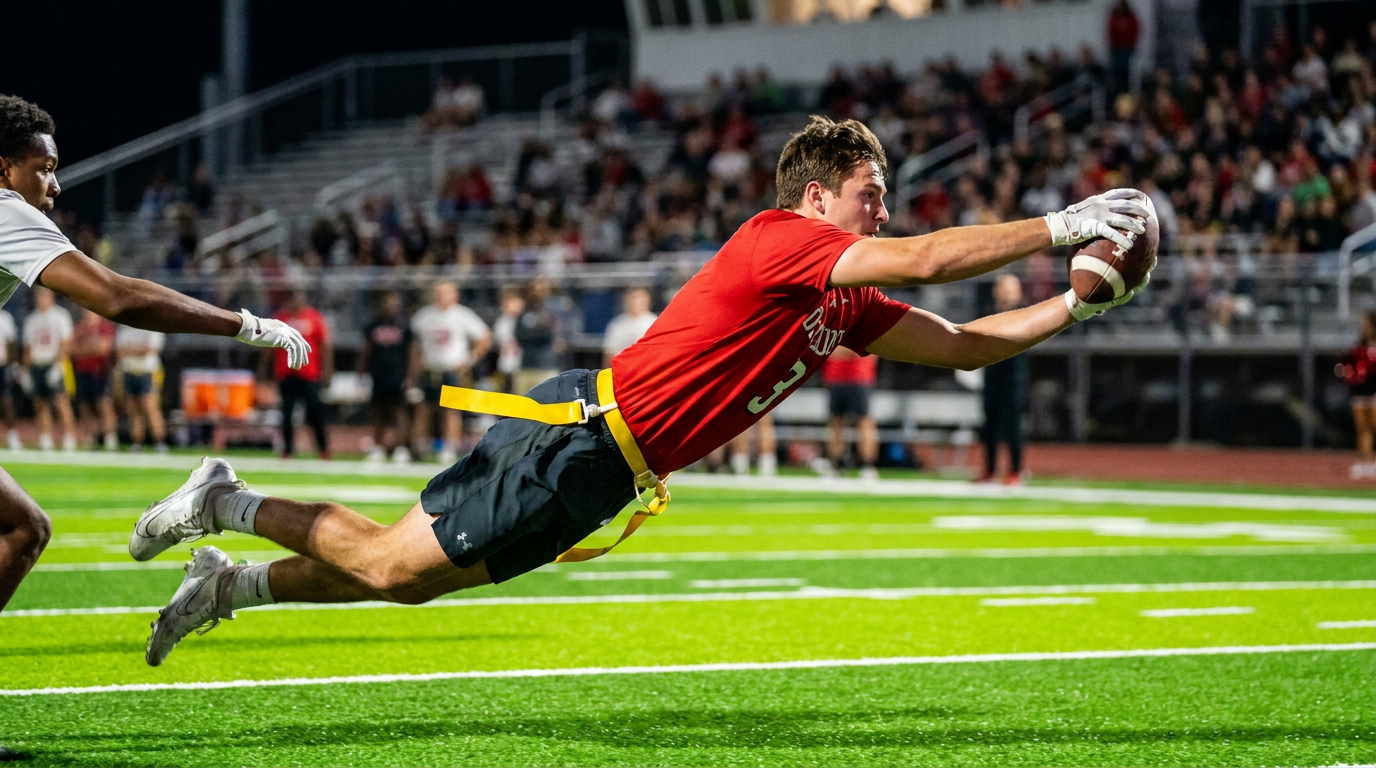
On the defensive side of the ball, the mechanics of stopping a play require immense precision. Instead of tackling the ball carrier to the ground, defenders must remove one of the three vinyl flags attached to the offensive player's waist belt. This requires defenders to track the ball carrier's hips rather than their shoulders, prioritizing agility and hand-eye coordination over sheer mass. The moment a flag is detached, the play is immediately blown dead at that spot.[2][3]
The venue for this inaugural tournament perfectly aligns with Los Angeles's sustainable hosting strategy. Flag football events are slated to take place at BMO Stadium, the 22,000-seat home of Major League Soccer's LAFC. Because the sport requires a smaller footprint than traditional football, the soccer pitch can easily accommodate the flag football dimensions without requiring any permanent structural modifications to the stadium.[1][4][5]

The IOC's embrace of flag football is largely driven by the sport's explosive international growth. Because it requires minimal equipment—essentially just a ball, cleats, and a set of flags—it has become highly accessible in countries without a deep-rooted American football infrastructure. The International Federation of American Football (IFAF) currently oversees leagues in over 100 countries, and the Olympic tournament will reflect this global footprint by featuring both men's and women's competitions running concurrently.[1][3]
As the 2028 Games approach, the most heavily debated topic is roster composition. The NFL has aggressively championed flag football's Olympic inclusion and has signaled a willingness to allow its active superstars to participate. The prospect of elite quarterbacks and wide receivers donning Team USA jerseys is a massive commercial draw. However, international flag football specialists argue that the 5-on-5 game requires highly specific lateral movements and route-timing that do not perfectly translate from the 11-on-11 tackle game, setting the stage for a fascinating clash of athletic disciplines.[7][8]
Ultimately, flag football's debut in Los Angeles represents a rare opportunity to introduce a genuinely new athletic paradigm to the Olympic stage. By stripping away the armor and the collisions, the sport highlights the pure geometry of the gridiron—speed, space, and strategy. If the 2028 tournament delivers the high-scoring, fast-paced spectacle organizers anticipate, flag football could easily secure its place as a permanent fixture in the Summer Games for decades to come.[1][8]
How we got here
July 2017
Los Angeles officially secures the rights to host the 2028 Summer Olympics, promising a sustainable 'no-build' approach.
October 2023
The International Olympic Committee officially approves the addition of flag football to the LA 2028 program.
February 2026
Organizers confirm BMO Stadium as the official venue for both the men's and women's flag football tournaments.
Summer 2028
Flag football will make its official Olympic debut with men's and women's national teams competing for gold.
Viewpoints in depth
Traditional Flag Specialists
Dedicated flag football athletes believe their specialized skill sets will outmatch transitioning tackle football stars.
While the public clamors for NFL superstars to join Team USA, veteran flag football players argue that the 5-on-5 game is a fundamentally different sport. Without offensive linemen to create pockets or the threat of a power running game, flag football relies entirely on lightning-fast processing, lateral agility, and highly specific route combinations. Specialists argue that NFL players, who are accustomed to breaking tackles and using their mass to gain extra yardage, will struggle to adapt to a format where a simple pull of a vinyl flag instantly ends the play.
NFL Talent Advocates
Proponents of NFL inclusion argue that world-class athleticism will ultimately dictate the Olympic podium.
Conversely, many sports analysts and fans believe that the sheer athletic disparity between NFL superstars and amateur flag players will be insurmountable. Advocates argue that the processing speed, arm talent, and explosive acceleration of elite NFL quarterbacks and wide receivers will easily translate to the condensed 50-yard field. From this perspective, the Olympic tournament represents an opportunity for the NFL's brightest stars to showcase their dominance on a global stage, overwhelming opponents with physical traits that cannot be replicated outside the professional tackle ranks.
Global Growth Proponents
International organizers view flag football as the key to exporting American football worldwide.
For the International Olympic Committee and global sports federations, the debate over NFL participation is secondary to the sport's accessibility. Tackle football has historically struggled to gain a global foothold due to the prohibitive costs of helmets and pads, as well as growing concerns over concussions. Flag football removes both the financial and physical barriers to entry. Proponents view the LA 2028 tournament as a massive marketing catalyst that will inspire youth leagues across Europe, Africa, and Asia, transforming a uniquely American pastime into a truly international pursuit.
What we don't know
- Whether active NFL superstars will ultimately be cleared by their teams to participate in the 2028 Games.
- The exact qualification pathway and number of participating nations for the final Olympic tournament.
- How traditional tackle football strategies will evolve when adapted to the strict 5-on-5, no-contact Olympic format.
Key terms
- No-Run Zone
- A designated 5-yard area before midfield and the goal line where the offensive team must attempt a forward pass.
- Down
- A single play or attempt by the offensive team to advance the ball; teams receive four downs to cross midfield and four more to score.
- Sudden-Death Overtime
- A tie-breaking format used at the end of regulation where the first team to score any points immediately wins the match.
- Line to Gain
- The midfield line, which the offense must successfully cross within four downs to earn a fresh set of downs.
Frequently asked
Will NFL players compete in the 2028 Olympics?
The NFL has expressed strong support for allowing its players to participate, though final roster decisions, insurance logistics, and qualification formats are still being finalized.
How long is an Olympic flag football game?
Games consist of two 20-minute halves. The clock runs continuously until the two-minute warning of each half, at which point it stops for incomplete passes and out-of-bounds plays.
Are there kickoffs or punts in flag football?
No. There is no kicking game in the Olympic format. Every offensive drive automatically begins at the team's own 5-yard line.
What is a No-Run Zone?
It is a 5-yard restricted area before midfield and the end zone where the offense is strictly prohibited from running the ball and must attempt a forward pass.
Sources
Source coverage
8 outlets
3 viewpoints surfaced






[1]Olympics.comGlobal Growth Proponents
Introducing the new Olympic sports for Los Angeles 2028
Read on Olympics.com →[2]Squire Patton BoggsGlobal Growth Proponents
Flying the Flag for Football at LA 2028 – A Review of the Latest Sport To Be Added
Read on Squire Patton Boggs →[3]Big League ShirtsGlobal Growth Proponents
Who Is Playing Flag Football in the Olympics?
Read on Big League Shirts →[4]Alta Journal
The Olympic Gold Won't Go to L.A.
Read on Alta Journal →[5]Slowtwitch News
Triathlon Events Moved to Venice Beach for 2028 Olympic Games
Read on Slowtwitch News →[6]Grokipedia
2028 Summer Olympics
Read on Grokipedia →[7]ESPNNFL Talent Advocates
Olympics Flag Football Odds LA 2028: Favorites, Rules, & AI's Team USA Roster Prediction
Read on ESPN →[8]Factlen Editorial TeamTraditional Flag Specialists
Synthesis by Factlen editorial team
Read on Factlen Editorial Team →
More in sports
See all 14 stories →Standings
Snooker's New Era: Judd Trump Clings to World No. 1 as Chinese Prodigies Surge
7 sources
Transfer Market
Liverpool Hijacks Newcastle to Sign Spain Winger Víctor Muñoz for €40 Million
6 sources

Injury
PDC Injury Report: Van Gerwen Undergoes Surgery as Price and Smith Battle Lingering Health Issues
8 sources
Standings
Race to Blackpool: Veterans and Rising Stars Clash as World Matchplay Cut-Off Looms
6 sources

Every angle. Every day.
Get sports stories with full source coverage and perspective breakdowns delivered to your inbox.