
The Rise of Local AI: How to Run Powerful LLMs on Your Own PC
Advancements in model compression and open-source software have made it possible to run frontier-level AI models entirely on consumer hardware, offering unprecedented privacy and zero API costs.
By Factlen Editorial Team
- Privacy & Open-Source Advocates
- Champions of local AI view it as a necessary defense against centralized corporate control.
- Enterprise IT Leaders
- Corporate technology leaders view local AI as a solution to skyrocketing API costs and compliance risks.
- Hardware Enthusiasts & Developers
- The technical community focuses on the engineering challenges of compressing massive models into consumer hardware.
What's not represented
- · Hardware Manufacturers
- · Cybersecurity Researchers
Why this matters
Running AI locally gives you complete ownership of your data, eliminates monthly subscription fees, and allows you to use powerful language models entirely offline. It represents a major shift in digital power from centralized cloud providers back to individual users.
Key points
- In 2026, 55% of enterprise AI inference has moved on-premises, up from 12% in 2023.
- Techniques like quantization compress massive AI models so they can run smoothly on standard laptops and PCs.
- Local AI guarantees complete data privacy, as prompts and documents never leave the user's device.
- Tools like Ollama and LM Studio have eliminated command-line friction, making setup a five-minute process.
The era of renting artificial intelligence by the query is facing a quiet rebellion. For years, the default assumption was that the most capable AI models lived exclusively behind proprietary walls, accessible only through a cloud API and a recurring monthly subscription.[7]
But in 2026, the center of gravity is shifting from massive server farms to the laptop sitting on your desk. Driven by breakthroughs in model compression and a surge of highly capable open-source releases, running Large Language Models (LLMs) locally has transformed from a niche developer hobby into a mainstream productivity strategy.[7]
The numbers reflect a structural industry shift. According to recent industry data, 55% of enterprise AI inference now happens on-premises, a massive leap from just 12% in 2023. Organizations and individuals alike are realizing that they no longer need to send their private data to a third-party server to get frontier-level AI assistance.[1][3]

To understand how this is possible, you have to look at the mechanism of "quantization." AI models are essentially massive collections of numbers, or "weights," which dictate how the model predicts the next word. Historically, these weights were stored in high-precision formats that required hundreds of gigabytes of memory.[5]
Quantization compresses these numbers—often down to 4-bit precision—sacrificing a microscopic amount of accuracy to drastically shrink the model's footprint. Formats like GGUF have become the industry standard, allowing a model that once required a massive server to run smoothly on a standard consumer MacBook or a PC with a mid-range graphics card.[5]
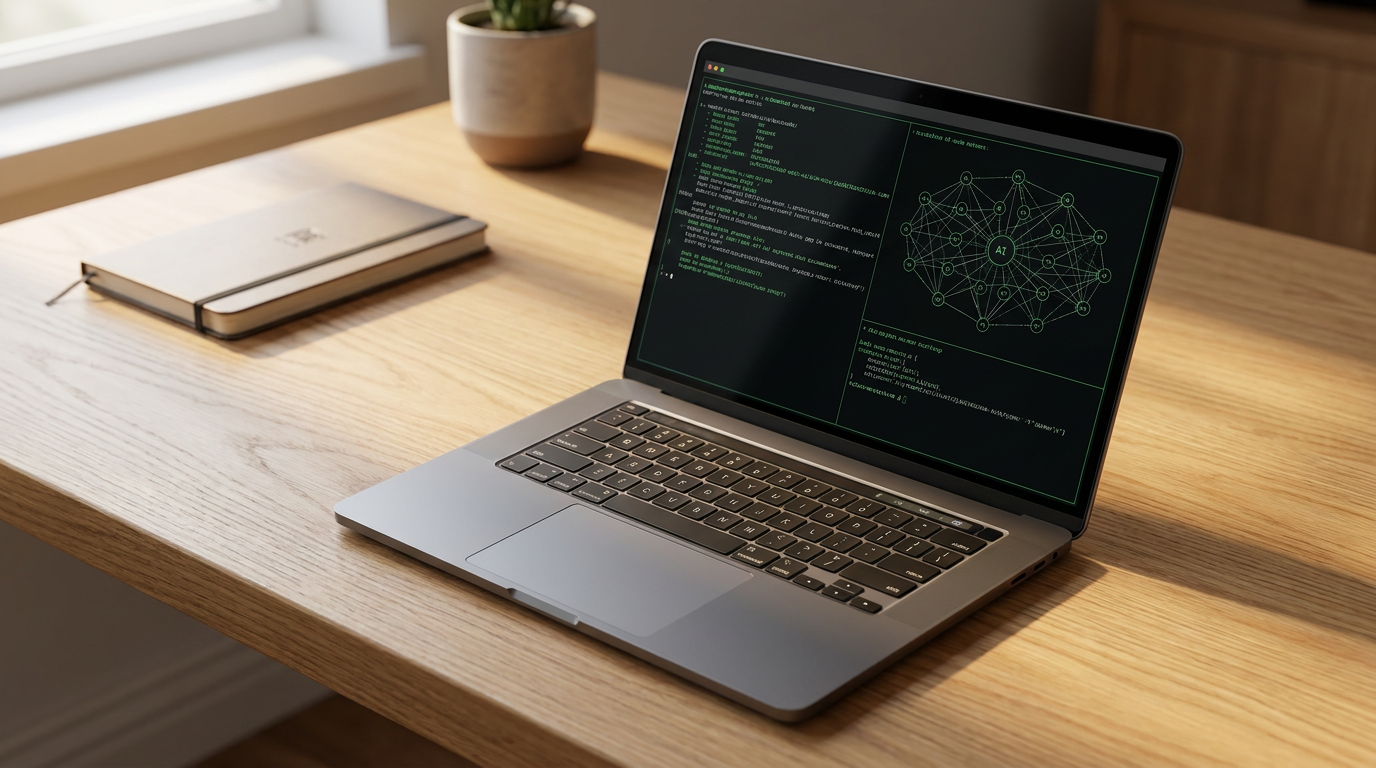
The software ecosystem has also eliminated the command-line friction that previously kept everyday users away. Tools like Ollama and LM Studio act as simple desktop applications. Users can download the software, select a model from a visual menu, and have a fully private, ChatGPT-style interface running in under five minutes.[1][6]
"You can run an LLM locally on your own machine right now—no API keys, no monthly bill, no data leaving your hardware," notes technical analysis from Techsy. These tools also expose local APIs, meaning developers can plug their local models directly into coding environments, writing assistants, and automation scripts without changing their workflow.[1]
"You can run an LLM locally on your own machine right now—no API keys, no monthly bill, no data leaving your hardware," notes technical analysis from Techsy.
The models themselves have crossed a critical threshold of competence. In 2026, the open-weight ecosystem is dominated by highly efficient architectures, particularly Mixture of Experts (MoE) models. Instead of activating the entire neural network for every query, MoE models route the prompt to specialized sub-networks, saving massive amounts of computational power.[2]

Google's Gemma 4, for instance, offers a 12-billion parameter model that runs comfortably in 16GB of RAM, while Meta's Llama 4 and DeepSeek's V4 series provide reasoning capabilities that rival the best cloud models from just a year ago. These are not toys; they are production-grade tools capable of complex coding, drafting, and analysis.[2][6]
The primary driver for this local migration is data sovereignty. When a user queries a cloud-based LLM, that data traverses external networks and is governed by third-party privacy policies. For developers feeding proprietary code into an AI, or professionals analyzing sensitive financial documents, that data exposure is a non-starter.[3]
Local LLMs change the equation entirely. "No API calls going out to a third-party cloud, no data leaving the organization's network, moreover no vendor deciding what the model can or can't say," IBM researchers note regarding the enterprise shift. The user owns the system prompt, the guardrails, and the outputs.[3]
Speed and reliability offer another compelling advantage. Cloud APIs are subject to network latency, rate limits, and peak-hour throttling. A well-configured local setup bypasses the network entirely, often delivering sub-40-millisecond first-token latency. For latency-sensitive applications like voice interfaces or real-time coding copilots, this local execution is vastly superior.[1][4]

However, the local AI movement is not without its physical constraints and trade-offs. The ultimate bottleneck remains Video RAM (VRAM). While a standard laptop can run smaller 8-billion parameter models, running the massive 70-billion+ parameter models required for deep, multi-step reasoning still demands expensive, high-end GPUs.[5]
Furthermore, local inference drains battery life rapidly on mobile devices and laptops, as the processor works at maximum capacity to generate tokens. There is also the maintenance burden: users are responsible for updating their own models, managing storage space (as models can be tens of gigabytes each), and securing their local endpoints.[1][5]
Because of these hardware limits, the industry is settling into a "hybrid" paradigm rather than a total cloud exodus. Routine, privacy-sensitive, and high-volume tasks—like summarizing local documents, basic code completion, and drafting emails—are routed to the local LLM running on the user's machine.[1]

Meanwhile, the most complex, compute-heavy queries that require frontier-level reasoning are selectively pushed to cloud APIs. This hybrid routing gives users the privacy and zero-cost baseline of local AI for 80% of their workload, while keeping the heavy artillery of cloud models in reserve for when it is genuinely needed.[1][7]
Ultimately, the democratization of AI execution represents a profound shift in digital power. By packaging immense computational intelligence into downloadable files that run on consumer hardware, the open-source community has ensured that the future of AI will not be entirely centralized in a handful of corporate data centers.[2][7]
How we got here
2023
Local LLM inference is a niche hobby, with only 12% of enterprise AI running on-premises.
Early 2024
The GGUF format and tools like Ollama launch, simplifying the installation of local models.
January 2025
DeepSeek R1 proves that highly capable open-weight models can match proprietary cloud performance.
Mid 2026
Over 55% of enterprise AI inference moves on-premises, driven by efficient MoE models like Gemma 4 and Llama 4.
Viewpoints in depth
Privacy & Open-Source Advocates
Champions of local AI view it as a necessary defense against centralized corporate control.
For this camp, the shift to local LLMs is fundamentally about digital rights. They argue that relying on cloud APIs forces users to surrender their data, code, and creative output to third-party servers, where it may be used for future model training. By running open-weight models locally, advocates ensure that AI remains a tool for individual empowerment rather than a surveillance mechanism. They also value the uncensored nature of local models, which allow researchers and developers to bypass the restrictive guardrails often imposed by commercial vendors.
Enterprise IT Leaders
Corporate technology leaders view local AI as a solution to skyrocketing API costs and compliance risks.
In the enterprise sector, the enthusiasm for local LLMs is driven by the bottom line and legal liability. IT leaders point out that high-volume AI usage via cloud APIs can result in unpredictable, massive monthly bills. Furthermore, feeding sensitive customer data or proprietary company code into a public cloud model often violates strict data governance and GDPR compliance rules. By moving inference on-premises, companies lock in their hardware costs upfront and completely eliminate the risk of external data leaks, making AI deployment viable for highly regulated industries.
Hardware Enthusiasts & Developers
The technical community focuses on the engineering challenges of compressing massive models into consumer hardware.
This group is less concerned with ideology and more focused on optimization. They are the driving force behind techniques like quantization and the GGUF format, constantly experimenting to see how much intelligence can be squeezed into 16GB of RAM. They acknowledge the real physical bottlenecks—specifically the high cost of Video RAM (VRAM)—and actively benchmark different models to find the perfect balance between speed, memory usage, and accuracy. For them, the local AI movement is an ongoing engineering puzzle to maximize efficiency.
What we don't know
- Whether future frontier models will become so massive that local hardware can no longer keep up with the compression techniques.
- How major operating system developers will fully integrate these open-source local models into their base platforms long-term.
Key terms
- Quantization
- A compression technique that reduces the precision of an AI model's internal numbers, making the file size small enough to run on consumer hardware.
- VRAM (Video RAM)
- The dedicated memory on a graphics card (GPU), which is the most critical hardware component for running AI models quickly.
- GGUF
- A popular file format designed specifically for running quantized AI models efficiently on standard consumer computers.
- MoE (Mixture of Experts)
- An AI architecture that divides a model into specialized sub-networks, activating only the relevant parts for a query to save computational power.
- Parameter
- The internal variables or 'weights' that an AI model uses to make predictions; higher parameter counts generally mean a smarter but more hardware-intensive model.
Frequently asked
Can I run ChatGPT locally on my computer?
No. ChatGPT is a proprietary cloud service. However, you can run highly capable open-source models like Meta's Llama 4 or Google's Gemma 4 locally, which offer similar conversational and coding capabilities.
Do I need an internet connection to use a local LLM?
You only need the internet to initially download the model and the software (like Ollama). Once downloaded, the AI runs 100% offline.
Will running an AI model damage my laptop?
No, but it is computationally intensive. It will cause your CPU or GPU to run at maximum capacity, which will spin up your fans, generate heat, and drain your battery much faster.
Is it free to run these models?
Yes. The software tools and the open-weight models themselves are free to download and use. Your only cost is the electricity and the hardware you already own.
Sources
Source coverage
7 outlets
3 viewpoints surfaced






[1]Techsy.ioEnterprise IT Leaders
Run LLMs Locally 2026: The 5-Minute Setup for Any GPU
Read on Techsy.io →[2]NeuralWiredPrivacy & Open-Source Advocates
Open Source AI Models 2026: The Definitive Ranked List
Read on NeuralWired →[3]IBMEnterprise IT Leaders
Organizations running their AI ecosystem on local LLMs
Read on IBM →[4]RunAnywhere.aiEnterprise IT Leaders
Best AI Platforms for Local LLMs in 2026
Read on RunAnywhere.ai →[5]Stormap.aiHardware Enthusiasts & Developers
Open-Source LLM Comparison 2026
Read on Stormap.ai →[6]Pinggy.ioHardware Enthusiasts & Developers
Top 5 Local LLM Tools in 2026
Read on Pinggy.io →[7]Factlen Editorial TeamPrivacy & Open-Source Advocates
Synthesis by Factlen editorial team
Read on Factlen Editorial Team →

Every angle. Every day.
Get ai stories with full source coverage and perspective breakdowns delivered to your inbox.