
Vast Secures $500 Million as Commercial Space Stations Prepare to Replace the ISS
With the International Space Station set to retire in 2030, a $500 million funding round and a successful in-orbit technology demonstration have positioned Vast Space to launch the world's first commercial space station.
By Factlen Editorial Team
- Commercial Space Developers
- Private industry can build and iterate orbital habitats faster and more cost-effectively than traditional government programs.
- Space Agencies
- Commercial stations are essential to maintaining a low-Earth orbit presence while freeing up government budgets for deep-space exploration.
- Industry Analysts
- Cautiously optimistic about technical milestones, but skeptical about the long-term financial sustainability of the non-government market.
What's not represented
- · International partners reliant on the ISS who lack domestic commercial space programs
- · Scientific researchers concerned about the cost of access to private microgravity labs
Why this matters
The transition from the government-run International Space Station to private orbital outposts will dictate the future of human spaceflight and microgravity research. If successful, it will drastically lower the cost of accessing space, opening low-Earth orbit to new industries, medical breakthroughs, and international partnerships.
Key points
- Vast Space raised $500 million in April 2026 to accelerate the production of its commercial space stations.
- The company successfully deorbited its 'Haven Demo' testbed after completing 49 in-orbit test objectives.
- Haven-1, targeted for a 2027 launch, will be the world's first commercial space station.
- The station will host up to four astronauts and operate on a 'Lab-as-a-Service' business model.
- The European Space Agency has already contracted payload space aboard Haven-1.
- Next-generation super heavy-lift rockets will be required to launch larger successor stations.
For nearly a quarter of a century, the International Space Station (ISS) has served as humanity's permanent foothold in the cosmos. But the sprawling, football-field-sized laboratory is aging, and NASA, alongside its international partners, plans to safely deorbit the facility by 2030.[4]
The looming retirement of the ISS has sparked a quiet but high-stakes race in low-Earth orbit. To prevent a "space gap" where the United States and its allies lose their orbital presence, a new generation of commercial space stations is rapidly moving from the drawing board to the launch pad.[3][4]
Leading the charge is Vast Space, a California-based aerospace startup that has emerged as a formidable frontrunner. In April 2026, the company secured a massive $500 million funding round to accelerate the production of its orbital habitats.[1]
The fresh capital injection, led by Balerion Space Ventures with participation from international heavyweights like the Qatar Investment Authority, underscores a major shift. The private sector is no longer just providing the rockets; it is now financing and building the destinations.[1]

Vast's progress is not merely theoretical. In early 2026, the company successfully completed the controlled deorbit of "Haven Demo," an in-orbit testbed that launched late last year to prove out the company's core engineering.[2]
Over a three-month mission, the Haven Demo spacecraft completed 49 distinct test objectives. It validated critical systems under real orbital conditions, including guidance, navigation, propulsion, and onboard power generation—proving that the company's technology works in the harsh environment of space.[2]
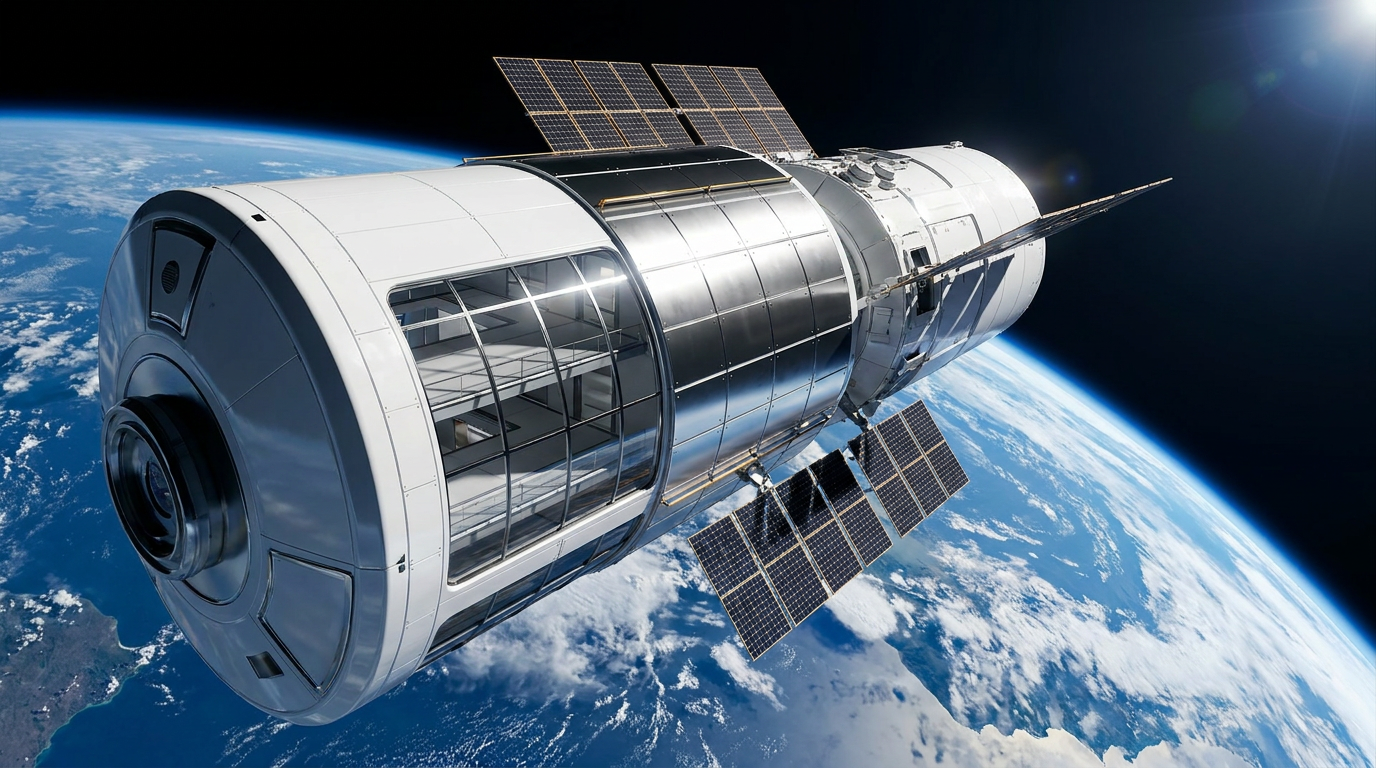
This successful demonstration paves the way for Haven-1, which Vast aims to launch in 2027. Designed to be the world's first fully commercial space station, Haven-1 is a single-module outpost weighing approximately 14 tonnes.[1][3]
This successful demonstration paves the way for Haven-1, which Vast aims to launch in 2027.
Haven-1 will launch aboard a SpaceX Falcon 9 rocket and is designed to host up to four astronauts for short-duration missions of around two weeks. It features a dedicated science laboratory and a 1.1-meter domed window, offering crews a sweeping 180-degree view of Earth.[3][5]

The business model for these new outposts represents a radical departure from the ISS era. Rather than relying entirely on government funding, commercial stations operate on a "Lab-as-a-Service" model, leasing space and astronaut time to a variety of clients.[5]
This approach is already attracting international customers. At the 41st Space Symposium in April 2026, Vast announced that the European Space Agency (ESA) had contracted payload space aboard Haven-1 through a partnership with the microgravity research firm Yuri.[5]
While Haven-1 will serve as a crucial bridge, the ultimate goal is to build facilities capable of fully replacing the ISS. Vast's proposed successor, Haven-2, envisions a much larger, modular architecture designed to support a continuous human presence throughout the 2030s.[1][3]
Constructing these massive next-generation stations will require a revolution in space transportation. The successful test flight of SpaceX's Starship V3 in May 2026 provided a glimpse of that future, demonstrating the super heavy-lift capability necessary to loft massive station modules into orbit efficiently.[6]

Vast is not alone in this endeavor. NASA's Commercial LEO Destinations (CLD) program is fostering a competitive ecosystem, supporting rival concepts like Blue Origin's Orbital Reef and Axiom Space's modular additions to the ISS.[4]
The logistics network supporting these stations is also maturing. Companies like Sierra Space are developing reusable cargo vehicles, such as the Dream Chaser spaceplane, which is slated for its inaugural free-flyer demonstration in late 2026.[7]
Despite the rapid technical progress, uncertainties remain. The ultimate success of commercial space stations will depend on whether the private sector can generate enough non-government revenue—through in-space manufacturing, pharmaceutical research, and space tourism—to sustain operations.[1][4]

How we got here
Nov 2025
Vast's Haven Demo testbed launches to low-Earth orbit to validate core station technologies.
Feb 2026
Haven Demo successfully completes its mission and safely deorbits.
Apr 2026
Vast secures $500 million to accelerate space station production and announces an ESA partnership.
2027
Target launch for Haven-1, designed to be the first commercial space station.
2030
Planned retirement and deorbit of the International Space Station.
Viewpoints in depth
Commercial Space Developers
Private industry can build and iterate orbital habitats faster and more cost-effectively than traditional government programs.
Companies like Vast, Axiom Space, and Sierra Space argue that the traditional aerospace contracting model is too slow and expensive for the modern era. By relying on private capital, vertical integration, and rapid iterative testing—such as Vast's Haven Demo—these developers believe they can deploy operational space stations in a fraction of the time it took to build the ISS. They view low-Earth orbit as a burgeoning economic zone where competition will drive down costs and accelerate technological breakthroughs.
Space Agencies
Commercial stations are essential to maintaining a low-Earth orbit presence while freeing up government budgets for deep-space exploration.
For NASA and the European Space Agency (ESA), the transition to commercial outposts is a strategic necessity. Maintaining the aging ISS consumes a significant portion of NASA's annual budget. By shifting to a model where they are simply one of many customers purchasing 'Lab-as-a-Service,' space agencies can redirect billions of dollars toward the Artemis program and future crewed missions to Mars. However, they remain deeply invested in ensuring these private stations meet rigorous safety and operational standards before the ISS is retired.
Industry Analysts
Cautiously optimistic about technical milestones, but skeptical about the long-term financial sustainability of the non-government market.
While aerospace analysts praise the rapid technical progress and successful fundraising rounds, they caution that the business case for multiple competing space stations remains unproven. The core question is whether emerging markets—such as in-orbit pharmaceutical manufacturing, advanced materials production, and space tourism—can generate enough revenue to keep these stations profitable once government subsidies and initial venture capital run out. If the non-government market fails to materialize, the industry could face a severe consolidation.
What we don't know
- Whether the non-government market for microgravity research and tourism is large enough to sustain multiple competing commercial space stations.
- Exactly how much NASA will contribute to the operational costs of these stations once the ISS is retired.
Key terms
- Low-Earth Orbit (LEO)
- An Earth-centered orbit with an altitude of 2,000 kilometers or less, where the ISS and future commercial stations reside.
- Commercial LEO Destinations (CLD)
- A NASA initiative designed to fund and support the development of private space stations to replace the ISS.
- Microgravity
- The condition in which people or objects appear to be weightless, which is crucial for specialized in-space research and manufacturing.
- Super Heavy-Lift Vehicle
- A massive launch vehicle, like SpaceX's Starship, capable of carrying more than 50 metric tons of payload into orbit.
Frequently asked
When will the International Space Station retire?
NASA and its international partners plan to safely deorbit the ISS in 2030, shifting low-Earth orbit operations to private companies.
What is Haven-1?
Haven-1 is a single-module commercial space station developed by Vast, designed to host four astronauts for up to two weeks of microgravity research.
How do commercial space stations make money?
They operate on a 'Lab-as-a-Service' model, generating revenue by leasing lab space and astronaut time to government space agencies, pharmaceutical companies, and private researchers.
How will astronauts travel to these new stations?
Crews will launch aboard commercial spacecraft, such as SpaceX's Crew Dragon, which are designed to dock directly with the private orbital outposts.
Sources
Source coverage
7 outlets
3 viewpoints surfaced







[1]Los Angeles TimesIndustry Analysts
Building the ISS Successor: Vast Raises $500M for Haven Commercial Space Stations
Read on Los Angeles Times →[2]Orbital TodayIndustry Analysts
Vast Completes Controlled Deorbit of Haven Demo Spacecraft
Read on Orbital Today →[3]Aerospace Global NewsIndustry Analysts
Vast's Haven-1 aims to become the first commercial space station
Read on Aerospace Global News →[4]Space.comSpace Agencies
Vast Space targets 2026 for launch of 1st commercial space station
Read on Space.com →[5]Vast SpaceCommercial Space Developers
Vast at the 41st Space Symposium: Showcasing Our Progress Toward Launching Haven-1
Read on Vast Space →[6]WikipediaSpace Agencies
SpaceX Starship
Read on Wikipedia →[7]Spaceflight NowCommercial Space Developers
Sierra Space's Dream Chaser delayed to 2026, will no longer visit ISS
Read on Spaceflight Now →
Every angle. Every day.
Get transportation stories with full source coverage and perspective breakdowns delivered to your inbox.