
How Humanoid Robots Finally Made It to the Factory Floor
Major automakers like BMW, Hyundai, and Mercedes-Benz are deploying AI-powered bipedal robots to handle physically exhausting tasks, marking a historic shift in industrial automation.
By Factlen Editorial Team
- Automotive Manufacturers
- View humanoids as a flexible solution to labor shortages and a way to avoid costly factory redesigns.
- Robotics Developers
- Focus on scaling production, improving AI foundation models, and achieving hardware reliability.
- Labor Advocates
- Monitor the line between worker augmentation and eventual job displacement, while acknowledging the immediate safety benefits.
- AI Researchers
- View humanoids as the ultimate testbed for embodied AI and physical reasoning in unstructured environments.
What's not represented
- · Factory floor line workers directly interacting with the robots
- · Industrial safety regulators
Why this matters
The transition of humanoid robots from viral lab experiments to active factory workers is solving severe labor shortages in physically dangerous jobs. This milestone proves that AI can now navigate and manipulate the physical world reliably, paving the way for advanced robotics in logistics, construction, and eventually the home.
Key points
- Humanoid robots have transitioned from lab experiments to active deployments in major automotive factories.
- Bipedal designs allow robots to work in facilities built for humans, avoiding costly factory redesigns.
- Figure AI's 11-month pilot at BMW successfully loaded 90,000 parts over 1,250 hours of operation.
- Boston Dynamics has deployed its new electric Atlas robot at Hyundai's Georgia Metaplant.
- Modern humanoids use AI foundation models to learn tasks through imitation rather than hard-coded scripts.
- The industry is now focused on scaling production and improving long-term hardware reliability.
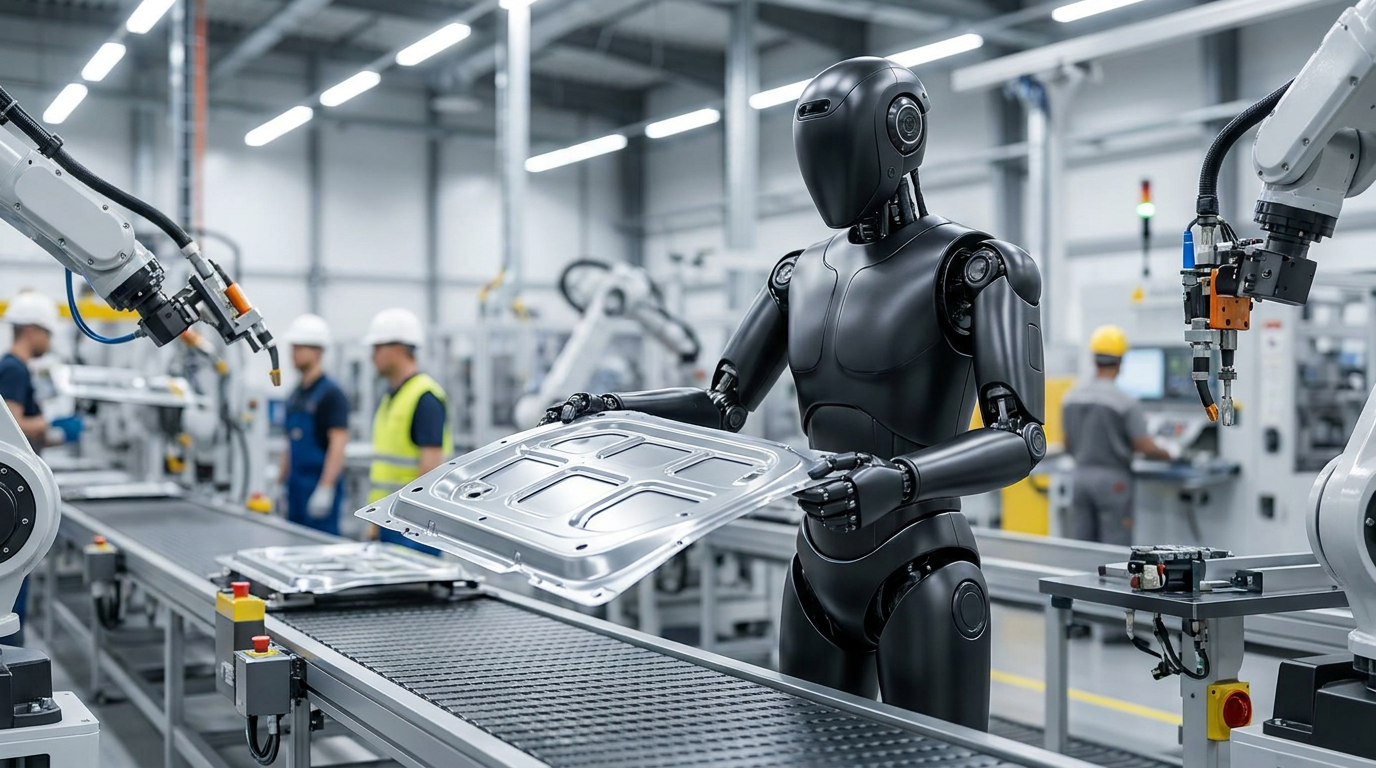
For years, the public perception of humanoid robots was defined by viral videos of machines performing backflips in controlled laboratories or stumbling through obstacle courses. But in 2026, the narrative has fundamentally changed. Humanoid robots are no longer research experiments; they are actively bolting parts, moving totes, and loading sheet metal on active production lines.[6]
The automotive industry has become ground zero for this robotic revolution. Major automakers—including BMW, Mercedes-Benz, Hyundai, and Tesla—have moved beyond theoretical pilots and are now integrating bipedal machines into their live manufacturing environments alongside human workers.[7]
The core mechanism driving this rapid adoption is spatial economics. Traditional industrial robot arms require massive capital investment to deploy. Factories must be redesigned, safety cages must be built, and the entire environment must be rigidly structured around the limitations of the machine.[7]
Humanoid robots flip that equation entirely. Because automotive assembly plants were originally designed for human workers—with workbenches, tool racks, and aisles sized for bipedal operators—a humanoid can drop into existing infrastructure without requiring a costly facility overhaul. The robot adapts to the plant, rather than the plant adapting to the robot.[3][7]
The most mature and data-rich deployment to date occurred at BMW's Spartanburg plant in South Carolina. Over an 11-month period, California-based robotics firm Figure AI deployed its Figure 02 robots to perform physically demanding sheet-metal loading tasks in a live production environment.[1][2]
The operational data from that pilot is striking. Operating in 10-hour shifts, the Figure 02 fleet accumulated over 1,250 hours of runtime. During that window, the robots successfully loaded more than 90,000 parts, directly contributing to the assembly of 30,000 BMW X3 vehicles.[2]

The robots were tasked with picking sheet metal from bins and placing them onto welding fixtures within a strict 5-millimeter tolerance. This is a classic "pick-and-place" job that is ergonomically exhausting and highly repetitive for human workers, making it the perfect entry point for an automated bipedal assistant.[2]
The robots were tasked with picking sheet metal from bins and placing them onto welding fixtures within a strict 5-millimeter tolerance.
Meanwhile, Boston Dynamics—long famous for its hydraulic research robots—has officially commercialized its technology. At CES 2026, the company unveiled a fully electric, production-ready version of its Atlas humanoid, designed specifically for heavy industrial use and continuous 24/7 operation.[4][8]
Atlas is currently deployed at the Hyundai Motor Group Metaplant in Georgia. Operating autonomously in the parts warehouse, the robot handles automotive components and sequencing tasks, leveraging its impressive 50-kilogram lift capacity to manage heavy payloads without human intervention.[4][5]

To power its cognitive abilities, Boston Dynamics partnered with Google DeepMind. The collaboration uses advanced foundation models to help Atlas interpret spoken instructions, adapt to unstructured environments, and safely navigate around human coworkers on the factory floor.[4][8]
Mercedes-Benz has taken a similar approach, partnering with Texas-based Apptronik to deploy the Apollo robot. Standing 5-foot-8 and weighing 160 pounds, Apollo is focused heavily on logistics—delivering assembly kits, inspecting components on the line, and providing ergonomic relief to the human workforce.[3][6]

Tesla is also scaling its internal operations rapidly, reportedly running over 1,000 of its Optimus Gen 3 units at its Fremont and Gigafactory facilities. Tesla's unique advantage lies in its vertical integration, adapting the massive neural network infrastructure originally built for its self-driving cars to train its robotic fleet.[7]
The software powering these machines has fundamentally shifted over the last two years. Early robots relied on hard-coded scripts and rigid waypoints. Today's humanoids are driven by Vision-Language-Action (VLA) models, which allow them to process visual data, understand context, and learn tasks through imitation rather than explicit programming.[5][6]
Despite the rapid progress, hardware reliability remains a hurdle for the industry. Figure AI noted that the forearm subsystem on its Figure 02 was a frequent failure point due to thermal constraints and complex cabling, prompting a complete redesign for its upcoming Figure 03 model to improve uptime.[2]

As production scales—with companies building dedicated facilities to manufacture thousands of units annually—the focus is shifting from basic capability to cost reduction and durability. The humanoid workforce has officially arrived, and the next challenge is proving it can operate flawlessly at a global scale.[2][7]
How we got here
2021
Tesla publicly announces its Optimus humanoid robot program, signaling major automotive interest in bipedal automation.
March 2024
Mercedes-Benz signs a commercial agreement to pilot Apptronik's Apollo robot in its manufacturing facilities.
2024 - 2025
Figure AI completes an 11-month pilot at BMW's Spartanburg plant, successfully loading 90,000 parts.
January 2026
Boston Dynamics unveils the production-ready electric Atlas at CES and deploys it to Hyundai's Georgia Metaplant.
Viewpoints in depth
Automotive Manufacturers
Focus on avoiding facility redesigns and filling labor shortages for ergonomically dangerous tasks.
For automakers, the appeal of humanoid robots is purely economic and spatial. Traditional industrial automation requires tearing up the factory floor to install fixed arms and safety cages. Because humanoids are built to the exact dimensions of a human worker, they can drop directly into existing workstations. Manufacturers view these robots as a critical tool to fill chronic labor shortages in roles that are highly repetitive and ergonomically damaging to human bodies, such as heavy sheet metal loading and low-angle assembly.
Robotics Developers
Focus on Vision-Language-Action models, sim-to-real transfer, and scaling hardware production.
The engineering camps building these machines are currently focused on the transition from software capability to hardware reliability. While the AI brains—powered by Vision-Language-Action models—have proven they can learn complex tasks, the physical bodies still suffer from wear and tear. Developers are heavily invested in redesigning actuators, improving thermal management in the joints, and building dedicated robot-manufacturing facilities to drive down the per-unit cost to a target of $20,000 to $30,000.
Labor Advocates
Monitor the line between worker augmentation and eventual job displacement.
Labor organizations are watching the deployment of humanoids with cautious pragmatism. In the short term, there is broad agreement that removing humans from dangerous, heavy-lifting tasks improves workplace safety and reduces injury rates. However, advocates are concerned about the long-term trajectory. As the robots become cheaper and their AI models become more capable of dexterous, high-skill assembly, the conversation will inevitably shift from augmenting the existing workforce to directly competing with it.
What we don't know
- How quickly the per-unit cost of a humanoid robot will drop to the industry target of $20,000.
- Whether the robots can maintain 99% uptime over multi-year deployments without requiring constant maintenance.
- How quickly these robots will expand beyond automotive manufacturing into logistics, construction, and eventually consumer homes.
Key terms
- Vision-Language-Action (VLA) model
- An AI system that allows a robot to see its environment, understand spoken instructions, and translate them into physical movements.
- Degrees of Freedom (DoF)
- The number of independent ways a robotic joint or limb can move, which is crucial for achieving human-like dexterity in the hands and arms.
- Sim-to-real transfer
- The process of training a robot's artificial intelligence in a virtual simulation before deploying that knowledge into a physical machine in the real world.
- Cobot
- A collaborative robot designed to operate safely alongside human workers without needing protective safety cages.
Frequently asked
Are humanoid robots replacing human factory workers?
Currently, they are augmenting the workforce by taking on physically exhausting, repetitive tasks like loading heavy sheet metal. This allows human workers to focus on more complex, dexterous assembly tasks.
Why build bipedal robots instead of traditional robotic arms?
Factories are already designed for humans. A bipedal robot can navigate existing aisles and workbenches without requiring a multi-million dollar facility redesign to accommodate fixed machinery.
How do these robots learn new tasks?
They use Vision-Language-Action (VLA) AI models, allowing them to process visual data and learn through observation and imitation, rather than needing every single movement explicitly hard-coded by an engineer.
Sources
Source coverage
8 outlets
4 viewpoints surfaced








[1]BMW GroupAutomotive Manufacturers
Figure 02 robot tested at BMW Group Plant Spartanburg
Read on BMW Group →[2]Assembly MagazineRobotics Developers
Figure AI Completes BMW Pilot, Prepares Figure 03
Read on Assembly Magazine →[3]Automotive Manufacturing Solutions
Mercedes-Benz partners with Apptronik to integrate Apollo robots
Read on Automotive Manufacturing Solutions →[4]ThomasNetAI Researchers
Boston Dynamics Begins Testing Atlas Robot in Hyundai Factory
Read on ThomasNet →[5]CBS NewsLabor Advocates
Inside the rise of humanoid robots: Boston Dynamics' Atlas goes to work
Read on CBS News →[6]EE TimesAI Researchers
Humanoids Hit the Factory Floor in 2026
Read on EE Times →[7]iFactoryAutomotive Manufacturers
Humanoid & Quadruped Robots in Automotive Manufacturing 2026
Read on iFactory →[8]New AtlasRobotics Developers
Boston Dynamics' enterprise-grade Atlas humanoids heading for Hyundai factories
Read on New Atlas →
Every angle. Every day.
Get ai stories with full source coverage and perspective breakdowns delivered to your inbox.