
How Mass Timber is Rewriting the Rules of Sustainable Architecture
Engineered wood products like cross-laminated timber are allowing developers to build 30-story skyscrapers that store carbon rather than emit it.
By Factlen Editorial Team
- Climate Architects & Developers
- Argue that mass timber is the fastest way to decarbonize the built environment while improving construction speed and occupant well-being.
- Ecological Researchers
- Emphasize that the climate math only works if forests are sustainably managed and the full life-cycle of logging waste is accounted for.
- Risk & Safety Regulators
- Focus on the structural integrity, fire encapsulation standards, and building code evolution required to safely scale timber high-rises.
What's not represented
- · Traditional Steel & Concrete Manufacturers
- · Local Indigenous Forestry Communities
Why this matters
The global building sector accounts for nearly 40% of all energy-related carbon emissions. Transitioning from concrete to mass timber could turn our rapidly expanding cities from massive climate liabilities into active carbon sinks.
Key points
- Mass timber uses engineered wood like CLT to build skyscrapers that rival the strength of steel and concrete.
- Because trees absorb CO2, timber buildings act as massive carbon sinks, locking away emissions for a century.
- Widespread adoption of mass timber could reduce global greenhouse gas emissions by up to 39 gigatons by 2100.
- Timber panels are prefabricated, allowing buildings to be constructed 25% to 30% faster than traditional methods.
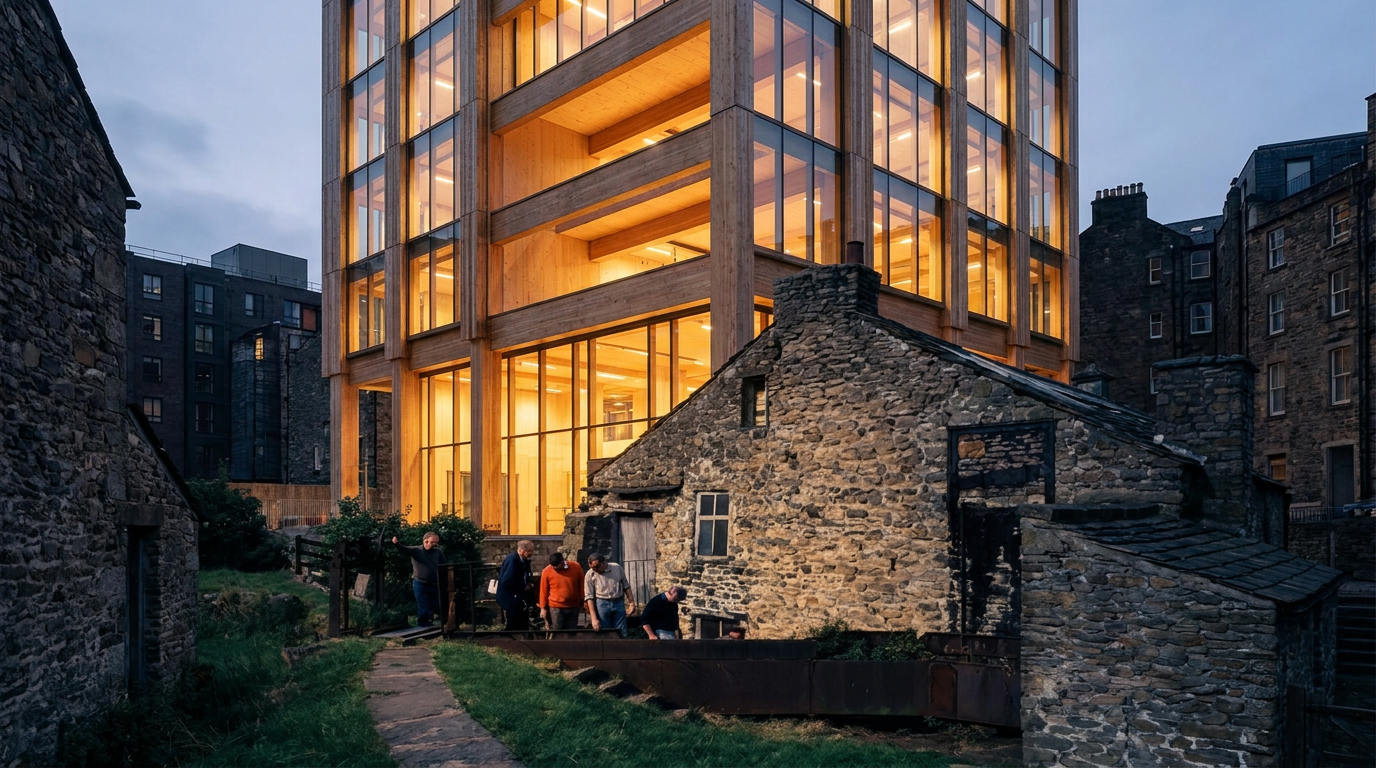
For more than a century, the silhouette of urban progress has been forged in steel and poured in concrete. But a quiet, natural revolution is taking root in the world's skylines. In downtown Milwaukee, construction is underway on The Edison, a 31-story residential tower that will reach 362 feet into the air. When completed, it will claim the title of the world's tallest mass timber building, surpassing a neighboring 25-story tower that set the record just a few years prior.[2]
The Edison is not an anomaly; it is the vanguard of a structural paradigm shift. Across the United States and Europe, mass timber construction is transitioning from a niche architectural experiment to a mainstream commercial solution. In the U.S. alone, the number of mass timber projects has grown by roughly 20 percent annually since 2015, with over 2,500 buildings either completed or in progress. Major corporations, including Google and Under Armour, are adopting the material for their sprawling new campuses.[3][8]
To understand the appeal, one must first understand the mechanics of the material. Mass timber is not the standard dimensional lumber used to frame suburban houses. It relies on highly engineered wood products, primarily Cross-Laminated Timber (CLT) and Glued-Laminated Timber (glulam). By stacking layers of kiln-dried wood perpendicular to one another and bonding them under immense pressure with structural adhesives, manufacturers create thick panels that rival the tensile and compressive strength of steel and concrete.[7][8]
The primary catalyst for this architectural pivot is the urgent math of climate change. The global building and construction sector is responsible for nearly 40 percent of energy-related carbon emissions, with concrete and steel production serving as massive, carbon-intensive culprits. Mass timber offers a radical alternative: rather than emitting vast amounts of carbon during production, the building material itself acts as a carbon sink.[4][6]

Trees absorb carbon dioxide from the atmosphere as they grow. When harvested and engineered into CLT panels, that biogenic carbon is locked within the building's structure for a century or more. A comprehensive study published in Nature Communications by researchers at the Yale School of the Environment quantified this potential. The research modeled future adoption scenarios and found that switching to CLT in 30 to 60 percent of new urban buildings between 2020 and 2100 could reduce life-cycle greenhouse gas emissions by up to 39 gigatons of CO2 equivalent.[1][6]
That figure is roughly equal to the entire planet's annual energy-related CO2 emissions in 2024. Furthermore, the Yale study challenged the intuitive fear that a timber boom would lead to rampant deforestation. The researchers found that increased demand for engineered wood would actually incentivize the market to protect and expand intensively managed forestland, potentially adding up to 36.5 million hectares of productive forests globally by the end of the century.[1]
That figure is roughly equal to the entire planet's annual energy-related CO2 emissions in 2024.
However, ecological researchers and industry analysts caution that the climate benefits of mass timber are not automatic; they must be rigorously engineered into the supply chain. Life-cycle assessments can sometimes underestimate emissions by ignoring the carbon lost during the harvesting and milling processes.[5]

When a tree is logged, roughly 25 percent of its biomass—twigs, bark, and roots, known as "slash"—is left behind to decompose, releasing carbon back into the atmosphere. Sawing logs into planks and drying them requires energy and generates further waste. For mass timber to fulfill its promise as a climate savior, forests must be sustainably managed, and the full biogenic emissions of the manufacturing process must be accounted for in the final carbon ledger.[5][6]
Beyond environmental concerns, the most common question surrounding wooden skyscrapers is one of safety: What happens in a fire? Counterintuitively, heavy timber performs exceptionally well under extreme heat. Unlike steel, which can warp, melt, and buckle when exposed to high temperatures, mass timber chars on the outside at a highly predictable rate.[4]
This outer layer of char acts as a natural insulator, protecting the structural integrity of the inner wood. To meet stringent modern building codes, developers also utilize "encapsulation"—covering critical structural timber with fire-resistant materials like gypsum drywall. These proven safety mechanisms led the International Building Code (IBC) to update its standards in 2021, officially permitting mass timber structures up to 18 stories. Today, hybrid systems that pair a concrete core with CLT floors are pushing those limits well past 30 stories.[2][4]
The advantages of mass timber extend to the construction site itself. Because CLT panels are prefabricated in high-tech factories and cut to millimeter precision using digital models, they arrive on site ready to be assembled like a massive interlocking puzzle. This modularity allows timber buildings to go up 25 to 30 percent faster than traditional concrete structures, requiring fewer trucks, less on-site labor, and generating a fraction of the noise pollution.[5][8]

Finally, there is the human element. Architects and developers are increasingly drawn to the psychological benefits of "biophilic design"—the integration of natural elements into the built environment. Studies indicate that living or working in spaces with exposed wood grain can lower blood pressure, reduce heart rates, and improve overall mental well-being and productivity.[3][7]
As cities race to decarbonize, the skyline of the future is taking on a warmer, more organic hue. From the soaring Atlassian hybrid tower in Sydney to the Sara Kulturhus in Sweden and the record-breaking Edison in Milwaukee, mass timber is proving that the built environment does not have to be at odds with the natural world. By turning our largest structures into carbon vaults, the construction industry is finding a way to build upward while driving emissions downward.[1][2][7][8]
How we got here
2015
Mass timber construction begins gaining early traction in the U.S. commercial real estate market.
2021
The International Building Code (IBC) is officially updated to allow mass timber structures up to 18 stories.
2022
Ascent MKE in Milwaukee is completed, setting a temporary world record for timber buildings at 25 stories.
2025
Construction begins on The Edison in Milwaukee, slated to reach 31 stories and 362 feet by 2026.
Viewpoints in depth
Climate Architects & Developers
Argue that mass timber is the fastest way to decarbonize the built environment while improving construction speed and occupant well-being.
For the architecture and development community, mass timber represents a rare alignment of environmental and economic incentives. Proponents point out that the building sector is historically one of the hardest industries to decarbonize due to its reliance on concrete and steel. By switching to engineered wood, developers can immediately slash a project's embodied carbon by up to 40 percent. Beyond the climate math, developers highlight the operational efficiencies: prefabricated CLT panels arrive on site ready for assembly, cutting construction timelines by months, reducing labor costs, and minimizing neighborhood disruption. They also point to the premium that commercial tenants are willing to pay for biophilic office spaces that feature exposed natural wood.
Ecological Researchers
Emphasize that the climate math only works if forests are sustainably managed and the full life-cycle of logging waste is accounted for.
While ecological researchers generally support the transition to mass timber, they caution against viewing it as a flawless climate panacea. Their primary concern is carbon accounting. When a tree is harvested, a significant portion of its biomass—branches, roots, and bark—is left behind to rot, releasing carbon back into the atmosphere. Furthermore, the milling and drying processes require substantial energy. Researchers argue that if the timber industry expands without strict sustainable forestry mandates, the resulting deforestation and logging waste could negate the carbon storage benefits of the buildings themselves. They advocate for rigorous, end-to-end life-cycle assessments to ensure the material is truly carbon-negative.
Risk & Safety Regulators
Focus on the structural integrity, fire encapsulation standards, and building code evolution required to safely scale timber high-rises.
For insurance underwriters, city planners, and fire safety regulators, the rapid ascent of wooden skyscrapers presents a novel risk landscape. Their focus is strictly on empirical testing and code compliance. Regulators have been convinced by extensive fire testing which demonstrates that mass timber chars predictably, insulating its structural core rather than collapsing like heated steel. However, they mandate strict "encapsulation" rules—requiring drywall or other fire-resistant barriers over critical load-bearing timber in taller structures. This camp is also actively studying the long-term moisture resilience and seismic performance of hybrid timber systems to ensure they match the century-long durability of traditional concrete towers.
What we don't know
- How the global timber supply chain will handle a massive, sudden spike in demand without compromising sustainable forestry practices.
- The long-term feasibility and cost of repairing mass timber structures after a localized fire or severe water damage event.
Key terms
- Cross-Laminated Timber (CLT)
- An engineered wood product made by gluing layers of solid-sawn lumber together, with each layer oriented perpendicular to the adjacent one for maximum strength.
- Glulam
- Short for glued-laminated timber, this material is made by gluing layers of wood in the same direction, typically used for large structural columns and beams.
- Biogenic Carbon
- Carbon that is absorbed from the atmosphere by living organisms, such as trees, and stored within their biomass.
- Embodied Carbon
- The total greenhouse gas emissions generated during the extraction, manufacturing, transportation, and assembly of a building material.
- Biophilic Design
- An architectural approach that seeks to connect building occupants more closely to nature through the use of natural lighting, ventilation, plants, and exposed natural materials like wood.
Frequently asked
What is mass timber?
Mass timber refers to a category of engineered wood products, like Cross-Laminated Timber (CLT), made by binding layers of wood together to create structural panels that rival the strength of steel and concrete.
Is mass timber a fire hazard?
No. Unlike steel, which can warp and melt, mass timber chars on the outside at a predictable rate during a fire. This char layer insulates and protects the structural integrity of the inner wood.
Does mass timber cause deforestation?
Studies indicate that increased demand for mass timber actually incentivizes the market to plant and protect more intensively managed forestland, potentially expanding global forest cover.
How tall can a mass timber building be?
The International Building Code allows pure mass timber buildings up to 18 stories, but hybrid designs (using a concrete core) are currently pushing past 30 stories, such as the 362-foot Edison tower in Milwaukee.
Sources
Source coverage
8 outlets
3 viewpoints surfaced








[1]Yale School of the EnvironmentEcological Researchers
Mass Timber Could Drive Forest Expansion and Cut Emissions
Read on Yale School of the Environment →[2]Construction DiveClimate Architects & Developers
World's tallest mass timber building breaks ground in Wisconsin
Read on Construction Dive →[3]TrellisClimate Architects & Developers
Mass timber usage rises in U.S., European building construction
Read on Trellis →[4]Zurich InsuranceRisk & Safety Regulators
Mass timber: Insuring the future of sustainable construction
Read on Zurich Insurance →[5]TimbA SystemsEcological Researchers
Is Mass Timber Worth Its Environmental Impact?
Read on TimbA Systems →[6]MDPIEcological Researchers
Environmental Impact of a Mass Timber Building—A Case Study
Read on MDPI →[7]DezeenClimate Architects & Developers
The top 10 mass timber buildings of 2025
Read on Dezeen →[8]Factlen Editorial TeamClimate Architects & Developers
Synthesis by Factlen editorial team
Read on Factlen Editorial Team →
Every angle. Every day.
Get culture stories with full source coverage and perspective breakdowns delivered to your inbox.